Our readers keep the lights on and my smoothie glass nicely filled. As an Amazon Associate, I earn from qualifying purchases.
Specs are compiled from manufacturer listings and verified buyer reviews and can change over time — please confirm the key details on the product page before buying.
You want a cheap 3D printer that actually prints on the first try. The best budget machines no longer punish you with manual bed-screw adjustments and hours of assembly. Instead, they show up fully built, level their own print bed with a sensor, and let you send your first model from an app. Your first creation can be a real object, not a test cube. The trade-offs come down to print size, how fast the head moves, and whether the printer can handle more than one color at a time.
I’m Mohammad Maruf — the founder and writer behind WellFizz. This guide is built by comparing the manufacturers’ published specifications and the patterns across verified customer reviews, so you get each pick’s real strengths and trade-offs instead of marketing spin.
From fully assembled beginner kits that print in minutes to multi-color machines that swap filament automatically, these are the cheapest 3d printer options that deliver reliable results without a steep learning curve.
Quick Picks
- Fully Assembled Mini 3D Printer TINA2S — Best Overall
- Entina Tina2C 3D Printer for Kids & Beginners — Best for Kids
- Geeetech Smart 3D Printer M1S — Speed Champion
- Anycubic Kobra X Multicolor 3D Printer — Multi-Color Pick
How To Choose The Best Cheapest 3D Printer
The cheapest 3D printers today skip the two worst hassles of older models: manual bed leveling (where you turn screws under the print bed with a piece of paper) and complex assembly. Almost every budget machine now includes auto-leveling, but the big differences are in print speed, the size of objects you can make, and whether the printer can handle more than one color of filament at a time.
Check the Build Volume First
Build volume is the maximum size object the printer can create in a single print — measured in length, width, and height. Budget models typically top out around 4 inches cubed. That is fine for small toys, fidgets, custom phone stands, and action-figure accessories. If you want larger prints like a helmet or a full-size lamp shade, you need a bigger machine, which costs more. A 100mm cube (about 4 inches) is the baseline for entry-level printers.
Auto-Leveling Saves Hours
Auto-leveling uses a small sensor in the print head to measure the print bed at multiple points. The printer then compensates for any tilt or unevenness automatically. Without it, you have to manually adjust the bed using screws, a process that can take 15–30 minutes and often fails on the first try. Every printer on this list has auto-leveling, so your first layer sticks without the frustration.
Filament Compatibility and Ease of Use
The cheapest 3D printers for beginners almost always use 1.75mm PLA filament — it is the easiest material to print with because it melts at a low temperature, produces very little smell, and sticks well to a heated or magnetic bed. Some budget printers also support TPU (a flexible rubber-like filament) or PETG (stronger and more heat-resistant than PLA). Look for one-button filament loading, which pushes the filament into the nozzle automatically, so you never have to force it in by hand.
Quick Comparison
| Model | Best For | Build Volume | Speed | Weight | Amazon |
|---|---|---|---|---|---|
| Mini 3D Printer TINA2S | Easiest setup from the start | 100 x 120 x 100 mm | Not listed | 6.4 pounds | Amazon |
| Entina Tina2C | App-guided printing for kids | 3.9 x 3.9 x 3.9 in | Not listed | 8.16 pounds | Amazon |
| Geeetech M1S | Fast printing on a budget | 3.94 x 4.33 x 3.94 in | 250 mm/s | 9.78 pounds | Amazon |
| Anycubic Kobra X | Multi-color printing on a budget | 260 x 260 x 260 mm | 600 mm/s | 20.9 pounds | Amazon |
In‑Depth Reviews
1. Fully Assembled Mini 3D Printer TINA2S

The lightest printer in the lineup, at 6.4 pounds, delivers flawless benchies straight from the box — and that weight is 53 percent less than the Geeetech M1S, so you can move it easily between a desk and a shelf without straining.
That featherweight build does not cut corners on print quality. Buyers report it “produced flawless prints (rabbit, Benchy)” right from the start, with auto-leveling (a sensor that measures the bed and adjusts the nozzle height automatically) and a flexible magnetic build plate that pops models off with a simple bend. The 100 x 120 x 100 mm build volume is small (roughly 4 inches on each side), so larger objects must be split into parts and glued. But for its price bracket, the active pause-and-resume function means you can stop a print to swap filament and pick up exactly where you left off without scrapping the job. Unlike the Entina Tina2C, this one includes 10 meters of PLA filament and an SD card pre-loaded with models, so you truly have everything to start before the USB cable comes from the start.
One buyer did note that the auto-leveling did not prevent frequent print failures in their experience, saying it felt “cheaply built” and not truly plug-and-play. Most users, however, describe it as the easiest intro to the hobby. Just remember the note about using a metal build plate — the proximity sensor does not work with non-magnetic plates, which causes the leveling to fail entirely.
What you get right away
- Fully assembled — no tools or setup beyond plugging it in
- One-touch filament loading removes the hassle of hand-feeding filament
- Multiple buyer reviews confirm flawless prints (rabbit and Benchy) as first prints
What can trip you up
- Small 100 x 120 x 100 mm build volume limits what you can print in one piece
- The non-metal plate warning is easy to miss and will break auto-leveling
- A small number of buyers experienced constant adhesion and software issues
Who it’s for: you want the lowest-friction entry into 3D printing and can work within a 4-inch build cube for toys and small tools.
Pick the larger Anycubic Kobra X instead if: you already know you want to print full-size models like helmets or large props — the build volume is too limiting for that.
2. Entina Tina2C 3D Printer for Kids & Beginners
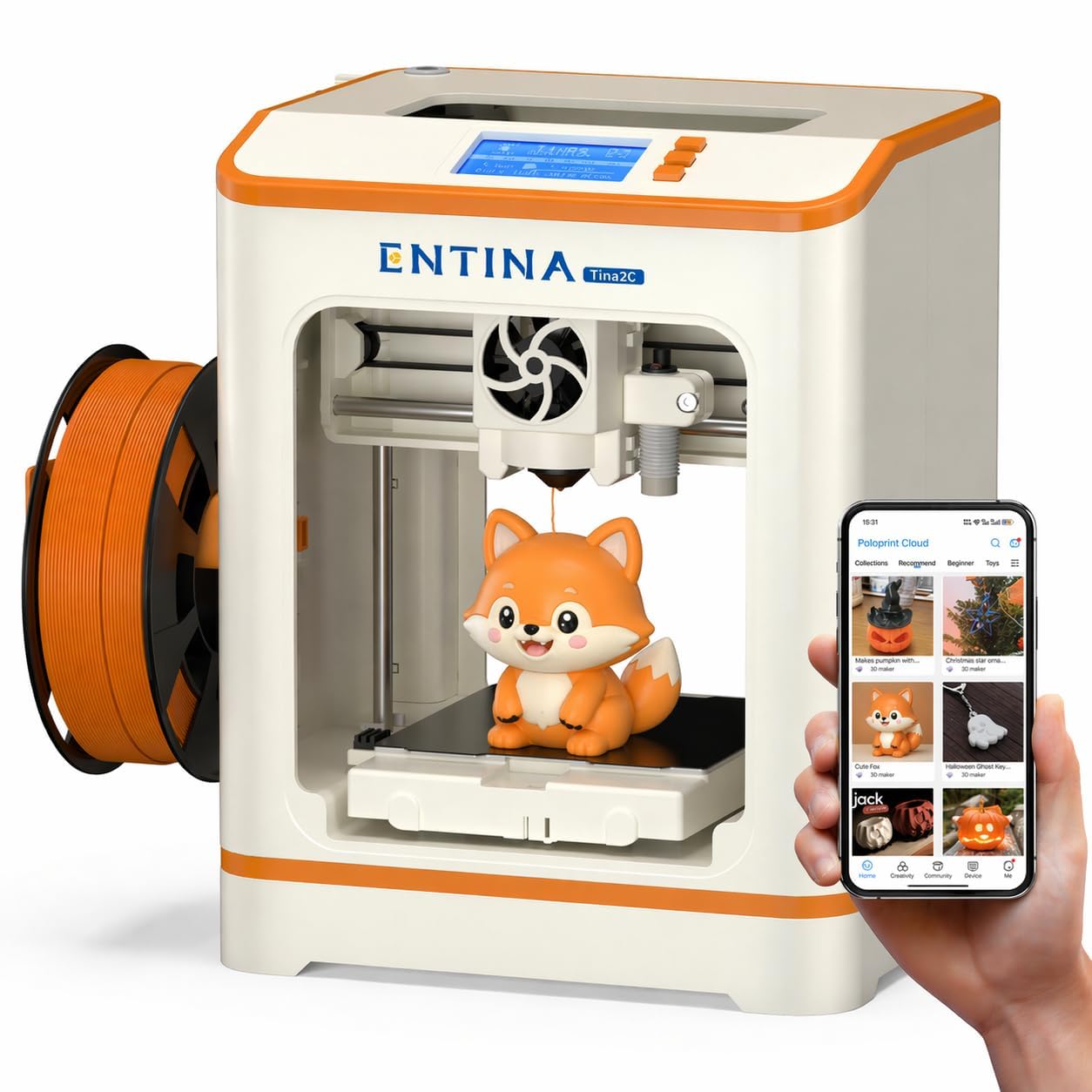
Where the TINA2S relies on an SD card and pre-sliced models, the Tina2C is built around the Poloprint Cloud app — an interface that, according to the maker, uses AI to let you search for models, take a photo and convert it to a print, or pick from 20 creative modules — so a nine-year-old can turn it on, connect to a phone, and print in under eight minutes.
That app-first approach lowers the barrier for anyone who does not want to learn slicer software right away. One parent wrote their son “loves it and has been using every day since he got it,” often printing from his phone without needing a laptop at all. The printer weighs 8.16 pounds and measures 8 x 6.5 x 10 inches, which is slightly more compact than the TINA2S in footprint but a bit heavier. Its 3.9 x 3.9 x 3.9 inch build volume is the smallest on this list. You will not print anything larger than a small toy or a phone stand in one go. However, the self-cleaning nozzle reduces failed prints due to clogs — a common frustration on cheaper machines — and the power-loss recovery means you do not lose a multi-hour print if the power flickers.
The trade-off is the app dependency. If you want full control over slicing settings like layer height or infill density, you will need to use Cura or Simplify3D on a computer, which undercuts the “no computer needed” appeal. Buyers also note the print volume means “small things only,” as one reviewer put it, which is fine for keychains and figurines but limiting for larger STEM projects.
App-driven ease
- Poloprint Cloud app provides AI photo-to-print and guided setup for kids
- Self-cleaning nozzle reduces clogs and maintenance time
- Multiple parent reviews confirm kids use it daily without adult help
Where it shrinks
- Build volume of just 3.9 x 3.9 x 3.9 inches is the smallest in this guide
- Full slicing control requires using a separate computer and software
- Some beginners may find the app interface too guided for advanced projects
Grab this for: a family with kids aged 8–12 who want to print from a phone or tablet without learning professional slicing software.
Hold off if: you are an adult hobbyist who wants to print functional parts larger than a few inches — the TINA2S gives you more printable height (100 mm vs 3.9 inches) for the same price.
3. Geeetech Smart 3D Printer M1S
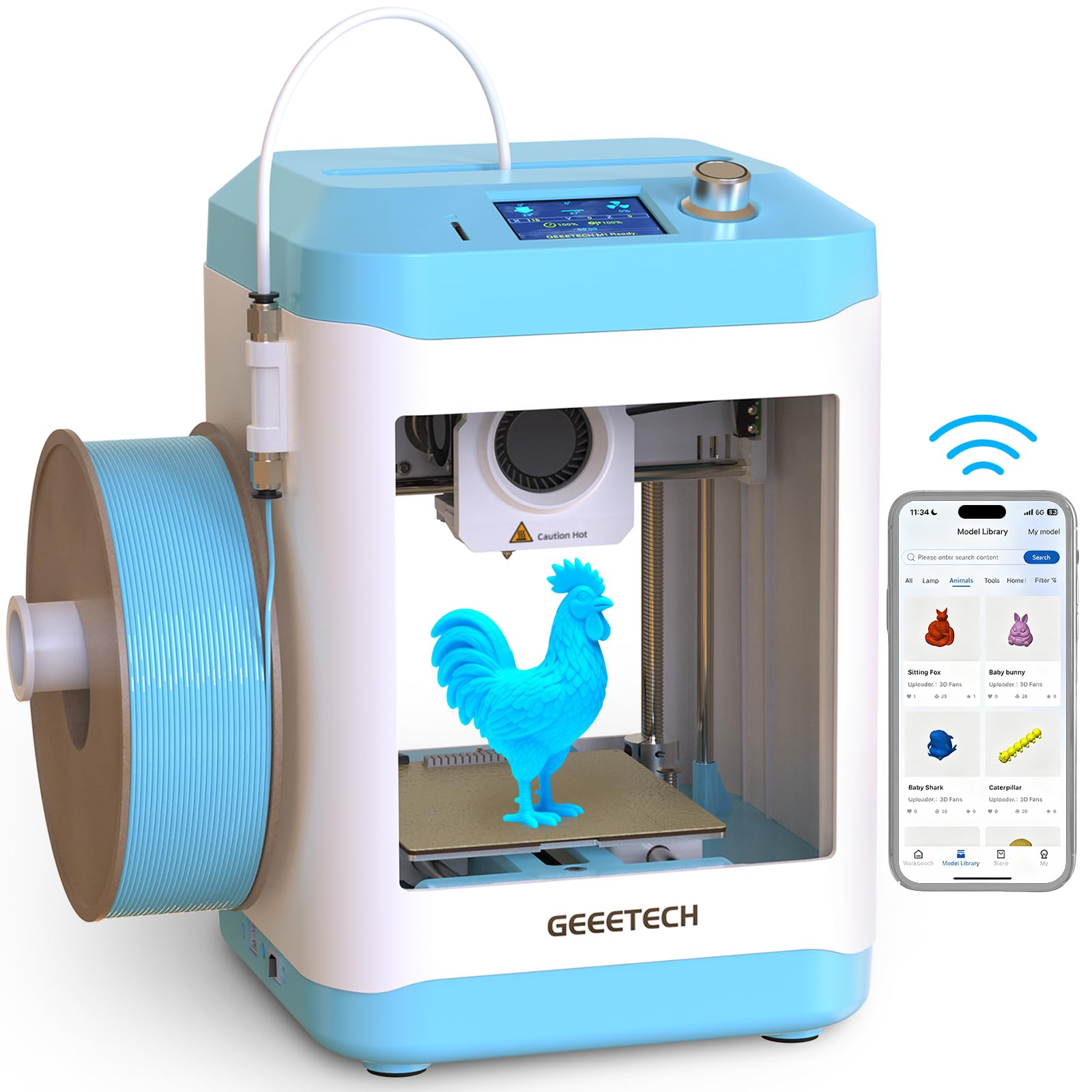
While the TINA2S and Tina2C do not list their print speeds, the Geeetech M1S pushes a maximum of 250 mm/s (millimeters per second — how fast the print head moves while laying down filament), so small objects like a calibration cube finish in roughly half the time.
That speed comes from a 50W hot-end heating rod that melts filament faster, paired with a dual-drive metal extruder gear with a 1:5 ratio for stronger extrusion force. The 3.94 x 4.33 x 3.94 inch print area is slightly taller than the Entina’s, giving you a touch more room for vertical models. It is also the heaviest of the three small printers at 9.78 pounds, which is 53 percent heavier than the TINA2S — the extra mass helps dampen vibrations during fast printing. Owners mention the auto-leveling worked well on the replacement units some received, though some initial units had problems. One reviewer noted a “power-on issue resolved by customer service with diagrams; user had unplugged a harness,” which suggests the wiring can come loose in shipping. The included PEI print plate (a textured surface that grips filament when hot and releases when cool) is a notable upgrade over the magnetic plates on cheaper models — it needs no glue.
The catch is reliability reports are mixed. Several verified reviews describe first units failing auto-leveling or producing a long beep before replacement units worked fine. The 30-day return and 12-month free repair warranty is generous for this price tier, but you may need it if you get a dud. If consistency matters more to you than speed, the TINA2S has far fewer defect reports.
Speed advantage
- 250 mm/s print speed cuts small-object print times significantly versus unlisted-speed competitors
- Direct-drive dual-metal extruder handles flexible TPU filament without jamming
- PEI print plate provides strong bed adhesion without glue sticks
Quality-control warnings
- Multiple reviews report first unit was faulty and needed replacement
- Harness can come loose during shipping, requiring a call to support
- Only 0.5 kg of sample filament included (most competitors include 1 kg or a full spool)
Choose this if: you value faster print times for small objects and are comfortable troubleshooting a potential first-unit defect under warranty.
Steer toward the TINA2S if: you want the highest chance of a perfect first print with zero wiring checks — that machine has far fewer defect reports.
4. Anycubic Kobra X Multicolor 3D Printer
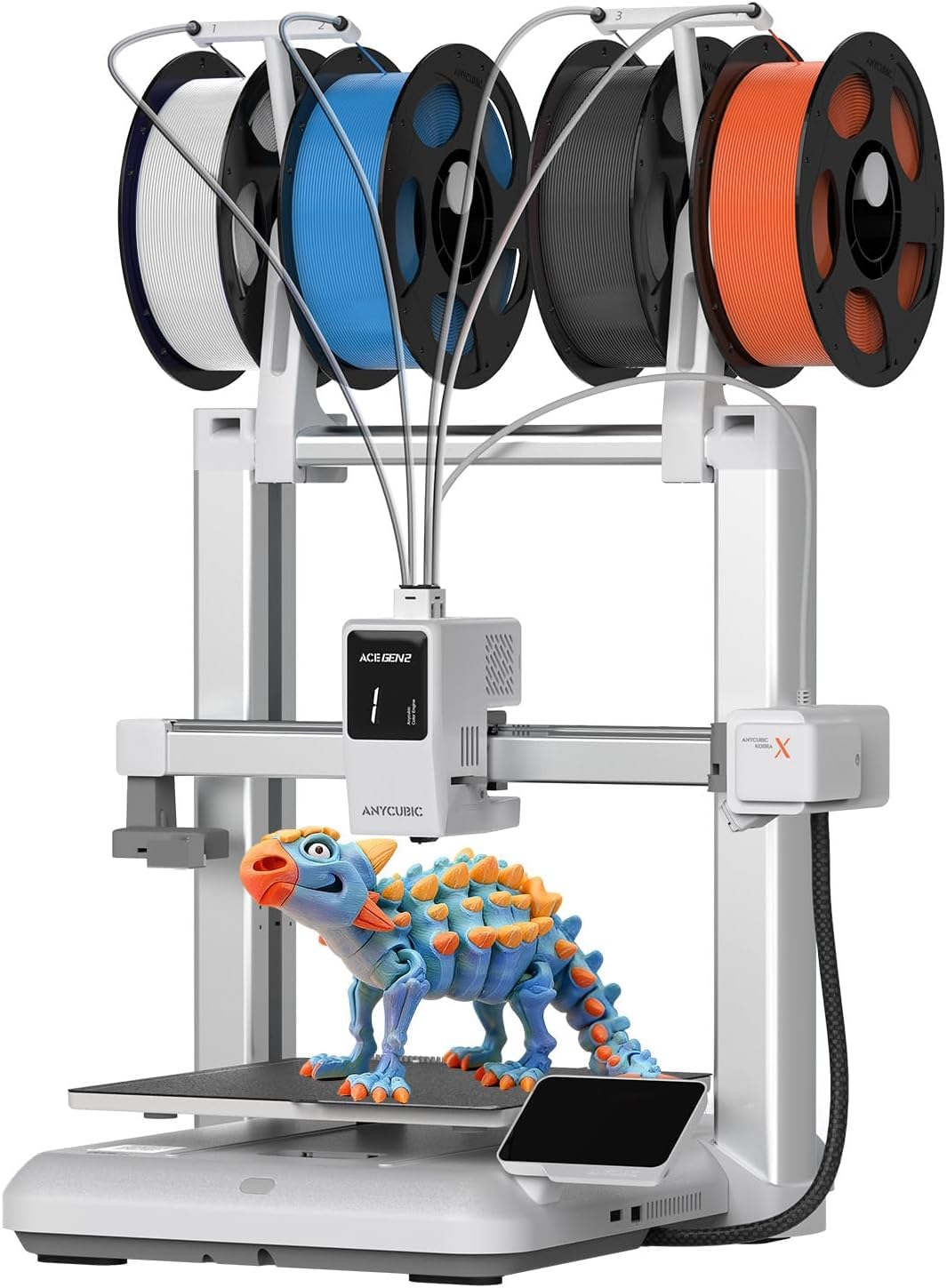
The only printer on this list that can switch filament colors mid-print without you pausing and manually swapping spools — it prints a Benchy boat in 14 minutes using up to 19 different colors.
The Kobra X comes with a built-in system for four colors, and you can expand to up to 19 colors by adding up to four ACE 2 Pro units. The core trick is a redesigned filament path that, according to the manufacturer, reduces waste by 81.25 percent compared to typical multi-color setups — so you spend less money on purged filament and more on the actual model. Beyond color, the print speed of 600 mm/s is more than double the Geeetech’s 250 mm/s — complete a Benchy boat in just 14 minutes. The build volume of 260 x 260 x 260 mm is massive compared to the 4-inch cubes of the other three printers, meaning you can print full-size helmet halves or large objects in one go. The 49-point auto-leveling system (LeviQ 3.0) is more precise than the 16-point system on the Geeetech, and the app includes AI-powered spaghetti detection that the brand claims stops a failed print automatically.
At 20.9 pounds and 23 x 13 x 22 inches, this machine takes up significant desk space — it is not a portable unit you tuck away. There are no customer reviews available yet at the time of writing, so long-term reliability is unknown. If you just want a single-color starter printer, you can save money and desk space with the TINA2S. But if multi-color printing without manual filament swaps is your goal, this is the cheapest route into that capability right now.
Color and speed leap
- Native 4-color printing expandable to 19 colors with ACE 2 Pro units
- 600 mm/s print speed completes a Benchy in 14 minutes
- 260 mm³ build volume allows large objects not possible on smaller budget machines
Practical trade-offs
- Significantly larger and heavier than any other pick (20.9 pounds)
- No verified buyer reviews yet to confirm reliability in the long run
- Higher price point — you pay a premium for the multi-color capability
Buy this if: multi-color printing is your primary goal and you have the desk space for a larger machine — no other budget printer offers this feature set.
skip it if: you are on a strict entry-level budget or only need single-color prints to get started — the TINA2S or Geeetech will serve you well for a lot less money and desk space.
Understanding the Specs
Build Volume (mm or inches)
This is the maximum size of the object the printer can make in one print. Think of it as a cube of empty space inside the printer where your creation grows. The TINA2S has a 100 x 120 x 100 mm volume (roughly 4 x 4.7 x 4 inches), while the Kobra X offers 260 x 260 x 260 mm (10.2 inches cubed). If you only plan to print small toys or parts under 4 inches, a compact volume is fine. For helmets, lamps, or large models, you need the extra space.
Print Speed (mm/s)
Measured in millimeters per second, this tells you how fast the print head moves while laying down filament. The Geeetech M1S hits 250 mm/s, and the Kobra X reaches 600 mm/s. Faster speeds mean a small object like a Benchy finishes in minutes instead of hours. However, very fast printing can reduce surface quality on complex curves — budget machines often produce the best results at around 60–100 mm/s.
Auto-Leveling (points)
A small sensor on the print head touches the bed at multiple points (16 on the Geeetech, 49 on the Kobra X) to map its flatness. The printer then compensates for any tilt automatically. More points mean better accuracy on an uneven bed. Without it, you must manually level the bed with a piece of paper and four screws, which can take 15–30 minutes and fail on the first try.
Filament Compatibility (PLA, TPU, PETG)
All printers on this list support 1.75mm PLA filament, which is the standard for beginners: low melting point, minimal smell, and easy adhesion. Some also handle TPU (flexible rubber-like filament for phone cases or shoe insoles) or PETG (stronger and heat-resistant for functional parts). The direct-drive extruder on the Geeetech handles TPU better than the Bowden-style extruders on the TINA2S or Entina.
FAQ
Do cheap 3D printers need a computer to run?
What is the difference between FDM and resin 3D printers?
How long does a 3D print take on a cheap printer?
Will a budget 3D printer work with my Chromebook?
What is the smallest object a budget 3D printer can make?
How much filament does a cheap 3D printer use?
Is it safe to leave a 3D printer running overnight?
Can I use any brand of PLA filament with these printers?
What does auto-leveling actually do for a beginner?
How long do budget 3D printers typically last?
Final Thoughts: The Verdict
For the majority of shoppers, the best cheapest 3d printer is the TINA2S Fully Assembled Mini Printer because it combines straightforward assembly with the highest verified satisfaction from beginners — it just works. If you want a printer that kids can operate from a phone without adult help, grab the Entina Tina2C. And for multi-color or large-format printing at a budget price, the Anycubic Kobra X is the cheapest way into that capability right now.
How We Picked
We do not accept paid placement. Every pick is matched to a real buyer and a real use-case; we do not hands-on test units.
Sources & Methodology
Specifications: manufacturer listings and product documentation. Review insights: verified customer reviews, as of July 2026. Pricing: not shown on this page (it changes often); check the current price via the retailer link.
As an Amazon Associate, WellFizz earns from qualifying purchases. This does not affect which products we feature.

Mo Maruf
I created WellFizz to bridge the gap between vague wellness advice and actionable solutions. My mission is simple: to decode the research and give you practical tools you can actually use.
Beyond the data, I am a passionate traveler. I believe that stepping away from the screen to explore new environments is essential for mental clarity and physical vitality.