Our readers keep the lights on and my smoothie glass nicely filled. As an Amazon Associate, I earn from qualifying purchases.
Specs are compiled from manufacturer listings and verified buyer reviews and can change over time — please confirm the key details on the product page before buying.
Finding a wireless mouse under that does not feel like a frustrating toy is tougher than it sounds. Most cheap mice cut corners you only notice after the first month—drifty tracking that makes you overshoot buttons, clicks that go silent then die, or a battery drain that has you swapping AAs (standard alkaline batteries) every two weeks. A well-priced budget mouse should still track accurately for basic office work, last at least a year on one set of batteries (or recharge overnight), and fit your hand well enough that you do not resent it by 4pm. That is the standard this guide holds every pick to.
I’m Mohammad Maruf — the founder and writer behind WellFizz. This guide is built by comparing the manufacturers’ published specifications and the patterns across verified customer reviews, so you get each pick’s real strengths and trade-offs instead of marketing spin.
You walk into a store—or open a browser—needing a reliable pointing device under twenty bucks, and suddenly you are deciding between battery life specs, DPI (dots per inch, a measure of cursor sensitivity) ranges, and Bluetooth versus 2.4GHz (a wireless technology using a USB dongle), all without knowing which trade-offs actually matter for daily use. By the end of this guide, you will know exactly which cheap wireless mouse gives you the best real-world value for your specific desk setup, without wasting money on features you will never use.
Quick Picks
- TECKNET Wireless Mouse (Pink) — 24-Month Battery, Ergonomic — Best Overall
- Acer Wireless Mouse — 4000 DPI — Best Value
- TECKNET Wireless Mouse (BT+2.4G) — Premium Pick
- Logitech M185 — 12-Month Battery — Compact Pick
- Amazon Basics 2.4 GHz Wireless Mouse — Budget Champion
- Kovess Rechargeable Bluetooth Mouse — Best for Travel
- XBG B15pro — Tri-Mode, LED Battery Display — Most Features
How To Choose The Best Cheap Wireless Mouse
A budget wireless mouse is a compromise by definition—you are trading premium materials and extra features for a low price. But three specs separate a smart purchase from a regret you will feel every day. Focus on these first.
Battery life and power type
Battery life is the single biggest daily annoyance on a cheap wireless mouse. Manufacturers often advertise “12-month battery” or “24-month battery” using idle-mode testing—real-world battery life depends on how many hours you actively use the mouse each day. Standard alkaline AAs or AAAs typically last longer between swaps than rechargeable built-in packs, but a rechargeable mouse saves you from buying batteries. Look for a power-saving sleep mode that kicks in after 5–10 minutes of inactivity; without it, the mouse drains battery even when you are away from the desk.
DPI and tracking accuracy
DPI (dots per inch, a measure of cursor sensitivity) measures how many pixels the cursor moves per inch of physical mouse movement. Lower DPI (800–1200) gives you finer control for detailed work like photo editing; higher DPI (2400–4800) lets you zip a cursor across a large monitor with a small wrist flick. For standard office documents and web browsing, 1000–1600 DPI is a comfortable balance. Adjustable DPI is a real bonus—it lets you toggle between precision and speed without changing Windows settings.
Connectivity: 2.4GHz vs Bluetooth
A 2.4GHz wireless mouse uses a tiny USB dongle for a dedicated, lag-free connection. Bluetooth frees up a USB port and works with tablets and phones, but can introduce a slight delay or occasional re-pairing glitch on older computers. For a single desktop setup, 2.4GHz is simpler and more reliable. If you switch between a laptop and a tablet, Bluetooth (or a dual-mode mouse with both) saves the hassle of moving a dongle.
Quick Comparison
| Model | Best For | Battery Life | Max DPI | Connectivity | Amazon |
|---|---|---|---|---|---|
| TECKNET Pink (Ergo) | Everyday office / long battery life | 24 months (2x AAA) | 2600 | 2.4GHz USB-A | Amazon |
| Acer Wireless | Large hands / high DPI | — | 4000 | 2.4GHz USB-A | Amazon |
| Logitech M185 | Compact travel / brand trust | 12 months (1x AA) | 1000 | 2.4GHz USB-A | Amazon |
| Amazon Basics | Absolute lowest spend | ~3 months (1x AA) | — | 2.4GHz USB-A | Amazon |
| TECKNET BT+2.4G | Dual-device / silent office | 36 months (2x AAA) | 4800 | BT 5.0/3.0 + 2.4GHz USB-A | Amazon |
| Kovess Rechargeable | Travel / USB-C laptops | 90 days standby (800mAh) | 1600 | BT 5.2/3.0 + 2.4GHz USB-A & USB-C | Amazon |
| XBG B15pro | Feature lovers / LED screen | ~1 month (500mAh) | 2400 | BT 5.0/4.0 + 2.4GHz USB-A | Amazon |
In‑Depth Reviews
1. TECKNET Wireless Mouse (Pink) — 24-Month Battery, Ergonomic

A 24-month battery promise that actually holds up in daily use.
You will not need to touch batteries for almost two years with the TECKNET, which claims 24 months from two AAA batteries—and buyers report that figure is not just marketing. One reviewer noted it “lasted 6 years of daily use,” which is remarkable for a mouse in this price bracket. That battery life comes from a smart power-saving mode paired with an on/off switch, so the mouse is not trickle-draining while you are away. It uses 2.4GHz connectivity (USB-A dongle stored in the back) with 5-level adjustable DPI (dots per inch, which controls cursor speed) up to 2600—not the highest in this list, but high enough for precise cursor control on most surfaces. The compact design (4.09 x 2.68 x 1.49 inches) with rubber side grips makes it easy to tuck into a laptop bag without sacrificing a comfortable palm grip. Buyers also note “super quiet clicks” and a smooth scroll wheel that holds up over time.
Compared to the Logitech M185, the TECKNET doubles the rated battery life (24 months vs 12 months) and offers 6 buttons vs the M185’s 3. That extra button count includes forward/back navigation keys that speed up document browsing. The catch is the small size: some users with larger hands mention the mouse feels petite and the sleep mode wakes slowly (one buyer mentioned 30–45 seconds). But for office work, browsing, and travel, it delivers exceptional value.
Why It Earns The Top Spot
- Industry-leading 24-month battery life from 2x AAA batteries
- Rubber side grips for added thumb support and comfort
- 6 buttons including forward/back navigation
- 5-level adjustable DPI (800–2600)
Honest Trade-Offs
- Sleep mode wake time is slow (30–45 seconds according to some users)
- Small footprint may feel cramped for large hands
- Battery cover can loosen over years of daily use
Reach for it if: you want a single affordable mouse for office and travel that you will not need to touch batteries on for two years.
A better fit elsewhere if: you need a bigger palm-filling shape or instant wake from sleep.
2. Acer Wireless Mouse — 4000 DPI, 6 Buttons, Large-Hand Friendly
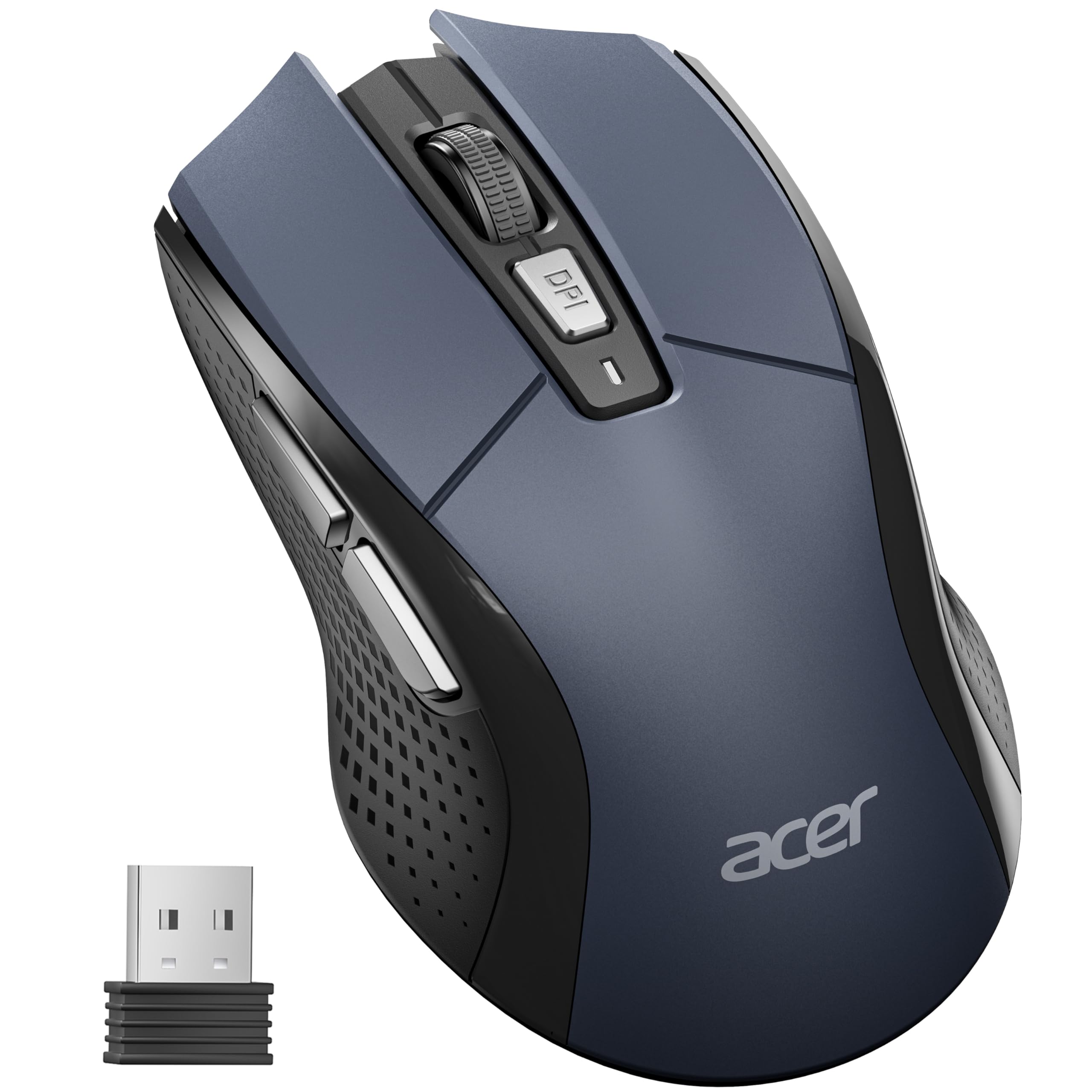
A no-frills workhorse built for bigger hands and higher sensitivity.
You get the highest raw sensitivity in this list with the Acer wireless mouse: 5 adjustable DPI (dots per inch, cursor speed) levels up to 4000—letting you slow down for precision design work or speed across a multi-monitor setup. It is sized for medium to large hands (4.9 x 2.7 inches) and comes with forward/back side buttons that stay on track. One buyer who rated it 5 stars called it “very solid mouse at the price point” and noted it would “compete with 4x pricier Logitech mice” if Acer offered button remapping software. The 2.4GHz USB-A dongle provides a reliable connection up to 33 feet, and a visual indicator light flashes red to warn when the battery drops below 10%. Unlike many budget mice, it offers a “click to wake” standby that activates after 10 minutes but responds after just 2–3 clicks—no 30-second wait.
Unlike the TECKNET, the Acer uses only one AA battery (not included) and does not advertise a specific battery month claim, so actual battery life will depend on how much you use it. The main trade-off: there is no dedicated remapping software for the side buttons, so they default to page forward/back in browsers with no way to reassign them without third-party tools. Also, it is a right-handed shape (no ambidextrous use) and the instructions are printed tiny across many languages, though setup is plug-and-play simple.
Where It Excels
- 4000 max DPI for multi-monitor setups and design work
- Visible low-battery indicator (flashing red LED below 10%)
- Fast wake from standby (2–3 clicks)
Where It Falls Short
- No button remapping software
- Right-handed only, no ambidextrous use
- AA battery not included in the box
Your pick if: you have medium-to-large hands, work across multiple screens, and want higher DPI than most budget mice offer.
skip it if: you are left-handed or need side buttons you can assign to custom shortcuts.
3. TECKNET Wireless Mouse (BT+2.4G) — Dual Connectivity, 4800 DPI, Silent Clicks

A dual-mode silent mouse that bridges your laptop and tablet smoothly.
This TECKNET is an upgrade over the pink ergo model—it adds Bluetooth 5.0/3.0 alongside the 2.4GHz dongle, so you can pair it with a laptop via USB and a tablet via Bluetooth and switch with one button slide. The max DPI (dots per inch) climbs to 4800 (6 levels), making it the highest-sensitivity pick on this list. The clicks are engineered to be whisper-quiet, which one buyer described as “the best mouse I’ve ever used” and another praised for “precise silent clicks” that do not disturb a shared office. Rated battery life jumps to 36 months from 2 AAA batteries, thanks to automatic sleep technology. The ergonomic profile is designed for small to medium hands, though the maker notes larger-handed users may still enjoy the compact feel.
Compare this to the Acer wireless mouse: the Acer tops out at 4000 DPI but lacks Bluetooth, while the TECKNET reaches 4800 DPI and offers dual connectivity for the same price tier. The trade-off is the smaller physical size—owners mention it is noticeably smaller than a full-size office mouse, and the scroll wheel has a minor reported issue where the rubber layer can separate from the inner plastic over time (some users fix it with superglue). The side buttons are also not compatible with macOS, so Mac users lose two buttons. But for a hybrid Windows user who switches between a desktop and a tablet, it is tough to top at this price.
What Makes It Premium
- Dual-mode (Bluetooth 5.0/3.0 + 2.4GHz) for two-device switching
- 4800 DPI with 6 sensitivity levels
- Silent clicks ideal for libraries and offices
What Holds It Back
- Smaller frame may feel cramped in larger hands
- Side buttons do not work on macOS
- Scroll wheel rubber can separate from plastic over months of use
Grab it for: a versatile one-mouse solution that connects to both a PC and a tablet without needing to unplug a dongle.
Look elsewhere for: a full-size palm-friendly shape or a Mac-compatible side button setup.
4. Logitech M185 — 12-Month Battery, Ambidextrous, Brand Reliability

A tiny, trusted workhorse that sets up in under a minute.
The Logitech M185 is the most recognized name in this list, and for good reason: it is ambidextrous (works for left- and right-handed users), comes with a pre-installed AA battery rated for 12 months, and the tiny nano USB receiver plugs in so fast that one owner reported “fast setup (<1 min), smooth tracking, comfortable for hours.” The DPI is fixed at 1000—the lowest max sensitivity among these picks—which is fine for standard office documents and web browsing but will feel sluggish on a high-resolution monitor spread across multiple windows. The scroll wheel is a basic line-by-line design with no tilt or horizontal scrolling. However, the plastic build uses certified post-consumer recycled plastic (77% for the black model), and the overall carbon footprint is rated at 3.97 kg CO2e. It works with Windows, Mac, and Linux without any driver installation.
Compared to the Acer mouse, the M185 has only 3 buttons (no forward/back navigation) and a fixed 1000 DPI vs 4000 adjustable. Battery life is rated at 12 months vs 24 months on the TECKNET pink model. The key advantage here is the Logitech brand reputation: the mouse is widely available, the receiver is easy to replace if lost, and buyers consistently call it “dependable” and “reliable.” The catch is the compact size—it works best for small to medium hands, and the switches may develop intermittent issues after several years of heavy use, according to long-term reviews.
Its Strongest Points
- Ambidextrous shape works for both left and right hands
- AA battery pre-installed, rated for 12 months
- Plug-and-play simplicity with no drivers needed
Its Biggest Limits
- Only 3 buttons and no forward/back navigation
- Fixed 1000 DPI—cannot adjust sensitivity
- Small size not ideal for large hands or extended heavy use
Choose it if: you want a simple, brand-name mouse with a tiny receiver and zero setup hassle for basic office tasks.
Pass it by if: you need side buttons, higher sensitivity, or a larger palm-friendly shape.
5. Amazon Basics 2.4 GHz Wireless Mouse — Entry-Level, Functional

The lowest-price entry point, but battery life is its weak link.
At the bottom of the price range sits the Amazon Basics wireless mouse—a simple 3-button ambidextrous design with a 2.4GHz USB nano receiver that stores inside the battery compartment. It comes with an included AA battery and a small plastic “guitar pick” tool to pry open the back cover. For the absolute lowest spend, it provides smooth optical tracking on most surfaces and a responsive red laser. Customers note it is “light, comfortable, works well” for basic use and has a sleep mode switch to conserve battery. However, the same buyers also report the weakest battery life of any pick here: one review specifically noted “awful battery life (2-3 weeks with heavy use)” and another measured about 3 months with the included Amazon Basics brand battery. That puts it far behind the 12- to 36-month claims of the TECKNET and Logitech models.
Compared to the Logitech M185 above, the Amazon Basics costs less but lacks the Logitech’s brand reputation and wider receiver compatibility. Both have only 3 buttons and no adjustable DPI. The Amazon Basics works with Windows 2000 through Windows 10 (no Windows 11 mention) and is technically compatible with Mac, but some users report inconsistent Mac driver support. For a spare mouse, a kids’ computer, or a very light user who does not mind changing batteries every few weeks, it gets the job done at the lowest cost. For daily professional use, the battery trade-off is simply too steep.
Why It Makes Sense
- Lowest upfront cost of any pick in this guide
- Comes with battery and back-opening tool
- Ambidextrous shape works for left-handed users
Why It Frustrates
- Battery life of 2–3 weeks with heavy use is very short
- Only 3 buttons, no DPI adjustment
- Best suited as a spare or for light use, not daily office work
Grab it for: the lowest possible spend on a functional wireless mouse for occasional use or a secondary computer.
Avoid it for: daily 8-hour desk work where constant battery swapping would be a pain.
6. Kovess Rechargeable Bluetooth Mouse — USB-C, 800mAh, Jiggler Mode

A rechargeable travel mouse with dual USB receivers and a clever jiggler trick.
The Kovess is the only mouse here that gives you both a USB-A and a USB-C 2.4GHz receiver in the box, plus Bluetooth 5.2/3.0 connectivity—four total connection modes. That makes it the most versatile option for a modern laptop that only has USB-C ports, because you never need an adapter or dongle. The 800mAh (milliampere-hours, a measure of battery capacity) rechargeable battery charges via USB-C cable (included) in 2–4 hours and lasts 3–4 weeks of average use, with a 90-day standby time. The “jiggler mode” is a genuinely useful extra: long-press the DPI button for 3 seconds, and the mouse randomly moves the cursor every few minutes to keep your computer from locking or going to sleep—handy for remote workers who need the screen to stay awake during downloads or idle sessions. Buyers call it “a must have for a remote job” and confirm the “silent clicking” and long charge life.
Next to the XBG B15pro (which has a 500mAh battery and an LED screen), the Kovess has a bigger battery (800mAh vs 500mAh) but a lower max DPI (dots per inch, cursor speed) of 1600 vs 2400. The Kovess does not have an LED status display—you cannot glance at the battery percentage without plugging it in. Additionally, some reviewers point out it is very small for large hands (one user with XL gloves found it cramped), and it glides poorly on bare desk surfaces without a mouse pad. The setup on a MacBook can take about 10 minutes vs the instant-connect of a 2.4GHz dongle. But for a minimalist traveler carrying a USB-C laptop, having both receiver types in the box is a rare convenience at this price.
What Stands Out
- Includes both USB-A and USB-C 2.4GHz receivers in the box
- 800mAh rechargeable battery with 3–4 week typical run time
- Jiggler mode keeps screen awake during idle periods
- True silent clicks
What To Consider
- Max DPI is only 1600—lowest among premium picks
- Small size may be uncomfortable for large hands
- No LED battery display; glides poorly without a mouse pad
Pack it if: you travel with a USB-C laptop and want one mouse that charges via the same cable as your phone.
Leave it if: you have large hands or need high DPI for detailed creative work.
7. XBG B15pro — Tri-Mode, LED Battery Display, Type-C Rechargeable
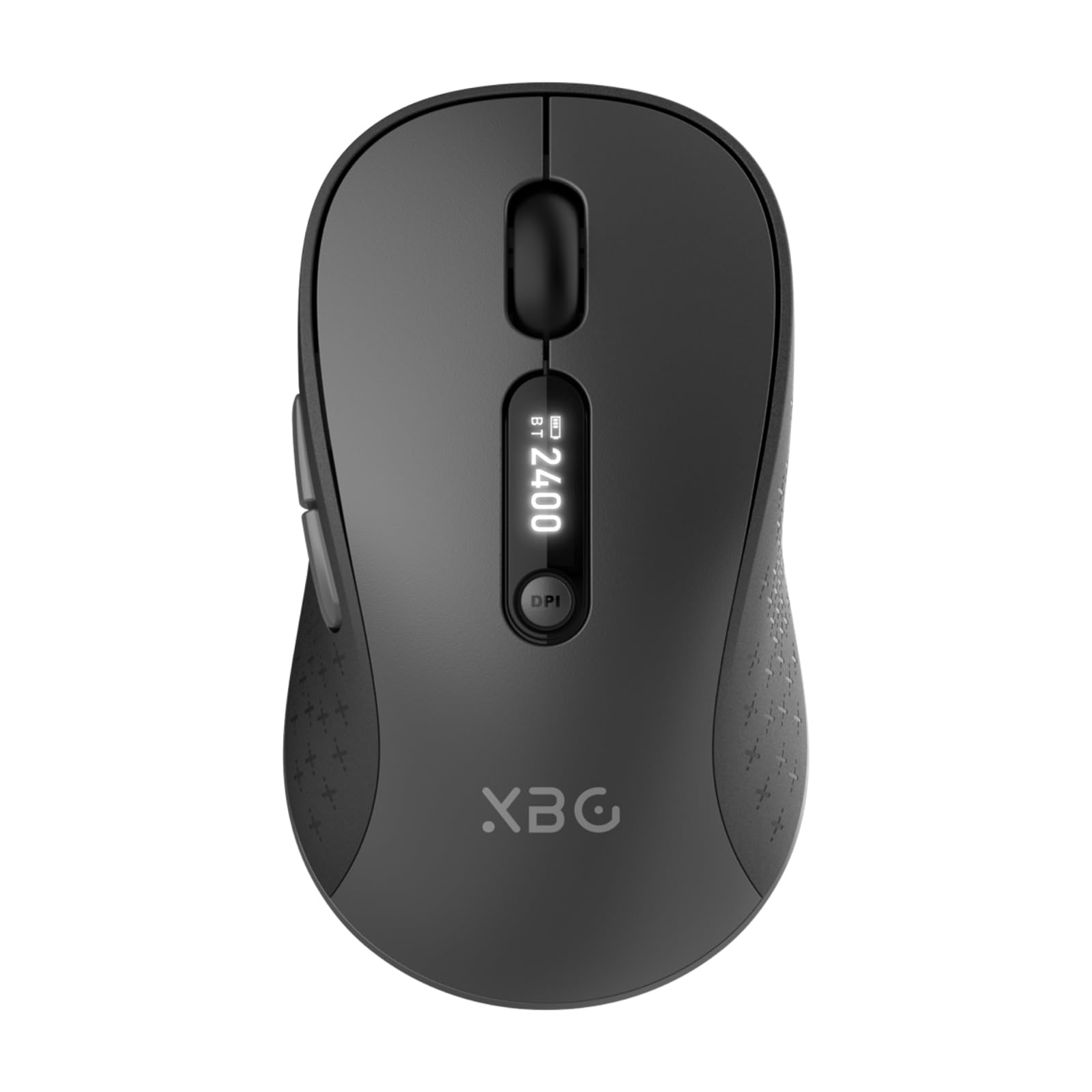
A feature-dense mouse with a live LED screen that shows your battery and DPI.
The XBG B15pro is the only mouse in this roundup with a built-in LED status display: it shows your exact battery percentage, the current DPI (dots per inch, cursor speed) level (800/1000/1200/1600/2400), and which connection mode is active—no more guessing or pressing buttons to check. It connects via Bluetooth 5.0/4.0 or 2.4GHz (tri-mode) and switches between paired devices in 0.8 seconds, making it a solid choice for hybrid workers who toggle between a desktop and a laptop. The 500mAh (milliampere-hours) rechargeable battery charges via USB-C and, according to the maker, lasts about one month on a full charge before needing a top-up. Buyers who tried it say “great value, very quiet clicks,” and particularly appreciate that “no dongle needed for BT” while the included dongle works for computers without Bluetooth. The ergonomic shape features a contoured thumb rest and arched palm support, plus a matte finish that resists fingerprints.
Next to the Kovess, the XBG has a smaller battery (500mAh vs 800mAh) and a shorter claimed battery life, but makes up for it with the LED screen, higher max DPI (2400 vs 1600), and 6 buttons including forward/back navigation. The one consistent buyer complaint is that you cannot remap the buttons or adjust the sleep mode timing—the mouse auto-enters sleep after 5 minutes and there is no software to change that. The instructions are considered unhelpful, though setup is straightforward. At the highest price in this list, it packs the most visual feedback and connectivity options, but the battery does need recharging more often than the Kovess.
Why It’s a Standout
- LED screen shows battery percentage, DPI level, and connection mode
- Tri-mode (Bluetooth 5.0/4.0 + 2.4GHz dongle) with 0.8s switching
- Contoured thumb rest for ergonomic palm support
- 6 buttons including forward/back navigation
Where It Compromises
- 500mAh battery needs more frequent recharging than the Kovess
- No button remapping software available
- Sleep mode timer (5 minutes) cannot be adjusted
Get it if: you want maximum feedback—exact battery readout, DPI level, and connection status—all on a visible screen.
Pass it for: longer battery life between charges or the ability to customize button assignments.
Understanding the Specs
DPI (dots per inch)
DPI dictates how far the on-screen cursor moves when you physically slide the mouse one inch. A higher DPI (e.g. 4800) means the cursor zips across a big screen with a tiny wrist flick—great for multi-monitor setups. A lower DPI (800–1200) gives you finer control for clicking small buttons or editing photos. Adjustable DPI lets you change sensitivity on the fly via a button on top of the mouse. For standard office work, 1000–1600 DPI is typically the most comfortable range.
2.4GHz vs Bluetooth
A 2.4GHz mouse uses a small USB dongle to create a dedicated, low-latency (low delay) wireless link. It is plug-and-play: insert the dongle, turn on the mouse, and you are connected with no pairing steps. Bluetooth frees your USB port and works with tablets and phones, but can introduce a tiny input delay and may require re-pairing if your computer has interference. Dual-mode mice (like the TECKNET BT and Kovess) give you both options, letting you use 2.4GHz for your main desktop and Bluetooth for a tablet without moving a dongle.
Battery life ratings
Manufacturers often test battery life under ideal conditions (2–4 hours of use per day, with sleep modes active). A “24-month battery” claim assumes a typical office usage pattern with the mouse automatically entering deep sleep when idle. Heavy all-day use will shorten that to 8–12 months on the same spec. For rechargeable mice, look at the mAh (milliampere-hours) capacity of the battery—higher mAh means longer run time between charges. An 800mAh battery typically outlasts a 500mAh one by 1.5–2x under equal usage.
Silent clicks and switch durability
“Silent” mice use dampened mechanical switches or rubber domes to soften the audible click. This is a real benefit in shared offices, libraries, or if you record audio at your desk. However, some cheap silent mice sacrifice long-term switch reliability—the dampening material can degrade or the switch contacts can wear faster than a standard crisp-click switch. Look for a mouse rated for a specific number of clicks (e.g., “up to 10 million clicks”) as a general indicator of build quality.
FAQ
What is the real-world battery life difference between a 12-month mouse and a 24-month mouse?
Can I use a 2.4GHz mouse without the USB dongle?
Is a 1000 DPI mouse too slow for a large 4K monitor?
What does “sleep mode” mean on a wireless mouse?
Why does my wireless mouse skip or stutter?
Can I use a cheap wireless mouse for gaming?
What does “ambidextrous” mean for a mouse?
How many buttons do I actually need for office work?
Is it better to get a rechargeable mouse or one that uses replaceable AA/AAA batteries?
Will a cheap wireless mouse work on a glass desk?
Final Thoughts: The Verdict
If you want one dependable pick, the cheap wireless mouse winner is the TECKNET Pink Ergo (24-Month) because it delivers the longest battery life, comfortable rubber grips, and six buttons—all at a price that makes the Logitech M185 and Amazon Basics feel like compromises. If you want a higher DPI and a larger shape for multi-monitor productivity, grab the Acer Wireless Mouse. And for the traveler who needs both USB-A and USB-C receivers in one box, the rechargeable Kovess is the easiest pick to throw in a bag.
How We Picked
We do not accept paid placement. Every pick is matched to a real buyer and a real use-case; we do not hands-on test units.
Sources & Methodology
Specifications: manufacturer listings and product documentation. Review insights: verified customer reviews, as of July 2026. Pricing: not shown on this page (it changes often); check the current price via the retailer link.
As an Amazon Associate, WellFizz earns from qualifying purchases. This does not affect which products we feature.
Related Guides

Mo Maruf
I created WellFizz to bridge the gap between vague wellness advice and actionable solutions. My mission is simple: to decode the research and give you practical tools you can actually use.
Beyond the data, I am a passionate traveler. I believe that stepping away from the screen to explore new environments is essential for mental clarity and physical vitality.