Our readers keep the lights on and my smoothie glass nicely filled. As an Amazon Associate, I earn from qualifying purchases.
Specs are compiled from manufacturer listings and verified buyer reviews and can change over time — please confirm the key details on the product page before buying.
Professional-looking 4K video usually costs thousands of dollars, but you can get it for much less. The trick is knowing which features you cannot skip — a large sensor that captures light well, a built-in stabilizer that keeps footage smooth, and a high frame rate for slow motion — and which ones you can compromise on. This guide points you to the three cheap videography cameras that actually deliver those specs without wasting your money on marketing fluff.
I’m Mohammad Maruf — the founder and writer behind WellFizz. This guide is built by comparing the manufacturers’ published specifications and the patterns across verified customer reviews, so you get each pick’s real strengths and trade-offs instead of marketing spin.
The right cheap videography camera gives you a 1-inch sensor and a 3-axis gimbal for a low price You can start a YouTube channel or just capture smooth, crisp footage without a mirrorless budget.
Our Picks at a Glance

How To Choose The Best Cheap Videography Camera
Buying a cheap videography camera means making smart compromises. Three specs separate a useful tool from a frustrating toy: the sensor size, the stabilization system, and the recording frame rate. Here is how to weigh each one against your actual filming needs.
Sensor size — the 1-inch benchmark
The sensor is the light-collecting chip inside the camera. A larger sensor lets in more light, which means cleaner footage in dim rooms and less digital noise — so your indoor shots stay clear instead of grainy. In this price range, a 1-inch CMOS sensor (about four times the surface area of a typical smartphone sensor) is the gold standard. Anything smaller — like a 1/2.3-inch sensor — will struggle in low light and produce grainier video. Every camera in this guide uses a 1-inch sensor, so you get that low-light headroom from the start.
Stabilization — built-in gimbal versus digital crop
Handheld video looks amateur when it wobbles. The best cheap videography cameras solve this with a mechanical 3-axis gimbal — a tiny motorized mount that physically keeps the lens level as you move. That is far more effective than digital stabilization (which smooths footage by cropping into the frame and can make the video look soft). A 3-axis gimbal lets you walk, run, or spin while the footage stays smooth and the full resolution remains intact.
Frame rate — what 120fps really gets you
Standard video runs at 30 frames per second (fps). A camera that shoots 4K at 120fps lets you slow that footage down to a quarter-speed for buttery slow-motion in high resolution — so action clips, B-roll, or any scene you want to dramatize looks smooth rather than choppy. That matters for action clips, B-roll, or any scene where you want dramatic slow-mo without dropping to 1080p. Both pocket cameras in this guide hit 4K at 120fps — a capability that used to cost well over a thousand dollars.
Quick Comparison
| Model | Best For | Sensor Type | Stabilization | Max Video | Amazon |
|---|---|---|---|---|---|
| Xtra Muse Pocket Camera★ Best Overall | Budget gimbal shooter | 1-inch CMOS | 3-axis gimbal | 4K @ 120fps | Amazon |
| DJI Osmo Pocket 3 | Top pocket production | 1-inch CMOS | 3-axis gimbal | 4K @ 120fps | Amazon |
| Sony ZV-1F | Wide-angle vlogging | 1-inch (20.1 MP) | Optical SteadyShot | 4K UHD | Amazon |
In‑Depth Reviews
1. Xtra Muse Vlogging Camera with 1-inch CMOS & 4K/120fps
This pocket-sized 4K camera undercuts the DJI Osmo Pocket 3 by a significant amount without cutting corners on the core specs that matter for video.
Buyers consistently say the Xtra Muse feels solid and its footage rivals the famous name brand. You get a 1-inch CMOS sensor (a light-gathering chip about four times larger than a phone sensor) that records 4K resolution at 120fps — so slow-motion clips stay crisp and detailed, letting you slow action down to one-quarter speed in full 4K. The 3-axis gimbal stabilizer (three tiny motors that hold the lens level) handles running or dancing without that seasick wobble your phone produces. The 2-inch touchscreen flips between horizontal and vertical shooting in an instant.
Face and object tracking keep the subject in the center of the frame even when you spin around, which makes solo vlogging much easier. The battery average life hits 161 minutes, and it supports micro SD cards with UHS Speed Class 3 (U3, a speed rating for fast writes that prevents recording dropouts). What the review pages sum up: it is “near identical to the competitor at half price.” The 10-bit X-Log color mode (a flat color profile that preserves more detail for editing) gives you room to grade footage in post, so sunrises and sunsets look rich rather than blown out.
The honest trade-off is battery life — some owners find it decent, others wish for more. Microphone connectivity also draws mixed feedback; you may want an external mic adapter for pristine audio.
What owners love
- Sharp 4K at 120fps with smooth gimbal
- Face/object tracking works reliably
- Compact enough for a jacket pocket
- 10-bit X-Log color for professional grading
The honest caveats
- Battery life gets mixed reviews — pack a power bank
- Microphone connectivity is limited; external mics need an adapter
Reach for it if: you want smooth gimbal-stabilized 4K video at the lowest entry price — this is the best cheap videography camera for beginners and budget-conscious creators.
Think twice if: you need all-day battery life straight from the start or plug-and-play external mic support without extra accessories.
2. DJI Osmo Pocket 3, Vlogging Camera with 1-inch CMOS & 4K/120fps
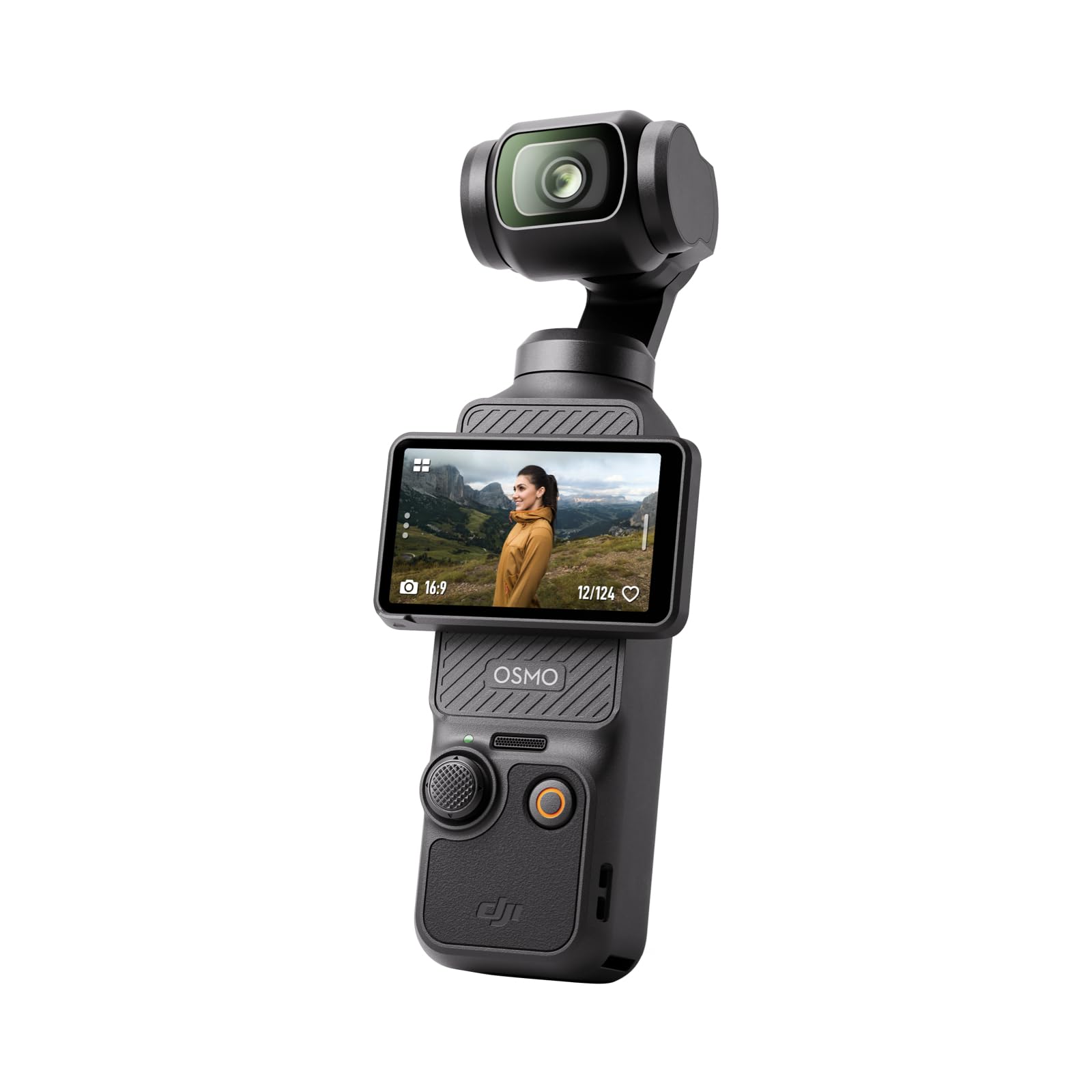
The crowd favorite among serious creators gets its edge from ActiveTrack 6.0 tracking — it’s noticeably faster and stickier than the Xtra Muse’s tracking, and that makes solo filming more reliable.
The DJI Osmo Pocket 3 packs a 1-inch CMOS sensor with 4K at 120fps, and its 3-axis mechanical stabilization is the benchmark that other cheap videography cameras try to match. ActiveTrack 6.0 (DJI’s latest subject-tracking system) lets you set it on a tripod and walk, jump, or spin, and it keeps you center-frame without drifting — a step up in reliability from the Xtra Muse’s tracking. The rotating 2-inch touchscreen switches between horizontal and vertical shooting in one smooth motion, which saves massive time when you post to both YouTube and TikTok.
Buyers report “excellent image quality from 1-inch CMOS sensor, 4K/120fps, outstanding stabilization, fast autofocus, face/object tracking.” The D-Log M 10-bit color profile (a flat color format capturing up to one billion colors) captures up to one billion colors for flexible post-production grading. It also connects directly to two DJI Mic 2 or Mic Mini transmitters (no dongle required), which simplifies audio for interviews and vlogs — a clear advantage over the Xtra Muse’s limited mic connectivity. The 166-minute battery life edges out the Xtra Muse’s 161 minutes .
Some owners treat it carefully as a premium tool rather than a throw-in-the-bag gadget. For the jump in polish, tracking reliability, and audio ecosystem, many find it worth the extra cost.
What gives it the edge: the ActiveTrack 6.0 tracking is noticeably faster and stickier than the competition, the rotating screen is a genuine workflow speed-up, and the direct DJI Mic pairing means no extra cables or adapters for clean audio.
Who might want to pass: if your budget is extremely tight, the savings from the Xtra Muse go further — but you lose the polish and the wireless mic integration.
Grab this if: you want the most polished pocket gimbal camera available — ActiveTrack, rotating screen, and smooth audio make it the best cheap videography camera for serious vlogging and travel content.
Look elsewhere if: you need a camera for rugged outdoor conditions or you are strict on spending the absolute minimum for good gimbal footage.
3. Sony ZV-1F Vlog Camera for Content Creators and Vloggers

Where the gimbal cameras focus on smooth walking footage, the Sony ZV-1F focuses on a different problem: capturing your whole scene — and your whole face — at arm’s length, without a gimbal.
The Sony ZV-1F takes a different approach from the gimbal cameras above. Instead of a mechanical stabilizer, it relies on a 20mm ultra-wide lens (a lens that shows a very wide field of view, so you and your background fit in the frame) and a 1-inch 20.1 MP sensor to deliver sharp 4K footage with a naturally defocused background. The F2 lens (a lens with a wide aperture of F2 that lets in a lot of light) pulls in plenty of light for indoor shoots, and the Eye AF autofocus (autofocus that locks onto your eye) plus subject tracking keep your face sharp as you move. The side-articulating touchscreen LCD flips forward, which makes solo selfie shots easy to frame.
What owners praise most is the camera quality — 148 buyers single it out as a standout feature. The built-in directional 3-capsule microphone with the included windscreen accessory captures clean audio even in breezy outdoor conditions, which saves you from buying an external mic immediately. Product Showcase mode smoothly shifts focus from your face to an object you hold up, perfect for unboxings and reviews. Camera quality (148) and photo quality (97) lead the praise list by a wide margin.
The main trade-off is that the ZV-1F lacks a gimbal. You get Optical SteadyShot (Sony’s lens-based stabilization) for stabilization, but it will not match the buttery smoothness of the Xtra Muse or DJI when you walk. Battery life also draws mixed feedback — expect roughly 45 minutes of continuous recording, so a spare battery is essential for a full day out. It is also more fragile than a traditional camcorder; a drop can affect the autofocus mechanism. Still, for sit-down vlogging, interviews, and desk content, the ultra-wide lens and reliable autofocus make it a standout tool at a mid-range price.
The real strengths
- Ultra-wide 20mm lens fits two people or a full background at arm’s length
- Eye AF and Product Showcase mode make solo shooting easy
- Built-in directional mic with windscreen captures clean audio
What to watch out for
- No mechanical gimbal — walking footage is noticeably less steady than the pocket cameras above
- Battery runs about 45 minutes; plan for spares on long shoots
Best for: vloggers and content creators who film mostly from a fixed position or tripod — the wide lens and Eye AF are class-leading in this price range.
Not ideal if: you need smooth walking shots or run-and-gun handheld footage without additional stabilization gear.
Understanding the Specs
1-inch CMOS sensor
This is the light-gathering chip inside the camera. A 1-inch sensor has roughly four times the surface area of a typical phone sensor, which means it captures more light in dim settings and produces cleaner, less grainy video — so your indoor footage stays clear instead of noisy. Every camera in this guide uses a 1-inch sensor, so you get low-light performance that typical cheap videography cameras under cannot match.
3-axis gimbal stabilization
Three tiny motorized motors physically hold the camera level as you move. Unlike digital stabilization, which crops into the frame and can soften the image, a gimbal keeps the full 4K resolution intact while smoothing out footsteps, spins, and sudden pans. The Xtra Muse and DJI Pocket 3 both use this system; the Sony relies on optical stabilization, which is lighter but less effective during active motion.
4K at 120fps
Standard video runs at 30 frames per second. Shooting at 120fps lets you slow that clip down to 25% speed for silky slow-motion while keeping 4K resolution — so action shots, nature B-roll, or dramatic transitions look smooth instead of choppy. That matters for action shots, nature B-roll, or dramatic transitions in travel videos. Both the Xtra Muse and DJI Pocket 3 hit this spec; the Sony ZV-1F shoots 4K at standard frame rates, so you get crisp video but not the slow-motion flexibility.
Face and object tracking
The camera locks onto a person’s face or a chosen subject and keeps them in focus and centered as they move. For solo creators, this means you can set the camera on a tripod, walk into frame, and the camera follows you automatically without a dedicated operator. ActiveTrack 6.0 on the DJI is the most advanced version here; the Xtra Muse’s Master Follow runs a close second.
FAQ
Can a cheap videography camera really shoot professional-looking footage?
What is the real difference between the Xtra Muse and the DJI Pocket 3?
Which camera is best for walking while filming?
How long does the battery last on these cameras?
Do I need an external microphone with these cameras?
Is the Sony ZV-1F worse than the gimbal cameras because it lacks a gimbal?
Can I use these cameras for livestreaming?
Which camera is most beginner-friendly?
Final Thoughts: The Verdict
For most people, the best cheap videography camera is the Xtra Muse Pocket Camera — it delivers the same core specs (1-inch sensor, 3-axis gimbal, 4K/120fps) as the premium option at a significantly lower entry point, making it the smartest value for budget-conscious creators. If you need the most polished image tracking and wireless audio integration, the DJI Osmo Pocket 3 is the upgrade pick that serious vloggers consistently choose. And for sit-down vlogging with an ultra-wide lens and reliable built-in audio, the Sony ZV-1F remains the go-to option for desk content and face-to-camera work.
How We Picked
We do not accept paid placement. Every pick is matched to a real buyer and a real use-case; we do not hands-on test units.
Sources & Methodology
Specifications: manufacturer listings and product documentation. Review insights: verified customer reviews, as of July 2026. Pricing: not shown on this page (it changes often); check the current price via the retailer link.
As an Amazon Associate, WellFizz earns from qualifying purchases. This does not affect which products we feature.
Related Guides

Mo Maruf
I created WellFizz to bridge the gap between vague wellness advice and actionable solutions. My mission is simple: to decode the research and give you practical tools you can actually use.
Beyond the data, I am a passionate traveler. I believe that stepping away from the screen to explore new environments is essential for mental clarity and physical vitality.