Our readers keep the lights on and my smoothie glass nicely filled. As an Amazon Associate, I earn from qualifying purchases.
A travel camera should vanish into your bag, not into your bank account. The challenge is separating the pocket-sized gems that punch above their weight from the cheap, compromised models that leave you with grainy, blurry memories of your trip.
I’m Mohammad Maruf — the founder and writer behind WellFizz. After analyzing hundreds of hours of customer feedback and cross-referencing specs across nine of the most popular budget travel cameras, I’ve zeroed in on the models that actually deliver on portability, image stabilization, and video quality without crossing into premium price territory.
Whether you’re documenting a backpacking journey through Europe or capturing candid moments at a family reunion, finding the right best cheap travel camera means balancing zoom reach, sensor size, and stabilization features that actually matter on the road.
How To Choose The Best Cheap Travel Camera
A budget travel camera forces trade-offs, but the right one prioritizes portability, stabilization, and a versatile zoom range. Understanding where to compromise and where to spend helps you pack a camera that actually feels worth using every day on the road.
Optical Zoom vs. Digital Zoom: Why Raw Reach Matters
Optical zoom uses the lens to magnify the scene without losing image quality. Digital zoom crops into the sensor, instantly reducing resolution and introducing noise. When comparing budget travel cameras, focus on the optical zoom number—anything below 8x will leave you frustrated at stadiums, safaris, or scenic overlooks where the subject is farther than a few feet away.
Stabilization: The Real Decider for Handheld Shooting
Handheld footage from a moving taxi, a hiking trail, or a crowded market needs stabilization. Two types exist: optical/mechanical (sensor or lens moves to counteract shake) and electronic (software crops the frame to smooth motion). Mechanical stabilization—whether a gimbal or O.I.S.—delivers cleaner video and sharper photos at full zoom. Budget cameras with weak stabilization will punish you with soft results the moment the sun drops or the zoom extends past halfway.
Sensor Size and Low-Light Performance
A larger sensor (1-inch) collects more light than a standard 1/2.3-inch sensor found in budget point-and-shoots. Cameras with a 1-inch sensor—like the DJI Osmo Pocket 3 or the Xtra Muse—deliver noticeably cleaner handheld shots at dusk and in dim interiors. If you plan to shoot indoors at museums, restaurants, or evening city walks, prioritize sensor size over megapixel count.
Quick Comparison
On smaller screens, swipe sideways to see the full table.
| Model | Category | Best For | Key Spec | Amazon |
|---|---|---|---|---|
| Canon EOS R100 Kit | Mirrorless | Entry-level interchangeable lens | 24.1MP APS-C sensor | Amazon |
| DJI Osmo Pocket 3 Creator Combo | Pocket Gimbal | Ultra-steady 4K vlogging | 1″ CMOS + 3-axis gimbal | Amazon |
| Xtra Muse Pocket Gimbal Camera | Pocket Gimbal | Budget-friendly gimbal vlogging | 1″ CMOS + 3-axis gimbal | Amazon |
| Canon PowerShot V10 | Ultracompact | Pocket vlogging with stand | 1″ BSI CMOS + flip screen | Amazon |
| Panasonic LUMIX ZS99 | Compact Superzoom | Pocketable 30x zoom | 30x optical zoom / 24-720mm | Amazon |
| Panasonic LUMIX FZ80D | Bridge Camera | Telephoto wildlife and sports | 60x optical zoom / 20-1200mm | Amazon |
| Kodak PIXPRO AZ528 | Bridge Camera | Entry-level superzoom reach | 52x optical zoom / 24mm wide | Amazon |
| GoPro HERO Black Compact | Action Camera | Adventure and waterproof shooting | HyperSmooth stabilization | Amazon |
| FJFJOPK 5K Camcorder | Camcorder | Live streaming with night vision | 8x optical zoom + 32GB card | Amazon |
In‑Depth Reviews
1. Canon EOS R100 Mirrorless Camera w/ RF-S18-45mm Lens Kit

The smallest body in the EOS R series, the R100 pairs a 24.1-megapixel APS-C sensor with Canon’s DIGIC 8 processor, delivering interchangeable-lens image quality at a price that rivals fixed-lens travel compacts. The kit’s RF-S18-45mm lens covers wide-angle to moderate telephoto — enough for street photography, landscapes, and group portraits — while Dual Pixel CMOS AF with face/eye detection makes focusing effortless for beginners.
At 4K up to 24 fps and Full HD up to 60 fps, the R100 won’t win any slow-motion awards, but the video quality is clean and color-accurate straight out of camera. The 6.5 fps burst rate and animal-detect autofocus add versatility for capturing moving subjects like pets or active kids during travel. It lacks in-body stabilization, but the kit lens offers up to 4 stops of optical image stabilization, which helps keep handheld daytime shots crisp.
The trade-off for the low weight and compact form is a smaller, lower-resolution electronic viewfinder and a fixed rear LCD rather than a fully articulating screen. Beginners will appreciate the guidance mode that explains each shooting setting in plain language. If you want a mirrorless camera that grows with your skills without the premium price tag, this is the most versatile option on the list.
Why it’s great
- Large APS-C sensor for superior image quality and natural bokeh
- Interchangeable lens system means you can upgrade later
- Reliable Dual Pixel autofocus with face and animal detection
Good to know
- No in-body stabilization — relies on OIS in the kit lens
- Fixed rear LCD, not fully articulating
- Battery charger sold separately from the camera
2. DJI Osmo Pocket 3 Creator Combo

The DJI Osmo Pocket 3 packs a 1-inch CMOS sensor and a built-in 3-axis mechanical gimbal into a body smaller than most point-and-shoots. That combination delivers gimbal-smooth 4K video at up to 120 fps — footage that looks like it belongs on a production set, not a pocket camera. The rotating 2-inch touchscreen seamlessly switches between horizontal and vertical orientation, making it effortless to create content for both YouTube and TikTok without cropping.
ActiveTrack 6.0 keeps you or your subject centered in the frame while walking or moving, which is a game-changer for solo vloggers who film themselves without a camera operator. The Creator Combo adds a DJI Mic 2 transmitter, battery handle, mini tripod, and wide-angle lens, turning the Pocket 3 into a complete travel video kit. Stereo recording with the option to connect two DJI mics wirelessly ensures clean audio alongside the stabilized video.
The 1-inch sensor pulls ahead of smaller 1/2.3-inch sensors in low light, producing usable footage at dusk and inside dim restaurants. Battery life reaches about 166 minutes per charge when using the included battery handle. The main limitation is the fixed 20mm equivalent f/2.0 lens — you cannot zoom optically, so framing relies on digital zoom or getting physically closer. For travelers who prioritize smooth, cinematic video over telephoto reach, the Pocket 3 is a compact powerhouse.
Why it’s great
- True 3-axis mechanical gimbal eliminates handheld shake completely
- 1-inch sensor delivers strong low-light and dynamic range
- Creator Combo has everything you need for vlogging out of the box
Good to know
- Fixed wide-angle lens — no optical zoom
- Requires in-app or cable transfer for footage offload
- Higher price than most dedicated travel compacts
3. Xtra Muse Vlogging Camera w/ 1″ CMOS & 3-Axis Gimbal

The Xtra Muse enters the same 1-inch CMOS + 3-axis gimbal space as the DJI Pocket 3 but at a significantly lower entry price, making it the strongest value option for budget-conscious vloggers who refuse to compromise on stabilization. It records 4K at 120 fps, uses true 10-bit X-Log color for flexible grading in post, and includes face/object tracking that keeps moving subjects in frame reliably.
The 2-inch touchscreen is responsive for switching between photo and video modes, and the compact form factor slides into a jacket pocket or waist pouch without protruding. Standard bundle accessories include a carrying bag, wrist strap, and a 1/4-inch handle that mounts to any tripod. Battery life exceeds 160 minutes in standard use, and the USB-C PD charging lets you top up from a portable power bank during a full day of sightseeing.
Autofocus is fast and reliable in well-lit conditions, and the integrated gimbal eliminates the need for post-production stabilization. The trade-off is that the Xtra Muse is a relatively new player with a smaller accessory ecosystem compared to DJI, and the companion app is not as polished. For travelers who want gimbal-stabilized 4K footage without paying a premium, the Xtra Muse is the most cost-effective path to smooth videos.
Why it’s great
- 1-inch sensor and 3-axis gimbal at a mid-range price point
- 4K/120fps with 10-bit X-Log color for flexible editing
- Face/object tracking works well for solo content creators
Good to know
- Smaller accessory ecosystem than DJI Pocket 3
- Companion app feels less polished than established brands
- Digital zoom only — no optical reach
4. Canon PowerShot V10 Vlogging Camera

The Canon PowerShot V10 is designed around a single, uncompromising idea: extreme portability for vlogging. The 1-inch back-illuminated CMOS sensor captures 4K video at 30 fps, and the built-in stand folds from both the front and back for hands-free tabletop shooting. The retractable front-facing screen makes self-recording straightforward without requiring a flip-up monitor that adds bulk.
A fixed 19mm equivalent f/2.8 lens means this is not a zoom camera — you frame with your feet. For city travel where subjects are close and you want to include wide backgrounds, the lens works well. The stereo microphones with a third, center-facing mic actively reduce background noise, and a 3.5mm external mic port gives you an upgrade path for windy outdoor locations.
The V10 fits into a fanny pack or coat pocket and weighs almost nothing, making it the easiest camera on this list to actually carry every day. The trade-off is the lack of optical zoom and a battery that drains faster than larger competitors — Canon rates it at roughly 45 minutes of 4K recording. Travelers who shoot mostly short clips and prioritize portability over zoom will find the V10 refreshingly simple and effective.
Why it’s great
- Extremely pocketable with a built-in stand for hands-free recording
- 1-inch BSI sensor delivers clean video in good and moderate light
- Includes external mic port and effective stereo microphones
Good to know
- No optical zoom — fixed wide-angle lens only
- Battery life is limited — plan for midday recharges
- No lens cap or included protective case
5. Panasonic LUMIX ZS99 (TZ99) Compact Digital Camera

The Panasonic LUMIX ZS99 is the ultimate pocket superzoom, packing a 30x optical zoom (24-720mm equivalent) Leica lens into a body slim enough for a jacket pocket. That zoom range covers everything from wide-angle cathedral interiors to telephoto shots of wildlife or stage performers from the back row, making it one of the most versatile single-lens travel cameras available at this price point.
It records 4K video at 30 fps and captures 4K photo bursts at 30 fps, pulling the best frame during action sequences. The 1,840k-dot tiltable touchscreen helps compose shots at awkward angles, and built-in Bluetooth 5.0 with a dedicated Send Image button transfers photos to your phone quickly. Five-Axis HYBRID O.I.S. keeps telephoto shots steadier than most superzooms in this class, though a firm grip still helps at full reach.
Image quality is very good in bright conditions and usable up to ISO 1600, but the small 1/2.3-inch sensor shows noise in dim environments. The ZS99 is not a low-light camera — it’s a daylight zoom monster that fits in your pocket. For travelers who want one camera that covers everything from a landscape vista to a distant mountain goat without changing lenses, the ZS99 is the obvious choice.
Why it’s great
- 30x optical zoom in a truly pocketable body
- Leica lens delivers sharp colors with minimal editing needed
- Bluetooth and one-touch image transfer to smartphone
Good to know
- Small sensor struggles in low light — stick to daytime shooting
- Autofocus uses single-point contrast detection — slower in low contrast scenes
- Menu system is dense and takes time to master
6. Panasonic LUMIX FZ80D Point and Shoot with 60x Zoom

The Panasonic LUMIX FZ80D is a bridge camera that puts a 60x optical zoom (20-1200mm equivalent) lens into a form factor that sits between a compact and a DSLR. That zoom reach captures subjects that are invisible to pocket cameras — birds at 200 yards, athletes on a far field, or the detail on a distant mountain peak. The POWER O.I.S. (Optical Image Stabilizer) is critical here, suppressing hand shake at full telephoto better than most budget superzooms.
4K video recording at 30 fps doubles as a 4K Photo burst mode, extracting 8-megapixel stills from video clips. The Post Focus feature lets you adjust the plane of focus after taking the shot, a unique trick for macro and telephoto composition. The 2,360K-dot electronic viewfinder is bright enough to compose shots in direct sunlight, and the 3-inch LCD tilts for low-angle shooting.
The 1/2.3-inch sensor is the FZ80D’s Achilles’ heel — images become grainy at ISO 800 and above, and low-light performance is poor even with the f/2.8-5.9 aperture. This is a daylight camera designed for travelers who prioritize zoom over everything else. It is lightweight for a bridge camera, making it a practical choice for hiking safaris and day trips where you cannot pack multiple lenses.
Why it’s great
- 60x optical zoom covers 20mm wide to 1200mm telephoto
- POWER O.I.S. keeps telephoto handheld shots stable
- Post Focus feature allows focus adjustment after capture
Good to know
- Small sensor produces noise above ISO 800
- Battery drains quickly at full zoom — carry spares
- No Wi-Fi — file transfers require a card reader or cable
7. Kodak PIXPRO Astro Zoom AZ528-BK Digital Camera
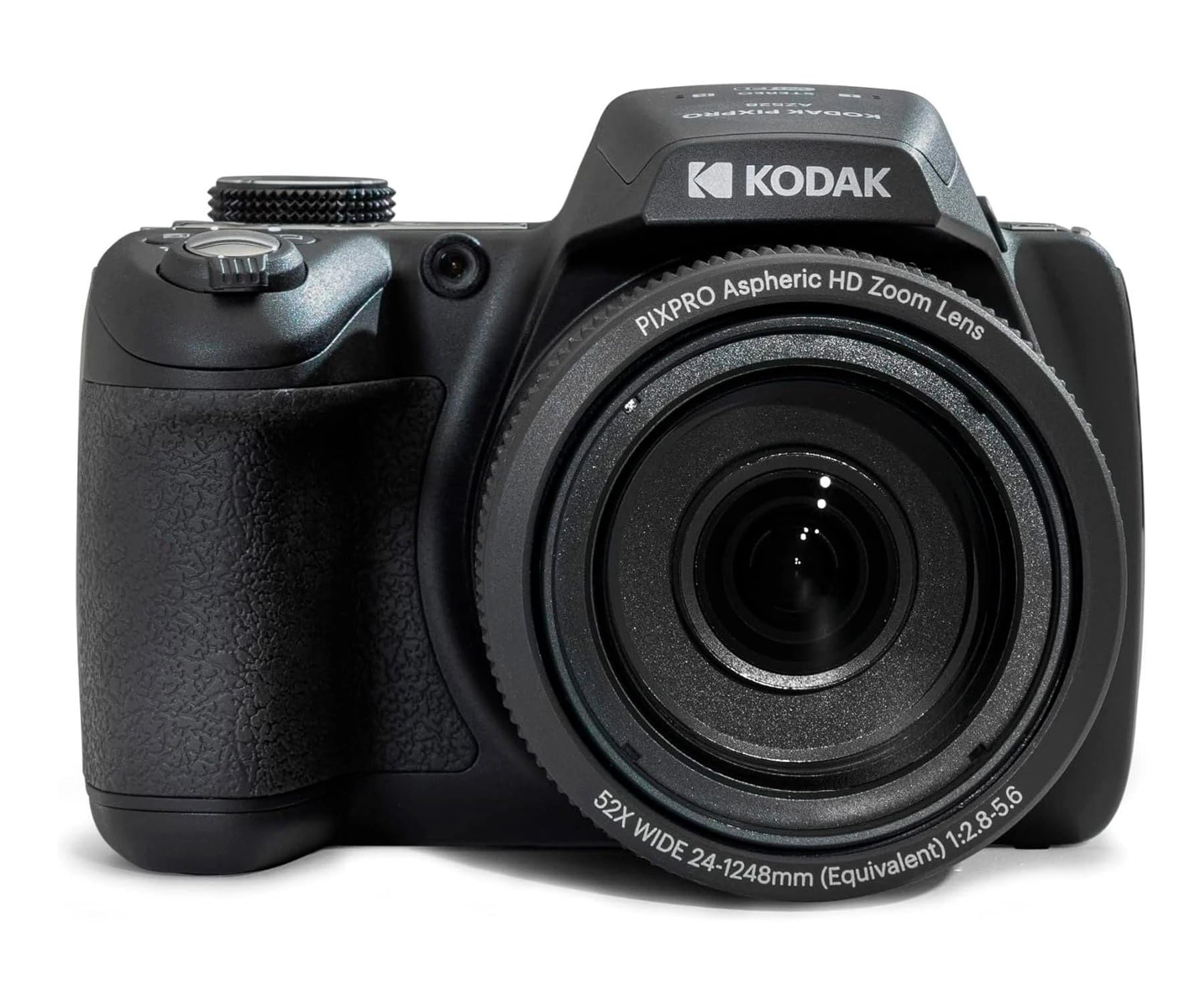
The Kodak PIXPRO AZ528 offers a 52x optical zoom (24-1248mm equivalent) and a 16-megapixel BSI CMOS sensor at a price that undercuts most superzooms. The 24mm wide-angle end is ideal for landscape vistas, and the telephoto reach brings distant subjects into frame with genuine optical sharpness — not cropped digital zoom. Built-in OIS helps stabilize handheld telephoto shots, though the system is less aggressive than Panasonic’s POWER O.I.S.
The 3-inch LCD and electronic viewfinder give you two framing options, and the 6 fps burst mode captures fast action sequences at the press of a button. Built-in Wi-Fi connects to the Kodak Pixpro app for remote shooting and instant social sharing, a welcome feature for travelers who want to post from the field. The camera runs on a rechargeable Li-Ion battery and accepts SD cards up to 512 GB, enough for thousands of photos on a long trip.
Image quality is solid in bright conditions, but the 1/2.3-inch sensor shows noise when light drops. The menu system is straightforward, and the comfortable grip makes extended shooting easy. Build quality feels slightly less premium than the Panasonic FZ80D, with some users noting the casing scuffs easily. For budget travelers who want superzoom reach without stretching into mid-range territory, the AZ528 is the most affordable entry point.
Why it’s great
- 52x optical zoom at a competitive entry-level price
- Wi-Fi connectivity for instant photo transfers to phone
- Comfortable grip and easy-to-learn controls
Good to know
- Small sensor produces noise in anything but bright light
- Battery life is shorter than expected during heavy zoom use
- Casing material scuffs and shows wear over time
8. GoPro HERO Black Compact Action Camera Bundle

The GoPro HERO Black Compact is purpose-built for travelers who push past paved paths. Waterproof to 33 feet without a housing, it goes directly into snorkeling, river crossings, and rainstorms without worrying about sealing a door. HyperSmooth video stabilization keeps handheld footage incredibly stable even when running, biking, or descending rocky trails — matching the smoothness of a mechanical gimbal through software and sensor cropping.
The bundle includes a 50-in-1 accessory kit and a 64GB microSD card, removing the need for separate purchases. Voice control works in 11 languages, letting you start and stop recording hands-free while climbing or paddling. The 12-megapixel photo resolution and 4K video at 30 fps are sufficient for social media and personal memories, though the small sensor cannot match the dynamic range or low-light performance of a 1-inch camera.
Battery life is about one hour at the highest settings, and the compact 3-ounce body means you barely notice it on a helmet mount or chest strap. The fixed wide-angle lens captures immersive POV shots but lacks optical zoom — everything is wide. For adventure travelers who need a waterproof, shockproof camera that survives abuse, the GoPro HERO is the safest bet on the list.
Why it’s great
- Waterproof to 33 feet without a housing
- HyperSmooth stabilization works well for high-motion activities
- Bundle includes essential accessories and a 64GB card
Good to know
- Small sensor struggles in low light and flat light conditions
- Fixed wide-angle lens — no optical zoom
- Battery lasts roughly one hour at 4K/30fps
9. FJFJOPK 5K Video Camera Camcorder with 8x Optical Zoom
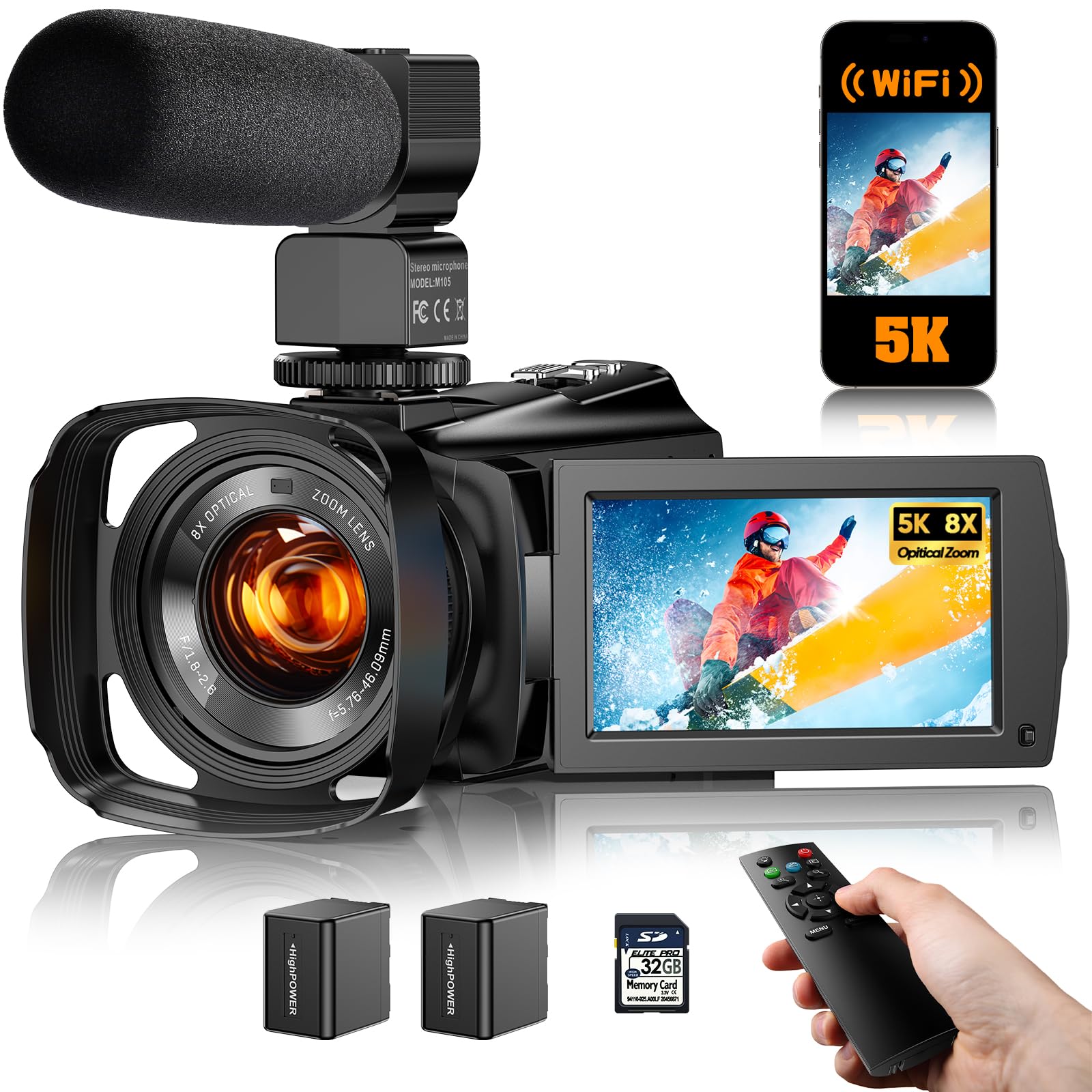
The FJFJOPK 5K Camcorder is the most feature-packed budget entry on this list, offering 5K video resolution, a 64-megapixel photo mode, and full-color night vision at a price that undercuts most point-and-shoots. The 8x optical zoom is modest compared to the superzooms above, but the inclusion of Wi-Fi live streaming, a 3.6-inch IPS touchscreen, and a 32GB SD card right in the box makes it a complete out-of-the-box solution for live broadcasters and beginner content creators.
Six-axis EIS electronic stabilization uses a gyroscope and accelerometer to smooth handheld footage, and the TOF laser autofocus assist speeds up focusing in dim scenes. The 270-degree rotating touchscreen flips forward for self-recording, and the included remote control lets you start and stop recording from across the room — useful for livestreaming product demos or cooking tutorials while traveling.
Customer reports indicate occasional audio-video sync issues on some units, so buyers should test the camera early and register for warranty support. The image quality is competitive for the price, but the 5K resolution and 64MP stills are interpolated — real-world sharpness is closer to a 4K sensor. For travelers who need an all-in-one camcorder with night vision, live streaming, and included accessories, this is the most budget-friendly way to get a full rig in one order.
Why it’s great
- Includes 32GB card, two batteries, microphone, and remote
- Full-color night vision works in pitch-black conditions
- Wi-Fi and live streaming support for real-time sharing
Good to know
- Some units report audio-video sync problems
- 5K and 64MP specs are interpolated, not native
- Electronic stabilization reduces shake but does not match a gimbal
FAQ
Should I choose a travel camera with a 1-inch sensor or a zoom bridge camera?
Is image stabilization worth paying extra for in a budget travel camera?
Can I use a budget travel camera for professional content creation?
Final Thoughts: The Verdict
For most users, the best cheap travel camera winner is the Canon EOS R100 because it offers interchangeable-lens versatility and the largest sensor at the best value. If you want gimbal-stabilized 4K video without a handler, grab the DJI Osmo Pocket 3. And for maximum zoom reach in a pocketable body, nothing beats the Panasonic LUMIX ZS99.

Mo Maruf
I created WellFizz to bridge the gap between vague wellness advice and actionable solutions. My mission is simple: to decode the research and give you practical tools you can actually use.
Beyond the data, I am a passionate traveler. I believe that stepping away from the screen to explore new environments is essential for mental clarity and physical vitality.