Our readers keep the lights on and my smoothie glass nicely filled. As an Amazon Associate, I earn from qualifying purchases.
Specs are compiled from manufacturer listings and verified buyer reviews and can change over time — please confirm the key details on the product page before buying.
Finding a cheap trail camera that actually delivers clear night shots, reliable motion detection, and decent battery life can feel like a gamble. You want to monitor wildlife, secure your property, or scout for hunting season without blowing your budget on a premium model with features you might never use. This guide cuts through the noise and compares seven budget-friendly picks so you know exactly which one fits your real-world setup.
I’m Mohammad Maruf — the founder and writer behind WellFizz. This guide is built by comparing the manufacturers’ published specifications and the patterns across verified customer reviews, so you get each pick’s real strengths and trade-offs instead of marketing spin.
You want a cheap trail camera that actually works for your specific job — whether that is solar-powered autonomy, a no-glow flash (invisible to animals) so skittish wildlife stays calm, or simple SD-card playback. The specs and real buyer feedback below will point you to the right one.
Quick Picks
- Solareye Trail Camera WiFi — Best Overall
- MAXDONE Solar Trail Camera WiFi Bluetooth — Premium Pick
- Meidase P70 Trail Camera, 64MP 1296p — Fastest Trigger
- XTU 4K 64MP Solar Trail Camera — Compact Power
- Assark Solar Trail Camera 48MP 30FPS — Best Value
- Punvoe Trail Camera 2 Pack 36 MP 2.7K — Two-Pack Value
- OUTDOOR EXPERT Game Camera 20MP Mini — Budget Champion
How To Choose The Best Cheap Trail Camera
Picking the right budget trail camera means looking past the headline resolution number and focusing on the features that matter for your specific placement and animal targets. Here are the three specs to prioritize.
Trigger Speed and Detection Range
A slow trigger means you get a photo of an empty patch of leaves where an animal just was. Look for a trigger speed of 0.2 seconds or faster, measured in seconds. A wider detection angle (measured in degrees, like 120°) and a longer detection distance (measured in feet, like 80ft) also increase the chances your camera catches the action.
Night Vision Technology: No-Glow vs Low-Glow
Trail cameras use infrared LEDs to see in the dark. “No-glow” (940nm infrared) LEDs are invisible to the human eye and won’t spook deer or other wary animals. “Low-glow” (850nm infrared) LEDs emit a faint red glow that some animals can notice, but they often provide a brighter night image. For security, the choice affects how discreet your camera is.
Power Source and Battery Life
A cheap trail camera typically runs on AA batteries, with some models offering a solar panel for continuous charging. The number of batteries a camera needs (6 or 8 AA) and whether it has a built-in rechargeable battery (measured in milliamp-hours, like 5200mAh) directly affects how long it runs before you have to change or recharge it. A solar camera saves you money on batteries, but its placement must get enough direct sunlight.
Quick Comparison
| Model | Best For | Max Image Resolution | Trigger Speed | Night Vision Range | Amazon |
|---|---|---|---|---|---|
| Solareye 4K Solar | Top Performer | 64 MP | 0.2s | 75 ft | Amazon |
| MAXDONE Solar 4K | Premium Pick | 64 MP | 0.1s | 65 ft | Amazon |
| Meidase P70 | Fastest Trigger | 64 MP | 0.1s | 100 ft | Amazon |
| XTU Solar 4K | Compact Power | 64 MP | 0.2s | 65 ft | Amazon |
| Assark Solar 48MP | Best Value | 48 MP | 0.2s | — | Amazon |
| Punvoe 2-Pack 36MP | Two-Pack Value | 36 MP | 0.2s | — | Amazon |
| OUTDOOR EXPERT 20MP Mini | Budget Champion | 20 MP | — | 80 ft | Amazon |
In‑Depth Reviews
1. Solareye Trail Camera WiFi – Solar Powered 4K 64MP
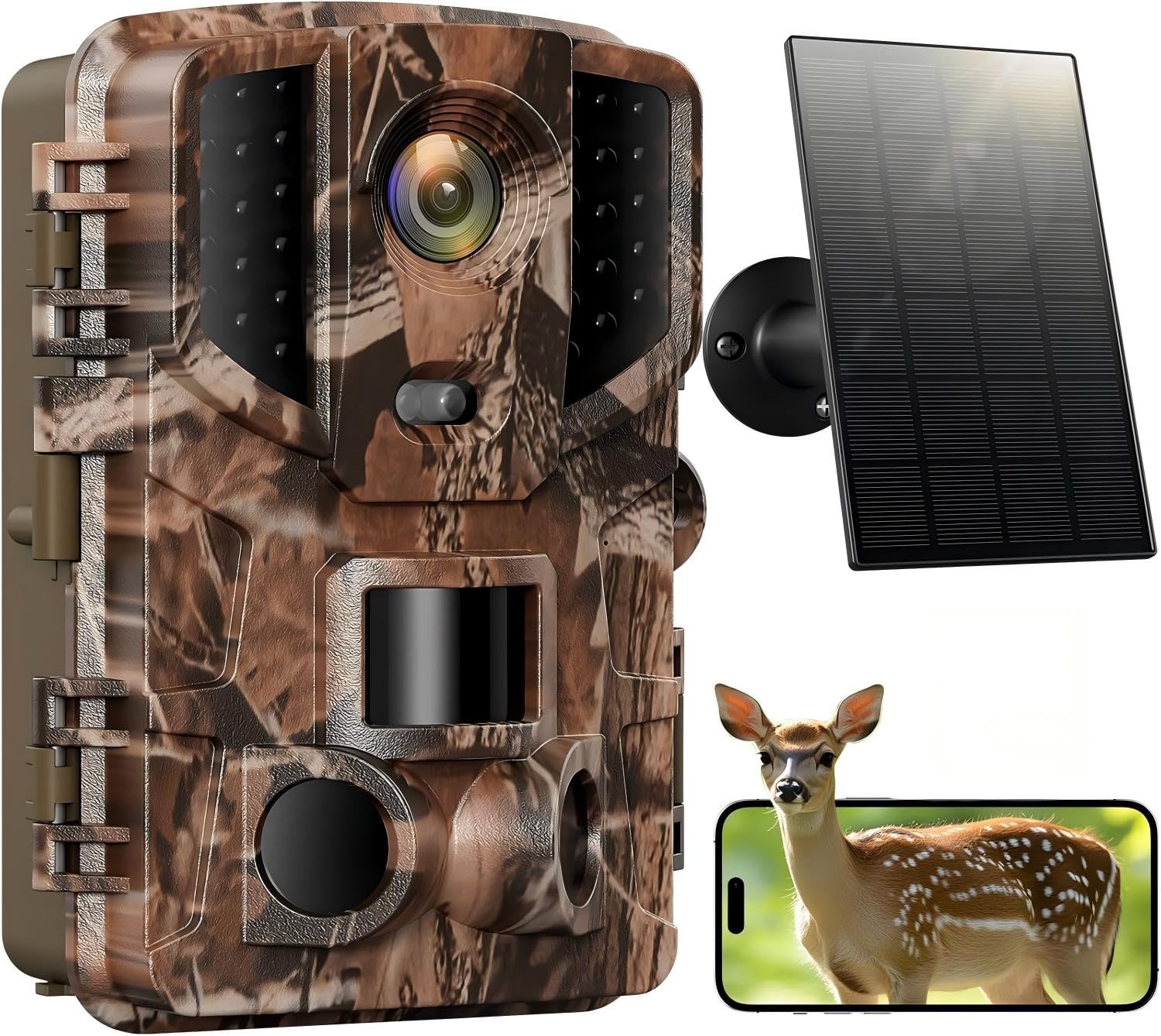
The solar-charging scout that delivers sharp 4K video without the subscription fees.
This trail camera takes the guesswork out of battery management. It packs a built-in 5000mAh rechargeable battery that recharges via the included solar panel, and a backup AA battery pack for cloudy weeks. You get 64MP still images and true 4K video, though one reviewer noted the 4K video appears interpolated and is likely 1080p resolution. The 120° detection angle and a 0.2s trigger speed, with a detection distance up to 75 ft, make it a reliable pick for covering a wide feeding plot or trail intersection.
You get finer detail on distant animals with the Solareye because it captures a 64MP effective still resolution — compared to the OUTDOOR EXPERT camera’s 20MP. (The Assark Solar 48MP supports up to 256GB SD cards, but the Solareye does not.) Buyers report that the solar panel keeps the internal battery charged even on cloudy days, and the app-based settings adjustment is very convenient. The catch is that connection range is about 20-25 feet line-of-sight and the app only works within that hotspot, not through your home Wi-Fi.
Solar Confidence
- Built-in 5000mAh rechargeable battery plus solar panel extends outdoor standby time indefinitely.
- 4-megapixel lens captures 64MP still images and 4K videos.
- Three PIR sensors provide a 120° detection angle and a 0.2s trigger speed with 75ft distance.
- Comes with a pre-installed 32GB SD card, so you can start monitoring immediately.
Signal Range Limits
- Wi-Fi hotpsot connection is limited to roughly 49ft from the camera; no home network or remote viewing.
- One buyer found the 940nm infrared has a faint red glow, contradicting the “no-glow” claim.
- Some users report the trigger is overly sensitive, capturing hundreds of false images from blowing vegetation.
the balance pick: Buy this solar-powered trail camera if you want 4K video quality and need a camera that maintains its battery for months without you having to swap AA cells.
The honest limit: The Wi-Fi range is very short, so plan on physically swapping the SD card or getting close to the camera for any image preview on your phone.
2. MAXDONE Solar Trail Camera WiFi Bluetooth – 4K 64MP

This 0.1s trigger and a massive 5200mAh battery redefine how long you can stay in the field.
Speed is the headline here. The MAXDONE reacts in just 0.1 seconds to motion — the same ultra-fast trigger as the Meidase P70, but wrapped in a solar-charging package. Its built-in 5200mAh rechargeable battery is one of the largest capacities among these picks, and the integrated solar panel means zero battery swaps under normal sun exposure. It captures 64MP still images and smooth 4K video, and uses the latest WiFi 6 technology for a stable built-in hotspot.
Reviewers find the Bluetooth-first setup quick and intuitive, and the solar panel keeps the unit at 100% charge even in partially shaded spots. The camera creates its own WiFi hotspot, meaning you can view and download footage from up to 55ft away. The honest trade-off is the detection angle is narrower at 100° compared to the Solareye’s 120°, so it covers a tighter corridor.
Field-Ready Powerhouse: The 5200mAh battery combined with solar charging eliminates battery cost and replacement trips, making this a truly set-and-forget camera for remote locations. One caveat: It lacks connection to home Wi-Fi or cellular networks, so all remote viewing happens within the 55ft hotspot range.
Reach for this if: You need the fastest possible trigger speed on a cheap solar trail camera and dislike changing batteries. Look elsewhere if: Your setup requires a wider detection angle or you need true 4K video at longer ranges.
3. Meidase P70 Trail Camera, 64MP 1296p
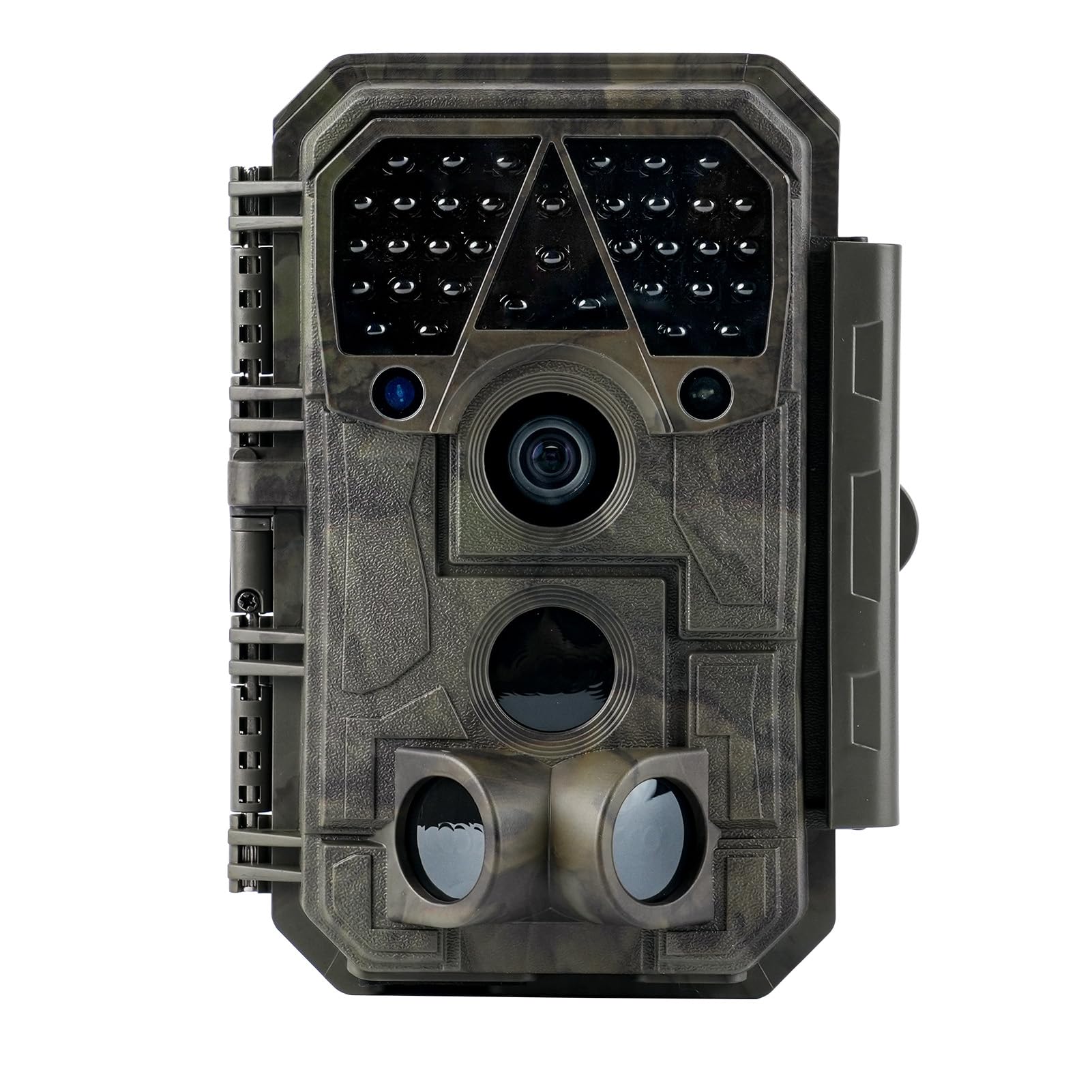
A no-WiFi workhorse with the widest night vision range and the fastest shot in the budget bracket.
The Meidase P70 is for purists who don’t need smartphone connectivity and just want the absolute best trigger speed and night clarity for the money. Its 0.1s trigger speed matches the MAXDONE, but its night vision range stretches to 100ft, beating every other camera here. The 940nm no-glow LEDs mean you get invisible infrared illumination for skittish deer, and the 2.4-inch color display lets you review shots on the spot without an app.
The camera captures 64MP still images and 1296p HD video using an f/1.6 lens aperture. It supports SD cards up to 512GB — compared to the 32GB limit on the OUTDOOR EXPERT. The trade-off is raw: no Wi-Fi, no Bluetooth, no app. You are swapping SD cards or using a USB cable. As one buyer mentioned, “the company recommends Energizer Lithium batteries for best performance”, as rechargeable AA batteries caused issues in tests.
Field Test Wins
- 100ft night vision range with 940nm no-glow LEDs that do not spook animals.
- Solar-ready design when paired with the Meidase SP350 panel, with 8 AA batteries as backup.
- 0.1s trigger speed and an f/1.6 aperture lens for sharp daytime and nighttime capture.
- Supports up to 512GB SD / SDHC / SDXC cards.
Connected Missing
- No Wi-Fi or Bluetooth connectivity at all; you must physically retrieve the SD card to see images.
- Requires 8 AA batteries and an SD card (neither included), increasing initial setup cost.
- One reviewer experienced a battery compartment issue that required contacting customer support.
For the analog hunter: Grab this model if you want the best night reach in this price tier and prefer a wired, simple camera with no apps to manage. Avoid it if: You rely on checking footage from your phone or plan to use rechargeable batteries.
4. XTU 4K 64MP Solar Trail Camera with WiFi & Bluetooth
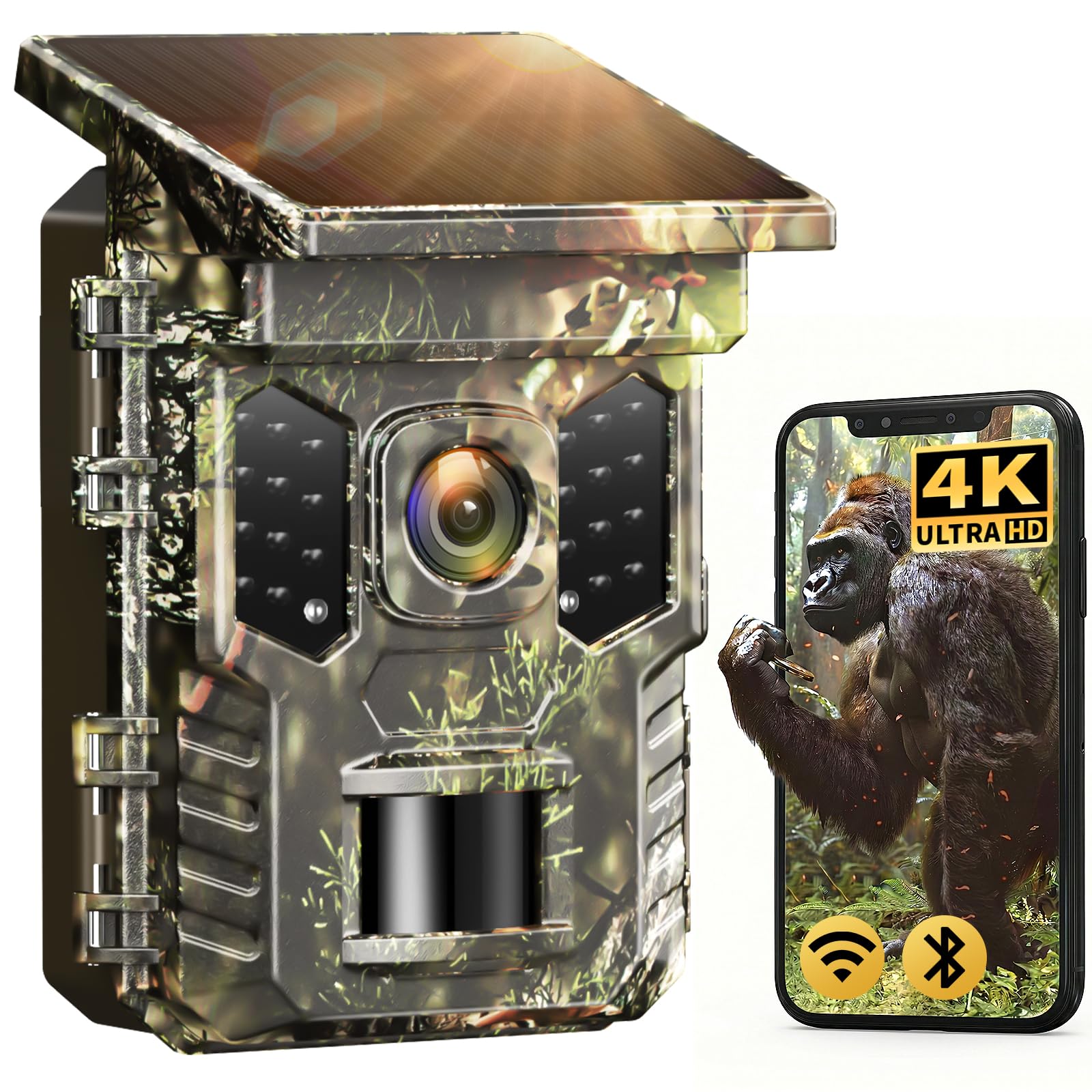
A camouflage solar camera with flexible power backup and Wi-Fi preview for under.
The XTU packs an internal rechargeable battery, solar charging, a USB-C port for quick recharges, and even a 4xAA backup bay for cloud-heavy days. This triple-power approach gives it more flexibility than the MAXDONE or Solareye. It shoots 64MP photos and 4K video, and its 0.2s trigger speed with a 65ft detection range keeps pace with the top picks. The built-in Wi-Fi hotspot works through the “TrailCamGO” app, letting you preview photos from up to 49ft away.
One owner reported that the Wi-Fi connection range is less than advertised and drops out further than 40ft line-of-sight. The camera uses 850nm low-glow infrared LEDs, which produce a faint red glow, so it is not truly “no-glow” like the Meidase P70. The IP66 waterproof housing and camouflage green color make it blend into tree trunks well.
Power flexibility winner: The XTU’s ability to run on solar, USB-C, or AA backup batteries makes it the most versatile pick for deep-woods deployment where consistent sunlight is uncertain. The drawback: The Wi-Fi range is weak and the low-glow IR might alert more sensitive wildlife.
Best for: Anyone placing a trail camera under heavy tree cover who wants the confidence of multiple power sources. Skip if: You need invisible night vision or reliable smartphone connection from a distance.
5. Assark Solar Trail Camera 48MP 30FPS, WiFi Bluetooth

The best bang-for-your-buck solar trail cam with Wi-Fi, a pre-installed card, and proven battery endurance.
The Assark makes the most compelling argument for the budget buyer who wants modern features. It packs a large solar panel, a rechargeable battery, built-in Wi-Fi and Bluetooth for the “TrialCam Go” app, and a pre-installed 32GB micro SD card — meaning you have a fully functional camera right from the start. It captures 48MP still images and 1080P video at 30fps, and its 0.2s trigger speed is competitive with more expensive models. One customer observed that their camera ran for 2 years straight without issues.
But there is a clear trade-off: one user highlighted “a twig got in front of the sensor and was shaking” and the camera took over 2,000 videos in 2.5 days, draining the battery. The solar panel was able to keep up, but it shows the sensor is sensitive to false triggers.
Ready from the start
- Comes with a pre-installed 32GB micro SD card, solar panel, and all mounting accessories.
- Wi-Fi and Bluetooth app connectivity for live preview and settings changes on your phone.
- Supports up to 256GB micro SD memory cards.
- One reviewer achieved 30 days of battery life without the solar panel, and indefinite life with it.
False Trigger Trap
- The PIR sensor can be triggered by moving branches or grass, leading to thousands of empty videos if placed poorly.
- Image quality is 48MP at best, lower than the 64MP models from Solareye and MAXDONE.
- Wi-Fi connection range is roughly 45ft and does not connect to home Wi-Fi.
Our budget top pick: Buy the Assark if you want the most complete package — solar, Wi-Fi, and a memory card included — at a low price point. Avoid if: You need invisible night vision or are placing the camera in an area with lots of wind-blown vegetation.
6. Punvoe Trail Camera 2 Pack 36 MP 2.7K

Two trail cameras and all the accessories for the price of one premium unit.
The Punvoe 2-Pack is the value king for covering multiple spots without doubling your spend. Each camera captures 36MP still images and 2.7K video, with 22 pieces of 850nm low-glow infrared LEDs for night visibility. The 0.2s trigger speed and 130° detection angle give it a slightly wider field than the Solareye. The 2.0-inch color screen and TV remote-style buttons make setup intuitive.
The kit includes two 32GB memory cards and 8 AA batteries, everything you need to start running both cameras. That is a clear advantage over the Meidase P70 which ships without batteries or an SD card. A reviewer noted that the included memory cards and batteries are lower quality and may fail quickly, so budget for replacements. It lacks Wi-Fi or app connectivity, so you will need to retrieve SD cards.
Double the coverage: At this price, getting two cameras with included cards and batteries makes the Punvoe the most economical pick for monitoring both a feeding station and a trail crossing. The compromise: No wireless viewing, no solar charging, and the pre-included accessories are not built to last.
Go for this if: You own a property and want to monitor 2+ locations immediately without buying extra accessories. Pass on it if: You prefer a solar setup or need to see images on your phone without leaving the house.
7. OUTDOOR EXPERT Game Camera 20MP Mini

The tiny, no-frills camera that fits in a cup for discreet security monitoring.
The OUTDOOR EXPERT Mini is the absolute cheapest way to get a working trail camera with no-glow 940nm night vision. It is half the size of most cameras here, making it easier to conceal. It captures 20MP still images and 1080P video, and its 80ft illumination range and 120° field of view are respectable for the price. The 940nm no-glow flash is invisible to animals and humans, making it a popular choice for co-opting as a security camera.
Reviewers report that battery life lasts months on 6 AA batteries. However, a serious durability issue emerged: one shopper added “the battery door hinge broke after a week (design flaw).” Another reviewer had a unit that died completely after the first power-on. The camera supports SD cards up to 32GB, the lowest limit in this comparison, and does not support Wi-Fi or app control.
Ultra-Discreet Monitoring
- Mini form factor makes it easy to conceal — one reviewer used it inside a cup for covert surveillance.
- 940nm no-glow infrared flash is invisible, ensuring it won’t spook wildlife.
- IP66 waterproof and dustproof case rated to survive harsh outdoor conditions.
- Remarkable battery endurance, with one owner reporting months of use on a single set.
Reliability Concerns
- Multiple owners mention the battery door hinge breaks after minimal use.
- Lowest image resolution in the lineup (20MP) and tops out at 32GB SD cards.
- One unit arrived dead on arrival, and another reviewer’s camera stopped turning on after initial setup.
For the truly tight budget: Consider this model only if you need an invisible, portable camera and you are willing to risk the known hinge durability issue.
Understanding the Specs
Trigger Speed (Measured in Seconds)
This is the time it takes for the camera to snap a photo after detecting motion. A 0.2-second trigger speed means from the moment an animal crosses the sensor, you have that photo within a fifth of a second. A 0.1-second trigger, found on the Meidase P70 and MAXDONE (versus the typical 0.2-second trigger), catches deer mid-stride rather than capturing a blur or an empty frame. For fast-moving animals, a faster trigger means fewer missed shots.
No-Glow vs Low-Glow Infrared (940nm vs 850nm)
This spec describes the wavelength of the infrared LEDs used for night vision. No-glow infrared (940nm) emits light invisible to both humans and animals, making the camera truly discreet — ideal for skittish game like deer. Low-glow infrared (850nm) emits a faint red light that some animals may notice, but it typically produces a slightly brighter night image with more detail. The right choice depends on how wary the wildlife is in your area; for security monitoring of humans, low-glow is usually fine.
FAQ
What is the best cheap trail camera for night image quality?
Do cheap trail cameras work with home Wi-Fi?
How long do AA batteries last in a budget trail camera?
What does IP66 waterproof mean for a trail camera?
What is the difference between a 20MP and a 64MP trail camera in real use?
Which budget trail camera has the fastest trigger speed?
Can I use rechargeable AA batteries in these cameras?
What is the maximum SD card size I need?
Do all budget trail cameras have a visible red glow at night?
Which cheap trail camera comes with everything needed to start?
Final Thoughts: The Verdict
Across the board, the cheap trail camera winner is the Solareye 4K Solar because it combines reliable solar charging, 4K video, a 64MP photo resolution, and a useful Wi-Fi preview feature at a mid-range price. If you want the absolute fastest trigger and the best night range, grab the Meidase P70. And for the best overall value with Wi-Fi and a pre-installed SD card, the Assark Solar 48MP is the budget champ that punches well above its weight.
How We Picked
We do not accept paid placement. Every pick is matched to a real buyer and a real use-case; we do not hands-on test units.
Sources & Methodology
Specifications: manufacturer listings and product documentation. Review insights: verified customer reviews, as of July 2026. Pricing: not shown on this page (it changes often); check the current price via the retailer link.
As an Amazon Associate, WellFizz earns from qualifying purchases. This does not affect which products we feature.
Related Guides

Mo Maruf
I created WellFizz to bridge the gap between vague wellness advice and actionable solutions. My mission is simple: to decode the research and give you practical tools you can actually use.
Beyond the data, I am a passionate traveler. I believe that stepping away from the screen to explore new environments is essential for mental clarity and physical vitality.