Our readers keep the lights on and my smoothie glass nicely filled. As an Amazon Associate, I earn from qualifying purchases.
Scouring the market for an affordable entry-level refractor often leads to a sea of plastic mounts and undersized objective lenses that frustrate more than they inspire. The difference between a cheap telescope that delivers crisp lunar craters and one that collects dust in a closet comes down to just a few critical specs—aperture diameter, coating quality, and mount stability.
I’m Mohammad Maruf — the founder and writer behind WellFizz. My research involves cross-referencing dozens of optical specifications, reading through hundreds of verified buyer experiences, and filtering out the models that genuinely reward a beginner’s curiosity without demanding a budget upgrade.
After comparing seven models across multiple tiers, the best cheap telescope balances a wide 80mm or 90mm objective lens, reliable fully-coated optics, and a stable tripod that doesn’t wobble with every breeze.
How To Choose The Best Cheap Telescope
Every budget refractor claims high magnification, but the real determinant of usable performance is light-gathering ability and mechanical stability. Here are the three specs that separate a rewarding first scope from a disappointment.
Aperture Size: The True Light Bucket
The objective lens diameter, measured in millimeters, is the single most important spec. A 70mm aperture gathers enough light for clear lunar views and the four largest moons of Jupiter, while an 80mm or 90mm aperture reveals finer crater details and brighter images of Saturn’s rings. Ignore the advertised maximum magnification—aperture determines what you can actually see.
Optical Coatings: Fully-Coated vs. Bare Glass
Full multi-coatings on the glass lenses reduce internal reflections and increase light transmission, resulting in sharper contrast and less glare around bright objects like the Moon. Entry-level scopes often use single-coated or uncoated glass. Always check the specifications for “fully coated” or “fully multi-coated” to ensure acceptable image quality.
Mount and Tripod Stability
A sturdy mount prevents vibration and image shake at higher magnifications. Lightweight aluminum tripods with thin legs tend to wobble when you focus or in a slight breeze. Look for stainless steel legs or reinforced aluminum, and a mount head that locks securely without slippage. A stable base makes the difference between seeing fine lunar detail and a blurry mess.
Quick Comparison
On smaller screens, swipe sideways to see the full table.
| Model | Category | Best For | Key Spec | Amazon |
|---|---|---|---|---|
| YENGUAN 90800 | Premium Refractor | Most detailed lunar views under budget | 90mm aperture / 800mm FL | Amazon |
| MEEZAA 90mm | Premium Refractor | Stable stainless tripod + high mag range | 90mm aperture / 240X max mag | Amazon |
| Dianfan 90×800 | Premium Refractor | Complete kit with stable stainless tripod | 90mm aperture / 32-240X | Amazon |
| Celestron Travel Scope 70 | Mid-Range Refractor | Trusted brand for portable travel | 70mm aperture / 400mm FL | Amazon |
| Gskyer 70mm | Mid-Range Refractor | Wireless remote for smartphone astrophotography | 70mm aperture / 400mm FL | Amazon |
| Hawkko 80500 | Budget Refractor | Best entry-level value with stickers | 80mm aperture / 500mm FL | Amazon |
| Dianfan 80×500 | Budget Refractor | Purple design with backpack | 80mm aperture / 500mm FL | Amazon |
In‑Depth Reviews
1. YENGUAN 90800 Telescope
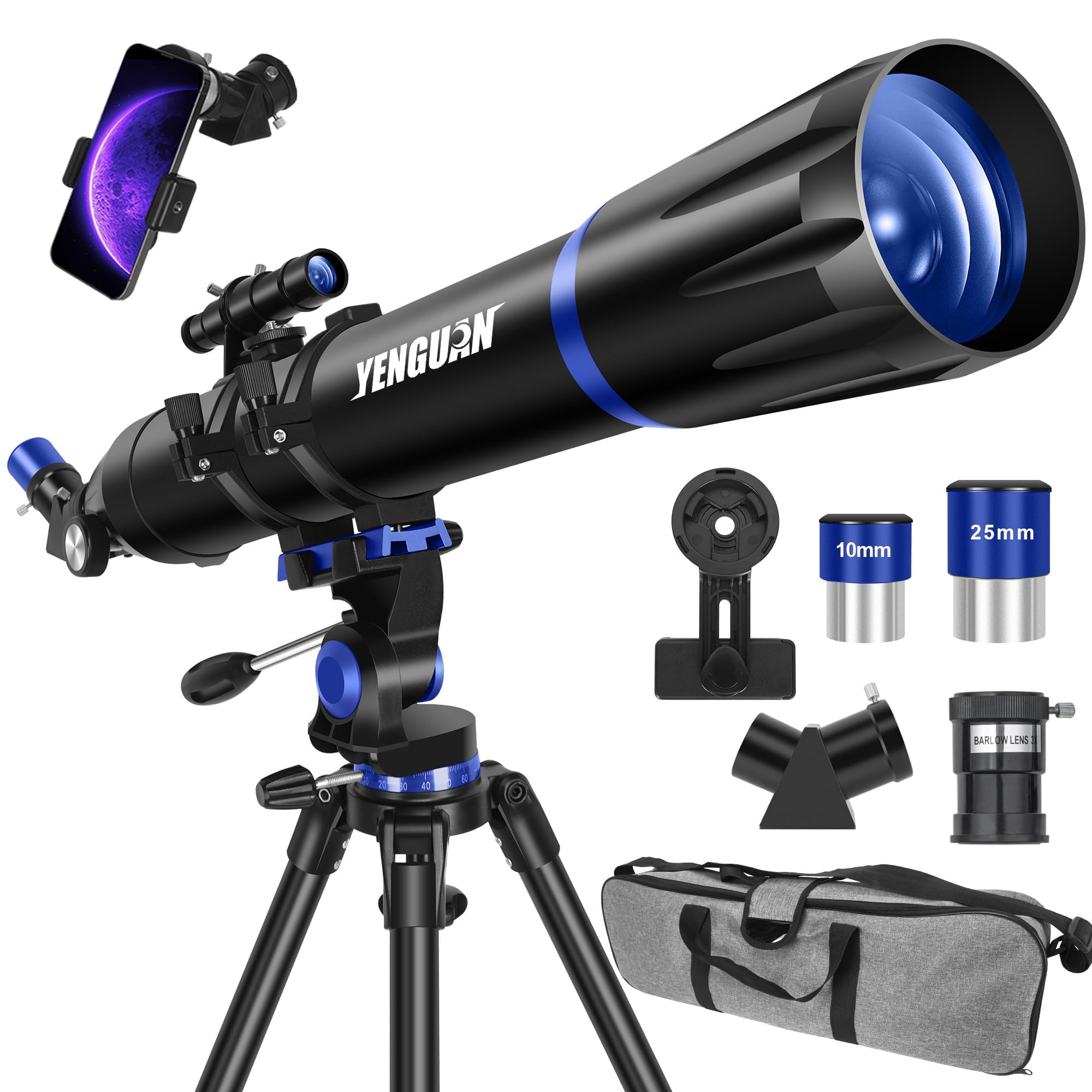
The YENGUAN 90800 stands out in this price range because its 90mm objective lens gathers significantly more light than the common 70mm models, revealing fine lunar crater textures and showing Jupiter’s cloud bands with respectable clarity. The 800mm focal length provides a nice balance between moderate magnification and a forgiving field of view for beginners learning to aim.
Setup requires no tools, and the included 25mm and 10mm Kellner eyepieces plus a 3X Barlow lens allow you to step through magnifications without buying extras immediately. The stainless steel tripod, while not heavy-duty, offers enough rigidity to keep the image steady during focusing at 120X.
The straight-through finderscope and smartphone adapter are basic but functional. A few users reported confusion with the lens cap left on, so double-check that before assuming a defect. The carry bag adds genuine portability for park or backyard sessions.
Why it’s great
- Best-in-class 90mm aperture captures finer lunar and planetary detail
- Tool-free assembly; stainless steel tripod reduces image shake
- Complete accessory kit includes Barlow lens, phone adapter, and carry bag
Good to know
- Fixed focus tube design; no fine-focus knob for micro adjustments
- Straight-through finder can be awkward for overhead targets
- Some units may require collimation out of the box
2. MEEZAA 90mm Telescope

The MEEZAA 90mm refractor shares the same aperture class as the YENGUAN but packs a few extra refinements. The stainless steel tripod adjusts from 28 to 46 inches, accommodating both seated adults and shorter users. Fully multi-coated glass delivers bright, contrast-rich views of the Moon’s surface and resolves Saturn’s ring separation.
With two Kellner eyepieces (25mm and 10mm) plus a 3X Barlow lens, the magnification range spans from 32X to 240X. In practice, the top end is usable only on nights of excellent atmospheric stability, but the 80X to 120X sweet spot is where this scope shines—showing Jupiter’s four Galilean moons and subtle bands.
The 45-degree erect image diagonal is a nice touch for daytime terrestrial viewing, saving you from buying an additional prism later. Most users report assembly in about 10 minutes, and the included carry bag holds everything neatly. The phone adapter works well enough for sharing quick shots of the Moon.
Why it’s great
- Taller adjustable stainless tripod suits different user heights
- Fully multi-coated optics minimize glare and boost contrast
- Quick 10-minute assembly with illustrated manual
Good to know
- Straight-through finder can be fiddly to align accurately
- Barlow lens extends focal ratio, making the image dimmer at 240X
- No fine-focus knob; rack-and-pinion focuser feels basic
3. Dianfan 90×800 Telescope

The Dianfan 90×800 is a direct competitor to the previous two 90mm models, with the same core optical specs but a focus on build refinement. The stainless steel tripod feels noticeably more resistant to vibration than budget aluminum counterparts, which matters at 150X when even a light touch on the focuser causes jitter.
Its 45-degree erect-image diagonal delivers properly oriented views both day and night, and the dual eyepieces plus 3X Barlow offer the same 32X to 240X range. The 90mm objective resolves the Cassini Division in Saturn’s rings under steady skies—a feat many 70mm scopes cannot accomplish even with perfect alignment.
The included backpack is padded and roomy enough for the tube, tripod, and all accessories. Assembly takes roughly 15 minutes, and the instructions are straightforward. A few experienced users noted the focuser can feel slightly stiff out of the box, but it smooths with use.
Why it’s great
- Stainless steel tripod provides excellent stability at high magnification
- 45-degree diagonal allows comfortable daytime and celestial viewing
- Good resolution shows Saturn’s ring division on clear nights
Good to know
- Focuser can be tight initially and requires break-in
- Straight-through finderscope is basic and benefits from replacement
- Phone adapter works but may not center perfectly on all devices
4. Celestron Travel Scope 70
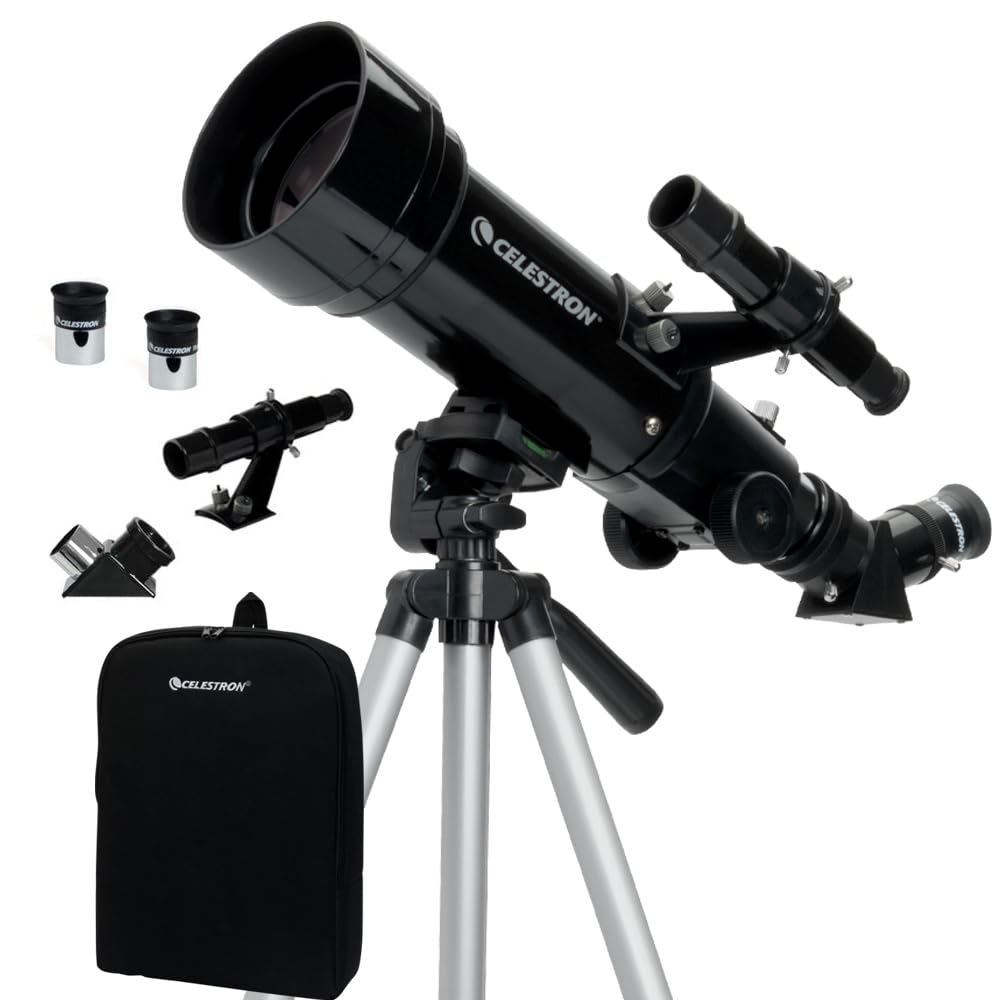
The Celestron Travel Scope 70 is the most portable option in this lineup, with a 70mm aperture and 400mm focal length that collapses into a padded backpack. Its strength is convenience—the scope sets up in seconds with no tools, making it ideal for camping trips, hikes, or quick backyard sessions where you want viewing without the setup ritual.
The fully coated glass delivers acceptable brightness for the Moon and bright planets. You’ll see lunar craters, the phases of Venus, and Jupiter’s four largest moons as pinpoints. Saturn’s rings appear as a thin oval, but the limited 70mm aperture means finer details remain elusive compared to 80mm and 90mm scopes.
Included 20mm and 10mm eyepieces give 20X and 40X respectively, and the Starry Night software download helps beginners learn the sky. The tripod is lightweight and can feel shaky at full extension; many users recommend setting it up on a picnic table at its shortest height for a steadier view.
Why it’s great
- Ultra-portable design with dedicated backpack for travel
- Trusted Celestron brand with 2-year warranty and US support
- Quick tool-free setup ideal for kids and absolute beginners
Good to know
- 70mm aperture limits planetary detail compared to 80/90mm models
- Included tripod is wobbly at full extension; use low or add weight
- 45-degree diagonal is inconvenient for high-altitude astronomy viewing
5. Gskyer 70mm Telescope

The Gskyer 70mm refractor competes directly with the Celestron Travel Scope but adds a wireless camera remote, making it easier to snap smartphone astrophotos without touching the phone and introducing shake. The 400mm focal length and 70mm aperture follow the same optical formula—good for lunar craters and bright planets, limited on deep-sky objects.
The tripod is a standard aluminum alloy model with adjustable height, but its legs are slightly sturdier than the Celestron’s. The 5×24 finderscope with crosshairs helps with target acquisition, though it requires careful alignment during setup. Users report that the 3X Barlow lens pushes magnification high enough to see Jupiter’s bands under stable conditions.
The wireless remote pairs easily with most smartphones and is a genuine advantage for anyone interested in astrophotography on a budget. The included carry bag fits all components, and assembly takes under 15 minutes. A common tip from owners is to use the 20mm eyepiece first for easy finding, then switch to the 10mm for closer inspection.
Why it’s great
- Wireless remote prevents camera shake during smartphone astrophotography
- Slightly sturdier tripod than similar 70mm travel scopes
- Includes 3X Barlow lens and two eyepieces for varied magnification
Good to know
- 70mm aperture limits viewable detail on fainter deep-sky objects
- Short tripod may require bending or a small table for comfortable use
- Finderscope needs meticulous alignment to be useful
6. Hawkko 80500 Telescope
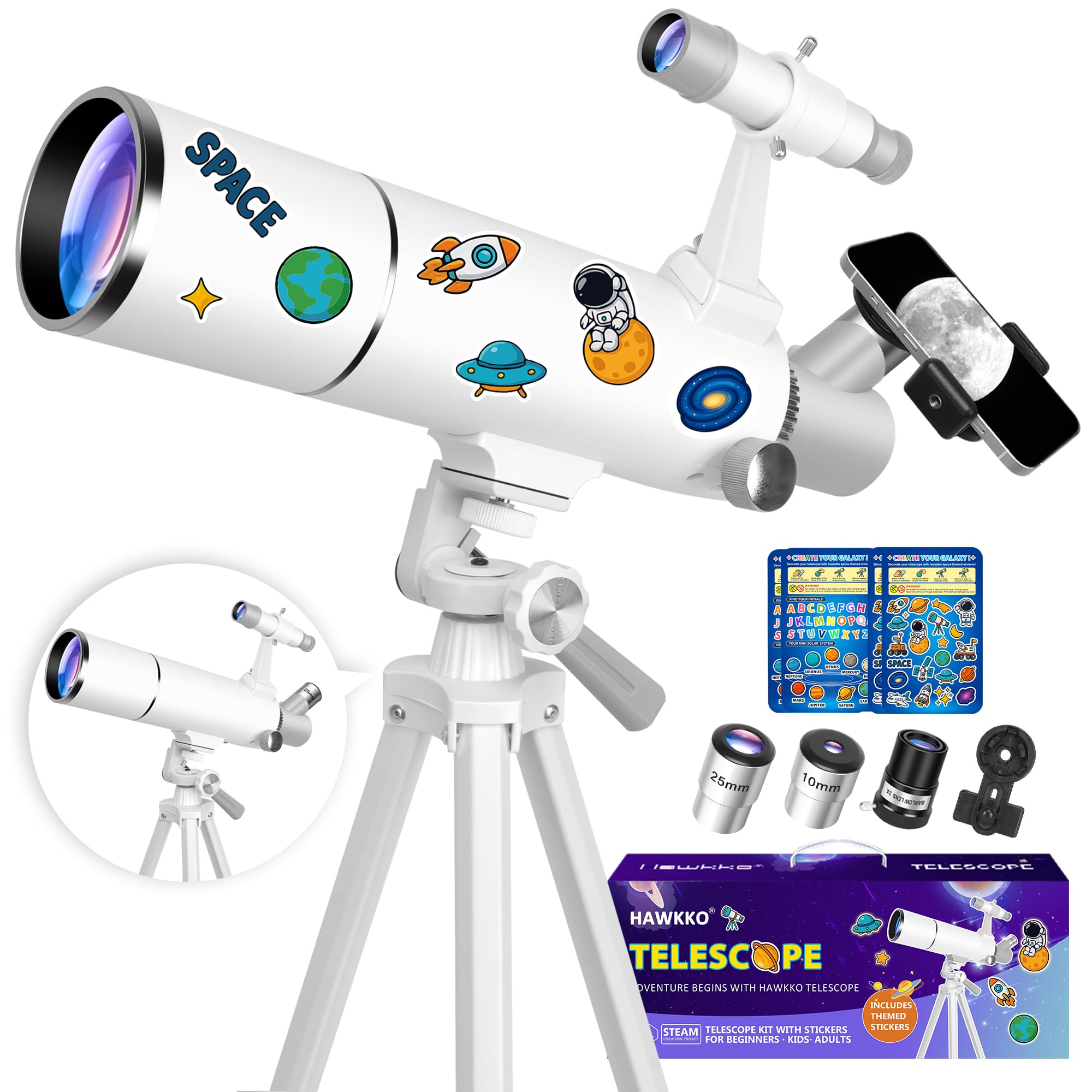
The Hawkko 80500 is a standout budget option because it offers an 80mm aperture at an entry-level price point—something many sub- scopes skip. The 80mm objective gathers roughly 30% more light than a 70mm, translating to brighter lunar views and the ability to spot Jupiter’s moons without struggling. The 500mm focal length keeps the tube short and portable.
Two Kellner eyepieces (25mm and 10mm) plus a 3X Barlow lens provide magnifications from 20X to 150X. The altazimuth mount is basic but functional for casual observing, and the lightweight aluminum tripod is adequate for low-wind conditions. Setup is genuinely tool-free and takes just a few minutes.
The included decorative stickers are a clever touch for engaging younger users, and the phone adapter captures decent Moon shots. The straight-through finderscope is simple but effective once aligned. At this price, the Hawkko delivers the most aperture per dollar, making it the smart choice for families testing the waters.
Why it’s great
- 80mm aperture at an entry-level price—best light-gathering in this tier
- Tool-free assembly; includes phone adapter and decorative stickers
- Versatile 20X-150X magnification range covers lunar and terrestrial viewing
Good to know
- Lightweight tripod is prone to wobble in breezy conditions
- Basic altazimuth mount lacks slow-motion controls for fine tracking
- Straight-through finder requires neck craning for overhead objects
7. Dianfan 80×500 Telescope
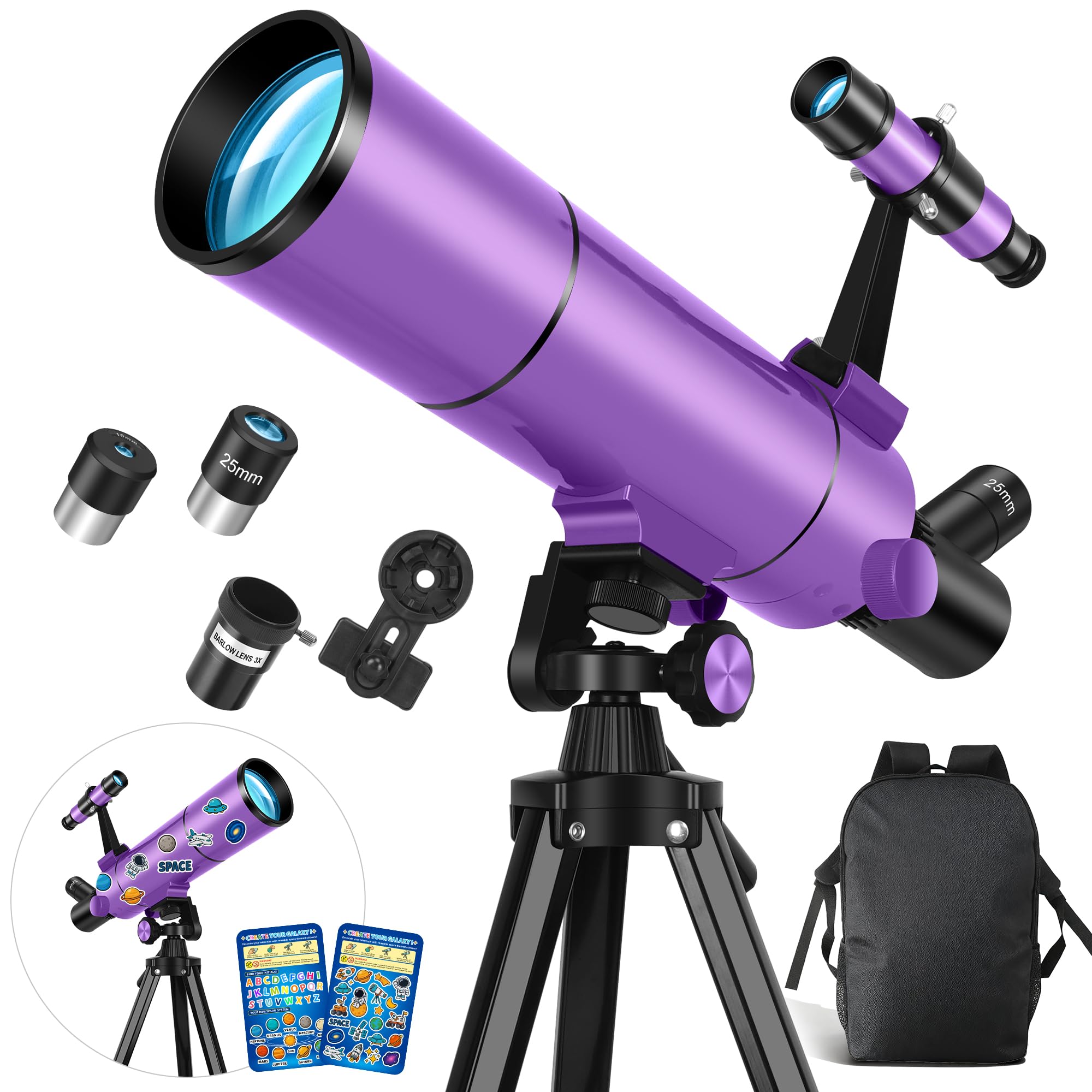
The Dianfan 80×500 matches the Hawkko’s 80mm aperture but adds a distinctive purple finish and reusable astronomy-themed stickers, making it especially appealing for younger beginners who want a personalized instrument. Optically, the fully coated 80mm objective and 500mm focal length deliver the same light-gathering advantage over 70mm scopes.
The included backpack is water-resistant and custom-fit, holding the tube, tripod, eyepieces, and phone adapter securely. The 10mm and 25mm Kellner eyepieces combined with the 3X Barlow yield 20X to 150X magnification. Lunar craters appear sharp, and Jupiter’s moons resolve well even at the lower end of the range.
Setup runs about 15 minutes with the illustrated manual. The altazimuth mount is smooth enough for casual tracking, and the phone adapter clips on firmly without slipping. The finderscope is identical to other budget models—proper alignment is required. This kit is best suited for families who value aesthetics and portability alongside performance.
Why it’s great
- 80mm aperture with fully coated optics for bright, clear images
- Eye-catching purple design with reusable stickers for personalization
- Includes water-resistant backpack for organized transport and storage
Good to know
- Lightweight tripod limits stability at higher magnifications
- Basic mount lacks precision slow-motion controls
- Finderscope requires careful alignment out of the box
FAQ
Is a 70mm aperture telescope enough for a beginner?
What does fully coated optics mean on a cheap telescope?
Why does the tripod matter so much for a cheap telescope?
Final Thoughts: The Verdict
For most users, the best cheap telescope winner is the YENGUAN 90800 because it combines a 90mm aperture with a stable stainless tripod and a complete accessory kit at a mid-range price—delivering the clearest lunar and planetary views without demanding a significant upgrade. If you want maximum portability and the trusted Celestron brand, grab the Celestron Travel Scope 70. And for an entry-level model that stretches your dollar to an 80mm aperture, nothing beats the Hawkko 80500.

Mo Maruf
I created WellFizz to bridge the gap between vague wellness advice and actionable solutions. My mission is simple: to decode the research and give you practical tools you can actually use.
Beyond the data, I am a passionate traveler. I believe that stepping away from the screen to explore new environments is essential for mental clarity and physical vitality.