You want clear stereo sound for music, movies, and games, but you do not want to spend a fortune. A pair of speakers with crisp vocals and punchy bass is possible on a tight budget — the hard part is knowing which specs separate a great bargain from a waste of money.
I’m Mohammad Maruf — the co-founder and writer behind WellFizz. This guide is built by comparing the manufacturers’ published specifications and the patterns across verified customer reviews, so you get each pick’s real strengths and trade-offs instead of marketing spin.
My goal here is to cut through the noise and give you a clear, honest look at the five best options for cheap stereo speakers that genuinely balance price, sound quality, and real-world usability for your home setup.
How To Choose The Best Cheap Stereo Speakers
Buying budget speakers is a minefield of hidden requirements and confusing tech terms. Here is what you actually need to check before clicking “add to cart.”
Passive vs. Powered
This is the single biggest fork in the road. Passive speakers require a separate amplifier or AV receiver (a device that boosts the audio signal) to power them — think of the amp as the engine and the speakers as the wheels. Powered speakers have that engine built right in, so you can plug your phone, TV, or turntable directly into them. Passive setups give you more upgrade flexibility and usually better sound per dollar, but you must account for the cost of an amplifier. Powered options are simpler and take up less space, but you are stuck with whatever amplifier is inside the box.
Woofer Size and Bass
The woofer (the larger cone that handles lower frequencies) is what produces bass. A bigger woofer moves more air, which gives you deeper and punchier low-end sound. As a rule, a 4-inch woofer can reach lower into the bass range than a 2.75-inch or 3-inch woofer. If you love action movies, hip-hop, or electronic music, you want the largest woofer your budget allows — or plan to add a separate subwoofer later.
Impedance and Power Handling
Impedance, measured in ohms, is how much electrical resistance the speaker offers to the amplifier. An 8-ohm speaker is a standard load that almost any amp or receiver can drive safely, while a 4-ohm or 6-ohm speaker demands more current from the amp and may cause issues with lower-end receivers. Power handling, measured in watts, tells you how much juice the speaker can take before distorting or damaging itself. Always match your amplifier’s output to the speaker’s recommended power range for clean sound.
Connectivity and Placement
Think about how you will use the speakers before you buy. Do you want to stream music wirelessly from your phone? Then look for built-in Bluetooth connectivity (powered speakers usually offer this; passive speakers never do). Are you placing them on a desk, a bookshelf, or mounting them on a wall? Check that the speakers include keyhole mounts or brackets if you plan to hang them. And always measure your space — a speaker that sounds incredible in a store may overpower a small bedroom or get swallowed in a large living room.
Quick Comparison
On smaller screens, swipe sideways to see the full table.
| Model | Category | Best For | Key Spec | Amazon |
|---|---|---|---|---|
| RIOWOIS Powered Bluetooth Bookshelf Speakers | Powered | Plug-and-play with Bluetooth | 40W total power | Amazon |
| Saiyin Passive Bookshelf Speakers | Passive | Deep bass in small rooms | 3.5-inch woofer | Amazon |
| SINGING WOOD T25 | Passive | Full-range home theater | 4-inch woofer | Amazon |
| Acoustic Audio by Goldwood AA351B | Passive | Indoor/outdoor durability | 500W peak power | Amazon |
| RIOWOIS Passive Bookshelf Speakers | Passive | Compact surround setup | 30W peak power | Amazon |
In‑Depth Reviews
1. RIOWOIS Powered Bluetooth Bookshelf Speakers

The 40W built-in amplifier makes the RIOWOIS Powered Bluetooth Bookshelf Speakers the top pick for anyone who wants a complete stereo system without buying a separate receiver or amplifier. You do not need an amplifier, receiver, or any extra gear at all to get good stereo sound from this pick — you can plug a turntable, TV, phone, or computer directly into them, making them the simplest path to clear sound without a learning curve.
Wireless streaming works through Bluetooth 5.3 (the latest version of short-range wireless audio) from any smart device, and for wired connections you get optical, AUX (standard headphone jack), and TV-ARC (Audio Return Channel, which lets a TV send sound back through an HDMI-like cable). Reviewers report that midrange clarity is exceptional for the price and that the speakers pair well with a subwoofer for deeper bass. The cabinet is reinforced MDF (medium-density fiberboard, a dense wood-like material) that reduces vibrations that can muddy the sound.
The honest limit: maximum volume is not wall-shaking. This is best for near-field listening on a desk, in a small bedroom, or as a small TV upgrade. If you want a clutter-free setup where you just unbox and listen, this is your speaker. skip it if you already own a good amplifier and want to spend less on just the speakers — for a clutter-free setup where you just unbox and listen, this is your speaker.
Why it’s great
- No amplifier or receiver needed — truly plug-and-play
- Bluetooth 5.3 streaming from any device
- Optical and TV-ARC inputs for easy TV connection
Good to know
- Limited maximum volume; not for large rooms
- Optical cable and ARC cable not included
2. Saiyin Passive Bookshelf Speakers

Compared to the compact RIOWOIS passive speakers, the Saiyin brings noticeably more bass thanks to a larger 3.5-inch woofer — 27% more cone area — that reaches down to 60Hz (60 vibrations per second), low enough to feel rumble in action movies and warmth in acoustic bass. But unlike the RIOWOIS powered speakers, these are passive: you must have an amplifier or receiver to drive them.
Where the Saiyin really shines is soundstage and imaging (the ability to place instruments and voices in a three-dimensional space). One reviewer, who also owns a Bowers & Wilkins 700 series system, called these “excellent desktop passive speakers,” noting their great finish and sound quality at low volumes. The silk horn tweeter (a small driver that handles high frequencies, made from woven silk for smooth sound) keeps vocals and high notes clear without harshness, while the custom-tuned woofer delivers tight, controlled low-end.
Buyers report a flat in-room response (even output across all frequencies) from 80Hz to 4kHz, so vocals and main instruments sound natural without artificial boosting. You will want a little EQ (equalization, or tone adjustment) above 4kHz to tame the silk tweeter’s rise. Choose these over the top pick if you already own an amplifier and want deeper bass from a passive speaker at this price. Skip them if you do not have an amp and want a ready-to-use system.
Where it shines
- 3.5-inch woofer delivers bass down to 60Hz
- Silk horn tweeter for smooth, detailed highs
- Excellent soundstage and imaging for the price
Worth noting
- Requires an external amplifier or receiver
- Cabinet resonances at higher volumes
3. SINGING WOOD T25 Passive Bookshelf Speakers
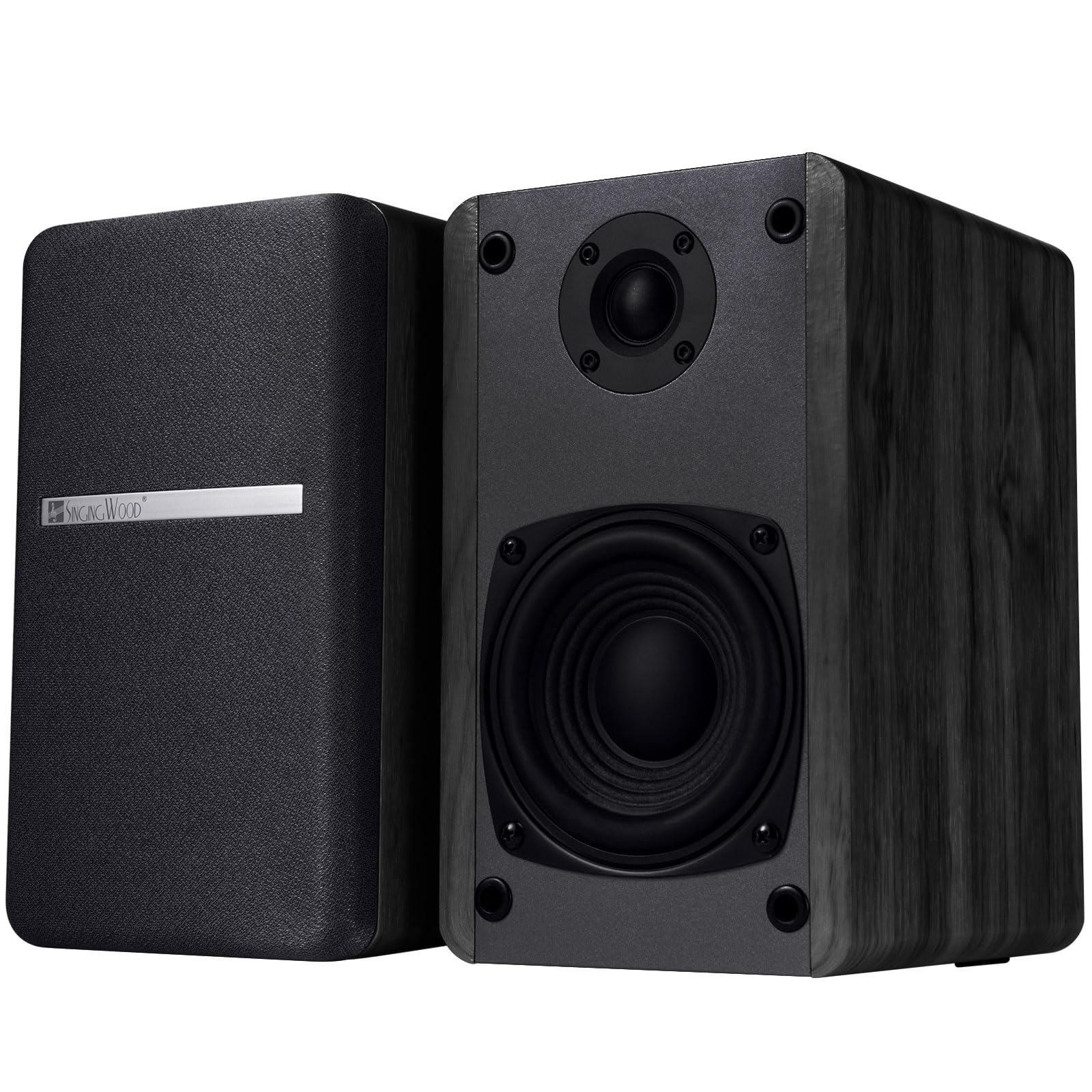
You are setting up a living-room stereo and want speakers that can actually produce some bass without a subwoofer. The SINGING WOOD T25 is the only model in this guide with a true 4-inch woofer (10.2 cm), which delivers noticeably deeper and punchier low-end than the 3.5-inch or 2.75-inch competitors — one reviewer noted that these filled a 20-by-10-foot kitchen with clear sound using a low-cost receiver.
The 0.75-inch silk dome tweeter handles high frequencies with smooth treble, avoiding the harsh edge that cheaper metal tweeters can produce. These speakers handle 60W total (30W per channel), and the MDF wooden enclosure minimizes acoustic resonance that can muddy the sound. Multiple reviewers praised the build quality, with one noting the wood finish “looks fabulous” and that the terminals accept both banana plugs and bare speaker wire easily.
The catch: these still need a separate amplifier or receiver, and some buyers noted that while the bass is good for such a small woofer, you will still want a subwoofer for really deep low-end extension. For anyone building a budget home theater or a desktop system with a receiver they already own, the SINGING WOOD T25 delivers the most bass for your dollar. Skip them if you cannot fit an amplifier into your budget or your space — but if you can, no other speaker at this price punches deeper.
What stands out
- 4-inch woofer delivers the deepest bass in this lineup
- Silk dome tweeter for smooth, non-fatiguing highs
- Accepts banana plugs and bare wire for easy connection
The trade-offs
- Requires an external amplifier or receiver
- May need a subwoofer for true deep bass extension
4. Acoustic Audio by Goldwood AA351B

89dB sensitivity—the single number that matters most for getting loud without a powerhouse receiver—and this speaker scores it exactly, matching the average for this category. On paper, these look like they could blow the doors off. For outdoor patios, garages, and pool areas, the Acoustic Audio by Goldwood AA351B delivers loud, clear sound without distortion, according to multiple verified buyers.
The downside is that you trade refined audio quality for raw output and weather resistance. These use 3-inch Poly Mica woofers (cone material made from mica-filled polypropylene for stiffness) with butyl rubber surrounds (a synthetic rubber that resists cracking in sun and cold), which means they handle rain, snow, and sun without degrading. The sealed ABS (acrylonitrile butadiene styrene, a tough plastic) cabinets keep moisture out. The 8-ohm impedance is a safe standard load for any amplifier, and the 89dB sensitivity (sound pressure level at one watt, one meter away) means they get loud without needing a powerhouse receiver.
Owners mention these are “compact speakers with strong performance” ideal for office music and video calls, but a few buyers reported quality control issues, including buzzing and rattling right out of the box. If your priority is weatherproof, install-and-forget speakers for a covered patio or workshop, the Goldwood AA351B is the only choice here that handles the elements. Skip them if you want pristine indoor audio and can live with a non-weatherproof speaker—the price-to-value read is that you pay for ruggedness, not refinement.
The upsides
- Weatherproof ABS sealed cabinets for outdoor use
- 500W peak power handling for loud playback
- 89dB sensitivity means efficient use of amplifier power
Keep in mind
- Sporadic quality control — some units arrive with buzzing
- Requires a separate amplifier or receiver
5. RIOWOIS Passive Bookshelf Speakers

At this entry-level price, you get a functional pair of passive bookshelf speakers with a 2.75-inch woofer and a 2-inch tweeter that can handle 30W peak power — enough to serve as surround speakers in a home theater or as a compact stereo pair for small rooms. One buyer called the 4-inch model an “excellent budget speaker for small rooms,” praising the surprising bass for its tiny size.
What you give up: the build quality is not premium — customers note wrinkled vinyl finishes and cheap spring terminals (connectors where you press a spring clip to insert bare wire) that do not accept banana plugs. The 6-ohm impedance means your amplifier needs to handle a slightly heavier load than standard 8-ohm speakers, so pair these with a decent receiver, not a cheap mini amp. The wall-mount kit is included, though some users found the keyhole bracket incompatible with standard Sanus mounts.
These are perfect if you need extremely small, wall-mountable satellite speakers for a budget surround sound system and you already own a receiver that can handle the 6-ohm impedance. At this price, they are a functional entry point rather than a sonic statement — a true budget option for those who need a speaker, not a showpiece.
Why we’d pick it
- Ultra-compact size fits tight spaces
- Very affordable entry point into passive audio
- Wall-mount kit included for surround sound setups
A few caveats
- 6-ohm impedance demands more from your amplifier
- Build quality is basic — wrinkled vinyl, cheap terminals
Understanding the Specs
Impedance (Ohms)
Impedance is how much electrical resistance the speaker presents to your amplifier. An 8-ohm speaker is the standard and works with almost any amp or receiver, making it the safest choice for beginners. A 6-ohm or 4-ohm speaker demands more current — your amplifier has to work harder to drive them. If you pair low-impedance speakers with a weak budget amp, you risk distortion or even damage. Always check that your amplifier’s minimum impedance rating matches or is lower than your speaker’s rating.
Power Handling (Watts)
This tells you how much power the speaker can safely handle. You will see two numbers: peak power (short bursts, like an explosion in a movie) and RMS power (continuous, like a sustained guitar chord). A speaker rated for 500W peak can handle brief loud moments but may distort if you push it hard for long periods. More important is matching the speaker’s RMS rating to your amplifier’s power output — an amp that is too weak can actually damage a speaker by sending a distorted “clipped” signal.
FAQ
Can I use passive speakers without an amplifier?
What size amplifier do I need for these budget speakers?
Will a 2.75-inch woofer give me enough bass for movies?
What is the difference between a silk dome tweeter and a full-range driver?
Final Thoughts: The Verdict
For most people, the best cheap stereo speakers are the RIOWOIS Powered Bluetooth Bookshelf Speakers because they eliminate the need for an amplifier entirely while still delivering balanced 40W sound with modern Bluetooth 5.3 and multiple wired inputs. If you already own an amplifier and want noticeably deeper bass, grab the Saiyin Passive Bookshelf Speakers with their 3.5-inch woofer. And for weatherproof, high-output sound in outdoor spaces, the Acoustic Audio by Goldwood AA351B is the only smart choice in this lineup.

Mo Maruf
I created WellFizz to bridge the gap between vague wellness advice and actionable solutions. My mission is simple: to decode the research and give you practical tools you can actually use.
Beyond the data, I am a passionate traveler. I believe that stepping away from the screen to explore new environments is essential for mental clarity and physical vitality.