Our readers keep the lights on and my smoothie glass nicely filled. As an Amazon Associate, I earn from qualifying purchases.
Specs are compiled from manufacturer listings and verified buyer reviews and can change over time — please confirm the key details on the product page before buying.
You know the feeling: you are trying to cream butter and sugar with a handheld electric mixer, and the beaters fling flecks all over the counter. A stand mixer solves that. But good ones often cost more than you want to spend. The three models here prove you do not need that big a budget. Each gives you the tilt-head convenience and planetary mixing action (a motion where the beater rotates around the bowl while spinning on its own axis, reaching every part of the bowl) that serious home bakers rely on, for genuinely budget-friendly prices.
I’m Mohammad Maruf — the founder and writer behind WellFizz. This guide is built by comparing the manufacturers’ published specifications and the patterns across verified customer reviews, so you get each pick’s real strengths and trade-offs instead of marketing spin.
The difference between a frustrating mixing session and a smooth one depends on motor power, bowl capacity, and how well the attachments reach every corner of the bowl. Here is what separates the three best options among a cheap stand mixer, focused on what actually matters when you are baking for your family.
What this article covers
Quick Picks
- FOHERE 5.8 QT Stand Mixer — Best Value
- Electactic 12-Speed Stand Mixer — Space Saver
- Amazon Basics Tilt-Head Stand Mixer — Budget Champion
How To Choose The Best Cheap Stand Mixer
When you shop on a budget, the biggest mistake is picking a mixer solely on looks or a low price tag. The real quality is in three things: the motor, the bowl size, and the range of speeds. A 300-watt motor can handle soft cookie dough, while a 600-watt motor gives you more headroom for dense bread dough and other heavy mixes. The bowl size matters because you need enough room for ingredients to mix without overflowing. And a good spread of speeds (six to twelve) means you can fold delicate ingredients slowly one minute and whip cream at full power the next.
Motor power and what it tells you
Wattage (the measure of electrical power, like the horsepower of the motor) is one useful predictor of a cheap stand mixer’s ability to handle heavy loads. Machines in the 300-to-350-watt range are fine for light batters, whipped cream, and egg whites, while a 600-watt model gives you more reserve for thicker doughs and stiff cookie batter. The downsides of a weaker motor can include slower mixing and a higher chance of the mixer straining on thick doughs.
Bowl capacity and attachment reach
A 5-quart to 5.8-quart stainless steel bowl is the balance for most home bakers — it holds enough for a batch of cookies, a loaf of bread, or a single cake. But capacity is only half the story. The planetary mixing action needs to sweep close to the walls and bottom of the bowl. If the attachments leave a ring of unmixed flour or butter, you will be scraping by hand mid-recipe, which defeats the point of a stand mixer. Reviews on the models below frequently mention this exact issue.
Quick Comparison
| Model | Best For | Motor | Bowl Capacity | Number of Speeds | Amazon |
|---|---|---|---|---|---|
| FOHERE 5.8 QT | Bread dough and family-sized batches | 600 watts | 5.8 quarts | 6 + Pulse | Amazon |
| Electactic 5.3 QT | Small kitchens and lighter daily baking | 300 watts | 5.3 quarts | 12 + Pulse | Amazon |
| Amazon Basics 5.3 QT | Budget entry-level mixing | 350 watts | 5.3 quarts | 12 + Pulse | Amazon |
In-Depth Reviews
1. FOHERE 5.8 QT Stand Mixer

The 5.8-quart workhorse with a 600-watt motor and family-size bowl.
Reach for this mixer if you bake bread regularly or mix thick batters for a family of four or five. The reason is its 600-watt motor, versus 300 watts for the Electactic and 350 watts for the Amazon Basics models. That gives the FOHERE more reserve for stiff dough and other heavy mixing jobs. The 5.8-quart stainless steel bowl, versus 5.3 quarts on the other two picks, gives you room to mix batter for up to two cakes or four loaves of bread in a single batch, according to the manufacturer.
A full metal body (not plastic with metal trim) helps release heat during long mixing sessions. Buyers report the “low-profile design fits in a corner cabinet” and the “strong suction cups prevent movement” during operation. The S-shaped spiral dough hook (curved in a spiral for more contact with the dough) kneads faster than a traditional straight hook. The main trade-off: you get six speeds plus a pulse function (a brief burst of mixing power), versus 12 speeds on the other two models. Still, six well-spaced speeds cover everything from a slow stir to a fast whip in practice.
Why it wins
- 600-watt motor handles dense doughs comfortably
- Full metal body for durability and heat management
- Largest bowl in this comparison at 5.8 quarts
The trade-offs
- Only 6 speed settings compared to the 12-speed competitors
- Some owners note the attachments do not reach the sides and bottom of the bowl, requiring periodic scraping
Grab it if: You bake bread or thick batters often and need a motor that handles the load without overheating.
Think twice if: You want precise control across many speeds or prefer a machine with a more compact footprint.
2. Electactic 12-Speed Stand Mixer
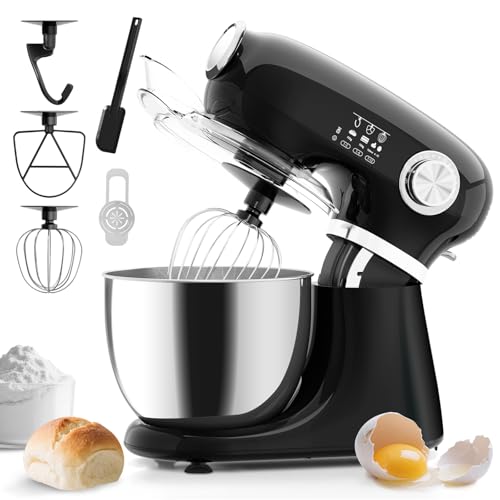
A 12-speed dial in a body that slides into a tight corner cabinet.
At just 8.9 inches wide and 8 pounds, the Electactic is the most storage-friendly option of the three — it measures 8.9 inches wide, versus 10.16 inches for the Amazon Basics model, and is nearly identical in height to the FOHERE. You get a 12-speed controller with a pulse function (a burst of power) for fine-grained control over tasks from folding whipped cream into a mousse to beating egg whites at top speed. The 300-watt motor, versus the FOHERE’s 600-watt unit, makes it a better fit for lighter daily baking: cookies, cakes, muffins, and the occasional bread dough.
Owners mention it “works well for thick batters like homemade brownies” and is “easy to use with heavy recipes,” though one reviewer noted it is “very good too noisy” at higher speeds. The included accessories go beyond the standard three — you also get a spatula and an egg white separator spoon (a tool to separate yolk from white), which are thoughtful extras at this price. The tilt-head design and anti-slip silicone suction feet mirror the layout of pricier mixers, so the learning curve is small if you have used any tilt-head machine before.
Why it fits
- Narrow 8.9-inch width is ideal for small kitchens and apartments
- Twelve speeds plus pulse for very precise mixing control
- Extra accessories (spatula, egg separator) included
The trade-offs
- 300-watt motor versus the FOHERE’s 600 watts, so dense bread dough may cause it to labor
- Some customers note noticeable noise at higher speeds
Choose this for: Everyday baking in a small kitchen where counter space is tight and you want maximum speed control.
Skip it for: Heavy, frequent bread-making where the extra wattage of the FOHERE will save time and motor wear.
3. Amazon Basics Tilt-Head Stand Mixer
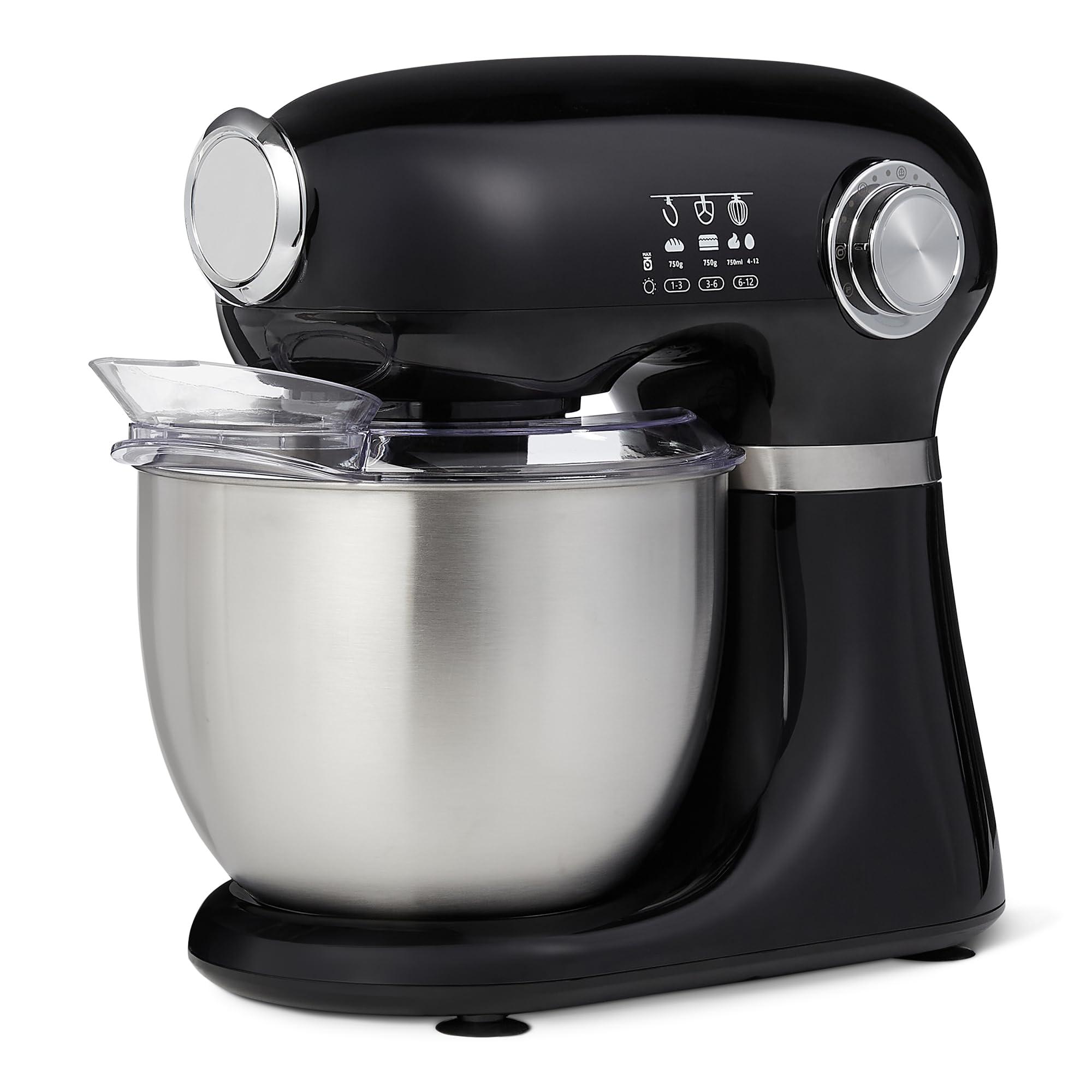
The entry-level 12-speed that gets you started while staying affordable.
At 350 watts and 5.3 quarts, this Amazon Basics mixer sits in the same motor-and-bowl class as the Electactic, but buyers give it a more cautious reception. The 12-speed dial with pulse function is identical on paper, and the tilt-head design makes swapping bowls and attachments simple. The large transparent splash guard (a clear lid that allows you to see your ingredients) helps you add ingredients mid-mix without making a mess. The three included attachments (dough hook, flat beater, and stainless steel whisk) cover the basics a new baker needs.
But some owners are less impressed. One verified buyer described it as “underpowered and flimsy” with a “thin metal bowl, crude hinge, plastic body with vibration,” and noted it feels “loud and oversized for performance.” The same review suggested it is a “good starter mixer for ~ but not for bread or pastries.” At 8.23 pounds and 17.8 inches tall, it is the tallest of the three models, so check your upper-cabinet clearance before buying. Other buyers call it a “solid, well-made mixer” for beginners, so the experience varies depending on the type of baking you do.
What works
- 12-speed control plus pulse for versatile mixing
- Tilt-head design and splash guard for easy use
- Lowest price point in this comparison
What to watch for
- Some reviewers point out plastic body vibration and a crude hinge
- 350-watt motor may struggle with heavy bread dough over time
- Tallest profile at 17.8 inches, so check overhead cabinet clearance
Ideal for: A casual baker on a very tight budget who mainly makes cookies, cakes, and whipped cream.
Not the one if: You plan to knead bread dough weekly or want a metal body that will handle years of heavy use.
Understanding the Specs
Motor Wattage
This number tells you how much raw power the mixer has to turn its beaters through thick dough. A 300-to-350-watt motor handles light batters, whipped cream, and egg whites well. A 600-watt motor, like the one in the FOHERE, gives you more reserve for bread dough and stiff cookie batter. If you bake bread more than once a month, a higher-wattage model can be worth considering.
Bowl Capacity and Material
Capacity (measured in quarts) determines how much you can mix in one batch. A 5.3-quart bowl works for most home recipes — a single cake, a batch of cookies, or one loaf of bread. A 5.8-quart bowl gives you room for larger batches (up to two cakes or four loaves, according to the brand). Stainless steel is the standard material because it is dishwasher-safe, does not chip, and does not react with acidic ingredients.
FAQ
Can a cheap stand mixer knead bread dough?
What is the difference between a tilt-head and a bowl-lift stand mixer?
How many speeds do I actually need in a stand mixer?
Why do shoppers say the attachments miss the sides of the bowl?
Will a cheap stand mixer fit under my kitchen cabinets?
What attachments come with a cheap stand mixer?
How loud is a cheap stand mixer compared to a premium one?
Can I wash the bowl and attachments in the dishwasher?
Final Thoughts: The Verdict
Across the board, the best cheap stand mixer is the FOHERE 5.8 QT, because its 600-watt motor and full-metal body give it the power to handle bread dough without the reliability concerns that lower-wattage models have. If you need a compact, 12-speed machine for a small kitchen, get the Electactic 12-Speed. And for the lowest entry price on a functional tilt-head mixer, the Amazon Basics covers light baking if you accept the plastic build and mixed reviews.
How We Picked
We do not accept paid placement. Every pick is matched to a real buyer and a real use-case; we do not hands-on test units.
Sources & Methodology
Specifications: manufacturer listings and product documentation. Review insights: verified customer reviews, as of July 2026. Pricing: not shown on this page (it changes often); check the current price via the retailer link.
As an Amazon Associate, WellFizz earns from qualifying purchases. This does not affect which products we feature.

Mo Maruf
I created WellFizz to bridge the gap between vague wellness advice and actionable solutions. My mission is simple: to decode the research and give you practical tools you can actually use.
Beyond the data, I am a passionate traveler. I believe that stepping away from the screen to explore new environments is essential for mental clarity and physical vitality.