Our readers keep the lights on and my smoothie glass nicely filled. As an Amazon Associate, I earn from qualifying purchases.
Specs are compiled from manufacturer listings and verified buyer reviews and can change over time — please confirm the key details on the product page before buying.
You are staring at a mess of black wire on a shelf and just want to know which spool actually sounds good without being expensive. The problem is thin, low-quality wire can quietly strangle your sound, leaving your speakers flat and lifeless — and the trouble was never the speakers. This guide cuts through the noise on gauge (the thickness of the copper), material, and jacket rating, so you pick the wire that fits your setup without throwing away money on specs you do not need.
I’m Mohammad Maruf — the founder and writer behind WellFizz. This guide is built by comparing the manufacturers’ published specifications and the patterns across verified customer reviews, so you get each pick’s real strengths and trade-offs instead of marketing spin.
Whether you are wiring a home theater, connecting car speakers, or running cable through a wall, these seven options cover every scenario where you need cheap speaker wire that does not compromise on signal quality or installation ease.
Our Picks at a Glance


How To Choose The Best Cheap Speaker Wire
The most important decision you make when picking speaker wire is not the brand or the color — it is the gauge (the physical thickness of the copper inside). Thicker wire (lower AWG numbers like 12 or 14) carries more current with less resistance, so your signal stays strong over long runs. Thinner wire (higher AWG numbers like 16) works fine for short, low-power runs and saves you money.
Material — CCA vs. OFC
Copper Clad Aluminum (CCA, a wire with an aluminum core and a thin copper coating) is lighter, noticeably cheaper, and perfectly fine for everyday home audio and car speakers. Oxygen-Free Copper (OFC, at least 99.99% pure copper) delivers lower resistance and conducts better over longer distances, so your sound stays clear. Buyers report that OFC makes a real difference in demanding systems, but for a basic budget setup, CCA will sound identical to your ears.
Jacket Rating — In-Wall vs. Out-of-Wall
If the wire runs inside a wall, ceiling, or plenum space (an air-handling area like a drop ceiling or ventilation duct), you need a UL-rated jacket — CL2 or CL3 — that is flame-retardant and meets fire-safety codes. Plain PVC-jacketed wire is fine for exposed runs along baseboards or inside a car door channel, but it is not rated to be buried inside a wall. Using unrated wire in-wall can violate local building codes and insurance requirements.
Quick Comparison
| Model | Best For | Gauge | Length | Material | Amazon |
|---|---|---|---|---|---|
| DS18 SW-16GA-100RB★ Best Overall | Entry-level value | 16 AWG | 100 ft | CCA | Amazon |
| KnuKonceptz KordAlso Great | Audiophile sound quality | 12 AWG | 50 ft | OFC | Amazon |
| GEARit 12 AWG CL2 | In-wall installations | 12 AWG | 50 ft | OFC | Amazon |
| Monoprice 16 AWG Plenum | Plenum / in-wall safety | 16 AWG | 100 ft | Bare Copper | Amazon |
| GEARit 14 AWG CL3 | Outdoor & in-wall runs | 14 AWG | 100 ft | CCA | Amazon |
| Install Link 14 AWG | Budget home theater | 14 AWG | 100 ft | CCA | Amazon |
| Energeaster 14 AWG | Multi-purpose low-voltage | 14 AWG | 100 ft | CCA | Amazon |
In‑Depth Reviews
1. DS18 SW-16GA-100RB 16-Gauge Ultra Flex Speaker Wire – 100 Feet
100 feet of 16 AWG CCA that handles basic speaker wiring for about the price of lunch.
The DS18 is your honest entry-level option — 16 AWG Copper Clad Aluminum (CCA) with a flexible jacket that owners mention is “great quality for the price” and “flexible sheathing for clean install.” It is the thinnest wire on this list (16 AWG compared to the 14 AWG and 12 AWG options above), which means it is best suited for short runs of 25 feet or less where power demands are modest — think small bookshelf speakers, stereo pairs in a bedroom, or a basic car audio upgrade.
The 16 AWG gauge means higher resistance over long distances compared to the 14 AWG or 12 AWG picks. For a 50-foot run to passive surround speakers, it will work fine, but for a main floor-standing tower or a subwoofer, you want thicker wire. Buyers with home theaters report “zero issues” with it in basic setups, and the ultra-flex jacket makes it easy to route around furniture. If your system is simple and your budget is tight, this spool gets the job done.
Where it makes sense
- Very low entry cost for 100 feet of wire
- Flexible jacket that strips cleanly and routes easily
- Solid performance for basic home theater and car audio
The real limitations
- 16 AWG is too thin for high-power or long (50+ ft) runs
- CCA material, not pure copper
- Not rated for in-wall installation
Best for: A first-time install on a budget — small speakers, short distances, and a spool that costs less than a pizza and delivers solid audio.
Not for: A high-performance home theater with a separate subwoofer and tower speakers — those need the 12 AWG or 14 AWG OFC options like the KnuKonceptz.
2. KnuKonceptz Kord Speaker Cable 12 Gauge OFC – 50 Feet
Audiophile-grade pure copper that does not ask you to mortgage the house for it.
The KnuKonceptz Kord brings you 12 AWG Oxygen-Free Copper (OFC, at least 99.99% pure copper) at a price that undercuts most store-brand 14 AWG CCA spools. That means you get the lowest resistance and richest frequency response for your speakers, so they sound like you finally upgraded the whole system. The Ultra Flex PVC jacket stays soft and pliable, so it lays flat the second you uncoil it — no kinks, no fighting the spool memory.
Owners mention it is “superior to cables costing twice as much,” and one reviewer with decades of experience called the sound “comparable to cables.” That is a lot of signal quality from a 50-foot spool. The trade-off is the length — 50 feet is enough for a typical stereo pair or a center channel, but if you are running long distances to surround speakers, you may need two spools. It is also thicker wire, so squeezing bare ends into spring-clip terminals requires a bit of patience.
What makes it worth picking
- Genuine Oxygen-Free Copper (99.99% pure) for low-loss signal transfer
- Ultra-flexible jacket that lays flat immediately — no spool memory
- 12 AWG handles high-current systems and long runs with ease
The real trade-offs
- 50-foot spool is short for whole-home theater wiring
- Thick 12 AWG strands can be tricky to fit into small spring-clip terminals
- Premium price compared to 100-foot CCA alternatives
Who this is for: Anyone who hears the difference between decent and great sound and wants the real copper performance without the boutique price tag.
Who should skip it: If your speakers run 25 feet or less and you are on a strict budget, a 14 AWG CCA wire will perform practically identically for half the cost.
3. GEARit 12 Gauge UL CL2 Rated Speaker Wire – 50 Feet
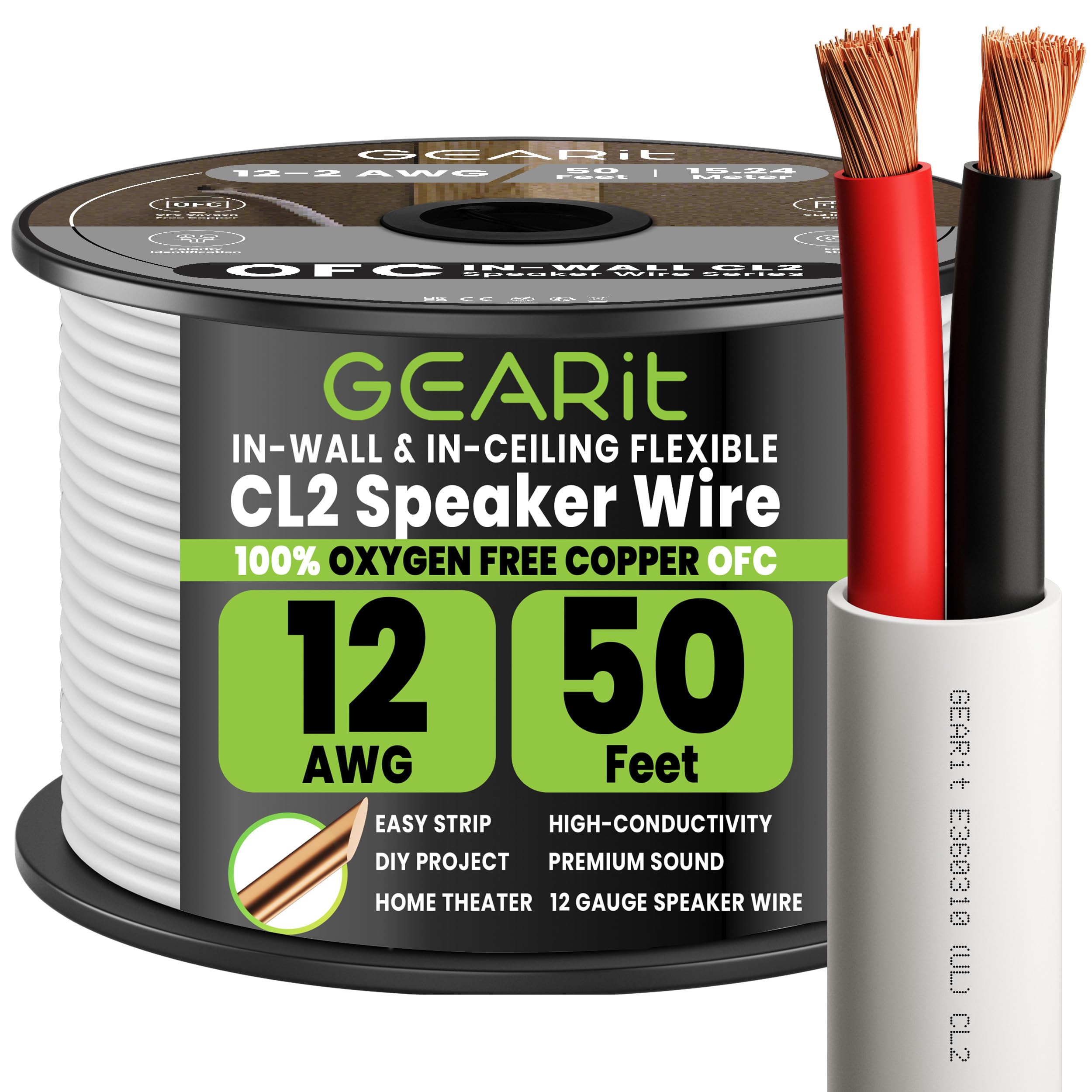
UL-listed 12 AWG pure copper that is made to live inside your walls.
The GEARit 12 AWG is the top choice when you need fire-code compliance for in-wall installation. It carries both UL Listing and CL2 rating (a fire-safety certification for wires inside walls), so your insurance is happy and the inspector is satisfied. The conductors are genuine Oxygen-Free Copper (OFC), which means lower resistance and cleaner signal than CCA alternatives — especially noticeable when driving a subwoofer or a surround-channel amp.
Unlike the KnuKonceptz above, this GEARit spool is only 50 feet and costs noticeably more per foot — the premium goes into the flame-retardant jacket and the safety certifications. Buyers mention the wire is “top-notch, flexible, easy to strip” but warn that the spool itself is flimsy and can collapse, causing tangles. If you need permanent in-wall safety, this is the safer bet than the KnuKonceptz which lacks the CL2 rating.
What it does best
- UL Listed and CL2 rated for safe in-wall installation
- OFC conductors for low signal loss and clear audio
- Flexible jacket that pulls easily through studs and corners
What to watch out for
- Short 50-foot length for the price — not cheap per foot
- Flimsy spool can break and cause tangles during install
- 12 AWG is thick for small spring-clip terminals
Reach for this if… you are installing new wire inside a wall, ceiling, or commercial space and need the UL safety stamp for confidence and code compliance.
Look elsewhere if… you just need a long exposed run for a garage or bookshelf setup — an unrated 14 AWG CCA wire will cost less and work fine.
4. Monoprice 16 AWG 2 Conductor CMP-Rated Plenum Speaker Wire – 100 Feet

100 feet of plenum-rated solid copper that slides through air ducts without a worry.
The Monoprice Nimbus Series is unique on this list because it carries a CMP (Plenum) rating — the strictest fire-safety classification, meaning it is certified for use inside air-handling spaces like drop ceilings and ventilation ducts. That is a big deal for commercial installs and residential buildings where local code demands plenum-rated cable. Beyond the jacket, the conductors are 100 percent pure bare copper, not CCA, so you get full conductivity over the full 100-foot run.
At 16 AWG, this wire is noticeably thinner than the 12 and 14 AWG picks above. For the 100-foot length Monoprice gives you, that is fine for low-power speakers and surround channels, but it cannot push as much current as a 12 AWG cable for a high-power subwoofer or main tower speakers. Customers note the vinyl jacket is stiffer than an OFC jacket and that the red inner sheathing can be brittle. That stiffness makes it less forgiving for tight bends, but the plenum rating is the reason the jacket is tough.
Where it shines
- CMP (Plenum) rated for safe use in air ducts and drop ceilings
- 100 percent pure bare copper conductors — not CCA
- Long 100-foot spool covers whole rooms
The honest downsides
- 16 AWG is thinner — not ideal for high-power or very long runs
- Stiff jacket is harder to route around tight corners
- Retains spool shape; needs careful uncoiling to lay flat
Grab it for: Commercial installs or home in-wall runs that go through plenum spaces and require the strictest fire rating.
skip it if: Your speakers need a thick 12 or 14 AWG conductor — go with an OFC cable instead.
5. GEARit 14 Gauge CL3 Rated Speaker Wire – 100 Feet
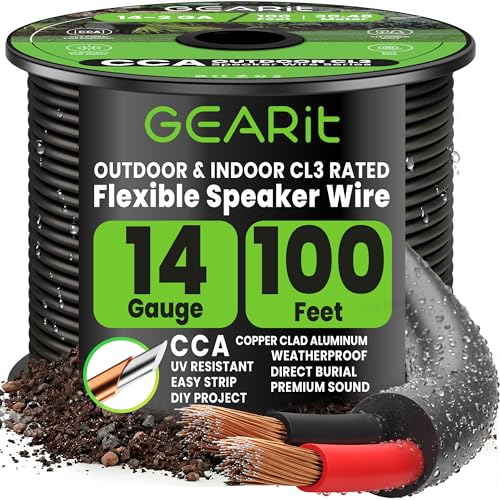
A 100-foot CL3 spool that handles outdoor and in-wall duty without busting your budget.
GEARit packs a lot of practical features into this 14 AWG CCA spool. It is CL3 rated (the standard for outdoor and in-wall installations, with a higher voltage rating than CL2 at 300V), the jacket is flame-retardant and flexible, and the wire has sequential foot markers printed right on the jacket — so you measure exactly what you cut without pulling out a tape. That sounds minor until you are on a ladder trying to mark a 47-foot run. The red and black color coding makes polarity identification instant at both ends.
At 14 AWG, this is a versatile middle-ground thickness — thicker than 16 AWG for better conductivity on longer runs, but thinner and more flexible than 12 AWG. The CCA material keeps the price low, and reviewers point out it works perfectly for outdoor landscape speakers and in-wall theater wiring. One reviewer used it “under a deck with no issues” and another noted it ran “through multiple studs without rips or freys.” The honest catch is that CCA does not conduct quite as well as pure copper, but for most home setups, your ears will never know the difference. Compared to the cheaper Install Link below, this one is CL3 rated for in-wall use.
What makes it a great value
- CL3 rated for safe outdoor and in-wall use
- Sequential foot markers on the jacket for precise cuts
- 100-foot spool at a friendly price point for 14 AWG
What to keep in mind
- CCA material is not as conductive as pure OFC copper
- Thicker jacket than some CCA wires, can be snug in connectors
- Not ideal for very high-power subwoofer runs
Best suited for: Outdoor speaker projects, in-wall runs in a standard home theater, or any install where you need CL3 safety and 100 feet of 14 AWG at a smart price.
Not ideal for: Audiophile-grade systems where every fractional dB of signal loss matters — those want OFC.
6. Install Link 14 AWG Gauge Speaker Wire Cable – 100 Feet

A no-fuss 100-foot CCA spool that strips clean and hides well along baseboards.
The Install Link 14 AWG wire is one of those rare products where the buyer reviews practically write the advertisement — “replaced old speaker wire; great value” and “very soft, flexible silicone jacket; easy to pull through conduit” are typical. The standout feature here is the SoftFlex jacket, which is noticeably pliable and makes the wire easy to bend around corners and tuck under carpets without kinking. The frosted blue and black color scheme is also easier to camouflage against dark walls than bright red.
At 100 feet of 14 AWG CCA, this is the same material class as the GEARit CL3 above, but the jacket feel is different — thinner and more supple, which some DIYers prefer for ceiling-mounted projectors or long runs through conduit. The trade-off is that a softer jacket may not be as durable against physical abuse in outdoor or high-traffic areas. Also, unlike the GEARit, it is not CL rated, so you cannot bury it inside a wall legally. For indoor home theater use, buyers consistently say it is “great value for money over going to the store.”
Why it works well
- Soft, flexible jacket that pulls through conduit with ease
- 100-foot spool covers most home theater rooms
- Easy-to-hide frosted blue and black color
The downsides to consider
- CCA material rather than pure copper
- Not CL rated for in-wall installation
- Soft jacket may not hold up to repeated outdoor exposure
Pick this if: You are wiring a home theater, office, or garage and want an easy-to-work-with 100-foot spool that hides well and does not fight you during installation.
pass on it if: You need in-wall rated wire or plan to bury it outdoors — pick a CL3-rated option like the GEARit 14 AWG CL3 instead.
7. Energeaster 14 Gauge Wire 100FT – 2 Conductor Red Black

A 14 AWG all-rounder that works for speakers, LED strips, and car wiring alike.
The Energeaster 14 AWG wire is not exclusively a speaker wire — it is marketed as a low-voltage electrical cable for 12V and 24V DC applications, which makes it a useful spool to keep around if you also wire LED strips, car accessories, or light bulbs. Shoppers say it “works great for wiring almost anything in my car” from speakers to USB plugs to light bulbs. The PVC jacket is flame-retardant, anti-aging, and rated for temperatures from -35°C to 105°C, so it handles hot engine bays and cold garages.
The catch that comes up repeatedly in reviews is the jacket thickness. Multiple buyers report that the PVC casing is thicker than other 14 AWG wires, which makes it a tight squeeze into some electrical connectors and quick-splice terminals. If you are running wire through a narrow door boot or into a small distribution block, you will want to test fit first. It is also not rated for direct burial, so keep it inside the car or above ground.
What it handles well
- Works for speakers, 12V lights, car accessories — one spool does it all
- Wide temperature range (-35°C to 105°C) for automotive use
- 100-foot spool at a very friendly price point
Where it stumbles
- Thick PVC jacket is hard to fit into some connectors
- Not rated for direct burial — do not bury it underground
- CCA material, not pure copper
Reach for this if: You need a versatile 14 AWG CCA spool for car audio, LED projects, and general low-voltage wiring — one spool that covers multiple jobs.
Look elsewhere if: You need wire specifically for in-wall speaker installation and want a flexible jacket that slips easily into banana plugs.
Understanding the Specs
AWG (American Wire Gauge)
This is the thickness of the copper conductor inside the wire. The rule is simple — a lower AWG number means a thicker wire. 12 AWG is thicker than 14 AWG, which is thicker than 16 AWG. Thicker wire has less resistance, so it carries more power over longer distances without signal loss. For runs under 25 feet to low-power speakers, 16 AWG is fine. For runs over 50 feet or high-power speakers, go with 14 AWG or 12 AWG.
CCA vs. OFC
Copper Clad Aluminum (CCA) has an aluminum core plated with copper. It is lighter, more flexible, and much cheaper than pure copper, but it has higher electrical resistance (roughly 60 percent higher than pure copper for the same gauge). Oxygen-Free Copper (OFC) is at least 99.99 percent pure copper and offers the lowest resistance. For most home and car audio, CCA sounds identical. For high-end systems or very long cable runs, OFC makes a measurable difference.
FAQ
What gauge speaker wire should I use for 100 feet?
Can I use CCA speaker wire instead of OFC?
Is CL2 or CL3 speaker wire required for in-wall installation?
What happens if I use 16 AWG wire on a high-power subwoofer?
Does expensive speaker wire sound better than cheap wire?
Can I use speaker wire for 12V LED strip lights?
How do I strip speaker wire without damaging the copper strands?
What does polarity mean on speaker wire and does it matter?
Final Thoughts: The Verdict
If you want one dependable pick, the best cheap speaker wire winner is the KnuKonceptz Kord 12 AWG because it delivers genuine Oxygen-Free Copper at a price that undercuts most CCA alternatives, giving you the lowest resistance and best frequency response without stepping into boutique pricing. If you need 100 feet of CL3-rated wire for outdoor or in-wall installation, grab the GEARit 14 AWG CL3 spool. And for a straightforward budget setup with short cable runs, the DS18 16 AWG CCA handles the job for pocket change.
How We Picked
We do not accept paid placement. Every pick is matched to a real buyer and a real use-case; we do not hands-on test units.
Sources & Methodology
Specifications: manufacturer listings and product documentation. Review insights: verified customer reviews, as of July 2026. Pricing: not shown on this page (it changes often); check the current price via the retailer link.
As an Amazon Associate, WellFizz earns from qualifying purchases. This does not affect which products we feature.
Related Guides

Mo Maruf
I created WellFizz to bridge the gap between vague wellness advice and actionable solutions. My mission is simple: to decode the research and give you practical tools you can actually use.
Beyond the data, I am a passionate traveler. I believe that stepping away from the screen to explore new environments is essential for mental clarity and physical vitality.