Our readers keep the lights on and my smoothie glass nicely filled. As an Amazon Associate, I earn from qualifying purchases.
You need a circular saw that makes clean cuts without stalling or burning out on the second piece of wood — not another tool that collects dust in your garage after one bad afternoon. This guide looks at five corded and cordless circular saws priced for home use, each picked so you see where your money goes and what you trade off to save it.
I’m Mohammad Maruf — the co-founder and writer behind WellFizz. This guide is built by comparing the manufacturers’ published specifications and the patterns across verified customer reviews, so you get each pick’s real strengths and trade-offs instead of marketing spin.
Whether you are framing a shed, cutting plywood sheets, or trimming pressure-treated lumber in the backyard, the right circular saw makes or breaks the job. This is your shortcut to finding the best cheap skill saw for your next project without overpaying or buying something too weak.
How To Choose The Best Cheap Skill Saw
Picking a circular saw on a budget means knowing where you can save and where you absolutely cannot. The biggest mistake is buying on price alone — a saw that stalls mid-cut or bends its base plate is no bargain at any price. Here are the three specs you need to check before you click “add to cart”.
Motor Power: Amps vs. Volts
Corded saws are rated by amperage (amps), and more amps means more torque (twisting force) to push through thick or dense wood without the motor slowing down. A 15‑amp motor, like the one in the SKILSAW SPT67WL-01, handles pressure-treated lumber and hardwood planks without bogging. An 11-amp motor can still cut plywood and 2x4s, but it works harder on dense material. Cordless saws are rated by voltage (volts), so a 20V platform like the DEKOPRO gives you portability at the cost of sustained power — you trade runtime for freedom from a cord.
Blade Size and Bevel Range
A 7-1/4-inch blade is the standard you want for almost any job — it cuts deeper in one pass and matches the widest selection of replacement blades. A 6-1/2-inch blade is lighter and more compact, but it limits your cutting depth, so you will struggle with thicker stock in a single cut. Bevel capacity tells you how far the saw base tilts. A 56-degree bevel (SKILSAW) lets you cut compound angles for things like rafters, while a 45-degree bevel (most others) handles the vast majority of home cuts. A “positive stop” at 45 degrees means the saw clicks into that common angle — you don’t have to eyeball it.
Build Quality and Weight
A cast aluminum base plate keeps the saw square longer than stamped steel or plastic, which matters because a warped base will give you crooked cuts even with a laser guide. Weight is a real factor if you are cutting overhead or all day — the SKIL 5180-01 weighs 7.2 pounds, which is noticeably easier on your arm than the 8.7-pound SKIL 5280-01. But lighter usually means more plastic parts, so you trade durability for comfort. Buyers sometimes note that plastic guards and housings feel “sketchy” or “cheap,” but the saw still performs well for home use.
Quick Comparison
On smaller screens, swipe sideways to see the full table.
| Model | Category | Best For | Key Spec | Amazon |
|---|---|---|---|---|
| SKILSAW SPT67WL-01 | Premium Corded | Demanding cuts / pros | 15A / 56° bevel / 8.6 lb | Amazon |
| SKIL 5280-01 | Mid-Range Corded | DIY + laser alignment | 15A / 5300 RPM / 8.7 lb | Amazon |
| SKIL 5180-01 | Mid-Range Corded | Lightweight performance | 14A / 51° bevel / 7.2 lb | Amazon |
| DEKOPRO 20V Cordless | Cordless | Portability / small jobs | 20V / 4500 RPM / 6.5″ blade | Amazon |
| Enventor 11A Corded | Budget Corded | Entry-level / occasional use | 11A / 6000 RPM / 2 blades | Amazon |
In‑Depth Reviews
1. SKILSAW SPT67WL-01 15 Amp 7-1/4 In. Sidewinder Circular Saw

The 15-amp motor (the highest amperage here) makes the SKILSAW SPT67WL-01 the top pick for anyone who regularly cuts pressure-treated lumber, hardwood plywood, or dense framing where stalling is not an option. Its 56-degree bevel handles compound rafters and furniture joinery that 45-degree saws cannot reach.
At 8.6 pounds, it is the lightest professional-class saw in this guide, yet buyers report it has been “reliable corded circular saw over 8 years” with zero mechanical issues. The 10-foot cord (longer than the Enventor’s 6.56-foot cord) keeps it from pulling off your work surface when cutting 4×8 sheets, and the cast aluminum base plate stays square cut after cut. The rubber handle grip also gives you better control in wet or sweaty conditions than the all-plastic grips on cheaper saws.
The honest catch: there is no blade brake, so the blade spins freely for several seconds after you release the trigger — a safety trade-off you need to work around by waiting or setting the saw down carefully. Still, if you need a saw that chews through 1.5-inch hard maple and framing lumber without complaint, this is the clear winner. This is the one to buy if you want to buy once and not upgrade later.
Why it’s great
- 15-amp motor powers through dense lumber without bogging
- 56-degree bevel handles compound cuts that cheaper saws cannot
- Lightest professional saw at 8.6 lb reduces arm fatigue
Good to know
- No blade brake — blade coasts after trigger release
- Premium price is more than a casual user needs to spend
2. SKIL 15 Amp 7-1/4 Inch Circular Saw with Single Beam Laser Guide – 5280-01
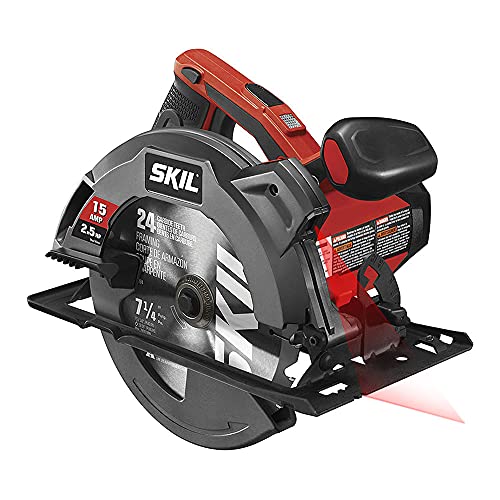
The SKIL 5280-01 matches the SKILSAW’s 15-amp motor but costs less, making it the strongest value proposition in the mid-range. Where it falls short is weight: at 8.7 pounds it is heavier than the SKILSAW (8.6 lb) and heavier than the 7.2-pound SKIL 5180-01 — a difference you feel when cutting overhead or across multiple sheets. The 51-degree bevel (with a positive stop at 45 degrees) covers almost any common angle, though it does not go as far as the SKILSAW’s 56 degrees.
The laser guide is the real draw here. It projects a line onto your cut mark, which buyers call “a big help keep your cut straight” — especially useful if you are newer to circular saws and do not trust your eye yet. The dust blower keeps sawdust off your cut line so the laser stays visible longer. One buyer summed it up: “Lightweight, powerful saw; cuts through lumber easily.”
Choose this SKIL over the SKILSAW if you want the same motor power with a laser guide for straight cuts, and you are willing to carry an extra 0.1 pound (negligible for most) and save money. It comes with a carry bag and a 24-tooth carbide blade, so you are ready to cut out of the box. skip it if you need a 56-degree bevel for steep roof rafters — the 5280-01 stops at 51 degrees.
Where it shines
- 15-amp motor delivers the same power as premium saws for less
- Laser guide helps beginners and DIYers make straight cuts
- Includes carry bag and carbide blade
Worth noting
- Heavier than other SKIL models at 8.7 lb
- Laser can be hard to see in bright outdoor sunlight
3. SKIL 14 Amp 7-1/4-Inch Circular Saw – 5180-01

Imagine you need to cut 40 boards in half for a shelving project — every half-pound of weight you save adds up by the end of the day. The SKIL 5180-01 weighs 7.2 pounds, which is 1.5 pounds lighter than the SKIL 5280-01 (an 21% reduction) and 1.4 pounds lighter than the SKILSAW. That difference makes it noticeably easier to control with one hand when you are balancing a sheet of plywood.
The 14-amp motor gives up only 1 amp compared to the 15-amp models, and buyers confirm it “rips 2″ oak plank without bogging down” — so you are not really losing cutting ability for standard home tasks. The 51-degree bevel with a positive stop at 45 degrees matches the 5280-01, and the improved dust blower clears your cut line better than older SKIL models. The included 20-tooth carbide blade is fine for framing but swap it for a 40-tooth finishing blade if you need cleaner edges on plywood.
The catch is visible: the all-plastic build feels less solid than the SKILSAW’s cast aluminum base, and owners mention the plastic guard “seems a bit sketchy at first blush.” But for DIY work, handyman jobs, and demolition where weight and price matter more than bulletproof construction, this saw is hard to beat. If you want a saw that saves your shoulder all afternoon and still cuts thick oak, start here.
What stands out
- Lightest at 7.2 lb — far easier on your arm all day
- 14-amp motor still powers through thick oak without stalling
- 51-degree bevel handles almost any angle you need
The trade-offs
- Plastic guard and housing feel flimsy compared to metal-base saws
- No laser guide — you line up cuts by eye
4. DEKOPRO 20V Cordless Circular Saw, 6-1/2-Inch Blade, 4500 RPM with 2 Batteries and Charger
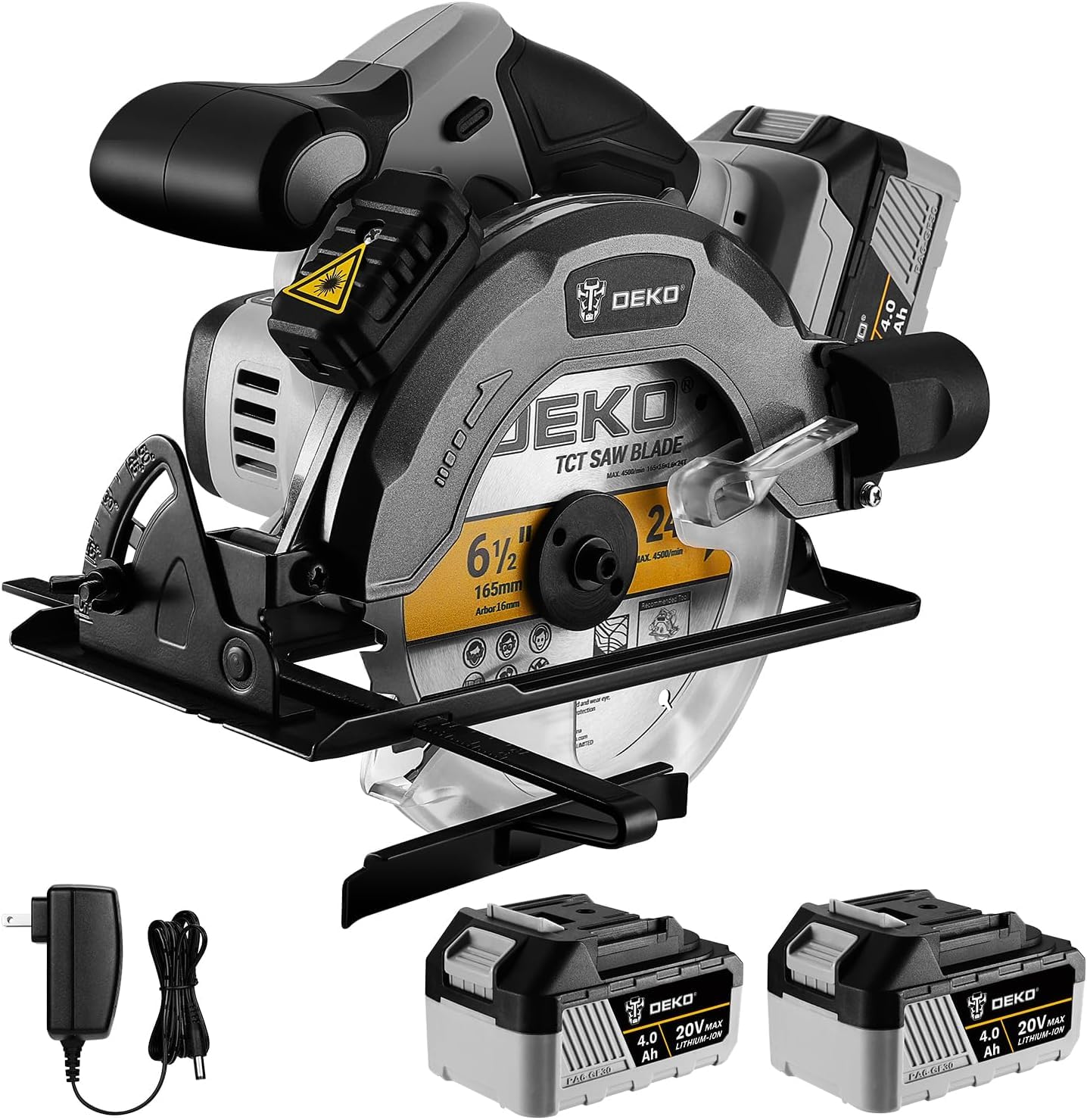
The single number that matters most in this category is RPM (blade spin speed), and the DEKOPRO 20V scores 4500 RPM — 33% slower than the Enventor’s 6000 RPM and slower than any corded saw here. That matters less for quick trim cuts but will slow you down on long rip cuts through thick lumber.
What you get instead is real portability: two 4.0Ah batteries (amp-hour capacity, meaning larger than typical starter packs) that customers note have “long lasting battery” life, plus a laser guide that “is a big help keep your cut straight.” The 6-1/2-inch blade is 17% smaller than the 7-1/4-inch standard, which means you lose cutting depth — you will need two passes to cut a 2×6, for example. The 0-to-45-degree bevel adjustment covers standard angles, and the ergonomic handle reduces hand fatigue during extended use.
The downside: no included carrying case (a buyer noted that directly), and the rectangular blade shape in the specs looks like a data error — the saw uses a standard 6.5-inch round carbide blade. For quick cuts, small repairs, and jobs where an extension cord is more trouble than it is worth, this cordless setup gives you genuine freedom at a very competitive price.
The upsides
- Two 4.0Ah batteries for extended runtime between charges
- Laser guide improves cut accuracy for cordless users
- No cord to manage — works anywhere
Keep in mind
- 6.5″ blade limits depth — needs two passes on thick stock
- 4500 RPM is slower than any corded saw in this guide
- No carrying case included
5. Enventor 11A Electric Circular Saw 7-1/4-Inch with Laser Guide and 2 Blades
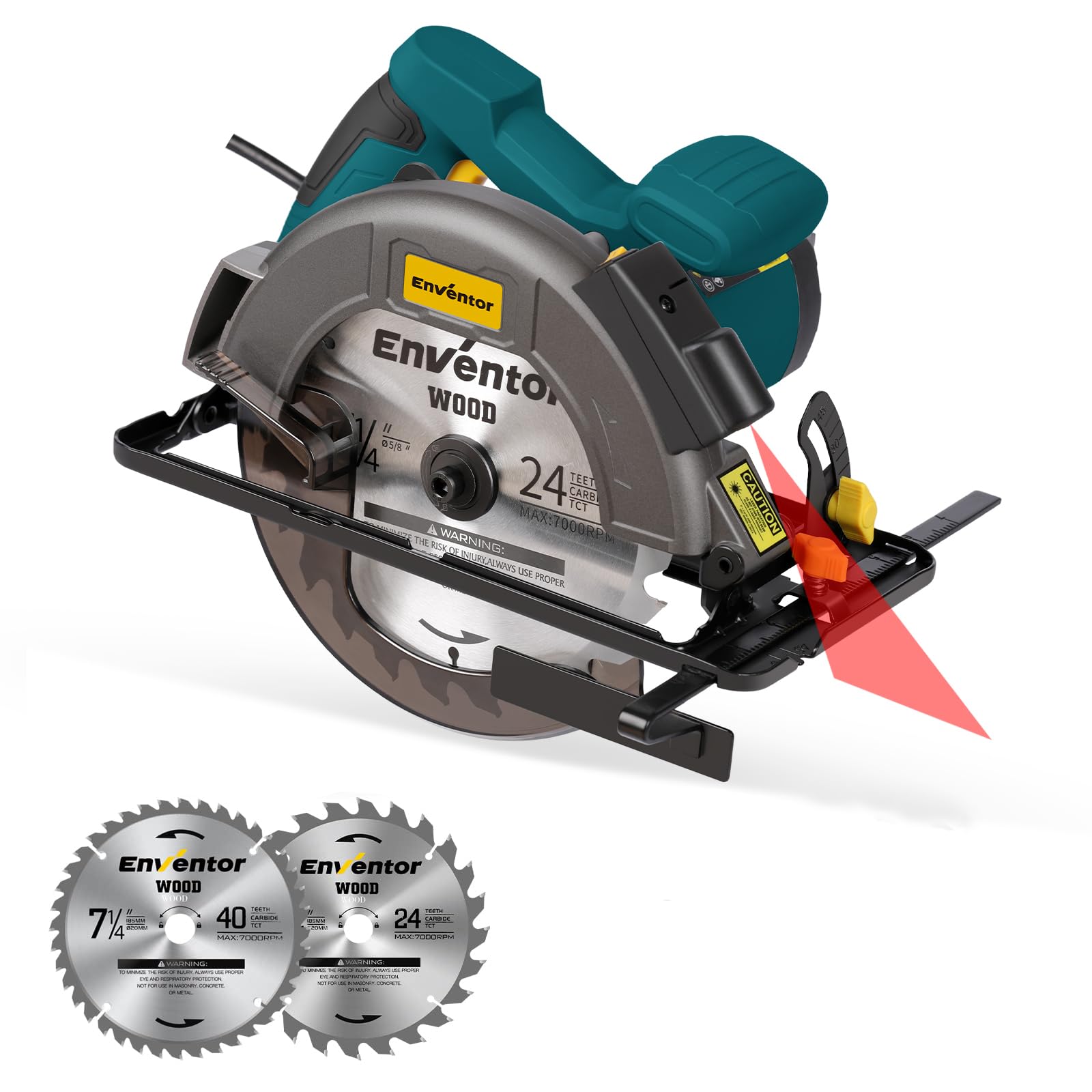
At roughly half the price of the SKILSAW, the Enventor gets you a 7-1/4-inch blade size (the same as the premium saws) and a laser guide — the two features that matter most for accurate cuts — while staying affordable. The 11-amp motor is 36% less powerful than the 15-amp options, but it still spins at 6000 RPM, which is faster than the SKIL 5280-01’s 5300 RPM. That higher no-load speed helps it cut through dry wood, plastic pipe, and plasterboard quickly, as long as you do not push into dense hardwood.
Reviewers point out “I used it all weekend and it worked flawlessly” and note the included 24-tooth and 40-tooth blades add genuine value — you get a rough framing blade and a finer finishing blade in the box, which most budget saws skip entirely. The double-protection switch (you must press both the trigger and a safety lock) prevents accidental startups, a meaningful safety feature at any price. The 6.56-foot cord is shorter than the SKILSAW’s 10-foot cord, so you may need an extension cord for anything beyond a small workbench.
The honest weakness: one reviewer noted the laser light died on the second cut, which tells you the laser module on this saw is not built for rough job site treatment. If you need a saw for occasional weekend projects where you can keep it in a clean toolbox, the Enventor delivers strong value. This is your entry point if you are on a tight budget but still want a full-size (7-1/4-inch, not compact) blade and a laser guide.
Why we’d pick it
- Comes with both a 24-tooth and 40-tooth blade for framing and finishing
- Full 7-1/4″ blade matches premium saws for cut depth
- Dual-trigger safety switch prevents accidental starts
A few caveats
- 11-amp motor struggles with dense hardwood like oak or maple
- Laser module reliability is inconsistent — some shoppers say early failure
- Short 6.5-foot cord limits reach without an extension
Understanding the Specs
Amperage (Motor Power)
A corded circular saw’s amperage rating (amps, such as 11A, 14A, 15A) tells you how much electrical current the motor draws. Higher amps equal more torque (twisting force), which keeps the blade spinning through dense wood without slowing down. A 15-amp saw like the SKILSAW can cut through pressure-treated 4×4 beams in one pass. An 11-amp saw like the Enventor works fine for pine and plywood but will bog down on thick oak or hardwood flooring. If you cut dense lumber regularly, aim for 14 or 15 amps.
Bevel Capacity
Bevel is the angle you tilt the saw base plate to make angled cuts. Most cheap saws reach 45 degrees, which covers common miter cuts for baseboards and trim. A 51-degree or 56-degree bevel (found on the SKIL 5180-01 and SKILSAW) lets you cut steeper compound angles for rafters, roof decking, or furniture joinery. A “positive stop at 45 degrees” means the saw clicks into that exact angle — you do not need to measure it. If you only cut straight 90-degree cuts, 45 degrees is plenty. If you frame roofs or build furniture, look for 51 degrees or more.
FAQ
Is a cheap skill saw worth buying for serious woodworking?
How important is a laser guide on a circular saw?
Can I use a 7-1/4-inch blade in a 6-1/2-inch saw?
What does “positive stop at 45 degrees” mean?
Final Thoughts: The Verdict
For most users, the best cheap skill saw winner is the SKILSAW SPT67WL-01 because its 15-amp motor, 56-degree bevel, and 8.6-pound weight give you professional cutting capability without a professional price tag. If you want a laser guide for straighter cuts at a lower cost, grab the SKIL 5280-01. And for lightweight portability or cordless freedom, the DEKOPRO 20V and SKIL 5180-01 each cover different needs without breaking your budget.

Mo Maruf
I created WellFizz to bridge the gap between vague wellness advice and actionable solutions. My mission is simple: to decode the research and give you practical tools you can actually use.
Beyond the data, I am a passionate traveler. I believe that stepping away from the screen to explore new environments is essential for mental clarity and physical vitality.