Our readers keep the lights on and my smoothie glass nicely filled. As an Amazon Associate, I earn from qualifying purchases.
A cheap skateboard shouldn’t feel like a toy. The wrong entry-level board fights you at every push — dead weight underfoot, wheels that stall on sidewalk cracks, grip tape that peels after two afternoons. Yet a properly selected budget board delivers the same pop and glide that keeps beginners progressing instead of quitting. The trick is knowing which hidden spec separates a cruiser from a clunker.
I’m Mohammad Maruf — the founder and writer behind WellFizz. I’ve spent hundreds of hours filtering through build materials, bearing grades, deck plies, and wheel durometers to find the boards that actually perform at a low price.
The goal of this guide is to cut through the noise and help you identify a genuinely capable cheap skateboard that won’t leave you wrestling with loose trucks or splintering decks before you’ve learned your first ollie.
How To Choose The Best Cheap Skateboard
Not all budget boards are built the same. The cheapest option often swaps real maple for plastic or pine, throws in soft bushings that wobble at low speed, and stamps a flashy graphic on a deck that has zero concave. To avoid waste, focus on three non-negotiable factors that define ride quality and durability.
Deck Construction and Ply Count
A genuine 7-ply Canadian maple deck is the baseline for any skateboard that deserves the name. Boards that list “hardwood” or “PP plastic” in the materials are heavier, less responsive, and prone to cracking under impact. The plies cross-laminate the wood grain, creating the flex-and-return pop that makes ollies possible. An 8-ply deck adds marginal stiffness for heavier riders or repeated stair drops.
Bearing Quality — ABEC Rating
The bearing rating tells you how precisely the steel balls are machined inside the race. ABEC-7 provides a fast, smooth roll suitable for street cruising and park riding. ABEC-11 is quieter and slightly faster, but more sensitive to dirt and moisture. Budget boards often ship with ABEC-5 or no rating at all — these create drag that makes every push feel twice as hard.
Wheel Durometer and Deck Shape
Hardness is measured on the A scale. A 95A to 99A wheel grips smooth pavement and park ramps without sliding out unpredictably. Softer wheels (78A–88A) absorb vibration but kill your speed on hard surfaces. A double-kick concave deck — where both the nose and tail curve upward — gives you the leverage for tricks and the ability to manual over cracks. Flat or single-kick boards are cruisers only, fine for rolling to a corner store but dead weight for learning anything beyond a push-and-glide.
Quick Comparison
On smaller screens, swipe sideways to see the full table.
| Model | Category | Best For | Key Spec | Amazon |
|---|---|---|---|---|
| CLYCTIP 31″ | Premium | Young beginners wanting durability & style | 8-layer maple deck | Amazon |
| Anyfun Checkerboard | Mid-Range | All-level riders on parks & streets | ABEC-11 bearings | Amazon |
| CAPARK Ocean | Mid-Range | Adult beginners & heavier riders | 31″ x 8″ 7-ply maple deck | Amazon |
| Gingili Life Skull | Mid-Range | Kids & teens learning first tricks | 88A durometer wheels | Amazon |
| Nattork Mini Cruiser | Budget | Young kids learning balance indoors | 22″ PP plastic deck | Amazon |
In‑Depth Reviews
1. CLYCTIP 31″ Complete Skateboard
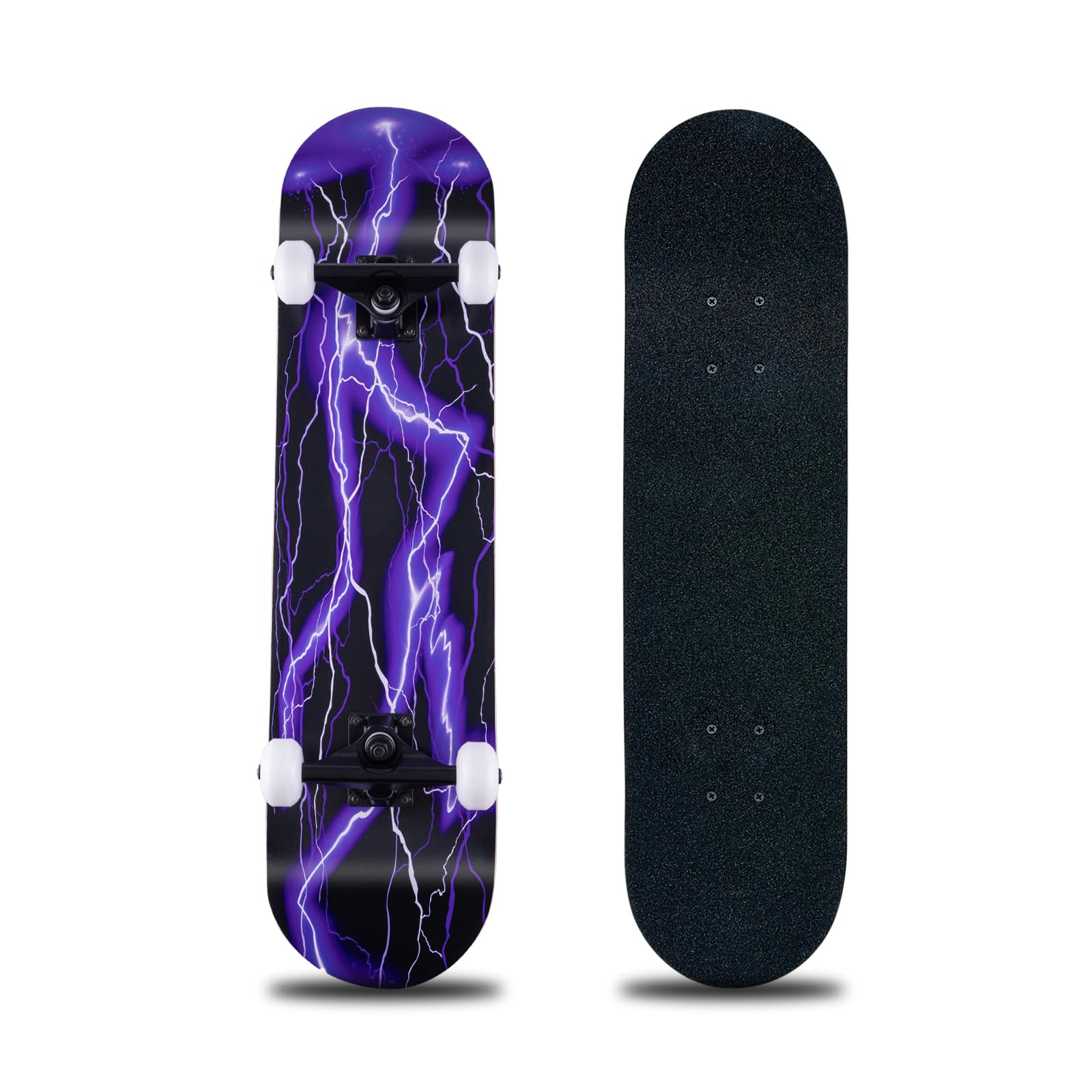
At the peak of the budget range sits a board that punches above its price tag with an 8-layer maple deck — one ply thicker than the standard seven. That extra layer adds noticeable stiffness without tipping the scale into dead weight, making it a solid foundation for kids or light adults learning to pop the tail. The 51mm 95A high-rebound PU wheels paired with ABEC-11 mute bearings deliver a quiet, fast roll that holds speed well through park transitions and rough parking-lot asphalt.
The double-kick concave is aggressive enough to lock your back foot in for ollies, yet the waterproof emery grip tape keeps your front foot planted during manual attempts. Buyers consistently note that children as young as five can push and glide confidently, and the thermal-transfer print holds up after weeks of sidewalk scraping. The only trade-off is the 220-pound weight limit — riders near that ceiling may feel the deck flex a bit more on hard landings.
Assembly is zero: the board ships fully built with the trucks tightened to a reasonable baseline. You can loosen the kingpin nut a quarter turn if you find the turning radius too tight, but most beginners will ride it straight out of the box without adjustments. For a first board that can survive the learning curve, this is the one to beat.
Why it’s great
- 8-ply maple deck offers superior durability over 7-ply alternatives
- ABEC-11 bearings provide a quiet, long-lasting roll
- Vibrant thermal-transfer design resists peeling and fading
Good to know
- Wheels are 51mm, slightly smaller than the standard 54mm, which can catch on larger cracks
- 200-pound+ riders may notice flex under hard impacts
2. Anyfun Checkerboard 31″ Complete Skateboard
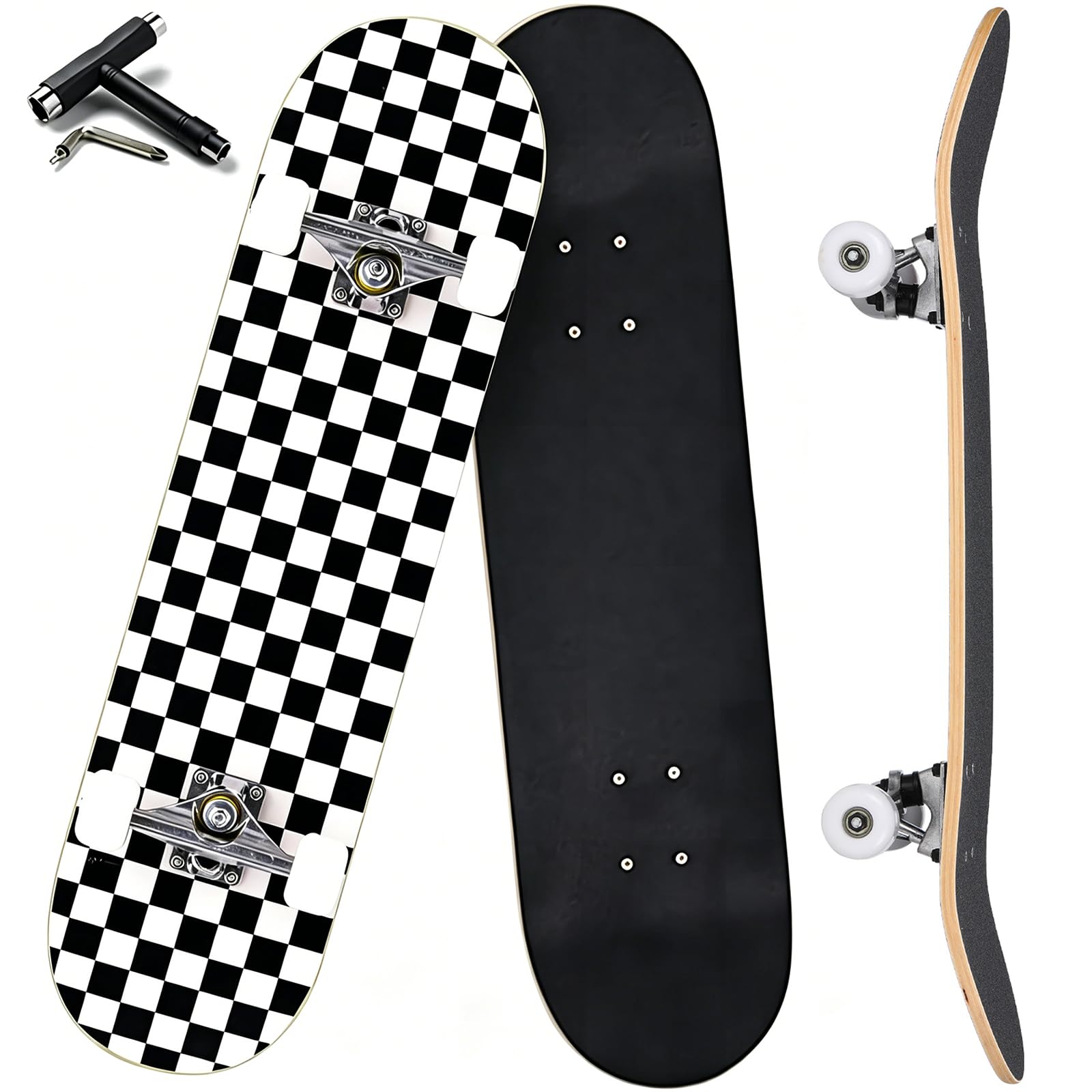
The Anyfun Checkerboard offers a near-identical spec sheet to boards costing twice as much: 7 layers of Canadian maple, ABEC-11 bearings, and 95A PU wheels that strike a reliable balance between grip and slide. The 31-by-8-inch deck gives you enough real estate for a natural stance without feeling like you’re steering a longboard. The concave is moderate — enough to feel the pockets for kickflips but forgiving enough for a six-year-old stepping on for the first time.
Where this board really earns its spot is the wheel-and-bearing combo. The 95A durometer wheels absorb sidewalk chatter without turning mushy, and the ABEC-11 bearings spin freely right out of the box. One common real-world note: the trucks arrive overtightened from the factory. Backing off the kingpin nut by a half-turn makes a dramatic difference in turning responsiveness — a two-minute fix that transforms the ride feel. Some users also report that the included T-tool fits the axle nuts better than the kingpin nut, so keep a standard skate tool handy.
Durability is solid for the price, though one reviewer noted cracking after an hour of kickflips on concrete. That’s not unusual for any board in this class — the 7-ply deck is built for learning, not repeated stair drops. For flat-ground tricks, campus cruising, and park sessions, this is a capable platform that won’t hold back progression.
Why it’s great
- Authentic 7-ply Canadian maple with a 330-pound weight limit
- 95A wheels / ABEC-11 bearings deliver smooth, fast rolling
- Comes with a T-tool for quick truck adjustments
Good to know
- Trucks often need loosening for proper turning feel
- Deck may develop stress cracks during heavy trick practice on rough concrete
3. CAPARK 31″ Pro Complete Skateboard

The CAPARK Ocean board mirrors the Anyfun in core construction — 7 plies of Canadian maple, double-kick concave, and a 31-by-8-inch silhouette — but it differentiates itself with 54mm 95A wheels that roll a bit faster over longer distances. The larger contact patch gives you a more planted feel when pushing across bumpy blacktop, and the ABEC-11 bearings hum along with less friction than the ABEC-7 units found on many comparably priced boards.
Customer feedback highlights the grip tape as a standout: it’s dense, waterproof, and holds traction even after a few light rain rides. The heavy-duty aluminum alloy trucks come with decently firm bushings that resist speed wobble during downhill rolls. One catch: the bushings are hard enough that lighter riders — kids under 70 pounds — may struggle to carve turns without leaning aggressively. Swapping in softer cone bushings is a cheap fix if you want a looser feel.
The heat-transfer graphics are clean and reportedly resist scuffing, though the “Ocean” colorway may not appeal to everyone. For an adult beginner or a teen wanting a board that doesn’t feel undersized, this is a stable, confidence-inspiring platform. The 220-pound load capacity is standard for this tier, but the 4.7-pound overall weight keeps it manageable for carrying into a shop or up a flight of stairs.
Why it’s great
- 54mm wheels roll smoothly over rough pavement and cracks
- Waterproof grip tape maintains traction in damp conditions
- Sturdy aluminum trucks with reliable kingpin hardware
Good to know
- Factory bushings are stiff, limiting turn responsiveness for lighter riders
- Bearing shields are basic — consider a drop of synthetic lube after a few sessions
4. Gingili Life Skull 31″ Complete Skateboard

The Gingili Life board leans harder into visual appeal and vibration dampening than the rest of this list. The 88A durometer wheels are noticeably softer than the 95A standard — they mute road buzz effectively, making this a better choice for neighborhood cruising than park trick practice. The trade-off is speed: softer wheels absorb your push energy, so you’ll need to pump more frequently to maintain momentum on long stretches.
The 7-ply maple deck is solidly built, though the load capacity tops out at 220 pounds. The double kick is present but shallower than the CLYCTIP or Anyfun boards, which limits leverage for advanced tricks like varial flips. Beginners, however, won’t notice the difference — the concave still gives enough pocket to feel where your feet are without thinking about it. The included carrying sleeve is a nice bonus for parents who want to keep the board clean between sessions, though the sleeve’s padding is thin and one reviewer noted wear-through from friction during shipping.
The skull graphic uses heat-transfer printing that holds up against abrasion from sidewalk slides. Overall, this board suits a younger rider (ages 9–14) who wants a stylish cruiser for rolling around the neighborhood. If your goal is strictly trick progression, the softer wheels and shallower concave will hold you back compared to the higher-durometer options above.
Why it’s great
- 88A wheels absorb bumps for a smoother ride on rough pavement
- Creatively designed graphics appeal to younger skaters
- Comes with a portable carrying sleeve for transport and storage
Good to know
- Softer wheels reduce roll speed and require more frequent pushing
- Shallow concave limits control for advanced trick execution
5. Nattork 22″ Mini Cruiser Skateboard

This is the outlier of the group — a compact 22-inch mini cruiser with a PP plastic deck instead of maple wood. That plastic construction makes it lighter (under 4 pounds) and completely weather-resistant, but it also eliminates the pop and flex that define a real skateboard. This isn’t a board for learning ollies or kickflips. It’s a balance-training tool for very young children (ages 4 to 8) who need a stable, low-to-the-ground platform to learn pushing and turning.
The light-up wheels are the main draw. They use self-generating LEDs that illuminate when the wheels spin, providing visibility at dusk without batteries. The 78A durometer wheels are soft enough to grip indoor tile and smooth concrete without slipping, but they’re frankly too sticky and slow for any serious outdoor riding on rough surfaces. ABEC-7 bearings are adequate for these small-diameter wheels but won’t generate the speed older kids or adults expect.
Several parents report that their 5- and 10-year-olds ride this daily with zero complaints. The 220-pound weight limit is technically higher than the board’s intended rider weight, so structural failure is unlikely. However, the PP deck flexes noticeably under any adult stepping on it, and the 5.9-inch width is narrow — comfortable for small feet but unstable for anyone over a youth shoe size 5. This is a purpose-built first board for toddlers, not a cheap alternative to a full-size setup.
Why it’s great
- Flashing light-up wheels improve visibility for evening rides
- Lightweight and compact, fits easily into a backpack
- No bearings to lubricate — low maintenance for busy parents
Good to know
- PP plastic deck has zero pop, unsuitable for learning tricks
- Narrow 5.9-inch deck feels unstable for riders over 80 pounds
FAQ
Can a cheap skateboard handle flip tricks?
What’s the right wheel durometer for a beginner?
My kid is 5 years old. Should I buy a mini cruiser or a full-size 31-inch board?
Final Thoughts: The Verdict
For most users, the cheap skateboard winner is the CLYCTIP 31″ because its 8-ply maple deck and ABEC-11 bearings deliver genuine performance without a premium price. If you want the best combination of pop and roll speed for trick progression, grab the Anyfun Checkerboard. And for a very young child learning basic balance on smooth pavement, nothing beats the Nattork Mini Cruiser, light-up wheels and all.

Mo Maruf
I created WellFizz to bridge the gap between vague wellness advice and actionable solutions. My mission is simple: to decode the research and give you practical tools you can actually use.
Beyond the data, I am a passionate traveler. I believe that stepping away from the screen to explore new environments is essential for mental clarity and physical vitality.