Our readers keep the lights on and my smoothie glass nicely filled. As an Amazon Associate, I earn from qualifying purchases.
Specs are compiled from manufacturer listings and verified buyer reviews and can change over time — please confirm the key details on the product page before buying.
Bad audio ruins a good shot quicker than bad video does. The fix is simple: you do not need a pro budget to get clean, directional sound that cuts out crowd rumble or the hum of an air conditioner. A cheap shotgun microphone is the easiest upgrade you can make, and today’s options pack serious features into tiny, battery-free bodies.
I’m Mohammad Maruf — the founder and writer behind WellFizz. This guide is built by comparing the manufacturers’ published specifications and the patterns across verified customer reviews, so you get each pick’s real strengths and trade-offs instead of marketing spin.
You want a best cheap shotgun microphone that fits your camera, phone, or computer, stays within your budget, and does not clutter your bag.
Quick Picks
- RØDE VideoMic GO II Helix — Best Overall
- Movo X1-Mini — Top Performer
- SENNHEISER Professional MKE 200 — Premium Pick
- Rode VideoMicro — Best Value
- Deity V-Mic D4 Mini — Versatile Pick
- COMICA VM10 PRO — Mid-Range Value
- COMICA CVM-VM10II — Budget Champion
How To Choose The Best Cheap Shotgun Microphone
A budget shotgun mic is a simple tool: it points at your subject and ignores everything else. You focus on three things: what cable it uses, how it rejects side noise, and whether it needs batteries.
Connection Type: Analog (3.5mm) vs Digital (USB-C)
Most budget mics use a standard 3.5mm jack, which works with cameras and many laptops. A few newer models add a USB-C output, letting you plug directly into a smartphone or a computer without an adapter. Some mics, like the Movo X1-Mini, include both cables in the box.
Polar Pattern: Why Directional Matters
A cheap shotgun mic almost always uses a cardioid or supercardioid polar pattern. That means it picks up sound mostly from the front and rejects noise from the sides and the back. This is the whole point of a shotgun mic — it keeps your subject’s voice clean while a busy street or a noisy coffee shop fades into the background.
Accessories: Shock Mount and Wind Protection
A shock mount (a flexible cradle that suspends the mic) stops handling noise and camera vibrations from reaching the recording. A foam windscreen or a furry “dead cat” wind muff is essential when you shoot outside — even a light breeze can ruin a take.
Quick Comparison
| Model | Best For | Connection | Weight | Audible Noise | Amazon |
|---|---|---|---|---|---|
| RØDE VideoMic GO II Helix | Versatile USB-C & 3.5mm use | 3.5mm + USB-C | 57 g | 79 dB | Amazon |
| Movo X1-Mini | Broadcast-quality digital audio | 3.5mm + USB-C | — | 80 dB | Amazon |
| SENNHEISER MKE 200 | Outdoor durability | 3.5mm (TRS/TRRS) | — | 75 dB | Amazon |
| Rode VideoMicro | Ultra-low self-noise | 3.5mm TRS | 42 g | 20 dB | Amazon |
| Deity V-Mic D4 Mini | Extra 3.5mm input | 3.5mm (TRS/TRRS) | 0.15 kg | 74 dB | Amazon |
| COMICA VM10 PRO | Digital & analog switching | 3.5mm + USB-C | 37 g | — | Amazon |
| COMICA CVM-VM10II | Entry-level value | 3.5mm (TRS/TRRS) | — | — | Amazon |
In‑Depth Reviews
1. RØDE VideoMic GO II Helix

A pocket-sized shotgun that talks to cameras and phones without adapters.
It gives you both a 3.5mm TRS output (for cameras) and a USB-C output (for smartphones or computers) in a chassis that weighs 57 grams. You get a simple setup with no switches, no batteries, and no complicated controls — just plug it in and the directional pickup handles the rest. The HELIX isolation mount is a cradle that protects your audio from knocks and handling noise better than a standard shock mount, according to the manufacturer.
Buyers report that in a very crowded symposium, voices still come through clearly. One reviewer described a built-in “superpower” that improve the performance compared to previous budget favorites. The trade-off: at 79 dB of audible noise (self-noise, the hiss the mic makes on its own), it is not the quietest mic on paper. Some users note they need minor post-production tweaks for perfect voice isolation. It is sharper for multi-device recording than the Rode VideoMicro, which lacks USB-C entirely.
If you shoot with a camera and also need to record directly to a phone or a laptop without carrying a bag of adapters, this is the most flexible pick on the list. Its size means you can keep it on your camera full-time. For silent-room recording where lowest self-noise is critical, a lower-hiss model like the Rode VideoMicro suits you better.
Why it stands out
- Dual 3.5mm and USB-C output covers cameras, phones, tablets, and computers
- HELIX isolation mount reduces handling noise better than standard shock mounts
- Extremely lightweight at 57 g — easy to carry on-camera
A couple of limits
- Audible noise at 79 dB means it is not the quietest option
- May need subtle audio tweaks in post for professional-grade isolation
Reach for this if: You need one microphone that works across all your devices — camera, phone, and PC — without adapters or extra batteries.
Look elsewhere if: You record in very quiet environments where the lowest possible self-noise matters more than multi-device compatibility.
2. Movo X1-Mini

Aluminum body, digital output, and a Rycote shockmount packed into a compact frame.
You get up to 24-bit resolution in its digital USB-C mode, which means finer audio detail than purely analog mics in this price range. The aluminum body feels more premium than the plastic shells on cheaper options. The included Rycote shockmount (a brand known for effective vibration isolation) does a noticeably good job at keeping camera vibrations out of the audio. It also ships with both 3.5mm TRS and TRRS cables plus a USB-C cable, so you are covered whether you plug into a Canon DSLR or a newer Android phone.
Owners mention the microphone is very sensitive and provides clarity, but recommend working on placement to keep it from distorting. One reviewer notes that for gaming and Zoom calls, the clarity from up to 5 feet away exceeds what typical gaming headsets deliver. The audible noise rating of 80 dB is a bit higher than some competitors, meaning its internal electronics produce a faint hiss in very quiet settings. Its supercardioid pattern (which rejects more side noise than a standard cardioid pattern) is effective at focusing on what is in front of it. It is a step up in digital quality compared to the RØDE VideoMic GO II Helix, which only delivers analog-level USB-C audio.
This is for a content creator who wants a USB-C digital workflow — recording straight to a phone or a computer with no audio interface — without sacrificing the option to mount it on a camera. If you need the absolute quietest mic for silent-room recording, a lower-noise model like the Rode VideoMicro will serve you better.
The strong points
- Up to 24-bit resolution in digital mode for broadcast-quality sound
- Rugged aluminum construction with a premium Rycote shockmount
- Includes three cables for cameras, smartphones, and computers
The weak ones
- Audible noise at 80 dB is on the higher side for quiet indoor work
- Very sensitive — needs careful gain management to avoid distortion
Best for digital-first creators: If you record directly to a computer or a phone using USB-C and want a pro-feeling metal mic with a great shockmount, this is your pick.
skip it if: You need the absolute quietest mic for silent-room recording — a lower-noise model will serve you better.
3. SENNHEISER Professional MKE 200
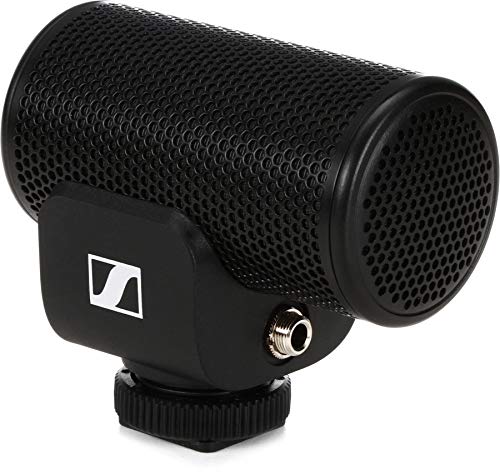
A Sennheiser shotgun that survived a rainstorm and kept recording crisp audio, according to reviewers.
The MKE 200 packs Sennheiser’s broadcast heritage into a compact form that does not need an external shock mount — it has an integrated internal suspension system and built-in wind protection, so it is ready to shoot outdoors when you slide it into the cold shoe (the standard camera-mount slot). Its frequency response extends down to 40 Hz (40 hertz, a low bass range), which gives voices a richer, fuller tone than mics that only reach 100 Hz. The interchangeable 3.5mm TRS and TRRS cables let you move between a DSLR and a smartphone, though you will need a separate adapter for modern iPhones with a Lightning port.
One reviewer described this as the best outdoor mic they have ever had, noting it survived heavy rain during a car show recording and remained fully operational, with audio staying crisp. Another buyer mentions the audio can sound a bit thin right from the start and benefits from EQ (equalizer) editing for the best results. At an audible noise level of 75 dB, it sits in the middle of the pack — quieter than the Movo X1-Mini (80 dB) but not as quiet as the Rode VideoMicro (20 dB), which makes it a solid middle ground for outdoor use.
This is the mic you grab when you are shooting outdoors in afternoon weather or want a reliable brand with a wide frequency range that captures more body in the voice. If you prefer plug-and-play audio with no post-production tweaking, a flatter-response mic like the RØDE VideoMic GO II Helix may suit you better.
The highlights
- Excellent outdoor durability with built-in wind protection and shock mount
- 40 Hz lower frequency range gives richer vocal tone than many rivals
- Interchangeable TRS and TRRS cables for camera and mobile use
The trade-offs
- Audio can sound thin straight from the box — some EQ tweaking helps
- No USB-C smartphone cable included; needs an adapter for Lightning iPhones
Choose this for: Outdoor recording where weather resistance and a wide frequency response matter more than plug-and-play flatness.
Not for you if: You want the simplest possible setup with no post-production tweaking.
4. Rode VideoMicro

The gold standard of budget shotgun mics, famous for how little noise it makes itself — just 20 dB of self-noise.
At 42 grams and 80mm long, it is the featherweight of the group, and its audible noise is only 20 decibels (dB) — a full 54 dB quieter than the Deity V-Mic D4 Mini. That means you can record in a quiet room without a distracting hiss underneath your voice. It is fully passive and runs off your camera’s plug-in power (minimum 3 volts), so there are no batteries. The all-metal body feels sturdy, and the included Rycote Lyre shock mount is effective for something that comes in the box at this price.
Customers note excellent rear noise rejection, making it ideal for recording live music where you need to isolate the source from the crowd behind it. Another buyer has been using it reliably for two years indoors and outdoors. The main limitation: it only has a single 3.5mm TRS cable for cameras — no TRRS cable for smartphones in the box, so you will need an adapter or a separate patch cable for phone use. It also requires louder speaking for vlogging, as it is not a very sensitive mic.
If your priority is a clean, silent recording with a proven mic that has been the community favorite for years, and you work mainly with a camera, this is the safest buy on the list. If you need a single cable to connect directly to an iPhone or Android phone without buying extra accessories, the Deity V-Mic D4 Mini includes that cable in the box.
What makes it great
- Extremely low self-noise at 20 dB — the quietest on this list
- Ultra-light at 42 grams, ideal for keeping on a camera gimbal
- Durable all-metal construction with an excellent included shock mount
What to watch for
- Only includes a TRS camera cable — no smartphone cable in the box
- Requires louder speaking for vlogging, as it is not a very sensitive mic
Perfect for camera shooters: If you record with a DSLR or mirrorless and want the cleanest, most hiss-free recording, grab the VideoMicro.
pass on it if: You need a single cable to connect directly to an iPhone or an Android phone without buying extra accessories.
5. Deity V-Mic D4 Mini

A small mic with a secret weapon: an extra 3.5mm input for a second microphone.
The D4 Mini is an ultra-compact supercardioid shotgun that gives you a feature rare at this price — a secondary 3.5mm aux input that lets you plug in a lavalier mic (a small clip-on mic) and record both sources onto a single audio track. This is a huge bonus for interview-style content where you want the shotgun pointing at the speaker and a lapel mic as a backup. It also ships with both a TRS camera cable and a TRRS phone cable, so unlike the Rode VideoMicro, you can plug it into a smartphone straight from the start.
One buyer reports the D4 Mini is their first DSLR mic and it works perfectly with their smartphone using the bundled TRRS cable, saving them about on a separate adapter. At 74 dB of audible noise, it is nearly 54 dB louder than the VideoMicro — meaning you will hear a faint background hiss in quiet recordings. The 20 mph wind rating means it handles moderate breezes okay with the included faux fur windshield. Its 0.15 kg weight is about 3.5 times heavier than the VideoMicro’s 42g, though still compact.
This is a smart pick for interviewers and run-and-gun creators who value recording a secondary audio source without any extra hardware. If you need pristine, silent recordings, the self-noise is too high for quiet rooms, so the Rode VideoMicro is a better fit.
Key strengths
- Rare secondary 3.5mm aux input for a lavalier microphone
- Includes both TRS and TRRS cables for cameras and smartphones
- Lightweight and can be used on a boom pole
Key weaknesses
- 74 dB audible noise means noticeable hiss in quiet spaces
- Internal lav input records on the same track with inconsistent volume
Grab this for: Interviews where you want both a shotgun and a lavalier recording to the same track without an audio mixer.
Avoid it if: You need pristine, silent recordings — the self-noise is too high for quiet rooms.
6. COMICA VM10 PRO
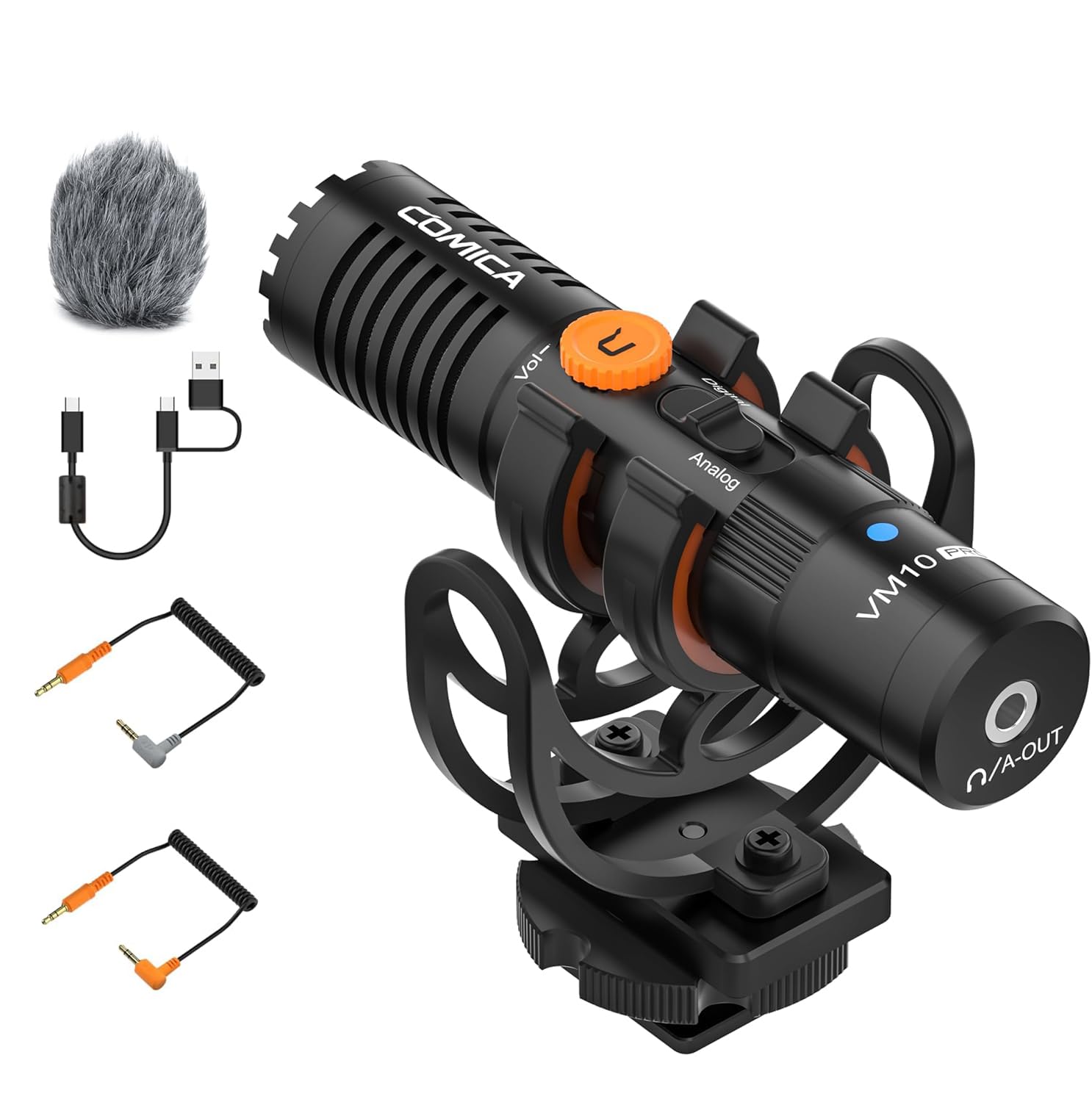
A featherweight 37-gram mic that switches between analog and digital outputs.
The key difference between this and the entry-level CVM-VM10II is the adjustable gain control and the USB-C digital output, which makes this model work smoothly with modern computers and phones in addition to cameras. At 37 grams and about 0.87 inches thick, it is one of the smallest and lightest mics on the list. The 100% aluminum body gives it a more premium feel than plastic alternatives.
Reviewers point out this mic excels at eliminating bar noise and capturing clear sound from 20 feet away, making it ideal for karaoke video recording. One reviewer noted that on a PC using the analog cable, the audio is quiet and requires a mic boost, and the USB connection starts very quiet too until you engage the gain knob. This means the VM10 PRO rewards users who are comfortable adjusting audio levels but may frustrate those who want plug-and-play simplicity. Its dimensions (3.62 x 1.18 x 0.87 inches) are 41% more compact than the larger CVM-VM10II. It is a lighter, more feature-rich alternative to the Movo X1-Mini if you need gain control on the mic itself.
This is the right choice for a vlogger or streamer who needs a small, switchable mic to move between a camera and a computer setup and does not mind tweaking the gain dial. If you want a single, dead-simple connection with no level adjustment needed, the RØDE VideoMic GO II Helix is simpler to operate.
The good
- Dual digital (USB-C) and analog (3.5mm) output modes for broad compatibility
- Extremely compact and lightweight at 37 grams
- Stepless gain control in digital mode lets you dial in the perfect level
The not-so-good
- Analog output is quiet on PCs — often requires a mic boost
- Some users find the setup quirky and not perfectly plug-and-play
Ideal for multi-device creators: If you switch between a camera and a computer and want the smallest possible mic with adjustable gain, get the VM10 PRO.
Not for you if: You want a single, dead-simple connection with no level adjustment needed.
7. COMICA CVM-VM10II

The cheapest way to get a solid cardioid mic with a full accessory kit.
At the lowest entry fee on this list, the CVM-VM10II gives you a cardioid microphone, a professional shock-absorption stand, a hard carrying case, a foam windscreen, a furry wind muff, and separate cables for both cameras and smartphones. The cardioid pattern (heart-shaped, picks up sound mostly from the front) makes it a straightforward upgrade from your camera’s built-in mic.
Shoppers say a key trade-off: the mic must be 18 to 24 inches from the speaker to avoid a distant, hollow sound. Another reviewer found that the plastic cold shoe mount sags under the weight of the furry cover, causing the mic to drift into the camera frame. On the positive side, multiple users say the audio quality is great for the price and recommend it over a more expensive Rode Mic. The included 3.5mm TRRS smartphone cable means you can start recording on your phone right away. Its cardioid pattern is less focused than the supercardioid on the Movo X1-Mini, meaning it picks up more side noise in busy environments.
This mic is for someone just starting out with video or live streaming who wants to spend as little as possible while still getting a real directional mic with a shock mount and all the cables. If you need consistent placement on top of the camera without the mount drooping into the shot, the metal-bodied Movo X1-Mini is a step up in build quality.
Pros
- Comes with a complete accessory kit: case, two windscreens, and two cables
- No battery needed — passive design powered by your device
- Cardioid pattern reduces surrounding room noise for the price
Cons
- Must stay 18–24 inches from the subject to avoid distant sound
- Plastic cold shoe mount can sag under the furry wind muff
For absolute beginners: If your budget is tiny and you need a functional microphone plus all the accessories in one box, the CVM-VM10II is a low-risk starting point.
Move up if: You need consistent placement on top of the camera without the mount drooping into the shot.
Understanding the Specs
Audible Noise / Self-Noise
This is the faint hiss a microphone produces when no sound is hitting it, measured in decibels (dB). A lower number, like 20 dB on the Rode VideoMicro, means a quieter, cleaner recording in silent rooms. A higher number, like 74 dB on the Deity V-Mic D4 Mini, means you will hear a subtle background hiss — more noticeable indoors than outdoors.
Supercardioid vs Cardioid
These are directional patterns that define where the mic picks up sound. A cardioid pattern (heart-shaped) picks up mostly from the front and partially from the sides. A supercardioid pattern is narrower and rejects more sound from the sides, offering better focus on the subject. If you are recording in a busy environment, a supercardioid mic will do a better job of isolating your speaker.
FAQ
Do cheap shotgun microphones need batteries?
Can I use a shotgun mic with my smartphone?
What is the difference between TRS and TRRS cables?
Why does my shotgun mic sound distant?
What does a supercardioid polar pattern do?
Will a cheap shotgun mic fit on any camera?
How does a shock mount help my audio?
What is a dead cat wind muff and when do I need one?
Is a USB-C shotgun mic better than a 3.5mm one?
Can a cheap shotgun mic pick up sound from far away?
Final Thoughts: The Verdict
Across the board, the cheap shotgun microphone winner is the RØDE VideoMic GO II Helix because it gives you both 3.5mm and USB-C outputs, a clever isolation mount, and proven audio quality in a tiny 57-gram package. If you want the absolute quietest recording with the lowest self-noise, grab the Rode VideoMicro. And for a digital-first creator who wants 24-bit USB-C audio with a metal body, the standout is the Movo X1-Mini.
How We Picked
We do not accept paid placement. Every pick is matched to a real buyer and a real use-case; we do not hands-on test units.
Sources & Methodology
Specifications: manufacturer listings and product documentation. Review insights: verified customer reviews, as of July 2026. Pricing: not shown on this page (it changes often); check the current price via the retailer link.
As an Amazon Associate, WellFizz earns from qualifying purchases. This does not affect which products we feature.
Related Guides

Mo Maruf
I created WellFizz to bridge the gap between vague wellness advice and actionable solutions. My mission is simple: to decode the research and give you practical tools you can actually use.
Beyond the data, I am a passionate traveler. I believe that stepping away from the screen to explore new environments is essential for mental clarity and physical vitality.