Our readers keep the lights on and my smoothie glass nicely filled. As an Amazon Associate, I earn from qualifying purchases.
Finding a camera that delivers professional-level results without requiring a second mortgage is the central tension in today’s gear market. Whether you need rugged 4K for outdoor action, a full-frame sensor for portrait work, or a versatile mirrorless system for hybrid photo and video, the affordable tier now offers real capability — if you know which specs actually matter and which marketing features you can safely ignore.
I’m Mohammad Maruf — the founder and writer behind WellFizz. I’ve spent hundreds of hours analyzing sensor sizes, stabilization systems, lens ecosystems, and real-world user feedback to separate genuine value from spec-sheet hype in this crowded price bracket.
This guide cuts through the noise to help you find the best cheap professional camera for your specific shooting style without wasting money on features you will never use.
How To Choose The Best Cheap Professional Camera
The phrase “professional” in a cheap camera often means different things depending on whether you shoot video or stills. An action camera valued for rugged stabilization will feel frustrating for studio portraits, and a full-frame DSLR loved for dynamic range may weigh too much for hiking. The trick is matching the camera’s strengths to your specific workflow.
Sensor Size Dictates Your Ceiling
Full-frame sensors (35.6 x 23.8mm) capture more light per pixel, giving you better dynamic range, shallower depth of field, and superior low-light performance. APS-C sensors (roughly 22 x 15mm) trade some of that light-gathering for smaller, lighter bodies and cheaper lenses. For professional portrait or event work, full-frame remains the gold standard, but APS-C is more than capable for run-and-gun video and travel photography.
Stabilization Type Changes What You Can Shoot Handheld
In-body image stabilization (IBIS) shifts the sensor to compensate for shake, working with any lens you mount. Lens-based optical stabilization (OIS) works only with that specific lens. Hybrid systems that combine both deliver the smoothest handheld footage. If you shoot video on the move — action sports, vlogging, gimbal-free walking shots — prioritize IBIS or a camera with proven RockSteady/HorizonSteady performance.
The Lens Mount is a Long-Term Commitment
Your camera body is temporary; your lens collection is the real investment. Canon’s RF mount is newer and expanding, Sony’s E-mount has the widest third-party selection, Micro Four Thirds offers the lightest telephoto options, and Nikon’s F-mount (on DSLRs) offers incredible used-glass value. A cheap camera with a dead-end mount will cost you more in frustration later than spending a little more upfront on a system with room to grow.
Quick Comparison
On smaller screens, swipe sideways to see the full table.
| Model | Category | Best For | Key Spec | Amazon |
|---|---|---|---|---|
| Insta360 X5 | 360° Action | Immersive POV & reframable content | 8K30fps, dual 1/1.28″ sensors | Amazon |
| DJI Osmo Action 6 | Action Camera | 8K variable-aperture vlogging | 8K23fps, f/2.0–f/4.0 variable aperture | Amazon |
| Sony a7 III | Full-Frame Mirrorless | Professional stills & video hybrid | 24.2MP BSI full-frame sensor | Amazon |
| Canon EOS 5D Mark IV | DSLR Workhorse | Studio & event photography | 30.4MP full-frame CMOS, 61 AF points | Amazon |
| Panasonic LUMIX G85 | Mirrorless Hybrid | Stabilized 4K video on a budget | 16MP MFT, 5-axis IBIS, 4K30fps | Amazon |
| Sony Alpha a3000 | Entry Mirrorless | APS-C image quality at lowest price | 20.1MP APS-C Exmor sensor | Amazon |
| Canon EOS R100 | Entry Mirrorless | Beginner-friendly RF mount system | 24.1MP APS-C, 4K24fps, Dual Pixel AF | Amazon |
| Canon EOS Rebel T7 | Entry DSLR | First DSLR for learning fundamentals | 24.1MP APS-C, 1080p30fps, 9 AF points | Amazon |
| DJI Osmo Action 5 Pro | Action Camera | Long battery & low-light action | 4K120fps, 1/1.3″ sensor, 13.5-stop DR | Amazon |
| Nikon D3500 | Entry DSLR | Budget stills with no-frills operation | 24.2MP APS-C, 5fps burst, no OLPF | Amazon |
| Panasonic LUMIX FZ80D | Bridge Camera | Extreme zoom in a portable body | 18.1MP, 20-1200mm equiv., 60x zoom | Amazon |
In‑Depth Reviews
1. Insta360 X5
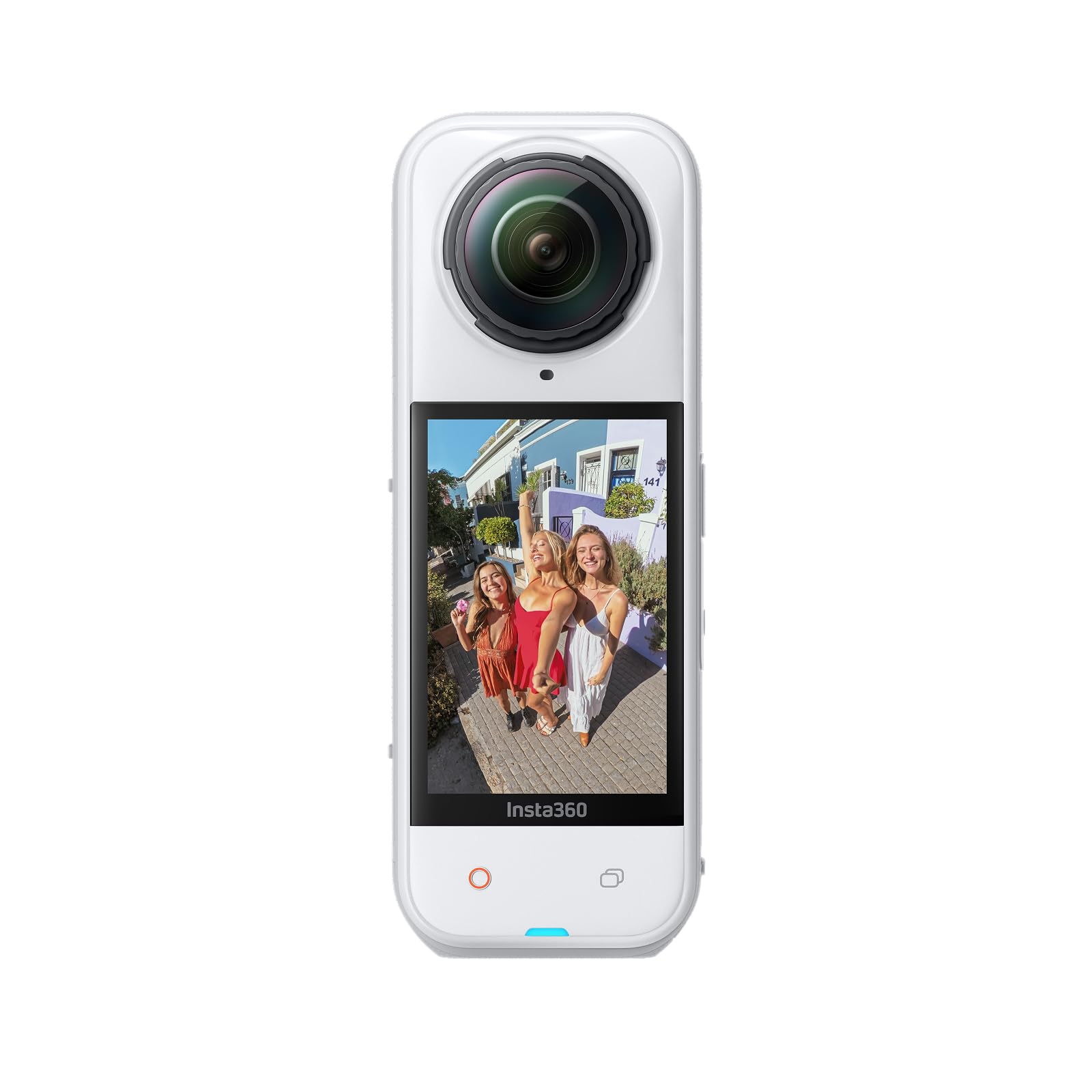
The Insta360 X5 is a category-defining 360° action camera that shoots 8K30fps video using dual 1/1.28-inch sensors. Its triple AI chip design drives aggressive noise reduction in low light, and the invisible selfie stick effect lets you capture what looks like drone-level third-person shots without any extra equipment. FlowState stabilization combined with full 360° Horizon Lock means you cannot get shaky footage, even during full barrel rolls.
Replaceable lenses are a major upgrade for durability — scratch or crack a lens and you swap it in seconds rather than replacing the whole unit. The new four-mic array with integrated wind guard delivers noticeably cleaner audio during outdoor vlogging, and the waterproof rating down to 15 meters (without a housing) makes it a serious underwater camera. Battery life hits 185 minutes, and you can fast charge to 80% in 20 minutes.
The trade-off is file size: 360° 8K footage requires fast V60 or V90 microSD cards and a PC with decent horsepower for reframing edits. The Insta360 app handles one-tap AI exports well for casual use, but anyone wanting flat standard 16:9 footage may find the workflow overcomplicated. It also requires the separately sold invisible selfie stick to achieve that signature shot.
Why it’s great
- Unmatched creative flexibility with reframable 360° footage
- Replaceable lenses add years to the camera’s life
- Excellent stabilization with full horizon lock
Good to know
- Large file sizes demand fast memory cards and a capable computer
- Standard POV shooters may find the 360° editing workflow unnecessary
2. DJI Osmo Action 6
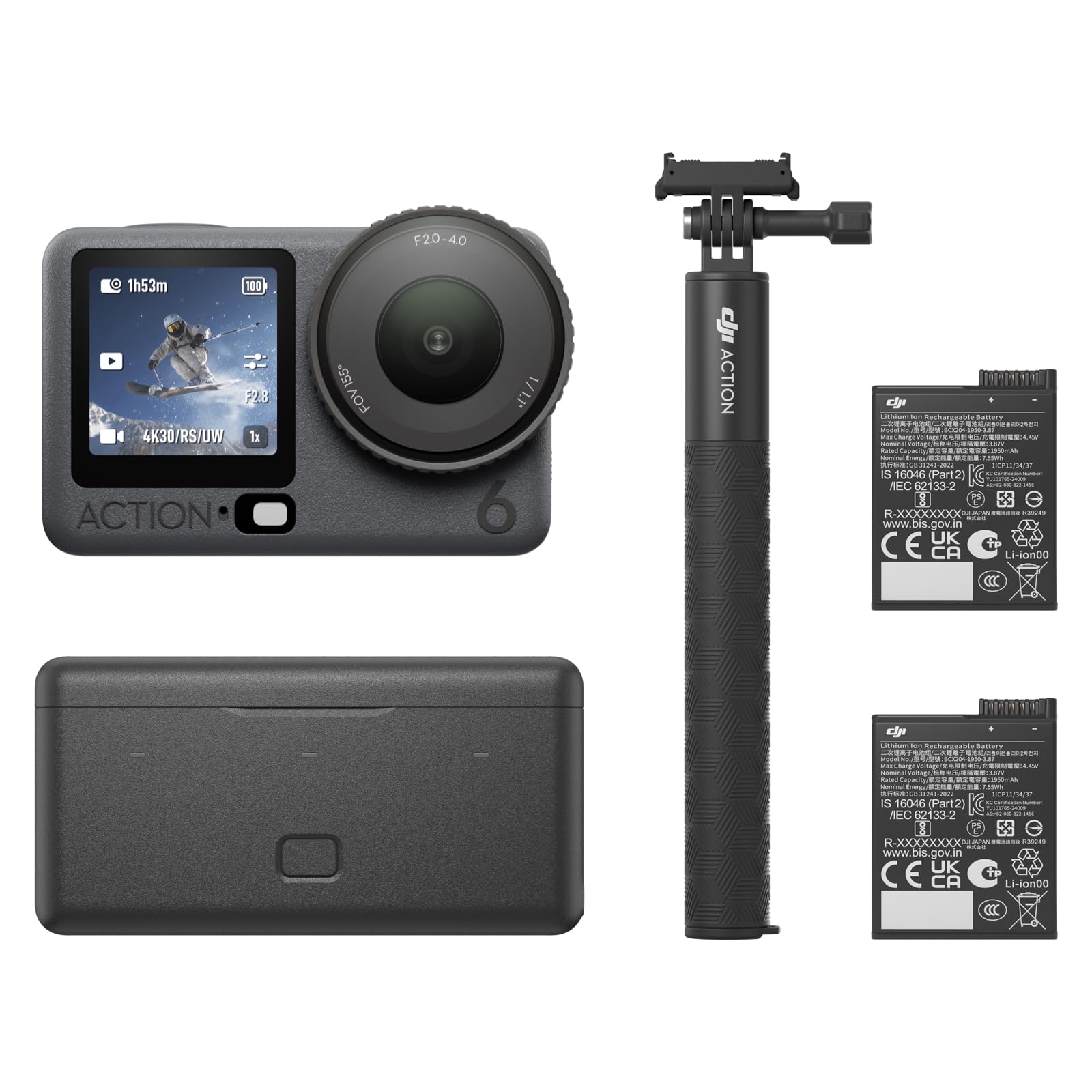
The DJI Osmo Action 6 takes the already-strong Action 5 platform and adds a larger 1/1.1-inch square sensor and a variable aperture ranging from f/2.0 to f/4.0. This combination lets you adapt exposure on the fly — open up in low light or stop down for deeper depth of field in bright scenes — a feature unique among action cameras at this price. The 8K video mode gives you room to crop and reframe in post without losing sharpness.
HorizonSteady locks the horizon flat even during 360° rolls, making it feel like a gimbal shot without the bulk. The Enhanced Combo includes two 1950mAh Extreme Batteries Plus and a multifunctional battery case, pushing total recording time well past eight hours for full-day shoots. Dual direct microphone connectivity means you can record two-person interviews without needing an external receiver, and the 50GB of built-in storage is a lifesaver if you forget your SD card.
Audio from the onboard mics is usable but thin for professional voice work — external mics still produce notably richer results. The waterproof touchscreen is functional but less responsive when wet, and some users report that the D-LogM color profile requires a light grade to match the standard profile’s look. Still, for a sub-premium action camera that can also serve as a vlogging rig, this is the most versatile option available.
Why it’s great
- Variable aperture is a genuine innovation for action cameras
- Long battery life with included dual-battery combo
- Excellent stabilization with full horizon lock
Good to know
- Onboard audio benefits from an external mic for professional use
- Wet touchscreen responsiveness can be finicky
3. DJI Osmo Action 5 Pro

The DJI Osmo Action 5 Pro uses a 1/1.3-inch sensor with 2.4-micron pixels and 13.5 stops of dynamic range to deliver exceptional low-light performance for a sub-mid-range action camera. It records 4K at 120fps for smooth slow-motion, and the 4nm chip enables accurate subject tracking that keeps fast-moving cyclists or skiers perfectly framed even in 9:16 portrait mode. The dual OLED touchscreens are bright and responsive, making framing easy in direct sunlight.
Battery life is the headline here: the 1950mAh Extreme Battery Plus gives you up to four hours of continuous recording in normal temperatures and 3.6 hours at -20°C. The IP68 rating lets you dive to 20 meters without a housing, and the color temperature sensor auto-adjusts white balance underwater so you do not need red filters. Voice control responds reliably within one meter, which is genuinely useful when you are wearing gloves.
The stabilization is very good but not quite as aggressive as the Action 6’s HorizonSteady — you will see slight horizon drift during full 360° barrel rolls. The 40MP still resolution is higher than the Action 6’s 38MP, but real-world photo quality is comparable. If you value battery endurance and low-light performance above the Action 6’s variable aperture, the 5 Pro is the smarter buy.
Why it’s great
- Industry-leading battery life for an action camera
- Excellent low-light performance with wide dynamic range
- Reliable voice and gesture controls for hands-free operation
Good to know
- Stabilization can show horizon drift during full rolls
- No variable aperture limits exposure flexibility
4. Sony a7 III

The Sony a7 III is the camera that made full-frame mirrorless accessible to serious enthusiasts. Its 24.2MP back-illuminated Exmor R sensor delivers 15 stops of dynamic range and clean files up to ISO 6400 with usable images well beyond. The 693-phase-detection autofocus points cover 93% of the frame, and the real-time Eye AF for humans and animals locks onto eyes with a stickiness that makes portrait and event work almost effortless.
Shooting at up to 10fps with full AF/AE tracking means you can capture action without leaving the silent electronic shutter mode. The NP-FZ100 battery is a massive upgrade over previous Sony bodies — expect around 710 shots per charge, which is class-leading for mirrorless. The kit 28-70mm f/3.5-5.6 lens is adequate for learning but will be the first upgrade most users replace with a fast prime or a constant-aperture zoom.
The menu system is famously dense and takes time to customize properly. The touchscreen only works for focus point selection, not menu navigation, and the 3-inch LCD is lower resolution than newer models. If you are coming from an older DSLR, the a7 III still feels like a massive leap in capability, especially for hybrid shooters who need both high-quality stills and 4K video in one body.
Why it’s great
- Incredible 15-stop dynamic range for pro-grade flexibility in post
- Reliable real-time Eye AF for portraits and pets
- Excellent battery life for a mirrorless camera
Good to know
- Menu system requires time to customize for quick access
- Kit lens is a placeholder; budget for better glass
5. Canon EOS 5D Mark IV
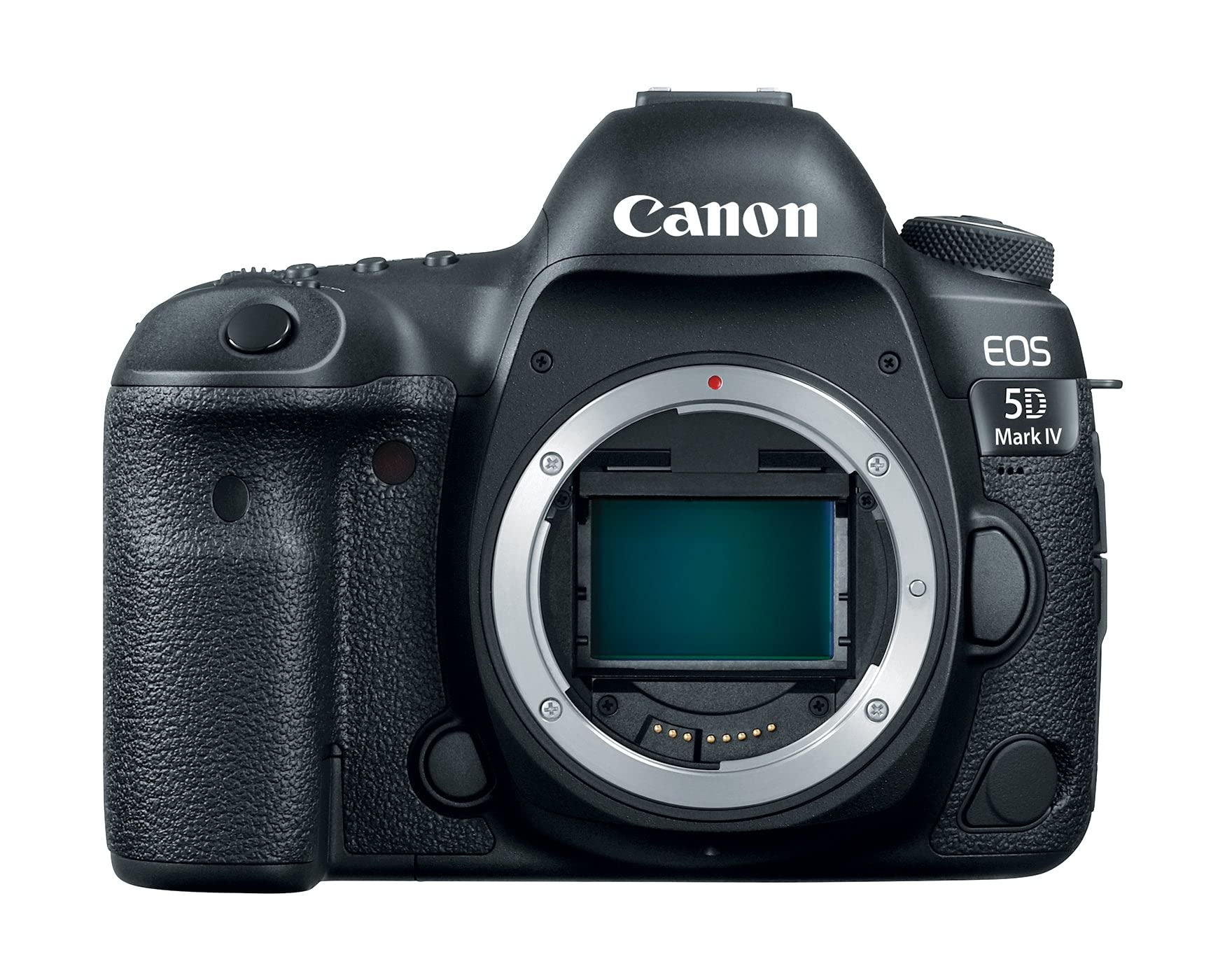
The Canon EOS 5D Mark IV is a professional DSLR workhorse that has proven itself across wedding, event, and commercial photography for years. Its 30.4MP full-frame CMOS sensor paired with the DIGIC 6+ processor delivers exceptional dynamic range and excellent high-ISO performance up to ISO 32000 (expandable to ISO 102400). The 61-point AF system with 41 cross-type points is fast and reliable in low light, and Dual Pixel CMOS AF makes live view shooting smooth and responsive.
Build quality is superb — magnesium alloy chassis, extensive weather sealing, and a shutter rated for 150,000 cycles mean this camera was designed to survive years of daily professional use. The optical viewfinder is bright and spacious, you get built-in GPS for geotagging, and the touchscreen, while not articulating, is responsive for AF point selection and image review. Wi-Fi and NFC make tethered transfer straightforward for studio workflows.
The 4K video implementation is a limitation: it uses Motion JPEG compression at 24/30fps, which produces massive file sizes and introduces a 1.74x crop factor. If video is your primary use, mirrorless options at similar prices offer better codecs and uncropped 4K. But for a photographer-focused professional tool with a deep EF lens ecosystem and the reliability that working shooters depend on, the 5D Mark IV remains a compelling choice.
Why it’s great
- Rock-solid build quality with excellent weather sealing
- Outstanding 30.4MP full-frame image quality and dynamic range
- Reliable 61-point AF system for low-light work
Good to know
- 4K video uses Motion JPEG with a significant crop factor
- No articulating screen limits creative angles
6. Panasonic LUMIX G85

The Panasonic LUMIX G85 packs a 16MP Micro Four Thirds sensor (without a low-pass filter) and combines it with 5-axis in-body image stabilization that works with virtually any lens you mount. The dual I.S. system — IBIS plus lens-based OIS — produces some of the smoothest handheld video you can get at this price, effectively turning any lens into a stabilized lens for walking shots. The 4K30fps video is oversampled, giving you sharp results, and the 4K Photo mode lets you extract 8MP stills from your clips.
The magnesium alloy front plate and weather-sealed construction are rare at this level, meaning the G85 handles light rain and dusty conditions without complaint. The 2.36M-dot OLED electronic viewfinder is crisp and lag-free, and the 3-inch fully articulating touchscreen makes vlogging and overhead shots simple. The included 12-60mm Power O.I.S. kit lens covers a useful 24-120mm equivalent range and is surprisingly sharp when stopped down slightly.
The 16MP sensor shows its age against modern 20MP+ APS-C competitors, especially in dynamic range where full-frame and larger sensors pull ahead. Low-light autofocus can hunt noticeably in dim conditions during 4K recording, and the battery life hovers around 330 shots per charge, which is below average for the category. Still, for videographers on a budget who need reliable stabilization, the G85 is a remarkably capable tool.
Why it’s great
- Effective 5-axis IBIS for stable handheld video
- Weather-sealed magnesium alloy build at a budget-friendly price
- Articulating touchscreen for flexible framing
Good to know
- 16MP sensor has less dynamic range than modern APS-C sensors
- Low-light AF can struggle during 4K recording
7. Sony Alpha a3000

The Sony Alpha a3000 offers entry into the Sony E-mount ecosystem at the lowest price for an interchangeable-lens APS-C camera. The 20.1MP Exmor APS-C sensor produces good image quality up to ISO 1600, with usable results beyond that in well-exposed shots. The body is designed around a DSLR-style grip that is genuinely comfortable for extended handheld shooting, and the built-in flash provides a usable emergency fill light.
Full HD 1080p video recording is present but basic — no 4K, no high frame rates, and the contrast-detect autofocus hunts during video recording. The electronic viewfinder has a low resolution (202K dots) that is fine for framing but not for critical focus checking. Where the a3000 shines is as a learning platform: you get full manual controls, RAW shooting capability, and access to the massive Sony E-mount lens library, including affordable third-party options from Sigma and Tamron.
The battery life is poor — expect around 20-30% drain per hour of active use, and the camera charges via USB with no included external charger. The LCD is low resolution (230K dots) and hard to see in bright sunlight. If you are budget-constrained and want to start building a Sony lens collection, the a3000 is a functional way in, but you will likely feel its limitations within weeks if you shoot seriously.
Why it’s great
- Lowest entry point to the Sony E-mount lens system
- Comfortable DSLR-style grip for long sessions
- Access to extensive third-party lens options
Good to know
- No 4K video and limited video autofocus performance
- Low-resolution viewfinder and LCD in bright conditions
8. Canon EOS R100

The Canon EOS R100 is the smallest and lightest body in the EOS R series, offering a 24.1MP APS-C sensor and the DIGIC 8 processor in a compact package that weighs less than many kit lenses. The RF mount gives you a clear upgrade path to Canon’s growing lineup of RF and RF-S lenses, and Dual Pixel CMOS AF with human, animal, and vehicle detection provides modern autofocus performance that was previously reserved for much more expensive cameras. The 143-zone AF area coverage makes tracking moving subjects reliable.
Continuous shooting at 6.5fps in One-Shot AF is decent for casual action, and the 4K24fps video (cropped) produces sharp footage for social media content. The camera connects to your phone via Wi-Fi and Bluetooth for easy image transfer and remote control. The included RF-S18-45mm f/4.5-6.3 IS STM lens is compact and stabilized, making this a genuinely portable setup for travel and daily carry.
The lack of a hot shoe on this specific kit means you cannot attach an external flash or microphone directly to the camera, which is a significant limitation for advancing photographers. Battery life is around 310 shots per charge, and the rear LCD is not touch-sensitive for menu navigation. If you are starting out and want to grow into the Canon RF system, the R100 is a capable entry point, but plan for a battery grip or spare batteries from day one.
Why it’s great
- Lightest and most compact EOS R body for travel
- Modern Dual Pixel CMOS AF with subject tracking
- Clear upgrade path within the Canon RF ecosystem
Good to know
- No hot shoe limits external flash and mic options
- Battery life is below average for the category
9. Canon EOS Rebel T7

The Canon EOS Rebel T7 is a straightforward entry-level DSLR with a 24.1MP APS-C CMOS sensor and a 9-point autofocus system. It includes the EF-S 18-55mm DC III kit lens, covering standard wide to short telephoto focal lengths. Scene Intelligent Auto mode and built-in Feature Guide make it easy for first-time DSLR users to understand what each setting does without needing an external manual. Full HD 1080p video at 30fps is functional for casual recording.
Wi-Fi and NFC allow quick image transfer to your phone for social sharing, which is convenient for beginners. The optical viewfinder offers a clear, lag-free view of your scene without battery drain, and the battery life is good for a DSLR at roughly 500 shots per charge. The camera is lightweight and comfortable to hold for extended periods.
The 9-point AF system is dated by modern standards — you will miss focus on fast-moving subjects compared to higher-end cameras. The 18-55mm DC III lens lacks image stabilization, so you need to pay attention to shutter speeds in low light. Video recording is limited to 1080p30fps with no external microphone input, which is a hard constraint for anyone wanting to create professional-quality content.
Why it’s great
- Excellent battery life for a beginner DSLR
- Optical viewfinder is crisp and battery-efficient
- Wi-Fi and NFC for easy phone sharing
Good to know
- 9-point AF system misses fast-moving subjects
- No external microphone input for video work
10. Nikon D3500

The Nikon D3500 is an entry-level DSLR that uses a 24.2MP DX-format APS-C sensor with no optical low-pass filter, resulting in slightly sharper images than similar cameras that include one. The native ISO range of 100-25600 is flexible for most daylight and indoor scenarios, and the 5fps burst rate is adequate for casual action. The included AF-P DX 18-55mm f/3.5-5.6G VR lens features vibration reduction, making handheld shots easier in moderate light.
Guide Mode is a standout feature for beginners — it walks you through different shooting scenarios and explains which settings to adjust and why, effectively acting as a built-in photography teacher. The battery life is excellent for a DSLR at about 1550 shots per charge, and the camera is lightweight enough to carry all day. The optical viewfinder is bright and clear.
The 11-point autofocus system is basic and will struggle in low light or with fast erratic movement. There is no built-in Wi-Fi or Bluetooth, meaning you need a wired connection or a separate dongle to transfer photos to your phone. The Snapbridge app is notoriously unreliable, and there is no way to connect a wired shutter release remote, which limits long exposure or time-lapse work.
Why it’s great
- Excellent battery life—around 1550 shots per charge
- Guide Mode is genuinely helpful for teaching photography basics
- Sharp images thanks to no optical low-pass filter
Good to know
- No built-in Wi-Fi or Bluetooth for wireless transfer
- Basic 11-point AF system limits action and low-light shooting
11. Panasonic LUMIX FZ80D

The Panasonic LUMIX FZ80D is a bridge camera that packs a 60x optical zoom lens covering a 20-1200mm equivalent range into a portable body weighing just 1.4 pounds. This makes it the only option on this list capable of bringing distant wildlife, moon craters, or stadium action into frame without carrying a massive telephoto lens. The Power O.I.S. stabilization is effective at suppressing shake at the telephoto end, and the electronic viewfinder helps keep the camera steady against your face.
The 4K Photo mode lets you extract 8MP stills from 4K video at 30fps, which is useful for capturing fast-moving subjects where precise timing is difficult. The Post Focus feature lets you select the focus point after taking a shot, giving you some margin for error with macro photography. The camera is lightweight and comfortable for long hikes or all-day shooting.
The 18.1MP sensor is small by interchangeable-lens standards, which means image quality takes a significant hit as you zoom in — expect softness and noise above ISO 400. Low-light performance is poor, with the lens aperture darkening to f/5.9 at the telephoto end. There is no Wi-Fi for wireless transfer, and the menu system is not the most intuitive for manual shooting. If you need extreme reach and cannot afford a super-telephoto lens system, the FZ80D delivers that reach at the cost of image quality.
Why it’s great
- Unmatched 60x optical zoom in a lightweight body
- Power O.I.S. keeps telephoto shots usable handheld
- 4K Photo mode for extracting stills from video
Good to know
- Image quality degrades noticeably at higher ISO and full zoom
- No Wi-Fi for wireless image transfer
FAQ
Can a cheap professional camera produce images good enough for client work?
How important is weather sealing for a budget professional camera?
What is the real difference between entry-level and professional autofocus systems?
Is it better to buy a used full-frame camera or a new APS-C camera?
Why do some cheap cameras have great specs but disappointing real-world performance?
Final Thoughts: The Verdict
For most users, the cheap professional camera winner is the DJI Osmo Action 6 because the variable aperture and 8K capability in a stabilized, waterproof body offer the best versatility-to-price ratio in this list. If you want full-frame image quality for portrait and event work, the Sony a7 III remains the standard-setter for pro-level stills and hybrid video at a manageable cost. And for immersive 360° content or creative reframing, nothing beats the Insta360 X5, whose replaceable lenses and AI-assisted editing make it a future-proof creative tool.

Mo Maruf
I created WellFizz to bridge the gap between vague wellness advice and actionable solutions. My mission is simple: to decode the research and give you practical tools you can actually use.
Beyond the data, I am a passionate traveler. I believe that stepping away from the screen to explore new environments is essential for mental clarity and physical vitality.