Our readers keep the lights on and my smoothie glass nicely filled. As an Amazon Associate, I earn from qualifying purchases.
Finding a pair of powered speakers that deliver clear, room-filling audio without draining your wallet often feels like chasing a ghost. Many budget-friendly options produce muddy midranges or screechy highs, forcing you to choose between saving money and enjoying decent sound. The reality is that thoughtful engineering and modern components have narrowed that gap considerably.
I’m Mohammad Maruf — the founder and writer behind WellFizz. I’ve spent hundreds of hours analyzing component specifications, tuning options, and real-world performance data across dozens of active speaker models to separate genuine value from inflated marketing claims.
This guide is built for the decisive shopper who wants clean output, versatile inputs, and honest build quality without overspending. Whether you need monitors for a desktop studio or speakers for casual listening, here is your definitive list of the best cheap powered speakers available right now.
How To Choose The Best Cheap Powered Speakers
Focusing on a few critical specifications will prevent the common pitfall of buying based on looks or peak wattage alone. The enclosure material, driver composition, and input selection define whether a budget speaker sounds open or congested at moderate volumes.
Cabinet Material and Resonance Control
An MDF wood enclosure, even a thin one, damps internal reflections far better than plastic. Wood cabinets reduce the boxy coloration that makes cheap speakers sound hollow. If a model uses plastic, look for internal bracing or a thicker wall design — the enclosure is the foundation of the speaker’s character.
Driver Type and Crossover Quality
A dedicated tweeter paired with a separate mid-bass driver almost always outperforms a single full-range driver. Look for silk dome tweeters and carbon fiber or coated paper cones. A passive crossover, even a simple one, ensures the tweeter isn’t forced to reproduce frequencies it can’t handle cleanly, which is the most common source of harsh treble in cheap speakers.
Connectivity That Matches Your Setup
Bluetooth 5.0 or higher with low latency is useful for video content. For a desk, at least one analog input (AUX or RCA) is essential. If you intend to connect a TV, optical input is a major convenience. Consider whether the controls are on the front of the speaker or the back — front controls are dramatically easier to reach in a typical desktop arrangement.
Quick Comparison
On smaller screens, swipe sideways to see the full table.
| Model | Category | Best For | Key Spec | Amazon |
|---|---|---|---|---|
| Edifier MR3 | Studio Monitor | Desktop monitoring & critical listening | 52Hz–40kHz, 18W×2 RMS | Amazon |
| Ortizan C7 | Studio Monitor | Near-field music production | 3.5″ carbon fiber + 0.75″ silk tweeter | Amazon |
| Edifier R33BT | Bookshelf | Casual desktop listening | 3.5″ mid-bass driver + 0.5″ tweeter | Amazon |
| SINGING WOOD BT27 | Bookshelf | Turntable & TV setup | 4″ bass driver + silk dome tweeter | Amazon |
| OHAYO 60W | Multimedia | Versatile gaming & music | 3″ carbon fiber driver + 0.75″ tweeter | Amazon |
| Majority D40 | Bookshelf | TV & movies with remote | 4″ bass driver, optical input | Amazon |
| Electrohome Huntley | Compact | Small rooms & casual listening | 3″ drivers, retro wood cabinet | Amazon |
In‑Depth Reviews
1. Edifier MR3

The Edifier MR3 delivers a flat frequency response from 52Hz to 40kHz, earning Hi-Res Audio certification that few budget monitors achieve. The 3.5-inch mid-low driver and 1-inch tweeter produce clean, neutral sound with tight bass that never overwhelms the mids — exactly what you need for audio production or analytical listening. The MDF cabinet reduces unwanted resonance, keeping the output predictable across different volume levels.
Connectivity is generous for a monitor at this tier: balanced TRS inputs alongside RCA and AUX, plus Bluetooth 5.4 with multi-point connection. The EDIFIER ConneX app provides three listening modes — Music, Monitor, and Custom — along with a parametric EQ for fine-tuning the curve to your room. The headphone output on the front panel is a practical touch for late-night sessions.
The MR3 excels as a desktop companion that doubles as a reference tool. Its low-noise amplifier stage and controlled distortion make it suitable for mixing and video editing without coloring the source. The detachable power cord and compact footprint make it easy to integrate into a clutter-free workspace.
Why it’s great
- Flat frequency response with Hi-Res certification
- Balanced TRS inputs for professional gear
- Bluetooth 5.4 with multi-point connectivity
Good to know
- White finish may not match darker setups
- Volume control requires the knob or app
2. Ortizan C7

The Ortizan C7 is built around a 3.5-inch carbon fiber mid-bass driver and a 0.75-inch silk dome tweeter, a combination designed for accurate sound reproduction in a near-field setup. The built-in 24-bit DAC processes digital audio directly via USB-C, minimizing signal loss during conversion and preserving detail across the frequency band. This makes the C7 a strong candidate for entry-level music production where sonic transparency matters.
Input options include 6.35mm TRS balanced connections for mixing consoles and electric instruments, plus two AUX unbalanced inputs and a front-panel headphone jack. Bluetooth 5.3 supports wireless streaming with stable connectivity up to 18 meters, though the default Bluetooth sound profile is noticeably less refined than the wired path. The dual-mode switch lets you toggle between Monitor and Music modes to match the listening scenario.
Reviewers consistently praise the C7’s precise treble and near-field imaging, noting that vocals and acoustic instruments sound natural without artificial warmth. The bass extends to approximately 45Hz in a small room, enough to feel kick drums without bloating the lower mids. The volume knob has abrupt steps rather than smooth rotation, a small ergonomic trade-off at this price.
Why it’s great
- Accurate near-field monitoring with flat response
- TRS balanced inputs for pro-level integration
- USB-C connection with built-in DAC
Good to know
- Volume knob has discrete steps, not smooth
- Bluetooth sound quality trails wired connection
3. Edifier R33BT

The Edifier R33BT uses a classic two-way design — a 3.5-inch mid-bass driver paired with a 0.5-inch tweeter — housed in a wooden enclosure that reduces acoustic resonance and adds a warm character to the sound. This is a straightforward desktop speaker built for everyday listening: clear vocals, balanced treble, and a polite bass that doesn’t intrude on the midrange. It fills a small to medium room without strain.
Bluetooth 5.0 provides reliable wireless streaming with a 20-meter range, while the 3.5mm AUX input covers wired connections to computers, phones, and game consoles. The top-mounted buttons put volume, input switching, and power at your fingertips without reaching behind the desk. The included 3.5mm audio cable and simple manual make the unboxing experience nearly instant.
Reviewers highlight the R33BT’s clarity for video editing and acoustic music, noting that the sound is honest if not spectacular. It works well as a neighbor-friendly monitor because the bass remains contained even at moderate volumes. The main drawback is the driver size: it cannot produce deep sub-bass, so electronic or rock-heavy genres may feel underpowered compared to speakers with larger woofers.
Why it’s great
- Wooden cabinet reduces unwanted resonance
- Top-mounted controls are easy to access
- Balanced sound suitable for editing work
Good to know
- Limited low-end extension for bass-heavy music
- No RCA or optical inputs
4. SINGING WOOD BT27
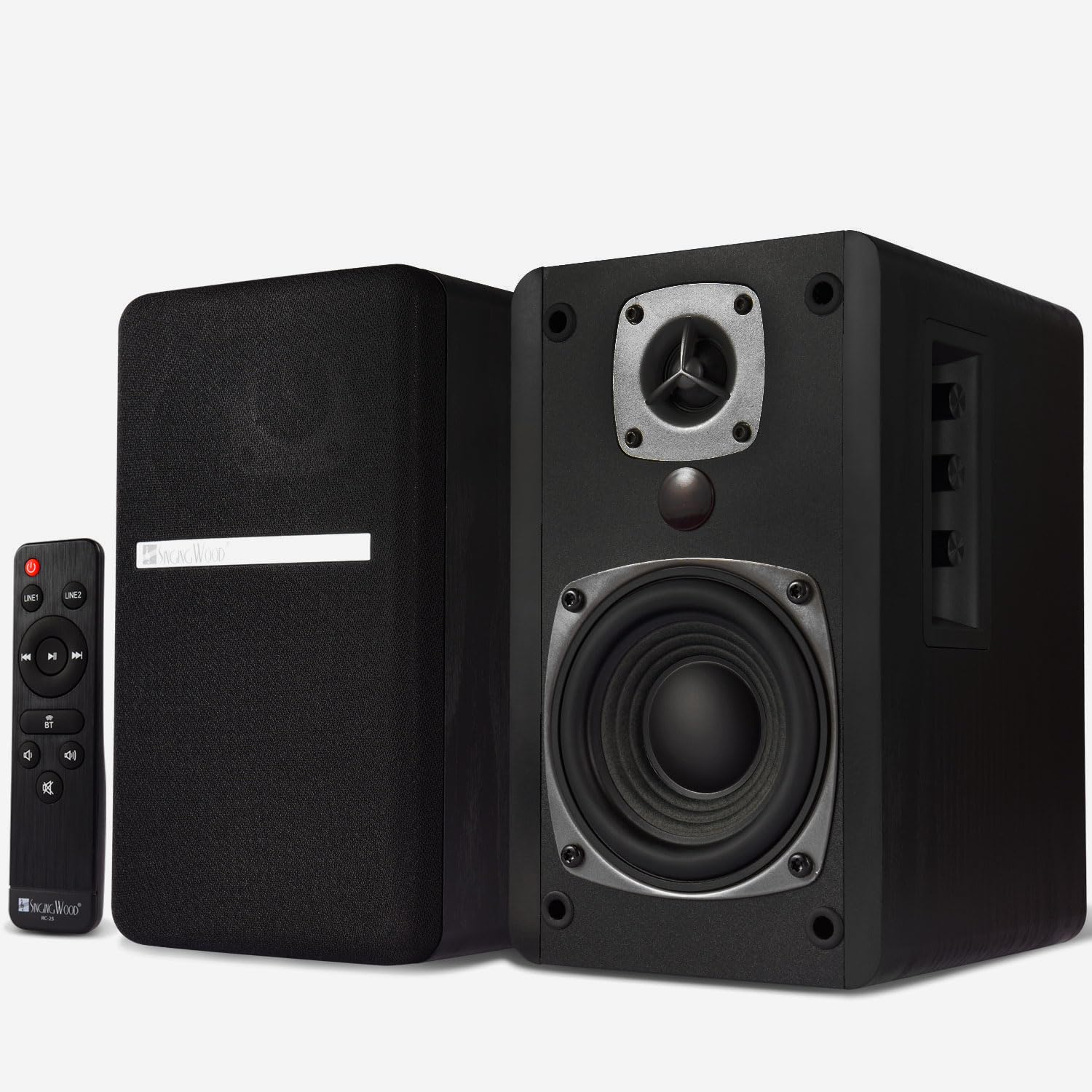
The SINGING WOOD BT27 pairs a 4-inch full-range bass driver with a 0.75-inch silk dome tweeter, delivering 60W RMS total power. The larger woofer gives these bookshelf speakers a noticeable advantage in low-end presence compared to 3-inch competitors, making them a solid match for turntable setups where vinyl’s natural warmth benefits from a fuller soundstage. The MDF wood cabinet with a black wood-grain finish contributes to a vintage aesthetic while dampening internal reflections.
Dual RCA inputs allow simultaneous connection to a TV and turntable without swapping cables — a genuine convenience for hybrid setups. The included IR remote controls volume, input selection, and power, while side-mounted bass and treble dials let you tune the output to your room’s acoustics. Bluetooth 4.2 is older but functional for casual streaming; the primary use case here is wired.
Users report easy integration with turntables set to LINE output, with no hum or feedback issues. The sound is described as full and engaging, with adjustable bass that can be dialed back if it becomes boomy. The remote has been noted to have intermittent battery contact issues in some units, but the overall build quality and sound-to-price ratio are consistently praised.
Why it’s great
- 4-inch driver delivers fuller bass than smaller options
- Dual RCA inputs for TV and turntable
- Bass and treble dials for room tuning
Good to know
- Bluetooth 4.2 is behind current standards
- Remote build quality is a weak point
5. OHAYO 60W

The OHAYO 60W system combines a 3-inch carbon fiber full-range driver with a 0.75-inch carbon fiber silk dome tweeter in an MDF wooden enclosure, targeting the sweet spot between gaming audio and music playback. The rear bass port adds low-end depth, and the integrated independent sound card provides smooth, detailed playback across multiple input paths. Each speaker outputs 30W, totaling 60W of clean power.
Connectivity includes Bluetooth 5.3, USB, RCA, AUX, and even a USB-C port — an unusually broad selection at this price tier. The front volume knob with integrated power control is convenient, and the tonal adjustment allows fine-tuning of treble and bass independently. Users report that Bluetooth and USB inputs sound noticeably cleaner than the 3.5mm aux path due to the on-board DAC.
Real-world feedback highlights the OHAYO’s energy efficiency, drawing less than 1W at full volume, and its ability to fill a small room without distortion. The bass is described as “good for the size” rather than deep, which is expected from a 3-inch driver. The simple Bluetooth toggle and easy setup make it a friction-free solution for mixed-use desktops shared between work and play.
Why it’s great
- Wide input selection including USB-C
- Energy efficient under 1W at full volume
- Carbon fiber drivers for clean sound
Good to know
- Bass is moderate, not deep
- 3.5mm input sounds less refined than USB
6. Majority D40

The Majority D40 is a 60W active bookshelf speaker pair that prioritizes versatility with optical, RCA, AUX, USB, and SD card playback. The 4-inch bass drivers produce a noticeably fuller sound than smaller competitors, making the D40 particularly effective for TV dialogue and movie soundtracks where vocal clarity and mid-bass punch matter. The wooden cabinet contributes to a controlled acoustic profile.
The included remote control provides bass and treble adjustment along with volume and input switching — a rare inclusion at this price point. Bluetooth connectivity is instant and stable within a 10-meter range, though the loud “Bluetooth connected/disconnected” voice alert has drawn criticism from users who prefer silent switching. The 3-year warranty and Cambridge UK development add confidence.
Users consistently describe the D40 as producing “crisp, clean sound with surprising bass for the size.” The optical input is the standout feature here, allowing a direct digital connection to a TV without the noise floor issues that sometimes plague analog inputs. The main compromises are a short RCA cable and some reported sensitivity in input switching when the device is idle for extended periods.
Why it’s great
- Optical input for clean TV audio
- Full remote control with tone adjustment
- 3-year warranty backs the product
Good to know
- Short included RCA cable limits placement
- Loud connection/disconnection voice prompt
7. Electrohome Huntley

The Electrohome Huntley EB10B offers a warm, natural sound profile from its handcrafted wood cabinet and 3-inch drivers. The rear ported design enhances bass response without making the speakers physically larger, and the classic retro aesthetic fits well with turntables and vintage-inspired decor. The sound is deliberately mellow — it rolls off the top end gently to avoid fatigue during long listening sessions.
Connectivity covers the essentials: Bluetooth 5.0, RCA, and AUX. The touch controls on the front panel are responsive, though they lack physical feedback. The 8-foot speaker wire provides plenty of slack for separating the passive and active units across a desk or console. Setup is genuinely plug-and-play, and the speakers automatically pair with the last connected Bluetooth device on power-up.
Listener feedback is positive for small-room use, with many noting that the Huntley sounds richer than its size suggests once properly positioned. The lack of a separate subwoofer output is a limitation for those wanting extended low-end, and the absence of tone knobs means you rely on your source device’s EQ. For a secondary setup in a bedroom or home office, the Huntley delivers pleasing, non-fatiguing sound with a look that stands out from black boxes.
Why it’s great
- Warm, non-fatiguing sound for long listening
- Classic wood cabinet suits retro setups
- Rear ported for enhanced bass from small drivers
Good to know
- No bass or treble adjustment knobs
- No subwoofer output for expansion
FAQ
Can I connect these speakers to a TV without optical input?
Do I need a separate amplifier for powered speakers?
Why does my cheap speaker hiss when nothing is playing?
Final Thoughts: The Verdict
For most users, the best cheap powered speakers winner is the Edifier MR3 because it combines a flat frequency response, Hi-Res certification, and balanced TRS inputs at a price that competitors cannot match. If you want a dedicated studio monitor with a 24-bit DAC and USB-C input, grab the Ortizan C7. And for a turntable or TV setup where a larger 4-inch driver and remote control matter most, nothing beats the SINGING WOOD BT27.

Mo Maruf
I created WellFizz to bridge the gap between vague wellness advice and actionable solutions. My mission is simple: to decode the research and give you practical tools you can actually use.
Beyond the data, I am a passionate traveler. I believe that stepping away from the screen to explore new environments is essential for mental clarity and physical vitality.