Our readers keep the lights on and my smoothie glass nicely filled. As an Amazon Associate, I earn from qualifying purchases.
Specs are compiled from manufacturer listings and verified buyer reviews and can change over time — please confirm the key details on the product page before buying.
You want a cheap PLA filament that prints reliably without constantly re-leveling your bed or clearing nozzle clogs. A low price per spool matters, but a jammed print head costs you hours and wasted material. This guide points you to the real bargains and away from the frustrating time-wasters.
I’m Mohammad Maruf — the founder and writer behind WellFizz. This guide is built by comparing the manufacturers’ published specifications and the patterns across verified customer reviews, so you get each pick’s real strengths and trade-offs instead of marketing spin.
I’ve lined up five of the most popular budget-friendly spools, weighing their dimensional accuracy (how consistently the filament keeps its 1.75mm thickness), print temperature ranges (the safe zone for your hot end), and real-world feedback from buyers. What follows is a clear, spec-based breakdown of the cheap pla filament options worth your money and the one clear long-term value choice among them.
Quick Picks
- SUNLU PLA 3D Printer Filament 1.75mm, White — Best Overall
- Creality PLA Filament 1.75mm, Black — Best Value
- ELEGOO PLA Basic Filament with Reusable Spool, Beige — Most Versatile
- HATCHBOX 1.75mm Natural PLA, 1 KG Spool — Top Performer
- Bambu Lab Genuine PLA Filament 1.75mm, Black — Premium Pick
How To Choose The Best Cheap PLA Filament
Not all budget PLA is created equal. The two specs that kill more prints than anything else are diameter tolerance (how much the thickness varies) and winding quality (how neatly the filament is layered on the spool). A spool with a ±0.03 mm tolerance (meaning the diameter can shift between 1.72 mm and 1.78 mm) can still jam if the variance spikes, while a ±0.02 mm filament (diameter between 1.73 mm and 1.77 mm) usually feeds smoothly across different hot ends. Neatly wound spools are mandatory — a tangle mid-print forces a full restart. Temperature range also matters: if your printer can only hit 210°C, you need a filament that flows well there without requiring the hot end to reach 230°C.
Dimensional Accuracy — The Clog Preventer
The most critical number on a cheap PLA spool is the tolerance listed next to the 1.75mm diameter. A ±0.02 mm spec means the filament barely changes thickness, so your extruder gear pushes a consistent volume every second. That prevents bulges, gaps, or sudden jams. A ±0.03 mm filament might still print fine, but you are rolling the dice on occasional under-extrusion (too little plastic coming out) or a jam if your hot end has a tight nozzle. Buyers report that brands advertising tighter tolerances almost always feed more reliably.
Spool Winding and Reusability — The Hidden Cost
A messy spool that tangles mid-print is the single biggest time-waster in budget filament. Look for language about “neat winding” or “automatic winding arrangement” — those spools typically pay off within the first few hours by avoiding tangles. Reusable spools are a newer trend: you buy a filament pack without the spool, then snap it onto a reusable core you already own. That lowers waste and can save you a dollar or two per refill, but only if you stick with the same brand’s ecosystem.
Quick Comparison
| Model | Best For | Diameter Tolerance | Print Temp Range | Spool Type | Amazon |
|---|---|---|---|---|---|
| SUNLU PLA | Reliable all-rounder | ±0.02 mm | 200–230°C | Standard (neat wound) | Amazon |
| Creality PLA | Beginner-friendly Ender | ±0.02 mm | 190–230°C (typical) | Standard (EPC wound) | Amazon |
| ELEGOO PLA Basic | Reusable spool value | ±0.02 mm | 200–210°C | Reusable (tool-free) | Amazon |
| HATCHBOX PLA | Trusted brand consistency | ±0.03 mm | 180–210°C | Standard (desiccant pack) | Amazon |
| Bambu Lab PLA | Premium automated setup | ±0.03 mm | 190–230°C (typical) | Reusable + RFID | Amazon |
In‑Depth Reviews
1. SUNLU PLA 3D Printer Filament 1.75mm, White

The budget spool that avoids the usual budget-filament headaches.
The SUNLU PLA earns its spot because it gives you the tightest diameter tolerance in this lineup — ±0.02 mm (so the thickness barely varies as it feeds) — which means you face fewer blobs, gaps, or sudden jams than with wider-tolerance spools like the ±0.03 mm HATCHBOX. Its recommended nozzle range of 200–230°C covers most standard hot ends, and owners mention “consistent, reliable PLA; no tangles,” confirming the neat winding pays off on long prints.
While the SUNLU comes in a standard single-use spool (no reusable core here), its per-spool price undercuts the premium Bambu Lab PLA by a significant margin. You trade the RFID auto-configuration (where a chip sets print settings automatically) and the reusable spool of the Bambu Lab for a near-flawless print experience that buyers consistently describe as minimal-tuning and clog-free. If you want a cheap PLA that just works without extra steps, this is the one to beat.
One thing to watch: at 2.2 lbs it is the same weight as the Creality spool (each 2.2 lbs), but the ±0.02 mm tolerance means you get better feeding consistency on printers with tight hot ends. The box does not include a resealable bag, so store the leftover filament in a dry container.
Why it outprints the price
- Tight ±0.02 mm diameter tolerance reduces the risk of clogs and uneven extrusion.
- Neat winding means you rarely deal with mid-print tangles.
- Wide 200–230°C nozzle range fits nearly all FDM printers.
Where it cuts corners
- Standard spool is single-use — no reusable core or RFID tag.
- No integrated desiccant (moisture-absorbing packet) or vacuum-sealed storage bag included.
The one to get if you want a reliable everyday PLA that prints cleanly on almost any 1.75mm printer without dialing in special settings. Look elsewhere only if you need a reusable spool system or want automatic print-profile loading via RFID.
2. Creality PLA Filament 1.75mm, Black

A reliable, no-frills spool that pairs perfectly with Creality machines.
Creality’s Ender PLA uses the same tight ±0.02 mm tolerance as the SUNLU pick above, so you get the same reduced risk of jams and uneven layers. It also adds an automatic winding arrangement (EPC) that customers note keeps the spool tangle-free and feeding smoothly. One reviewer using a Bambu Lab X1C noted “bed adherence fine; prints as well as others on textured/Cool PLA plates” — so it plays nicely outside the Creality ecosystem too. The black color is deep and consistent, and at 1 kg (2.2 lbs) it holds the same amount of material as the HATCHBOX spool.
The main trade-off versus the SUNLU is the print temperature guidance: Creality advertises low shrinkage and no warping with typical PLA settings around 190–230°C, but unlike the SUNLU it does not specify a precise recommended nozzle range on the listing. Still, the feedback from owners using it on Flash Forge and Bambu printers is uniformly positive, with strong layer bonding and no tangles. This is a safe, inexpensive bet if you own a Creality printer and want guaranteed compatibility from the start.
Solid picks
- EPC neat winding reduces snags during long prints.
- High-purity raw materials for consistent extrusion and no bubbles.
- Wide compatibility tested by BFP with Creality and other FDM machines.
Minor downsides
- No explicit recommended nozzle temperature printed on the listing.
- Standard spool — not reusable like the ELEGOO option.
Best matched with: Creality Ender and CR series owners who want a fuss-free first-party filament experience. Not ideal if you prefer a detailed, published temperature range for your print profile.
3. ELEGOO PLA Basic Filament with Reusable Spool, Beige
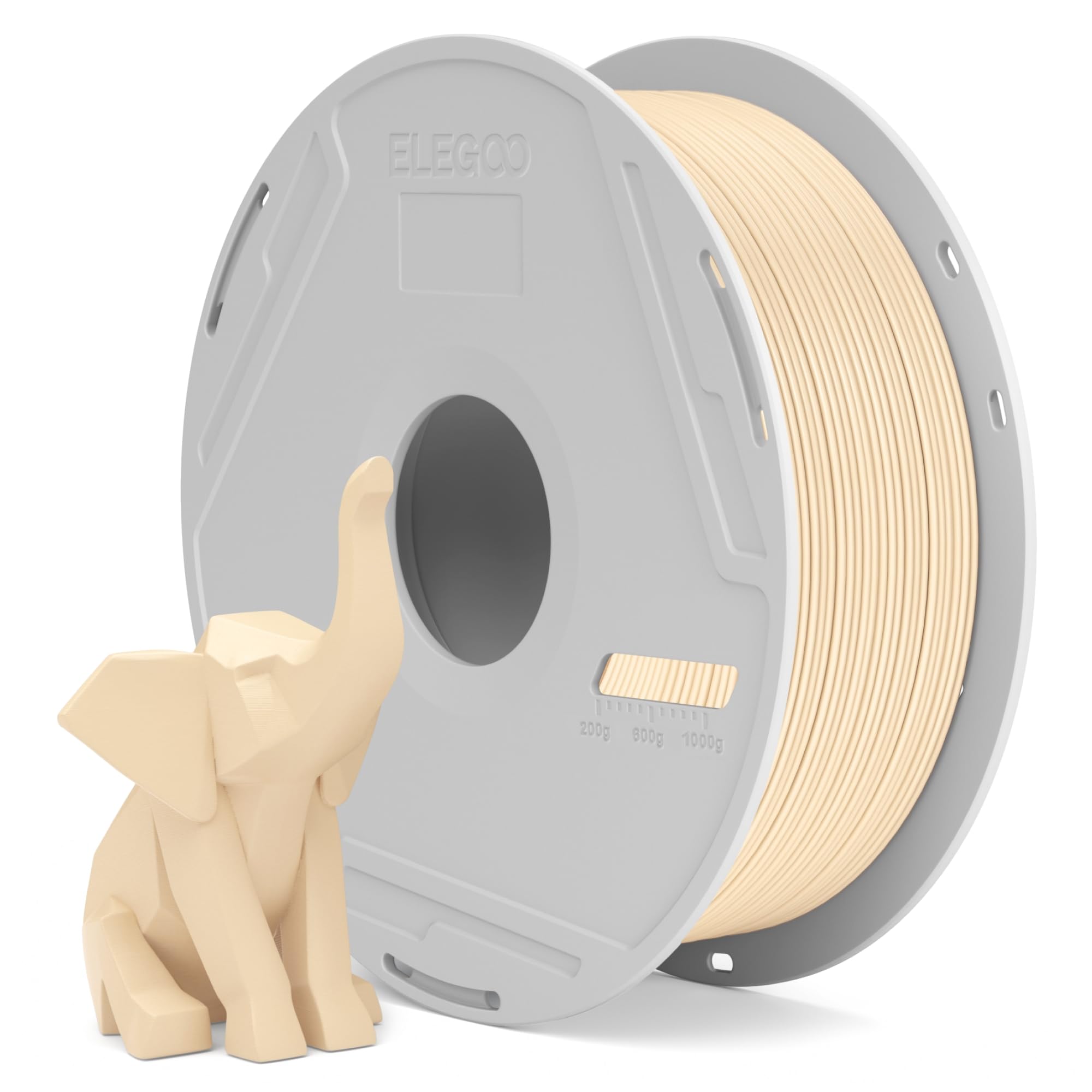
The same tight tolerance as the leaders, wrapped around a spool you keep.
ELEGOO matches the SUNLU and Creality with a ±0.02 mm tolerance, so diameter consistency is on par with the best budget options here. The standout difference is the reusable spool design: you twist the filament core into the spool without tools, and when the plastic runs out you keep the spool for the next refill. That cuts down on plastic waste and makes storage easier — just snap a partial roll off and set it aside. A buyer reviewing a red variant said it “prints easily at 200-210°C with good layer adhesion, minimal stringing, and no clogs,” which matches the smooth print quality across all reviews.
The downside is the narrower recommended nozzle range of 200–210°C compared to the SUNLU’s 200–230°C, which means it might not be the best choice for printers that run hot. Still, for standard PLA printing, this is a smart long-term value if you plan to stick with ELEGOO refills.
Clever design wins
- Reusable spool reduces single-use plastic waste and keeps storage neat.
- Tool-free installation — twist and lock, no screwdriver needed.
- The package weighs 1.2 kg total (including the reusable core).
A couple of catches
- Narrower nozzle temp window (200–210°C) than some competitors.
- Not ideal for high-heat or heavy-duty prints — standard PLA only.
Grab this for reducing waste and getting more grams per dollar — the reusable core pays off after the first refill. skip it if you print with hot end temps above 210°C or want the widest temperature flexibility.
4. HATCHBOX 1.75mm Natural PLA, 1 KG Spool
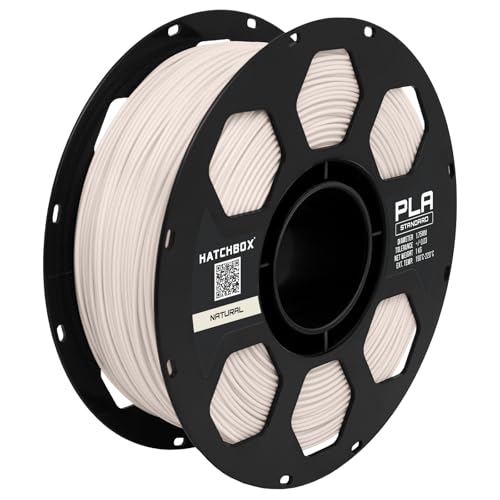
A trusted brand name with a slightly wider tolerance — but consistent reviews.
HATCHBOX ships its PLA with a ±0.03 mm tolerance (diameter between 1.72 mm and 1.78 mm), which is looser than the ±0.02 mm SUNLU, Creality, and ELEGOO above. But decades of community trust mean buyers rarely report issues: one owner said “HATCHBOX True Blue PLA: Vibrant color, smooth feeding, no tangles/jams.” The recommended extrusion range of 180–210°C is actually the lowest among the group, making it a friendly choice for printers with a weaker hot end that cannot push past 210°C. It also comes vacuum-sealed with desiccant (moisture-absorbing packets) — a detail the SUNLU and Creality spools skip — so the filament stays dry until you open it.
Against the SUNLU, the HATCHBOX costs a few dollars more per spool and has a wider tolerance, but the lower print temp means you save a bit on power and can use it on older machines. One reviewer noted a rare QC issue with an improperly wound spool, so while overall reliability is high, you are paying a small premium for the brand name. If you want a well-known label that beginners and pros both trust, this is a safe pick — just not the tightest tolerance in the lineup.
Where it shines
- Low 180–210°C nozzle range works on weaker or unenclosed hot ends.
- Vacuum-sealed with desiccant for dry storage from the start.
- Strong community reputation for consistent color and finish.
Where it loses ground
- ±0.03 mm tolerance is looser than the ±0.02 mm competition.
- Occasional winding QC issues reported by a small number of buyers.
Choose this for low-temperature printing on older or entry-level machines where a cooler nozzle is mandatory. Pass if you prioritize the tightest possible diameter tolerance for your high-speed CoreXY printer.
5. Bambu Lab Genuine PLA Filament 1.75mm, Black
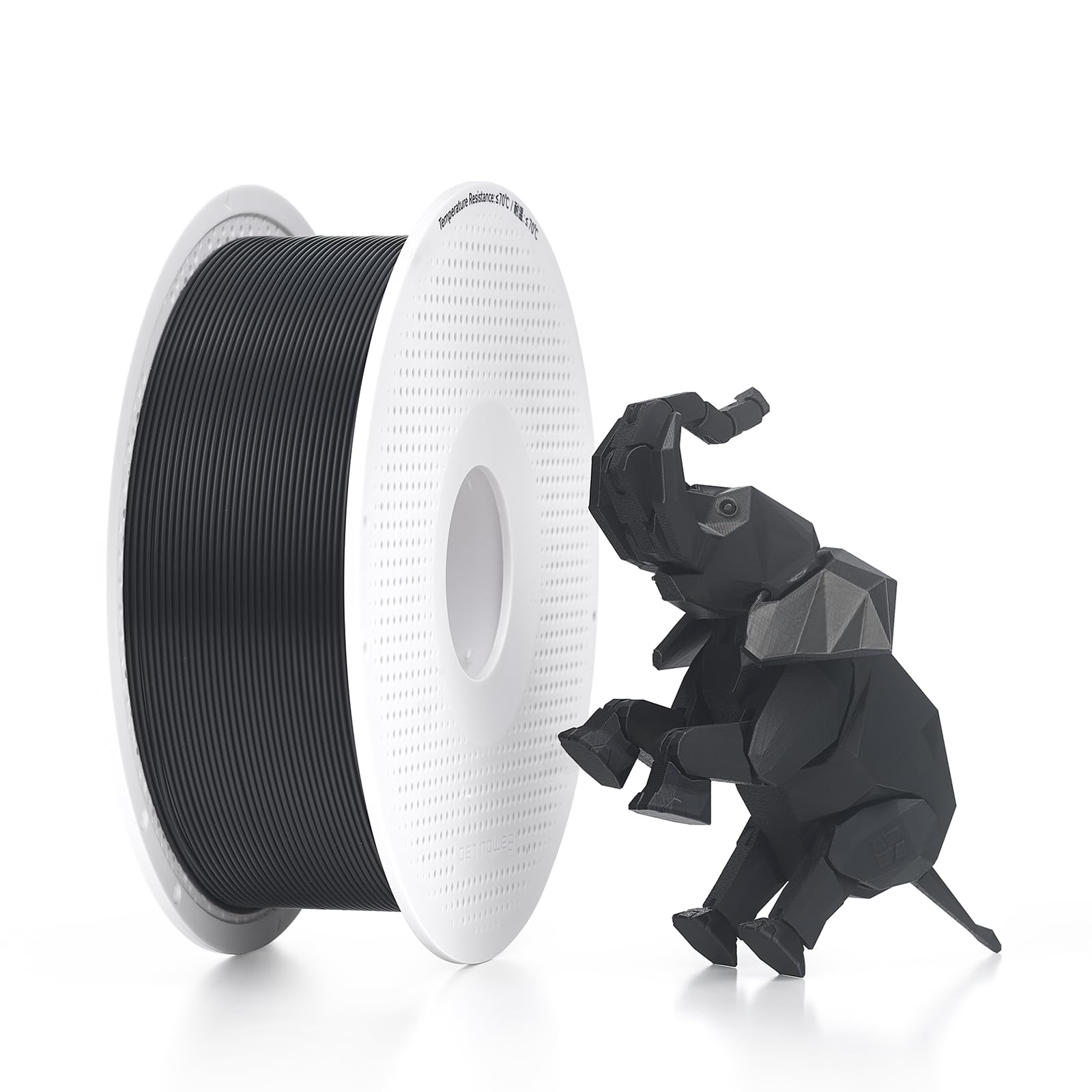
The priciest spool here — but the RFID convenience is genuinely new.
Bambu Lab’s own PLA comes with an RFID tag (a small radio chip) that your Bambu printer reads automatically, so it loads the correct temperature and speed profile without you touching a single setting. That is a real time-saver if you switch filaments often. The tolerance is ±0.03 mm like the HATCHBOX (diameter between 1.72 mm and 1.78 mm), but the spool is reusable (same concept as ELEGOO but with a dedicated brand lock-in). One buyer mentioned it is “better than the bargain brands — more consistent layers, smoother finish, better bed adhesion,” so the quality bump is real even if the numbers look similar on paper.
The obvious catch is the price: at a higher price than the SUNLU, you are paying for the RFID convenience, the reusable spool ecosystem, and the brand guarantee. If you own a Bambu Lab X1C or P1S, the hassle reduction is worth the premium. But if you are printing on a generic MK4 or Ender, you lose the RFID advantage and are simply buying an expensive PLA with a ±0.03 mm tolerance. That is still a great filament, but the value proposition shifts heavily toward brand loyalty.
Unique advantages
- RFID tag auto-configures print settings in Bambu Studio — zero manual tuning.
- Reusable spool design reduces waste and keeps storage tidy.
- Reviewers point out smoother layers and stronger bed adhesion vs. generic brands.
Trade-offs to consider
- Highest per-spool cost in this comparison.
- ±0.03 mm tolerance is not tighter than the cheaper ±0.02 mm options.
- RFID feature only works on Bambu Lab printers.
Invest in this if you own a Bambu Lab printer and want the easiest, fastest filament swap experience possible. pass on it if you are on a standard FDM machine — the premium buys you nothing you cannot get cheaper from the SUNLU.
Understanding the Specs
Dimensional Accuracy (±0.02 mm vs ±0.03 mm)
This number tells you how much the filament diameter varies along the spool. A ±0.02 mm spec means the width stays between 1.73 mm and 1.77 mm — very tight — so your extruder gear pushes a predictable volume of plastic every second. A ±0.03 mm filament can go from 1.72 mm to 1.78 mm, which is still fine for most printers, but you stand a slightly higher chance of under-extrusion (too little plastic) on a warm day or at high speed. If you print functional parts with tight tolerances, lean toward ±0.02 mm.
Print Temperature Range
The nozzle temperature range (e.g., 200–230°C) tells you the safe window for melting that specific PLA. Print too low and layer adhesion suffers; too high and you get stringing or oozing. A wide range like 200–230°C gives you flexibility to dial in the perfect temp for your printer. A narrow range like 200–210°C still works well but demands a more precise temperature setting. Always check that your printer’s hot end can hit the low end of the recommended range.
FAQ
Can I use cheap PLA filament on any FDM printer?
What does ±0.02 mm tolerance actually mean for my print quality?
Is neat winding really necessary, or is it just marketing?
How long does a 1 kg spool of PLA last?
Should I worry about PLA absorbing moisture before I open the spool?
What is the difference between a standard spool and a reusable spool?
Can I use Bambu Lab filament on a Creality or Prusa printer?
Why does the ELEGOO spool weigh 1.2 kg but the Creality is only 1 kg?
What print speed works best with cheap PLA filament?
Is cheap PLA filament safe for food-contact items?
Final Thoughts: The Verdict
If you want one dependable pick, the cheap pla filament winner is the SUNLU PLA because it combines the tightest ±0.02 mm tolerance, reliable neat winding, and a wide 200–230°C temperature range at a price that leaves room for a second spool. If you prefer a reusable spool system that cuts waste and keeps storage tidy, grab the ELEGOO PLA Basic. And for Bambu Lab owners who want a fully automated print setup, the Bambu Lab PLA delivers the sheer convenience of RFID-based profile loading.
How We Picked
We do not accept paid placement. Every pick is matched to a real buyer and a real use-case; we do not hands-on test units.
Sources & Methodology
Specifications: manufacturer listings and product documentation. Review insights: verified customer reviews, as of July 2026. Pricing: not shown on this page (it changes often); check the current price via the retailer link.
As an Amazon Associate, WellFizz earns from qualifying purchases. This does not affect which products we feature.
Related Guides

Mo Maruf
I created WellFizz to bridge the gap between vague wellness advice and actionable solutions. My mission is simple: to decode the research and give you practical tools you can actually use.
Beyond the data, I am a passionate traveler. I believe that stepping away from the screen to explore new environments is essential for mental clarity and physical vitality.