Our readers keep the lights on and my smoothie glass nicely filled. As an Amazon Associate, I earn from qualifying purchases.
Specs are compiled from manufacturer listings and verified buyer reviews and can change over time — please confirm the key details on the product page before buying.
You want a machine that tosses strikes, not a stack of frustration. A cheap pitching machine should help you train without twisting legs, blowing fuses, or costing more in time than it saves. This guide lines up seven models that actually deliver on that promise — from manual throwers you power with your foot to electronic units that handle the work for you.
I’m Mohammad Maruf, the writer behind WellFizz. These picks come from comparing manufacturers’ specs and patterns across verified customer reviews. You get the real strengths and honest trade-offs for each machine.
The six models range from manual foot-pedal designs to electronic auto-feeders. Whether you coach a Little League team or just want batting practice in the backyard, this list of the best cheap pitching machine options gives you a clear play for your money.
Our Picks at a Glance


How To Choose The Best Cheap Pitching Machine
A cheap pitching machine saves you cash upfront, but picking the wrong one costs you practice time. You need to match your choice to the player’s age, your available space, and how much effort you want to put into reloading or winding it up.
Speed Range — Know Your Hitter’s Level
A machine that only throws 30 MPH (miles per hour) is fine for a seven-year-old seeing live pitching for the first time. A high school player needs 50 MPH or more to make batting practice useful. Look for a machine with adjustable speed so you can progress as the hitter improves.
Power Source — Battery, Plug, or Your Leg
Electronic machines need either an AC wall outlet (110V standard) or batteries, which add both cost and weight. Manual machines with a spring arm — like the Louisville Slugger Blue Flame Pro — need zero electricity but require a foot pedal push each pitch. If you are taking the machine to a field with no outlet, a battery-powered or manual unit is your only real option.
Ball Type — Not All Balls Work
Most budget machines are designed for specific balls. Many use lightweight dimpled polyurethane balls (plastic balls with small indentations) that are sting-free and won’t dent your bat. Using a regulation baseball in the wrong machine can break a plastic throwing wheel. Always check the included balls and the machine’s ball compatibility before buying.
Quick Comparison
| Model | Best For | Max Speed | Power | Weight | Amazon |
|---|---|---|---|---|---|
| Furlihong 692BH★ Best Overall | Visual acuity training | 18 MPH | AC / C batteries | 4.4 lbs | Amazon |
| Heater Sports Slider Lite 360Also Great | All‑around batting practice | 80 MPH | 110V / battery station | 13 lbs | Amazon |
| Heater Sports Power Alley Lite 360 | Consistent training with variety | 80 MPH | 110V | 12.5 lbs | Amazon |
| Louisville Slugger Blue Flame Pro | Serious manual practice | 58 MPH | Manual foot pedal | 20 lbs | Amazon |
| MOXOW Sagitta BP55 | Backyard manual training | — | No electricity needed | 29.5 lbs | Amazon |
| Furlihong Upgraded Electronic | Absolute beginner training | 30 MPH | 6V AC / D batteries | 4.3 lbs | Amazon |
In‑Depth Reviews
1. Furlihong 692BH Baseball Pitching Machine
At 4.4 pounds and 18 MPH with a smaller ball, this trainer sharpens your eye without wearing out your arm.
The 692BH fires a special 5-inch circumference training ball (a ball smaller than a regulation baseball) at 18 MPH. The smaller size forces you to focus on visual tracking and bat control. You can power it with AC (wall outlet) or C batteries, so it works indoors or in the driveway with no outlet nearby. At 4.4 pounds, it is much lighter than the 20-pound Louisville Slugger Blue Flame Pro, so you can carry it anywhere.
The top basket holds up to 40 balls, letting you load once for a solid round of swings. A rotating screw bolt adjusts the height for different ages. Customers note the small ball takes getting used to, but it genuinely improves hand-eye coordination. This is a slow, lightweight trainer — it does not mimic real pitching speeds or handle full-size balls.
The strengths
- Extremely lightweight at 4.4 pounds for easy portability
- Runs on AC power or C batteries for flexible placement
- 40-ball top basket reduces reload downtime
- Small training ball helps improve visual tracking and accuracy
Where it falls short
- Low max speed of 18 MPH, too slow for older or advanced players
- Only works with special 5-inch training balls, not regulation baseballs
Best for: young kids and beginners who need to develop bat control with a lightweight, portable machine that fits in any bag.
Not for: anyone who needs game-speed reps or wants to throw full-size baseballs.
2. Heater Sports Slider Lite 360
This machine reaches 80 MPH and includes an auto feeder — the strongest all-around package for the price.
The Heater Sports Slider Lite 360 delivers a fastball or curveball at up to 80 MPH from 46 feet, so you get game-speed timing directly in practice. The pivot head (the part that angles to control ball spin) focuses on accurate curveballs, giving you a realistic breaking ball to read out of the hand. Buyers report the 13-pound steel tripod stays put on grass or pavement, even at 80 MPH.
The automatic ball feeder drops the next ball without you reloading — unlike the Furlihong 692BH that needs you to place each ball by hand. It uses only Heater Sports Lite Balls (lightweight dimpled polyurethane balls); you cannot use a regulation baseball here without damage. If you need field mobility without a cord, a separate battery Power Station (sold separately) gives you that option.
Where it earns its keep
- Delivers fastballs and curveballs up to 80 MPH for realistic practice
- Pivot head gives accurate curveball delivery
- Sturdy tubular steel legs with rubber tips for stability
- Automatic ball feeder keeps the practice flowing
One real constraint
- Designed for Lite balls only; cannot use standard baseballs
- No battery option built in — requires 110V outlet or separate power station
The right call when: you want an electronic machine that throws fast enough to challenge growing hitters and includes an automatic feeder for unsupervised practice.
Think twice if: you need a machine that works on a field with no power outlet nearby.
3. Heater Sports Power Alley Lite 360

A swivel head that fires fastballs, sliders, and fielding practice — all at up to 80 MPH.
This machine’s swivel head rotates a full 360 degrees to throw fastballs, sliders, and curves, so you go through a pitch sequence without moving the unit. Adjust the speed from 40 to 80 MPH with Heater Sports Lite Balls, covering warm-up to game speed. It also fires grounders, line drives, and pop flies up to 200 feet, which makes it a full defensive trainer, unlike the Slider Lite 360 which is focused on pitching.
The 1/8 HP (horsepower) motor keeps ball speed steady across a long practice session. At 12.5 pounds, the enclosed solid wheel is safe for indoor use. It runs on standard 110V power and can connect to the optional Portable Power Station for battery operation. Owners mention it throws far more consistently than the manual MOXOW Sagitta, because there is no user leg fatigue.
What stands out
- Swivel head throws fastballs, sliders, and curves for varied practice
- Speed range from 40 to 80 MPH suits multiple skill levels
- Throws grounders, line drives, and pop flies up to 200 feet
- Fully enclosed solid wheel for safe operation
One limit
- Runs on 110V only without the optional battery station
- Lite balls only — standard baseballs are not recommended
Grab this if: you need one machine that covers batting practice and full defensive drills without switching equipment.
Look elsewhere if: you prefer a manual machine that works anywhere with no cord.
4. Louisville Slugger Blue Flame Pro
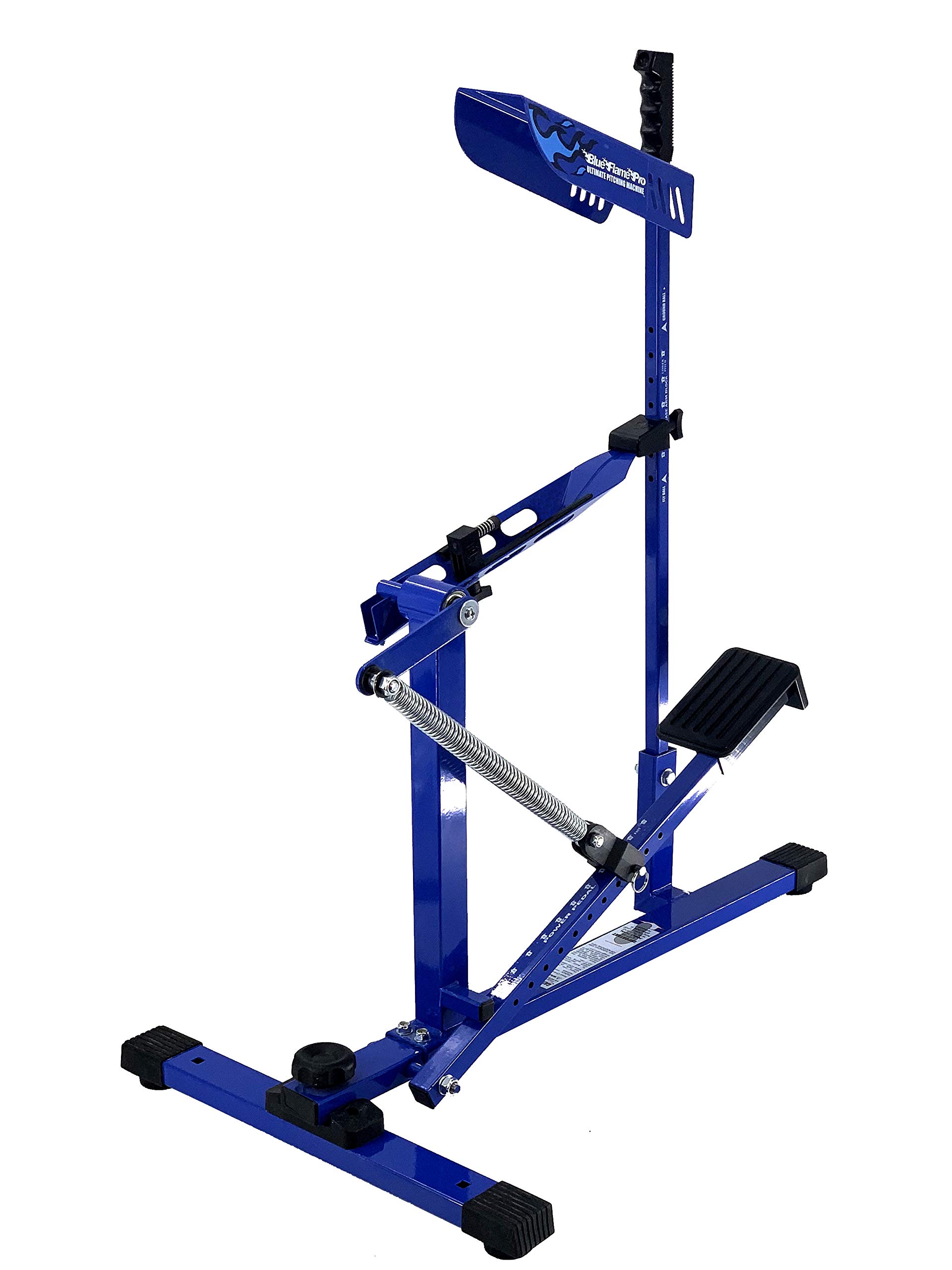
At 58 MPH with real baseballs, this steel manual machine outlasts any plastic electronic pick.
The Blue Flame Pro fires regulation baseballs at 30–58 MPH, and up to 65 MPH with restricted-flight balls — the only budget model here that handles a standard hardball. The upgraded ball-bearing throwing arm (a smooth rotating joint in the arm) delivers a consistent release every time. It is used by Babe Ruth League and Pony Baseball programs, according to the manufacturer, giving it real on-field credentials.
At 20 pounds, this machine is considerably heavier than the 4.4-pound Furlihong 692BH, and the steel frame shows that durability. It works with tennis balls, dimple balls, softballs, and baseballs — far more versatile than any electronic machine here. The ergonomic pedal needs less force than previous Blue Flame models, so you can pitch a full bucket without your leg giving out. No electricity, batteries, or motor means it runs anywhere.
The clear wins
- Throws real baseballs at 30–58 MPH, plus softballs and tennis balls
- Steel construction with upgraded ball-bearing arm for smooth throws
- Used by Babe Ruth League and Pony Baseball programs, per manufacturer
- Ergonomic pedal reduces leg effort per pitch
The honest trade-off
- Manual operation means every pitch requires a foot press — not hands-free
- Heavier than electronic options at 20 pounds
Reach for this when: you need a manual machine that lasts for years, throws regulation balls, and works on any field with zero electricity.
skip it if: you want an electronic machine that auto-feeds balls while you stand in the batter’s box.
5. MOXOW Sagitta Manual Baseball & Softball Pitching Machine
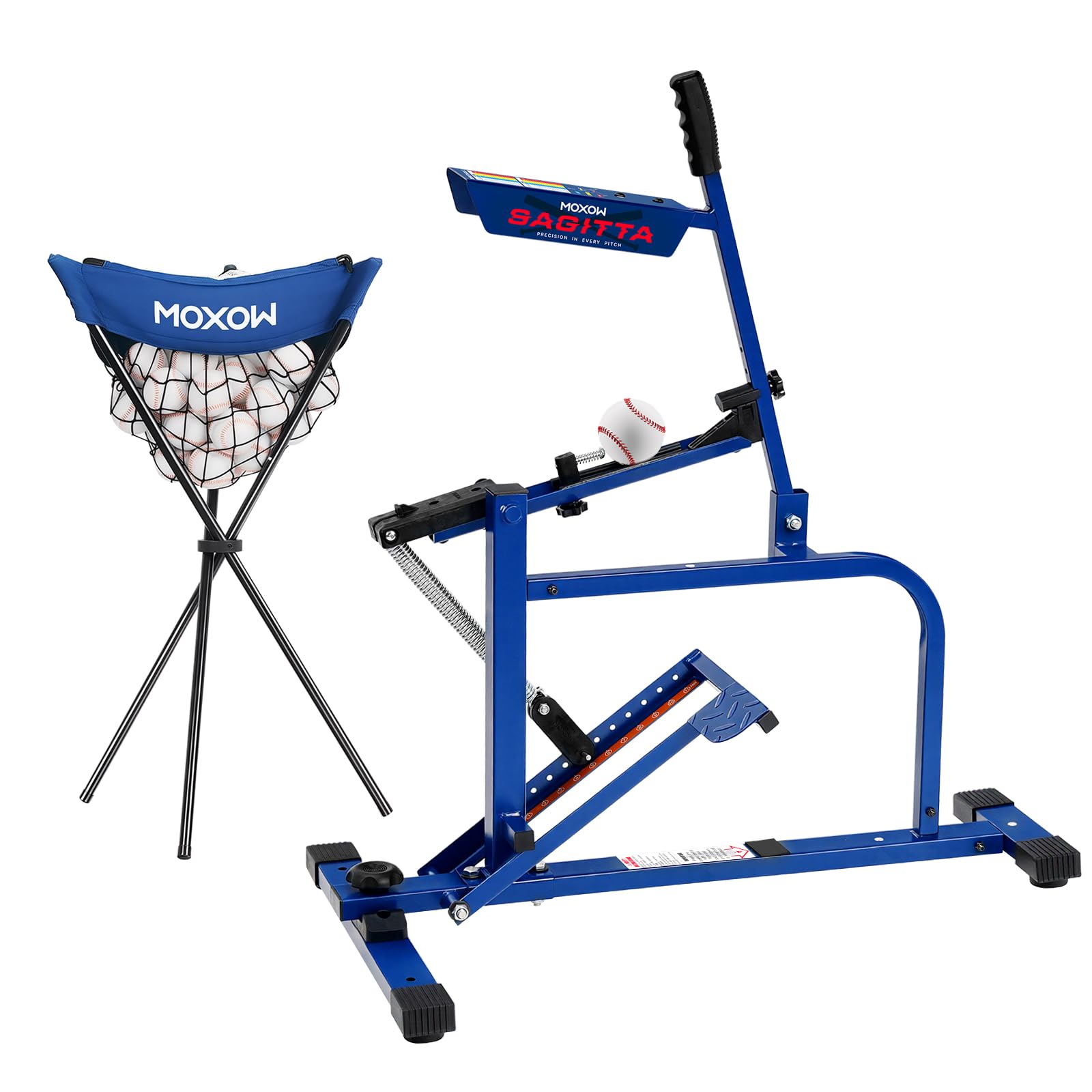
A 29.5-pound manual launcher with an anti-tilt bar that keeps every pitch straight and true.
The Sagitta uses coach-tested mechanics to deliver consistent pitches without a plug, battery, or charging. The anti-tilt bar stops the frame from leaning sideways, so each ball stays on target instead of drifting. The reinforced dual-purpose beam acts as a stability bar and a carrying handle for quick setup.
A color-coded speed chart on the machine lets you dial in pitch trajectory without guessing. It also throws ground balls and fly balls for a full defensive session. The included ball caddy holds up to 50 baseballs or 30 softballs — this is the only manual model that bundles a ball cart. Unlike the Louisville Slugger which takes real baseballs, the MOXOW works best with practice balls; check your ball type before loading.
What works
- No electricity required — works anywhere
- Anti-tilt bar keeps pitches on target
- Included ball caddy holds 50 baseballs or 30 softballs
- Color-coded speed guide for quick adjustments
The downside
- No automatic feeder — must manually place each ball
- Heavier than electronic options at over 29 pounds
Get this if: you want a manual machine that stays level, comes with a dedicated ball cart, and can travel to any field without power worries.
Pass if: you prefer an automatic feeder or a lighter unit for easy carrying.
6. Furlihong Upgraded Electronic Baseball Pitching Machine

A beginner electronic machine that hits 30 MPH with curves and sliders, powered by batteries or a wall plug.
Adjustable wheels on each side let you change speed and angle independently for fastballs, curves, and sliders. It runs on a 6V AC adapter (included) or 4 D batteries. The 30 MPH top speed is for beginners — compare that to the Heater Sports Slider Lite 360 at 80 MPH, so this is best for young kids just learning to track pitches.
The package includes eight polyurethane dimpled balls (sting-free plastic balls with small indentations). The machine does not work with regulation baseballs. Plastic construction keeps it at 4.3 pounds, which helps portability but means it can slide on hard surfaces if not level. Reviewers point out you need to wait a few seconds after turning it on for the ball to launch — a small quirk you get used to.
Why it works
- Adjustable wheels for different pitch types and speeds
- Dual power option — AC adapter or D batteries for field use
- Sting-free polyurethane dimpled balls protect bats
- Very lightweight and portable for quick setup
The catch
- 30 MPH top speed limits its use to beginner and youth players
- Cannot use regulation baseballs — only the included dimpled balls
Ideal for: parents introducing a young child to live pitching for the first time without the intimidation of high speed.
Not for: experienced youth or teen players who need 50+ MPH to stay challenged.
Understanding the Specs
Speed Range (MPH)
The speed a pitching machine throws, measured in miles per hour. A youth machine typically runs 15–48 MPH, while a machine for teens and adults starts at 40 and goes up to 80 MPH. If you are buying for a child, a machine that only goes 30 MPH is fine. For a high school player, you need at least 50 MPH to make batting practice feel real. Do not buy an 80 MPH machine for a beginner — they will flinch before they swing.
Power Source
This tells you how the machine runs. Electronic machines use either a standard 110V wall outlet (like a lamp) or batteries. Manual machines with a spring arm use a foot pedal — no electricity needed at all. If you plan to practice in a backyard with an outlet nearby, a 110V machine is fine. If you go to a public field, look for battery power or a manual unit. Batteries are not always included, so check the item details before you assume you can use it from the start.
FAQ
What is the best cheap pitching machine for a 10 year old?
Can a cheap pitching machine throw real baseballs?
How fast should a youth pitching machine throw?
Do cheap pitching machines need electricity?
Will a cheap pitching machine work for softball?
How many balls fit in a cheap pitching machine hopper?
Can I use a pitching machine indoors?
How long do cheap pitching machines last?
Final Thoughts: The Verdict
For most buyers, the best cheap pitching machine is the Heater Sports Slider Lite 360 because it reaches 80 MPH, includes an automatic ball feeder, and delivers fastballs and curveballs with a reliable pivot head. If you need a manual machine that throws real baseballs and works on any field without power, grab the Louisville Slugger Blue Flame Pro. And for a young beginner just learning to track pitches, the Heater Sports Junior offers a safe speed range from 15 to 48 MPH with a convenient auto feeder.
How We Picked
We do not accept paid placement. Every pick is matched to a real buyer and a real use-case; we do not hands-on test units.
Sources & Methodology
Specifications: manufacturer listings and product documentation. Review insights: verified customer reviews, as of July 2026. Pricing: not shown on this page (it changes often); check the current price via the retailer link.
As an Amazon Associate, WellFizz earns from qualifying purchases. This does not affect which products we feature.
Related Guides

Mo Maruf
I created WellFizz to bridge the gap between vague wellness advice and actionable solutions. My mission is simple: to decode the research and give you practical tools you can actually use.
Beyond the data, I am a passionate traveler. I believe that stepping away from the screen to explore new environments is essential for mental clarity and physical vitality.