Our readers keep the lights on and my smoothie glass nicely filled. As an Amazon Associate, I earn from qualifying purchases.
Finding cheap PC speakers that actually sound good is harder than it should be. Most under $50 look fine on a shelf but deliver thin, hollow audio that makes movies and music feel flat. This guide cuts through the noise to find the speakers that give you clear sound and real bass without draining your wallet.
I’m Mohammad Maruf — the co-founder and writer behind WellFizz. This guide is built by comparing the manufacturers’ published specifications and the patterns across verified customer reviews, so you get each pick’s real strengths and trade-offs instead of marketing spin.
The best cheap pc speakers overall are the FUNLOGY speakers — they deliver 14W of total power through 48mm drivers (the cones that produce sound), which is nearly triple the wattage of most budget rivals. For anyone upgrading from built-in monitor speakers or wanting better audio for gaming and video calls, that combination of loudness and clarity is a real deal.
How To Choose The Best Cheap PC Speakers
When you are shopping on a tight budget, a few key specs separate the speakers that sound decent from the ones that sound terrible. Here is what to look for without getting lost in technical jargon.
Total Wattage — How Loud They Go Before They Distort
The wattage (W) rating tells you how loud the speakers can get before the sound turns fuzzy. For cheap PC speakers, look for at least 10 watts total output — that is 5W per speaker. Anything below that struggles to fill a room and sounds thin when you turn it up. The FUNLOGY speaker delivers 14W total, which is nearly three times more powerful than typical budget options.
Driver Size — Bigger Cones Mean Fuller Sound
The driver is the actual speaker cone that moves air to produce sound. Driver size is measured in millimeters (mm). Larger drivers push more air, giving you fuller mids and better bass without needing a separate subwoofer (a separate box for low sounds). A 48mm driver will sound noticeably richer than a 40mm driver, especially at lower volumes.
Passive Bass Radiators — Fake Bass That Actually Works
A passive bass radiator is an unpowered diaphragm (a flat flexible disk) that moves along with the main driver to amplify low frequencies. It just vibrates in response to the air pressure inside the speaker box. This lets small speakers produce deeper bass — down to 115Hz (hertz, or cycles per second, measuring how deep the sound is) — adding subwoofer-like punch without the extra cost. The Sanyun SW102 uses this trick to reach 115Hz, impressive for a speaker smaller than your fist.
Connectivity — USB Power vs. AC Adapter
USB-powered speakers pull electricity from your computer’s USB port, which caps their maximum wattage at around 5-10W. That is fine for desk listening but limits volume and bass headroom. Speakers with an AC power adapter (wall plug) can draw more power and deliver louder, cleaner audio. For the budget tier, USB power is the standard and works well for most people on a typical desk.
Quick Comparison
On smaller screens, swipe sideways to see the full table.
| Model | Category | Best For | Key Spec | Amazon |
|---|---|---|---|---|
| FUNLOGY Speaker | Best Overall | Clear, loud sound on a budget | 14W total / 48mm drivers | Amazon |
| Redragon GS520 | Best RGB | Gamers who want style and decent audio | 6 RGB modes / touch controls | Amazon |
| Sanyun SW102 | Value Pick | Small desk setups needing rich bass | 5W x 2 / passive bass radiators | Amazon |
| Amazon Basics | Budget Reliable | Simple, no-fuss upgrade from built-in speakers | USB-powered / inline volume control | Amazon |
| ROSON A-293 | Compact & Simple | Ultra-basic desktop use with headphone jack | 3W x 2 / front-mounted controls | Amazon |
In‑Depth Reviews
1. FUNLOGY Speaker — 14W Stereo PC Speakers
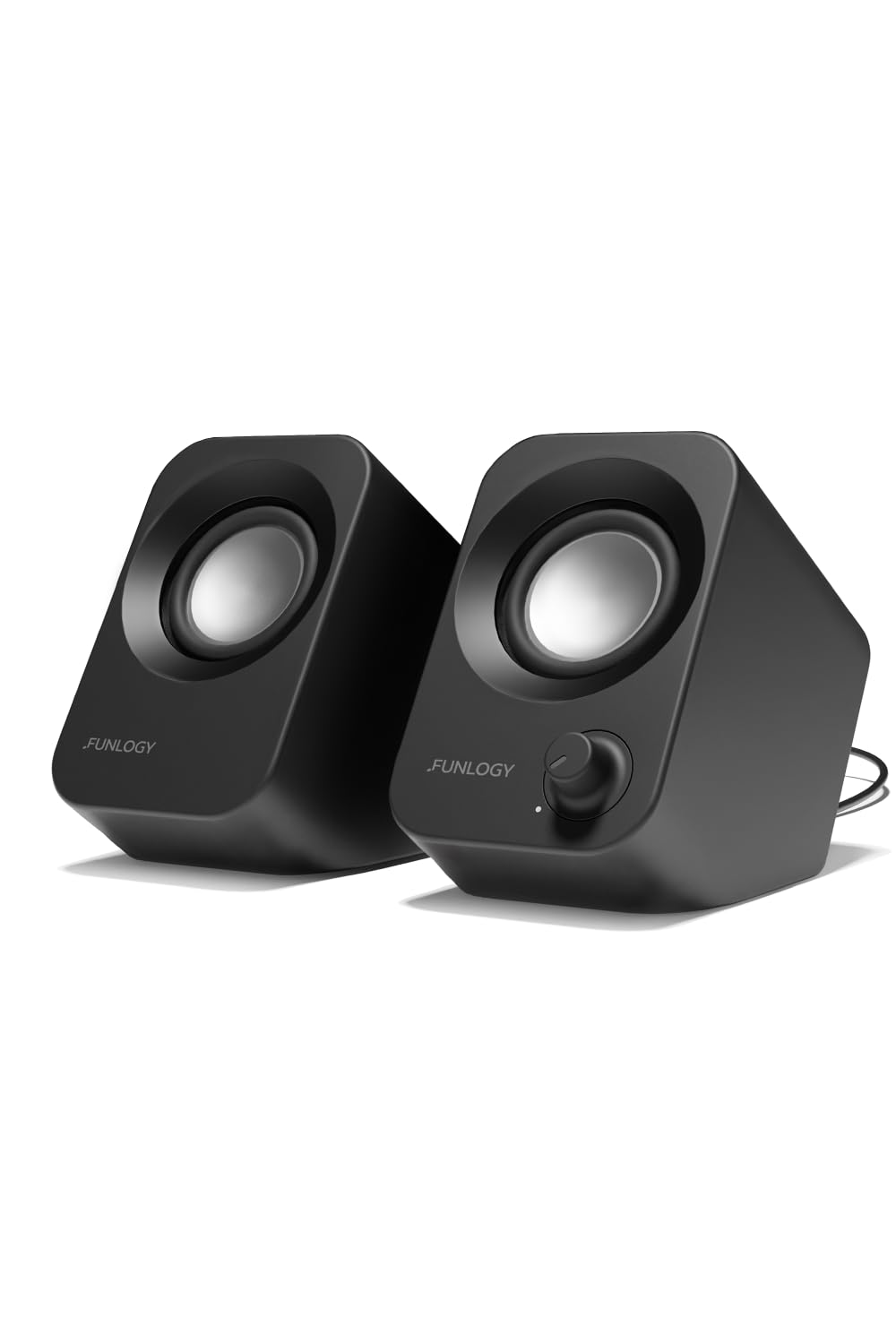
14 watts of total power (split between two speakers) makes the FUNLOGY speaker the top pick for anyone who wants genuinely loud, clear audio from a budget set — nearly three times the power of the Sanyun SW102 at 5W per speaker, so dialogue stays crisp and music fills a medium room without distortion.
Buyers report it is a “fantastic upgrade from Amazon Basics,” and the 48mm audio drivers are 20% larger than the 40mm drivers in the Redragon GS520, delivering fuller mids and cleaner highs for gaming or video calls. The 30-degree upward tilt aims sound directly at your ears, making audio feel more immersive without extra desk space.
The honest trade-off: owners mention the USB and AUX cables could be longer if your PC tower sits far from your desk. But for the combination of 14W loudness, 48mm driver size, and compact footprint, no other budget speaker matches this balance. It is the one to buy if you want real volume — loud enough to handle a medium room — without spending real money.
Why it’s great
- 14W total output is loud enough for medium rooms without distortion
- 48mm drivers produce noticeably fuller sound than the 40mm in the Redragon GS520
- 30-degree tilt design directs audio toward your ears for better clarity
Good to know
- USB and AUX cables are on the shorter side for some desk setups
- No Bluetooth connectivity — wired 3.5mm only
2. Redragon GS520 RGB Desktop Speakers

The Redragon GS520 cannot match the FUNLOGY on raw power — it uses smaller 40mm drivers and its total wattage is lower — but it beats the top pick on style. The touch-controlled RGB lighting (red-green-blue LEDs you can switch between six modes, including a slow-fade setting that you can turn off) is the main reason to choose it over the plainer FUNLOGY. For gamers building a themed setup, that visual flexibility matters.
In real use, customers note the audio is “decent up to 40% Windows volume” and that distortion creeps in above that point. That is a meaningful limit if you like your music loud, but for everyday YouTube, Discord calls, and casual gaming at moderate volume, the sound is clear and balanced. The plug-and-play setup works with PC, TV, and laptop via a single USB cable and 3.5mm audio jack (a standard round headphone plug).
The catch: the 31-inch fixed cable between the two speakers is too short for ultrawide monitors, several reviewers point out. The build also feels light and plastic-y, so the speakers shift when you press the top-mounted controls. Pick this if RGB lighting matters more to you than hitting 50% volume or having larger 48mm drivers. skip it if you need loud playback without distortion.
Where it shines
- Six RGB modes including an off switch for flexible desk aesthetics
- Touch controls on top for volume and lighting without reaching
- Plug-and-play with PC, TV, laptop, and smartphones
Worth noting
- Audio distorts above 40% Windows volume
- 31-inch cable between speakers is too short for ultrawide monitors
3. Sanyun SW102 Computer Speakers

If your desk is cramped and you still want bass that actually thumps — kick drums and explosions in games, not just a buzz — the Sanyun SW102 is the smart buy. A buyer in the reviews confirmed these speakers tested down to 115Hz using built-in passive bass radiators, deep enough to feel bass without a separate subwoofer, all from a speaker measuring just 3.94 x 2.76 x 2.95 inches.
The downside: at 5 watts per speaker, the SW102 puts out less than half the wattage of the FUNLOGY (14W total vs. 10W total). So it will not fill a large room at high volume, but on a typical desk within arm’s reach, it sounds rich and clear. One reviewer tested it against speakers from budget to premium brands in a blind A-B test and found the Sanyun matched or exceeded them all.
The standout feature is the passive bass radiator design squeezed into a metal-and-plastic chassis that stays steady without vibrating. For under $30, getting bass that works without a subwoofer is rare — the SW102 delivers it better than anything else at this price.
What stands out
- Passive bass radiators produce deep sound down to 115Hz from a tiny cabinet
- Compact 3.94-inch size easily fits under most monitors without blocking the screen
- Metal construction reduces vibration and feels more premium than plastic rivals
The trade-offs
- 5W per speaker limits maximum volume for larger rooms
- Some units develop left speaker issues after extended use, reviewers report
4. Amazon Basics Stereo 2.0 Speakers

The single number that matters most in this category is power output, and the Amazon Basics Stereo 2.0 Speakers deliver a modest but adequate 6W total (3W per channel).
The trade-off: these have minimal true bass and will not satisfy anyone looking for chest-thumping lows. They are much louder and clearer than built-in Dell monitor speakers, but they do not compete with the Sanyun SW102’s 115Hz passive radiator depth or the FUNLOGY’s 14W power. The inline volume control on the cable can dangle awkwardly below your desk — you may want to set it at max and adjust through Windows.
If your needs are straightforward — basic audio for video calls, YouTube, and casual music — and you want a brand you recognize, these are a solid value. They will not win any awards for deep bass, but they get the job done at a price that is hard to argue with. Budget buyers with no need for extreme loudness or bass, this is your pick — a price-to-value read that favors simplicity over performance.
The upsides
- Simple USB-powered design works with any computer without extra adapters
- Bottom radiator adds a slight bass boost for richer sound
- Inline volume knob gives quick access without reaching behind the desk
Keep in mind
- Minimal bass — not suitable for music lovers wanting deep low end
- Volume knob on cable can hang below desk and be inconvenient to reach
5. ROSON A-293 Computer Speaker

The ROSON A-293 is the entry-level champion of this list. At just 3 watts per speaker, it is the least powerful option here — half the wattage of the Sanyun SW102 — but it costs less than most coffee runs. What you get is a compact pair of speakers (6.96 x 3.34 x 3.14 inches each) that deliver clear, bright sound for basic desktop use. Reviewers confirm they “play loud and clear” for the price, making them a fine upgrade from a laptop’s built-in speakers.
What you give up is volume and bass. At 3W per channel, these will not fill a room or handle bass-heavy music well. The rear port holes attempt to add some low-end presence, but they cannot compete with the passive radiators on the Sanyun SW102 or the 14W output of the FUNLOGY. However, the front-mounted volume control and headphone jack (a 3.5mm port for private listening) are convenient features that pricier options sometimes skip.
This is the right pick if you have an ultra-tight budget and just need something better than monitor speakers for Zoom calls, browser games, and background music. The long cables — 39.37-inch USB and AUX, plus 31.49-inch between speakers — give you flexible placement options that the Redragon GS520’s 31-inch inter-speaker cable lacks. If you can stretch your budget, the Sanyun SW102 adds much better bass for a small extra spend.
Why we’d pick it
- Front-mounted volume knob and headphone jack for easy access
- Long cables (39 inches) allow flexible placement around large desks
- Plug-and-play USB power means zero driver setup required
A few caveats
- 3W per speaker limits loudness — not suitable for large rooms
- Minimal bass output compared to competitors with passive radiators
Understanding the Specs
Total Wattage (W)
The wattage tells you how much electrical power the speakers convert into sound. Higher wattage means louder, cleaner audio before distortion kicks in. For cheap PC speakers, 10W total is a good baseline — anything under 6W will struggle to fill a desk space. The FUNLOGY at 14W is the clear winner here, while the ROSON at 6W is best for quiet, close-range listening.
Driver Size (mm)
Driver size (measured in millimeters) determines how much air the speaker cone can move. A larger driver produces fuller mids and better bass extension. The 48mm drivers in the FUNLOGY move 20% more air than the 40mm drivers in the Redragon GS520, which translates to noticeably richer sound at the same volume level.
FAQ
Can cheap PC speakers produce decent bass?
Is USB power enough for PC speakers?
What does 2.0 channel mean on a speaker set?
Final Thoughts: The Verdict
If you want one dependable pick, the best cheap pc speakers winner is the FUNLOGY speaker because it delivers 14W of clean power through 48mm drivers at a price that undercuts everything else. If you want RGB lighting (red-green-blue LEDs) to match your gaming setup, grab the Redragon GS520. For bass that punches way above a tiny 3.94-inch footprint, the Sanyun SW102 is the one — just know you trade volume for that deep low end.

Mo Maruf
I created WellFizz to bridge the gap between vague wellness advice and actionable solutions. My mission is simple: to decode the research and give you practical tools you can actually use.
Beyond the data, I am a passionate traveler. I believe that stepping away from the screen to explore new environments is essential for mental clarity and physical vitality.