Our readers keep the lights on and my smoothie glass nicely filled. As an Amazon Associate, I earn from qualifying purchases.
Specs are compiled from manufacturer listings and verified buyer reviews and can change over time — please confirm the key details on the product page before buying.
You need a multimeter that will not lie to you, but you also do not want to spend a lot. The worry is that a cheap meter saves your weekend or feeds you wrong numbers that fry a circuit. The real question is which budget model still gives you True RMS (a technology that reads irregular electrical signals accurately), a dependable NCV sensor (non-contact voltage detector that finds live wires without touching them), and a build that does not crack in your tool bag. This guide pulls apart seven pocket-friendly meters, comparing their accuracy specs, safety ratings, and real feedback from buyers who used them on live wires and dead cars.
I’m Mohammad Maruf — the founder and writer behind WellFizz. This guide is built by comparing the manufacturers’ published specifications and the patterns across verified customer reviews, so you get each pick’s real strengths and trade-offs instead of marketing spin.
If you are a homeowner testing an outlet or a DIYer tracking a parasitic draw (a small battery drain that kills a car battery overnight), knowing which budget contender is trustworthy makes all the difference. This roundup ranks the best cheap multimeter options based on accuracy, safety, and real-world buyer experience.
Our Picks at a Glance


How To Choose The Best Cheap Multimeter
A low price tag on a multimeter often means a trade-off in safety rating, input protection, or the quality of the test leads. Here are the three things to check before you click buy.
Safety First — The CAT Rating
The CAT rating (Category rating) tells you how well the meter is protected against voltage spikes (sudden surges in power). A CAT II 600V rating is fine for household outlets and small appliances. A CAT III 600V rating is safer for higher-energy circuits like breaker panels because it has stronger surge protection. Cheaper meters sometimes exaggerate this rating, so stick with a known brand that lists its standard plainly.
True RMS vs. Average Responding
True RMS (Root Mean Square — a measurement method that accurately calculates the heating effect of an electrical signal) is not just jargon. It is how the meter accurately reads non-sinusoidal AC signals (irregular waveforms that are not perfect sine waves), like the ones from dimmer switches or variable-speed motors. An average-responding meter can be off by 40% on those waveforms, so you get a wrong reading. For almost any modern home or automotive circuit, you want a True RMS meter, even on a budget.
Counts and Resolution
The “counts” number (4000 counts, 6000 counts) describes how many different readings the display can show. A 6000-count meter can read up to 5999 on a given range, which gives finer detail than a 2000-count meter. For basic continuity (checking if a wire is unbroken) and battery checks, 4000 counts is plenty. For more precise automotive diagnostics, 6000 counts is better because you can see smaller voltage changes.
Quick Comparison
| Model | Best For | Counts | Safety Rating | Auto-Ranging | Amazon |
|---|---|---|---|---|---|
| Neoteck Pen Type★ Best Overall | Ultra-Compact Portability | 6000 counts | CAT II 600V | Intelligent | Amazon |
| Auto-Ranging TRMS 6000Also Great | Best Overall Value | 6000 counts | CAT III 600V | Yes | Amazon |
| KAIWEETS KM200P | All-Button Durability | 4000 counts | CAT II 600V | Yes | Amazon |
| Crenova 890Z | Most Accessories | 6000 counts | Not listed | Yes | Amazon |
| Neoteck 6000 Counts TRMS | Highest Safety Rating | 6000 counts | CAT III 1000V / CAT IV 600V | Yes | Amazon |
| Proster T28B | Hands-Free Magnetic Mount | 6000 counts | CE, RoHS | Yes | Amazon |
| Gardner Bender GMT-318 | Analog Simplicity | — | Agency Approved | No | Amazon |
In‑Depth Reviews
1. Neoteck 2 in 1 Pen Type Digital Multimeter
A multimeter that clips into your pocket — 81 grams and built like a fat pen.
This is the smallest multimeter in the lineup, measuring just 7.28 x 1.02 x 1.14 inches and weighing only 81 grams, while the Auto-Ranging TRMS meter weighs 300 grams. It works as both a voltage tester pen (which detects AC voltage without touching wires) and a full digital multimeter for DC/AC voltage, resistance, diode, continuity, capacitance, and frequency. In pen mode, it only measures AC voltage; in multimeter mode, it does both AC and DC.
The “intelligent operation” feature auto-detects what you are measuring (AC/DC voltage, resistance, or continuity) so you do not have to turn a dial. The NCV (non-contact voltage) sensor has different alarm frequencies for null wire (neutral) vs. fire wire (hot), which is handy for identifying which wire is live in a junction box. It has a built-in flashlight and a pen clip, plus a velvet pouch for storage.
The trade-off for this small size is the safety rating: it is only CAT II 600V (intended for household outlets and small appliances, not distribution panels). The test leads are small and the screen is limited in what it can show at once. But for a quick continuity check or a voltage test, you can grab it out of your pocket faster than any full-size meter.
Pocket-Sized Power
- Weighs only 81 Grams — truly pocketable with a pen clip
- Intelligent auto-detection of measurement type
- NCV sensor with different alerts for neutral vs. hot wire
Size Compromises
- CAT II 600V only — not for high-energy circuits
- Pen mode only measures AC voltage, not DC
- Small screen and smaller test leads
Reach for this if: You want a multimeter that lives in your shirt pocket for quick checks — the 81 Gram weight and pen clip make it always there when you need it.
Look elsewhere if: You need to test high-energy circuits (stick with the Neoteck 6000 Counts TRMS or the Auto-Ranging TRMS for CAT III protection) or need a large, easy-to-read display.
2. Auto-Ranging Digital Multimeter, TRMS 6000 Counts
The auto-ranging workhorse that impressed buyers enough to save a diagnostic fee.
This meter gives you True RMS (Root Mean Square — for accurate readings on irregular signals) and 6000 counts, compared to the KAIWEETS KM200P’s 4000 counts, so you get better detail when tracking tricky automotive circuits. The auto-ranging function removes the guesswork — you just pick what you are measuring (voltage, current, resistance), and the meter finds the correct range itself. That means you do not waste time dialing in the right range, so number plates stay readable at night.
Safety is strong here with a CAT III 600V rating (it can handle the higher energy found on distribution panels) and a double ceramic fuse plus thermistor protection circuit to prevent burn-out if you accidentally probe a live circuit on the wrong setting. The orange silicone cover is non-slip and adds drop protection. It also includes a thermocouple (a temperature probe) for temperature readings, which is a rare find at this price.
One reviewer noted it “Helped diagnose car issue, saving diagnostic fee.” That is real-world proof that this budget meter saves money the day it arrives. The only trade-off is the weight: at 300 Grams it is noticeably heavier than the 81-Gram Neoteck pen meter, so it is less pocket-friendly.
Reliable Daily Driver: The CAT III 600V safety rating, dual ceramic fuses, and thermistor protection circuit give you a meter that is genuinely safe for serious electrical work, not just household outlets.
Reach for this if: You want a well-rounded, auto-ranging multimeter with True RMS, temperature measurement, and a proven safety track record for home and car diagnostics. Buyers confirm it saves money on shop fees.
Look elsewhere if: You need a pocket-sized meter to carry around all day — the 300 Gram weight and standard body size are too bulky for a shirt pocket.
3. KAIWEETS KM200P Digital Multimeter
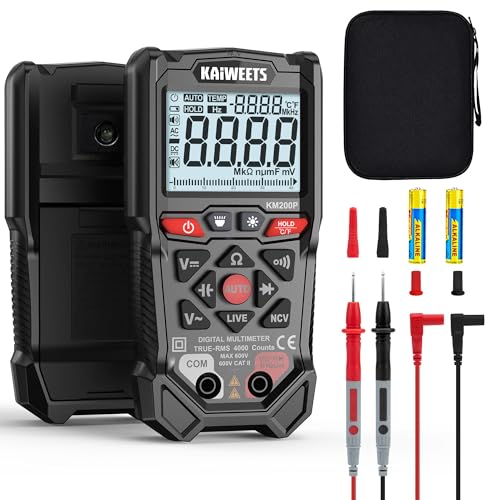
The meter that ditches the dial for buttons — and buyers report it actually works better.
Most cheap multimeters use a rotary dial that wears out over time, but the KAIWEETS KM200P replaces that with dedicated buttons. One buyer mentioned, “I used it to diagnose and find a short in my neighbor’s garage door opener sensors the day after it arrived.” The all-button design means no worn-out contacts and no accidental range change — just push and measure. It covers DC/AC voltage, resistance, capacitance, diode testing, continuity, and LIVE detection.
The 4000 counts and True RMS (Root Mean Square) provide accurate readings for non-sinusoidal waveforms, though it is slightly less granular than the 6000-count Auto-Ranging TRMS. The NCV (non-contact voltage) sensor alerts you with beeps and a red screen. Several reviewers noted the NCV can be hit-or-miss on well-insulated outlets, so do not rely on it as your only safety check. The 15-minute auto-shutdown (to save the 2x AAA batteries) and a built-in flashlight are helpful.
The battery compartment is tight, and some buyers said rechargeable AAs barely fit. The included manual is printed very small. But for a meter that changes how you interact with it, the KAIWEETS is a smart upgrade from a standard dial unit. It comes with a 3-year warranty, which is uncommon at this price tier.
Button-Based Advantages
- No rotary dial to wear out or get stuck
- Auto mode prevents measuring voltage while in Ohms mode (protects the meter)
- Includes a carrying case, test leads, and AAA batteries
Watch Out For
- NCV reliability is 50/50 on newer, well-insulated outlets
- Manual print is very small — you may need a magnifier
- Tight battery compartment may not fit all rechargeable AAAs
Great for daily use: Homeowners, DIYers, and anyone tired of a worn-out rotary dial. Buyers confirm it is easy to use and found a short in a neighbor’s garage door sensor the day after arrival. The 3-year warranty adds confidence.
Be aware: The battery compartment is tight and the NCV is not 100% reliable. Do not make it your only safety tool.
4. Crenova 890Z Digital Multimeter

The kit that keeps giving — alligator clips, thermocouple, and a semi-hard case included.
The Crenova 890Z stands out because of what comes in the box: a K-type thermocouple (temperature probe) for temperature readings, a pair of alligator clip test leads in addition to standard probe leads, and a semi-hard carrying case. For someone who does not own any accessories yet, this bundle saves a second trip to the store. It measures AC/DC current, voltage, resistance, frequency, capacitance, continuity, diode, and transistor (hFE — a gain measurement for transistors).
The 6000-count LCD display has a backlight for dimly lit areas and a built-in flashlight. It also uses True RMS (Root Mean Square) for accurate non-sinusoidal readings. Owners mention it is “larger, easier to read, flip-out stand, semi-hard case, alligator clips, thermocouple for temperature, versatile TRMS, great value.” One owner reported it replaced an old Radio Shack meter and felt far more versatile. The NCV (non-contact voltage) detection works, but one customer observed the light is dim — a minor annoyance.
The double fuse protection is a safety plus, though the exact CAT rating is not clearly stated in the product data. That means it is best suited for home, automotive, and light industrial use rather than heavy commercial panel work where a known CAT III rating is mandatory. The auto-power-off and data hold functions are standard but welcome.
Accessory King: The semi-hard case, alligator clips, and thermocouple make this the best kit for a beginner who has nothing. Buyers confirm it is great value for the money.
Reach for this if: You are starting from zero and want a complete test kit with every accessory you need — alligator clips, temperature probe, and a case to store it all.
Look elsewhere if: You need a clearly stated CAT III safety rating for commercial electrical work. The exact rating is not listed here, so stick with the Neoteck 6000 Counts or the Auto-Ranging TRMS for that.
5. Neoteck 6000 Counts True RMS Digital Multimeter
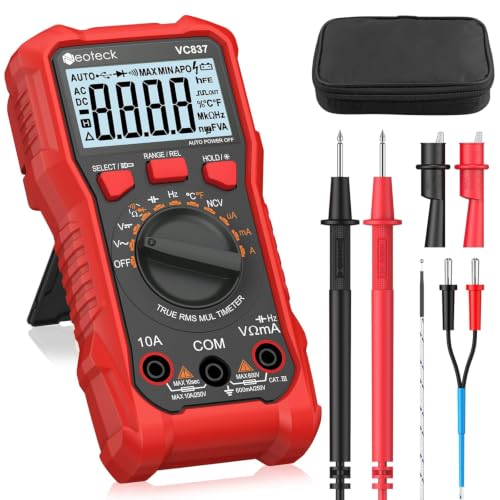
The budget meter that dares to carry a CAT III 1000V stamp — built for higher-stakes electrical work.
Most multimeters at this price point stop at CAT II 600V, but the Neoteck VC837 goes further with a CAT III 1000V and CAT IV 600V safety rating (it can handle voltage spikes on industrial distribution panels, not just your home outlet). The auto/manual dual-range switching lets you let the meter figure out the range, but you can also lock it manually for repeat measurements.
It covers AC/DC voltage, current, resistance, capacitance, frequency, duty cycle (the percentage of time a signal is on), temperature, diode, and continuity. The accuracy specs are published clearly (DC V: ±0.5%+4, AC V: ±0.8%+6), so you know how precise it is. Customers note it is “sturdy build, clear LCD, accurate readings, compact for tool bag.” The red shell protects the meter. One user highlighted you might need to buy your own alligator clips because the meter does not come with them.
The 18-month warranty from Neoteck is better than many budget competitors, and the CE, EN 61010-1, and RoHS certifications are clearly stated. The only real drawback is the lack of included alligator clips, but for the safety protection you get, this is a solid choice for anyone who goes beyond simple outlet testing.
Safety-First Build
- CAT III 1000V / CAT IV 600V safety rating (top-tier at this price)
- Dual fuses and full-range overload protection
- Auto and manual range selection for flexibility
One Missing Item
- Does not include alligator clips — you will need to buy a set separately
- Slightly larger than a pocket pen meter
Reach for this if: You test higher-energy circuits like breaker panels or motor controls and need a budget meter that still carries a CAT III 1000V safety rating. Buyers confirm it is accurate and well-built for the price.
Look elsewhere if: You want a complete kit with alligator clips included — the Crenova 890Z is a better bundle for the same price.
6. Proster Digital Multimeter T28B
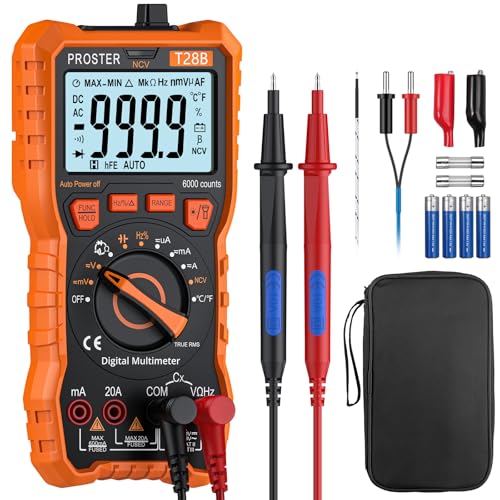
The meter that sticks to metal — literally — so you keep both hands on the probes.
The Proster T28B has a built-in magnetic back that lets you attach it to any ferrous metal surface: a breaker panel door, a car chassis, an AC unit frame. Combined with the fold-out kickstand, you get true hands-free operation — both hands stay on your probes, which is safer and more efficient. It measures AC/DC voltage, AC/DC current, resistance, capacitance, frequency, duty ratio (the percentage of time a signal is active), and temperature via the included K-type thermocouple (temperature probe).
The 6000-count display with True RMS (Root Mean Square) gives you accurate readings on non-sinusoidal signals. The built-in flashlight and backlit LCD help in dark spaces like under a dashboard. Reviewers point out it has “good flexible leads and solid attachments” and that it is “great for techs in the HVAC Industry.” One reviewer wished the leads were a bit sturdier. It comes with alligator clips, a screwdriver, and fuses — a complete kit.
The only real downside is the manual: it is printed in very small type and includes many languages, so the English section is only about 13 pages. You might need to scan it on your phone to read it. But for field work, the magnetic mount is a real differentiator that none of the other meters here offer.
Field-Ready Mount: The magnetic back and kickstand let you stick it on a panel or car chassis, keeping both hands free for probing. Buyers in HVAC and automotive industries praise this design.
Reach for this if: You work in tight spaces (breaker panels, car engine bays) where you cannot hold the meter and probe at the same time — the magnetic mount is a real hands-free solution.
Look elsewhere if: You need a clearly legible manual without squinting. The small print is a common complaint in buyer reviews.
7. Gardner Bender GMT-318 Analog Multimeter
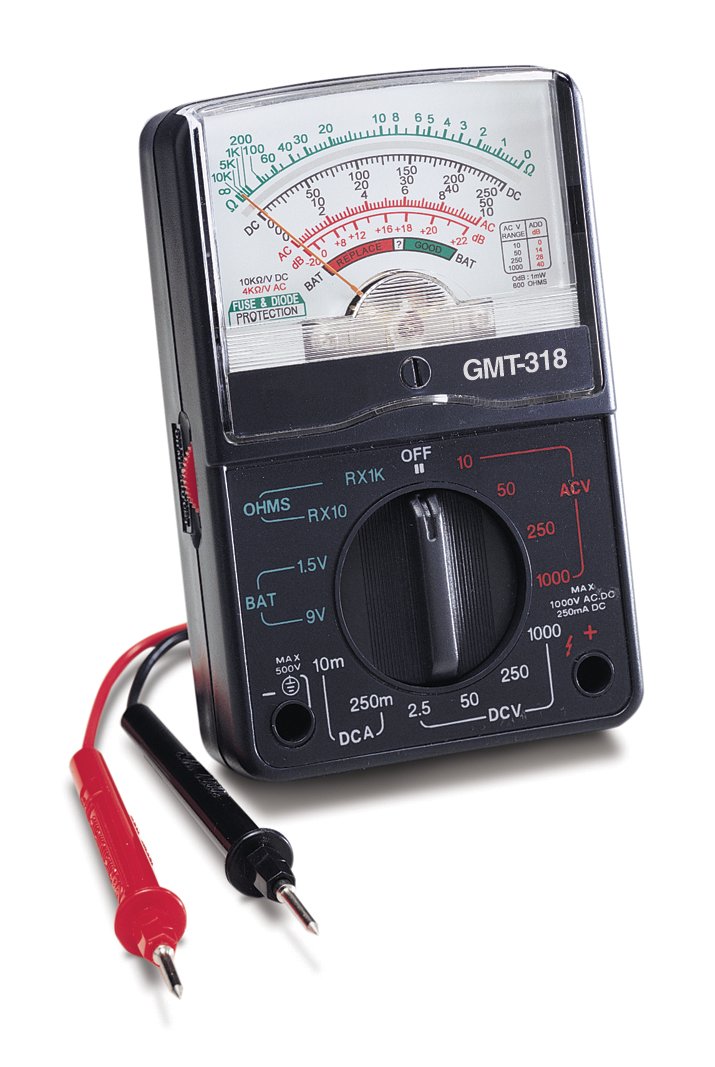
The analog needle that tells you more than a number ever could about a fluctuating signal.
This is the odd one out in a list of digital meters — and that is exactly the point. An analog multimeter uses a moving needle over a colored scale, which is still the best way to see a signal that is fluctuating or moving. You can visually track the needle’s swing, which helps you spot drifting voltage or a slow capacitor charge. The Gardner Bender GMT-318 is a 6-function, 14-range meter covering AC/DC voltage up to 500V, DC current, resistance, decibels (a measure of sound level), and battery tests.
The color-coded analog displays make it easy to read the right scale, and the 15-position rotary dial covers all your functions. It includes replaceable test leads and has fuse overload protection circuitry. Shoppers say it is “simple, sturdy quality build” and that you can “keep one in the shop, the house and also in the truck tool boxes.” It is compact at 1.25 x 2.75 x 4.25 inches, compared to the Neoteck pen meter’s 7.28 x 1.02 x 1.14 inches, but it feels solid in the hand.
The main drawbacks are manual range selection (you must guess the range before you measure) and the very tight battery compartment (some buyer could not fit rechargeable AA batteries). Also, the test lead plugs are very small, so finding replacement leads may be tricky. This is not a meter for precision digital work, but for continuity, basic voltage checks, and learning to read a moving needle, it is a classic tool.
Needle Over Numbers: The analog display lets you see fluctuating signals in real time — a dying battery or a pulsing sensor signal is obvious in the needle’s movement, not hidden in a digital number.
Reach for this if: You want a no-battery-needed hint (though it uses one for resistance), a simple tool for basic continuity and voltage checks, or you are learning how electronics work and want to see a signal’s behavior visually.
Look elsewhere if: You need precise digital readouts, auto-ranging, or True RMS for modern electronics — the analog needle cannot give you a 0.1V resolution.
Understanding the Specs
True RMS (Root Mean Square)
This is not just a buzzword — it is how the meter calculates AC voltage and current accurately when the waveform is not a perfect sine wave (like the signals from dimmer switches, variable-speed motors, or switching power supplies). An average-responding meter can be off by 40% on those signals. For most modern home and automotive electronics, you want True RMS.
CAT Safety Ratings
The CAT rating (Category rating) tells you where the meter is safe to use. CAT II is for household appliances and outlets. CAT III is for distribution panels and large motors. CAT IV is for utility-level installations. A higher number with a higher voltage (like CAT III 1000V) means the meter has better surge protection. Never use a low-rated meter on a high-energy circuit — it could explode in your hands.
FAQ
Can I use a cheap multimeter on a car battery?
What is the difference between 4000 counts and 6000 counts?
Do I really need True RMS on a cheap multimeter?
Can a cheap multimeter measure current without blowing a fuse?
Is a pen-type multimeter as accurate as a full-size one?
Why does my multimeter show “1” on the screen?
Can I measure temperature with a cheap multimeter?
How long does a multimeter battery last?
Final Thoughts: The Verdict
If you want one dependable pick, the cheap multimeter winner is the Auto-Ranging TRMS 6000 Counts because it combines True RMS accuracy, 6000 counts resolution, a strong CAT III 600V safety rating, and dual ceramic fuse protection — all at a price that still leaves room for a thermocouple and test leads. If you want a meter that ditches the rotary dial for buttons, grab the KAIWEETS KM200P. And for hands-free work in tight spaces, stick the Proster T28B to a metal panel and keep both hands on your probes.
How We Picked
We do not accept paid placement. Every pick is matched to a real buyer and a real use-case; we do not hands-on test units.
Sources & Methodology
Specifications: manufacturer listings and product documentation. Review insights: verified customer reviews, as of July 2026. Pricing: not shown on this page (it changes often); check the current price via the retailer link.
As an Amazon Associate, WellFizz earns from qualifying purchases. This does not affect which products we feature.
Related Guides

Mo Maruf
I created WellFizz to bridge the gap between vague wellness advice and actionable solutions. My mission is simple: to decode the research and give you practical tools you can actually use.
Beyond the data, I am a passionate traveler. I believe that stepping away from the screen to explore new environments is essential for mental clarity and physical vitality.