Our readers keep the lights on and my smoothie glass nicely filled. As an Amazon Associate, I earn from qualifying purchases.
Buying a cheap movie camera used to mean accepting grainy footage, frustrating autofocus, and shaky handheld shots that made viewers seasick. That trade-off is dead. Advances in sensor technology, gimbal stabilization, and AI-powered processing have pushed genuinely capable filmmaking tools below the threshold — but you still have to know exactly which specs matter and which marketing terms are noise. The wrong choice leaves you with a camera that overheats, delivers fake resolution, or handles low light like a smartphone from 2015.
I’m Mohammad Maruf — the founder and writer behind WellFizz. I’ve spent hundreds of hours analyzing sensor sizes, stabilization systems, bit depth, frame rates, and real-world customer feedback across the budget camera market to separate the gear that delivers professional results from the gear that just looks good in a product photo.
This guide cuts through the spec-sheet clutter to recommend the most reliable best cheap movie camera options tested for real-world filmmaking, vlogging, and content creation.
How To Choose The Best Cheap Movie Camera
Buying a cheap movie camera requires a ruthless focus on a few critical specs because the profit margins are thin — manufacturers often hide weaknesses behind inflated resolution numbers and accessory bundles. If you ignore sensor size, stabilization type, and audio input, you’ll end up with a box of accessories attached to a mediocre camera you never use. Here’s what to look for.
Sensor Size is Everything
The single biggest predictor of video quality in a cheap movie camera is the physical size of the image sensor. A 1-inch CMOS sensor (like the one found in serious vlogging cameras) captures significantly more light than the tiny 1/2.3-inch or 1/3-inch sensors found in bargain camcorders. That translates directly to cleaner footage in dim rooms, better background separation, and less digital noise. If a camera doesn’t specify its sensor size, assume it’s using a small sensor and move on.
Real Stabilization vs. Electronic Crop
Handheld movie footage lives or dies by stabilization. The best cheap movie cameras use either a mechanical 3-axis gimbal (like the Xtra Muse) or advanced electronic stabilization with horizon lock (like the Insta360 models). Avoid cameras that only offer “digital stabilization” without naming the specific technology — those typically crop your frame and introduce jitter. If you plan to walk, run, or move the camera at all, stabilization is more important than resolution.
Frame Rate Versatility
4K at 24fps is the minimum for cinematic-looking footage. But if you want slow motion, you need at least 60fps at 1080p, and ideally 120fps for buttery-slow playback. Check whether the camera can hold those frame rates continuously or only in short bursts — overheating is a real issue in cheap cameras with small heat sinks. Cameras that can sustain 4K/60fps or 4K/120fps without shutting down are worth a premium.
Audio Input Flexibility
Bad audio ruins good video faster than bad video does. A cheap movie camera should have at least a 3.5mm external microphone jack or support for wireless mics via Bluetooth. Built-in mics are fine for casual vlogging, but for interviews, voiceovers, or any narrative filmmaking, you need external audio. Cameras that rely solely on internal mics will pick up handling noise, wind, and room echo that you can’t fix in post.
Quick Comparison
On smaller screens, swipe sideways to see the full table.
| Model | Category | Best For | Key Spec | Amazon |
|---|---|---|---|---|
| Xtra Muse | Gimbal Camera | Smooth handheld run-and-gun | 1-inch CMOS, 3-axis gimbal | Amazon |
| Insta360 X4 Air | 360 Action | Creative 360 reframing | 8K 360, 165g, FlowState | Amazon |
| DJI Osmo 360 | 360 Action | High-end 360 & low light | 1-inch 360 sensor, 105GB | Amazon |
| Canon PowerShot V10 | Compact Vlog | Pocketable point-and-shoot | 1-inch CMOS, 19mm f/2.8 | Amazon |
| Sony ZV-1F | Vlog Camera | Entry-level vlogging | 1-inch sensor, 20mm f/2 | Amazon |
| Sony ZV-1 | Vlog Camera | Versatile content creation | 1-inch stacked, 24-70mm f/1.8 | Amazon |
| OBSBOT Tail Air | PTZ Streaming | AI tracking studio streaming | 4K PTZ, AI tracking | Amazon |
| DJI Osmo Nano | POV Action | Ultra-portable POV clips | 1/1.3-inch, 143° FOV, 128GB | Amazon |
| Acuvar 6K/4K | Budget Kit | Full accessory bundle | 18x digital zoom, 4500mAh | Amazon |
In‑Depth Reviews
1. Xtra Muse Vlogging Camera

The Xtra Muse strikes the rarest balance in the cheap movie camera segment: it pairs a true 1-inch CMOS sensor with a built-in 3-axis gimbal stabilizer, all for a price that undercuts DJI’s Pocket 3 by a wide margin. That sensor is the same physical size Sony uses in its RX100 series, capturing enough light to keep 4K/120fps footage clean in dim interiors. The gimbal eliminates the need for post-production stabilization or bulky rigs — handheld pans and walking shots come out smooth without the micro-jitter that electronic stabilization introduces.
Face and object tracking work reliably without hunting, and the 2-inch touchscreen makes framing simple. The camera logs 10-bit X-Log color, which gives you genuine grading latitude in post — a feature usually reserved for cameras twice this price. Battery life hits around 161 minutes, which is strong for a battery-powered gimbal camera, and the USB-C PD port supports charging while recording for extended sessions. DJI Pocket 3 accessories fit the body, opening up a wide aftermarket ecosystem.
A few trade-offs keep this from perfection: the lack of a built-in electronic viewfinder makes bright-sun shooting harder, and the microSD card slot requires a UHS Speed Class 3 card for reliable 4K/120fps recording. Some users report that the internal speaker is quiet for playback monitoring. But as a primary run-and-gun camera for vloggers, event shooters, and indie filmmakers working on a budget, it outperforms everything else at this price point.
Why it’s great
- 1-inch sensor delivers genuine low-light improvement over phone sensors
- Integrated 3-axis gimbal saves hours of stabilization work in post
- 10-bit X-Log color for professional-grade color grading
- Reliable face and object tracking without hunting
Good to know
- No electronic viewfinder, hard to frame in direct sunlight
- Requires fast UHS-3 microSD for 4K/120fps recording
- Internal speaker output is low for on-camera audio checks
2. Insta360 X4 Air Starter Bundle
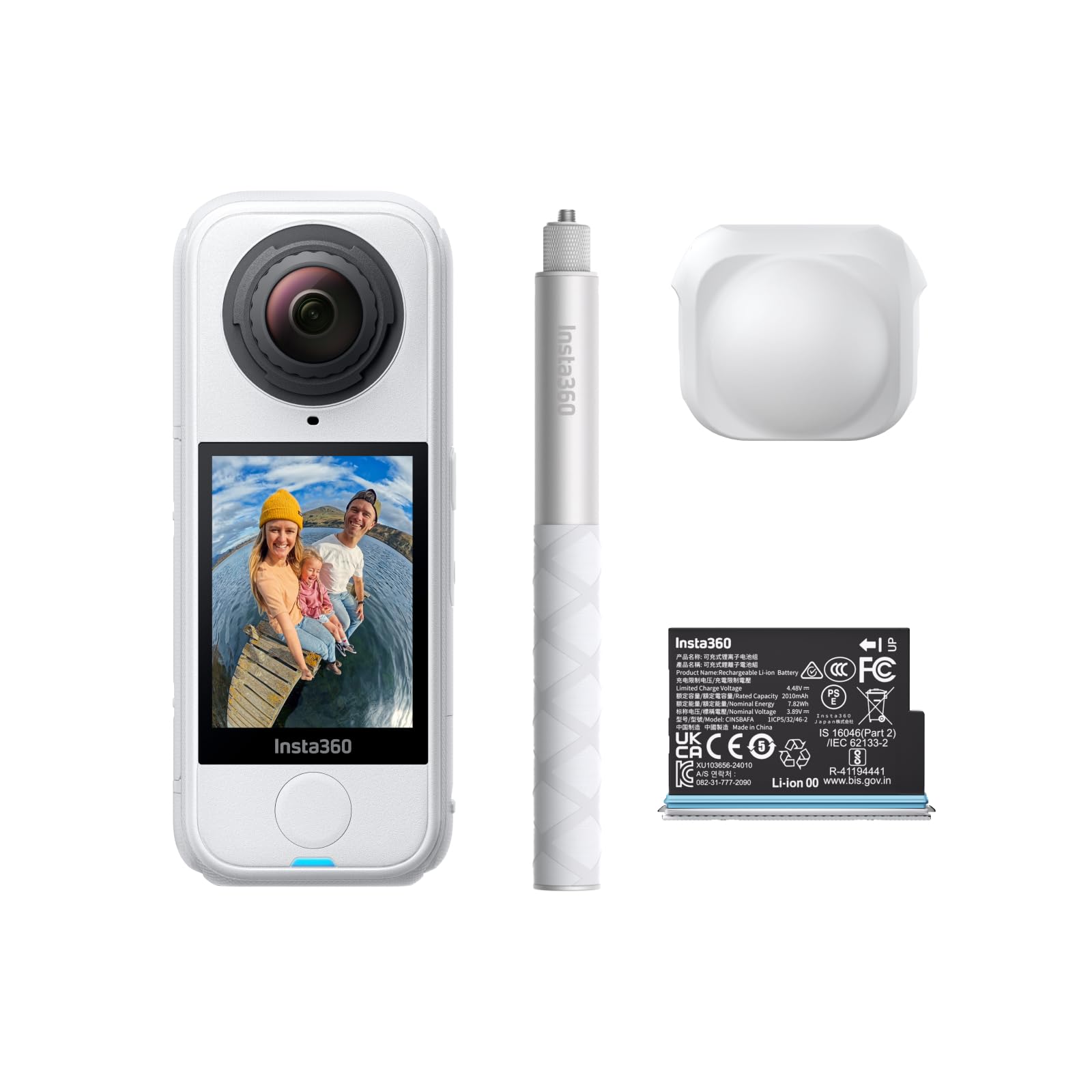
The Insta360 X4 Air redefines what a cheap movie camera can do by removing the single most stressful part of filming: framing. Its dual 360-degree lenses capture everything around you in 8K at 30fps, meaning you hit record first and choose your angle later — in the Insta360 app. For solo creators, action sports shooters, and travel filmmakers who don’t have a dedicated camera operator, this workflow is transformative. At 165 grams, it’s barely noticeable on a backpack strap or helmet mount.
FlowState stabilization and 360 Horizon Lock keep footage level even when the camera rotates completely, which is impossible for standard action cameras without a gimbal. The invisible selfie stick effect creates third-person perspectives — drone-like overhead shots and orbiting angles — that would otherwise require a full crew. The starter bundle includes an extra battery and a 114cm invisible selfie stick, which adds significant value over buying the body alone.
The main compromise is low-light performance: the smaller sensor required for the dual-lens design shows noticeable noise and clarity loss in dim environments. Audio quality is serviceable but not broadcast-grade; users report good results pairing it with a DJI Mic Mini via Bluetooth. The V60 microSD requirement means you can’t use old cards lying around. For 360 capture and creative flexibility at this price, it’s in a league of its own.
Why it’s great
- 8K 360 capture eliminates the need to frame shots in real time
- FlowState stabilization with Horizon Lock keeps footage level through any rotation
- Ultralight 165g body is unobtrusive for POV and travel use
- Invisible selfie stick effect creates drone-like angles affordably
Good to know
- Low-light footage shows noticeable noise and clarity loss
- Internal audio is adequate but benefits from an external mic
- Requires V60-rated microSD for stable 8K recording
3. DJI Osmo 360 Standard Combo
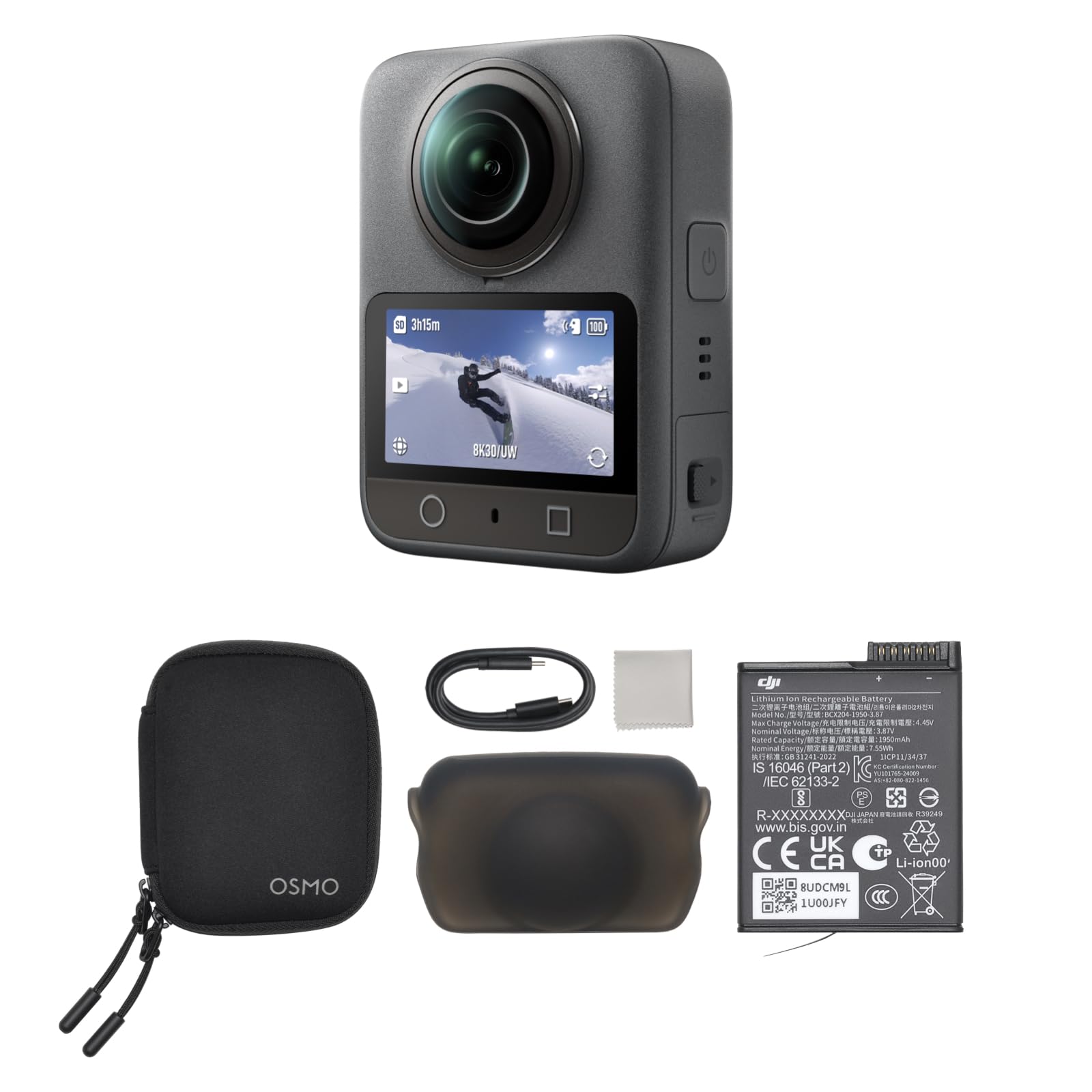
DJI’s Osmo 360 solves the single biggest weakness of 360 cameras: poor low-light performance. By putting a 1-inch CMOS sensor behind each of its two lenses, it captures significantly more light than any other 360 camera in this price range. The result is 8K/30fps 360 video that stays clean and vibrant in city-night scenes, indoor events, and even sunset landscapes — environments where smaller sensors fall apart into noise. For filmmakers who need 360 capture for B-roll, architectural walkthroughs, or immersive travel content, this is the camera to beat.
The built-in 105GB storage eliminates the immediate need for a microSD card, and the 190-minute recording time at lower resolutions covers full-day shoots without swapping batteries. OsmoAudio connects directly to up to two DJI microphones without a receiver, which simplifies wireless audio for interviews and vlogs. The 1.2m invisible selfie stick is included, and the magnetic quick-release mount switches between 360 mode and single-lens action cam mode in seconds.
The downsides are familiar for DJI’s newer products: the Mimo app was removed from Google Play, so Android users must sideload from DJI’s website, which is an extra step. The camera body gets hot during extended 8K recording, though built-in overheat protection prevents damage. Battery life at 8K runs closer to 100 minutes, which is still competitive but lower than the advertised 190-minute spec. For low-light 360 video, nothing at this price point comes close.
Why it’s great
- Dual 1-inch sensors deliver class-leading low-light 360 video
- 105GB built-in storage means no memory card purchase needed
- Direct wireless connection to two DJI mics without a receiver
- Magnetic mount switches between 360 and action cam modes
Good to know
- DJI Mimo app requires sideload on Android (removed from Play Store)
- Camera heats up noticeably during extended 8K recording sessions
- Real-world 8K battery life is about 100 minutes, not the full 190
4. Canon PowerShot V10

The Canon PowerShot V10 is the smallest 1-inch sensor camera in this lineup, and it prioritizes pocketability and ease of use over raw specs. The 19mm wide-angle lens (35mm equivalent) is fixed — no zoom at all — but that forces you to think like a cinematographer: move the camera to frame, don’t rely on a zoom ring. The retractable front-facing screen and built-in stand let you set it on a table, flip the screen, and start vlogging in seconds without a tripod. For solo creators who value speed over versatility, this workflow is hard to beat.
Video quality is pure Canon: accurate skin tones, good dynamic range for its size, and the 1-inch sensor handles moderate low-light better than any phone. The three-microphone array with a center channel for noise cancellation captures surprisingly clear audio for a camera this small. The USB-C port charges the battery and allows data transfer, and the micro-HDMI output lets you monitor on an external display. Image stabilization in the latest firmware offers three modes — IS Off, IS On, and IS Enhanced — that handle walking shots adequately.
The fixed lens means no optical zoom and no lens cap — the glass is exposed, so a protective case is strongly recommended. Battery life is average at best; expect about 45-60 minutes of continuous 4K recording. There’s no image stabilization in 4K at 30fps, only in 1080p modes, which limits its use for handheld cinematic work. It’s a specialist tool for on-the-go vloggers who want Canon color science in their pocket, not a general-purpose movie camera.
Why it’s great
- Smallest 1-inch sensor body makes it truly pocketable
- Built-in stand enables instant tabletop vlogging without a tripod
- Canon color science delivers accurate, pleasing skin tones
- Three-microphone array with noise cancellation for clear on-camera audio
Good to know
- Fixed lens has no zoom and no lens cover; glass is exposed
- Battery lasts about 45-60 minutes in 4K recording
- No image stabilization in 4K mode, only in 1080p
5. Sony ZV-1F Vlog Camera

Sony’s ZV-1F takes the successful ZV-1 formula and simplifies it for beginners who don’t need the fastest aperture or a zoom lens. The 20mm ultra-wide f/2 lens gets a generous field of view into the frame at arm’s length — ideal for vloggers who want to show themselves plus background context. The 1-inch sensor keeps video clean in moderate low light, and Sony’s Real-time Eye AF tracking locks onto faces with the kind of speed that makes solo shooting nearly foolproof. For a creator coming straight from a smartphone, the learning curve is essentially zero.
The built-in directional 3-capsule microphone, paired with the included windscreen, delivers audio quality that rivals some entry-level external mics. Background defocus is one-button simple, and the side-articulating touchscreen flips out for selfie framing without blocking the hotshoe or mic port. The camera connects to a smartphone via Bluetooth for wireless file transfer, which is convenient for social-media-first creators. It also functions as a plug-and-play USB webcam for streaming.
The compromises are deliberate to hit this price point. The fixed lens cannot zoom, so you must physically move to reframe. Battery life is roughly 45 minutes of continuous recording, which means a spare battery is non-negotiable for any shoot longer than a coffee break. The body is also quite fragile — several user reports mention that even a light drop can damage the autofocus system. It’s a pure vlogging tool for beginners, not an all-around movie camera.
Why it’s great
- Ultra-wide 20mm f/2 lens captures generous vlogging selfie framing
- Real-time Eye AF makes solo shooting effortless and reliable
- Built-in directional mic with windscreen rivals basic external mics
- Background defocus button creates professional separation instantly
Good to know
- Fixed lens has no optical zoom; you must walk to reframe
- Battery life around 45 minutes; spare batteries are essential
- Body is fragile; a drop can damage the autofocus mechanism
6. Sony ZV-1 Digital Camera

The original Sony ZV-1 remains the gold standard for cheap movie cameras that still deliver professional-grade features. The 20.1MP stacked 1-inch Exmor RS sensor with DRAM reads out fast enough to eliminate rolling shutter in most scenarios, and the Zeiss Vario-Sonnar T 24-70mm f/1.8-2.8 lens provides genuine optical zoom — a massive advantage over fixed-lens competitors. f/1.8 at the wide end lets in enough light for clean indoor and evening footage without pushing ISO into noisy territory.
Fast Hybrid AF with Real-time Eye Tracking for both humans and animals is the best autofocus system in this price tier. The Product Showcase Setting instantly transitions focus from a face to an object held up to the lens, which is essential for review channels and unboxing content. The built-in ND filter (a rare feature at this price) lets you maintain shallow depth of field in bright outdoor conditions. 4K video with HLG and S-Log3/S-Log2 profiles gives color graders real Pro-level flexibility.
Battery life is the weakest link — expect about 45-60 minutes of continuous recording, and the camera tends to overheat during extended 4K streaming or long takes. The lens is relatively slow at the telephoto end (f/2.8), and there’s no headphone jack for audio monitoring. The micro USB cable for charging and data transfer feels dated, especially on a camera at this price. Despite these issues, the ZV-1’s combination of optical zoom, professional color science, and best-in-class autofocus makes it the most versatile all-arounder in the lineup.
Why it’s great
- Optical 24-70mm f/1.8-2.8 zoom lens outperforms any fixed-lens competitor
- Fast Hybrid AF with Real-time Eye Tracking is the best in its class
- Built-in ND filter enables shallow depth of field in bright daylight
- HLG and S-Log profiles provide professional color grading latitude
Good to know
- Battery lasts 45-60 minutes; overheating occurs in 4K streaming
- No headphone jack for live audio monitoring
- Uses micro USB instead of modern USB-C for data and charging
7. OBSBOT Tail Air NDI Streaming Camera

The OBSBOT Tail Air is a different kind of cheap movie camera — it’s a PTZ (pan-tilt-zoom) streaming camera that packs AI tracking into a body smaller than a soda can. For church services, lectures, live-streamed events, and multi-camera studio setups, it fills a role that traditional camcorders can’t touch. The AI tracking locks onto humans, animals, or objects and follows them smoothly through a 320-degree horizontal and 180-degree vertical range. Gesture control lets you start/stop tracking, zoom, and trigger presets without touching the camera.
Connectivity is unusually flexible for this price: HDMI, USB-C, Ethernet, and wireless streaming support. The NDI license (sold separately) enables high-quality video-over-IP transmission, which is a pro-level feature rarely found under . The companion OBSBOT Start app gives full manual control over ISO, shutter, white balance, and exposure, plus preset position recall. The f/1.8 23mm equivalent lens keeps footage bright even in the challenging lighting of houses of worship and conference rooms.
The biggest reliability concern is the non-removable battery. Multiple user reports indicate that after roughly 12-14 months, the internal battery fails to hold a charge and the camera becomes unusable — it cannot bypass the battery to run on external power alone. This is a serious durability red flag for anyone buying for long-term use. The 4K recording is capped at 30fps (1080p hits 60fps), and the digital zoom degrades image quality quickly beyond 2x. For live event streaming where tracking matters more than raw resolution, it’s unmatched — but long-term reliability is questionable.
Why it’s great
- AI tracking handles humans, animals, and objects with smooth PTZ movement
- Four connection methods (HDMI, USB-C, Ethernet, Wireless) for any setup
- Gesture control enables hands-free operation during live events
- NDI support (add-on) enables pro-level video-over-IP workflows
Good to know
- Non-removable battery has a high failure rate after 12-14 months
- 4K recording limited to 30fps; digital zoom degrades quickly
- NDI license requires separate purchase
8. DJI Osmo Nano Standard Combo (128GB)
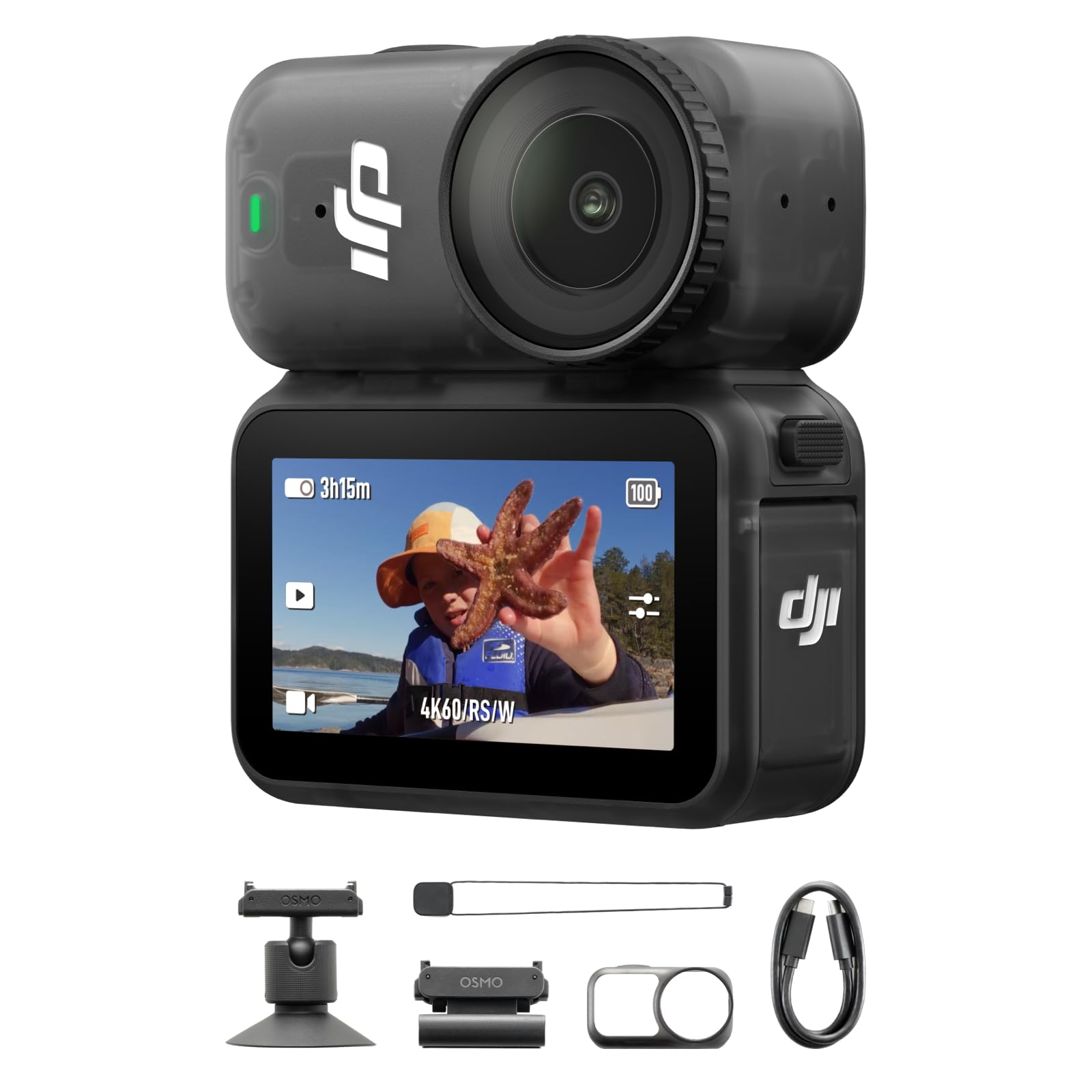
The DJI Osmo Nano is the most portable 4K movie camera in this lineup — a magnetic body smaller than a lighter that clips to your shirt, lanyard, or hat for true hands-free POV recording. The 1/1.3-inch sensor is smaller than the 1-inch sensors in the Canon and Sony cameras, but it’s paired with a 143-degree ultra-wide field of view that captures immersive first-person shots for vlogging, pet POV, cycling, and travel. The magnetic mounting system is genuinely clever: the ball-joint adapter, hat clip, and lanyard all snap on instantly without tools.
Built-in 128GB storage means you can start recording immediately without buying an SD card, and the Vision Dock extends battery life to roughly three hours of mixed use. The camera records 10-bit D-Log M color for grading flexibility, and direct OsmoAudio connection to two microphones provides clean wireless audio without a receiver. Waterproofing down to 10 meters with the dock adds underwater capability that most vlog cameras lack entirely.
The tiny body has thermal trade-offs: high-resolution recording generates noticeable heat, and the overheat protection can stop recording during long 4K takes. The built-in screen is tiny (not great for framing), so it’s best used as a POV camera where you trust the wide field of view rather than composing precise shots. The Vision Dock drains the battery even when the camera is off, which is frustrating for users who want a grab-and-go backup. It’s a specialist tool for hands-free POV capture, not a primary movie camera.
Why it’s great
- Smallest body in class clips to clothing for hands-free POV recording
- Included 128GB storage and magnetic accessories add immediate value
- 10-bit D-Log M color for creative grading in post-production
- Waterproof to 10m with the dock for underwater shots
Good to know
- Small body overheats and may stop recording during long 4K takes
- Tiny screen isn’t useful for precise compositional framing
- Vision Dock drains battery even while the camera is powered off
9. Acuvar 4K/6K Video Camera Camcorder

The Acuvar 4K/6K camcorder bundle is the classic budget-friendly entry point for absolute beginners who need everything in one box: the camera body, two 64GB SD cards, an external LED light, a shotgun microphone, a 50-inch tripod, a dual charger, two 4500mAh batteries, and more. For a parent filming a school play or a church volunteer recording a service without any prior gear, this kit removes the friction of buying accessories separately. The claimed 6K upscaling and 18x digital zoom promise reach that no compact camera in this price range can match.
In practice, the video quality is dramatically lower than any camera with a 1-inch sensor. Multiple user reports describe the output as resembling late-1990s camcorder quality: heavy resolution loss when zooming past 4x, poor low-light performance that introduces noise even in moderately lit rooms, and an autofocus system that hunts frequently. The external microphone improves audio over built-in mics, but the recording itself is limited by the small sensor and aggressive compression. The 4500mAh batteries provide decent runtime, and the ability to charge while recording is useful for long events.
The bundle value is real — you’d spend nearly as much buying the accessories separately — but the camera itself is the weakest component. For anyone who has used a modern smartphone in the last three years, the Acuvar’s video quality will be a downgrade. It’s a viable option only for the absolute lowest-budget scenario where a dedicated camcorder form factor is required and image quality is the lowest priority. Serious filmmakers should skip this and invest in one of the 1-inch sensor cameras above.
Why it’s great
- Comprehensive bundle includes tripod, lights, mics, and multiple SD cards
- Dual 4500mAh batteries provide extended runtime for long events
- Lowest initial investment for a complete camcorder kit
- Records while charging, useful for marathon sessions
Good to know
- Video quality is significantly worse than any 1-inch sensor camera
- Digital zoom degrades resolution heavily past 4x
- Autofocus hunts frequently in anything less than bright sunlight
FAQ
Is a cheap movie camera with a 1-inch sensor worth the extra cost over a smaller sensor model?
Does optical zoom matter more than digital zoom for movie cameras?
Can I use a cheap movie camera as a webcam for streaming?
Final Thoughts: The Verdict
For most users, the best cheap movie camera winner is the Xtra Muse because it combines a true 1-inch sensor with a built-in 3-axis gimbal, delivering smooth, clean footage that rivals cameras three times its price. If you want the creative flexibility of 360 capture with the best-in-class low-light performance, grab the DJI Osmo 360. And for the most versatile all-around filmmaking tool with optical zoom and professional color profiles, nothing beats the Sony ZV-1.

Mo Maruf
I created WellFizz to bridge the gap between vague wellness advice and actionable solutions. My mission is simple: to decode the research and give you practical tools you can actually use.
Beyond the data, I am a passionate traveler. I believe that stepping away from the screen to explore new environments is essential for mental clarity and physical vitality.