Our readers keep the lights on and my smoothie glass nicely filled. As an Amazon Associate, I earn from qualifying purchases.
A dull blade is a dangerous blade—it slips instead of cuts, turning a simple prep task into a wrist-straining chore. The difference between a frustrating kitchen tool and a precision instrument often comes down to a few dollars and the right sharpening system. Finding a cheap knife sharpener that actually works without damaging your steel is the real challenge, since the market is flooded with gimmicks that strip metal rather than hone it.
I’m Mohammad Maruf — the founder and writer behind WellFizz. I’ve spent countless hours breaking down the gritty specs of pull-through gadgets, whetstone grits, and oil-stone compositions to separate legitimate edge-restorers from countertop trash.
Whether you need a fast pull-through for daily kitchen use or a full whetstone kit for surgical-level edges, this guide stacks the best cheap knife sharpeners head-to-head based on real customer feedback, material quality, and ease of use. Below, you’ll find the best cheap knife sharpener options ranked by value, durability, and sharpening performance.
How To Choose The Best Cheap Knife Sharpener
Budget-friendly sharpeners come in three main families: pull-through gadgets, whetstones, and oil stones. Each trades off speed against edge quality. The right pick depends on your blade type, your tolerance for manual work, and how sharp you want the final edge.
Understand Grit Progression
A single coarse slot will not produce a shaving-sharp edge. Look for at least two distinct grits—one coarse (under 400 grit) to repair nicks and reshape the bevel, then a finer grit (above 1000 grit) to hone and polish. Multi-stage pull-through models and double-sided whetstones offer this without moving to premium pricing.
Match the Method to Your Knives
Pull-through sharpeners with carbide cutters remove metal aggressively and work fine for soft German steel knives. Japanese blades with a harder, thinner edge chip under carbide; these need a whetstone or ceramic rod. Serrated blades require a tapered ceramic rod—never run them through a straight-edge carbide slot.
Check the Base Stability
A sharpener that slides across the counter is dangerous. Suction bases, rubber feet, or non-slip silicone holders keep the tool planted while you draw the blade through. Entry-level models often cheap out on this, so confirm the base material before buying.
Quick Comparison
On smaller screens, swipe sideways to see the full table.
| Model | Category | Best For | Key Spec | Amazon |
|---|---|---|---|---|
| Norton Oil Stone | Oil Stone | Heavy-duty home use | 100 / 280 grit combo | Amazon |
| Kota Japan Whetstone | Whetstone | Razor-sharp edge finishing | 3000 / 8000 grit | Amazon |
| S SATC Whetstone Kit | Whetstone Kit | Complete starter setup | 400/1000/3000/8000 grit | Amazon |
| Smith’s Pull-Thru | Pull-Through | Quick daily maintenance | Carbide + Ceramic rods | Amazon |
| SHARPAL 191H | Pull-Through | Beginners and scissors | 3-stage system | Amazon |
In‑Depth Reviews
1. Norton Knife Sharpener Combination Grit Oil Stone

The Norton oil stone is the legacy choice for anyone who wants to sharpen axes, hunting knives, and kitchen blades on a single durable surface. At 100 grit on the coarse side, it repairs chipped edges fast; the 280 side refines the edge to a working sharpness that handles daily tasks without needing a finishing stone. The oil-filled design means it is ready out of the box—no soaking, no flattening, just lubricant and a steady hand.
Home sharpeners report that the coarse side cuts aggressively enough to reshape a hatchet bevel, while the fine side behaves more like an extra-medium stone that stops short of a mirror polish. Users who follow up with a 1000-grit stone and a strop get that refined finish, but as a standalone unit this Norton delivers consistent steel removal without the fuss of water preparation. At 8 x 2 x 1 inches, it doubles as a bench stone for scissors and straight razors.
The main trade-off is that the 280 side is not fine enough for the final keen edge some cooks demand. It also requires oil (not included) to prevent metal loading. For the price, however, the Norton is a buy-it-for-life stone that outperforms many plastic pull-through gadgets at double the cost.
Why it’s great
- Coarse side cuts fast for edge repair
- No soaking required; ready with oil
- Durable construction lasts for decades
- Large enough for axes and large blades
Good to know
- Fine side is more medium than fine; not for polished edges
- Requires honing oil or WD-40 to avoid clogging
- Heavier than whetstones of similar size
2. Kota Japan 3000-8000 Grit Whetstone Knife Sharpening Stone

Kota Japan’s dual-grit whetstone targets users who want a razor-sharp polished edge without stepping up to premium pricing. The 3000 grit side refines a blade that is already in decent shape, while the 8000 grit side produces a near-mirror finish that shaves arm hair. Made from premium corundum with consistent hardness, this stone resists cracking and stays flat through dozens of uses if you flip it regularly.
The included non-slip silicone holder is a rare bonus in the budget tier—it keeps the stone planted during long sessions and prevents the wrist fatigue that comes from chasing a sliding block. Users report that both sides stay true to their stated grit, though the 8000 side is soft enough to gouge if you press the blade tip too hard. A 10-to-15-minute water soak before use is all the prep needed; no messy honing oils required.
The 7 x 2.5 x 1.5-inch size is compact but sufficient for most kitchen knives, pocket knives, and chisels. Keep in mind that this is a finishing stone, not a repair stone—if your blade has deep nicks, you will want a coarser grit (400 or 1000) before stepping to this one. For maintaining already-sharp steel, this whetstone punches well above its weight class.
Why it’s great
- 8000 grit produces a mirror-polished edge
- Silicone holder prevents slipping during use
- No oil needed; simple water soak
- Good size for kitchen and pocket knives
Good to know
- Not for repairing chipped or very dull blades alone
- Soft 8000 side can gouge if technique is poor
- Plain stone only; no angle guide included
3. S SATC Knife Sharpening Stone Whetstone 4 Side Grit 400/1000 3000/8000

The S SATC kit is the most comprehensive sharpening bundle in the budget range. Two double-sided stones deliver 400, 1000, 3000, and 8000 grits, covering the full progression from chip repair to final polish. The kit also includes a wooden stone holder, two rubber nonslip bases, a leather strop, a flattening stone, and an angle guide—everything a beginner needs to go from dull to shaving-sharp in one purchase.
Users confirm that the 400 grit restores knives that have been abused or neglected, while the 8000 grit leaves a smooth, polished edge that glides through paper. The angle guide is especially useful for novices who have not yet developed muscle memory for holding a consistent edge angle. The leather strop is less impressive than a dedicated strop block, but it still refines the edge further after the final stone.
The downsides are minor at this price: the wooden holder is serviceable but not fine furniture, and the strop is a thin piece of plastic-backed leather rather than a thick hide. Still, having all four grits plus accessories in one box means you will not outgrow this kit until you move to high-end waterstones. It is also a generous gift option for anyone starting out in knife maintenance.
Why it’s great
- Four grits cover repair to polishing in one kit
- Includes angle guide, strop, and flattening stone
- Stones cut aggressively for fast results
- Excellent value for a full sharpening system
Good to know
- Leather strop is thin and plastic-backed
- Wooden holder is functional but basic
- Not for serrated or ceramic blades
4. Smith’s Pull-Thru Knife Sharpener
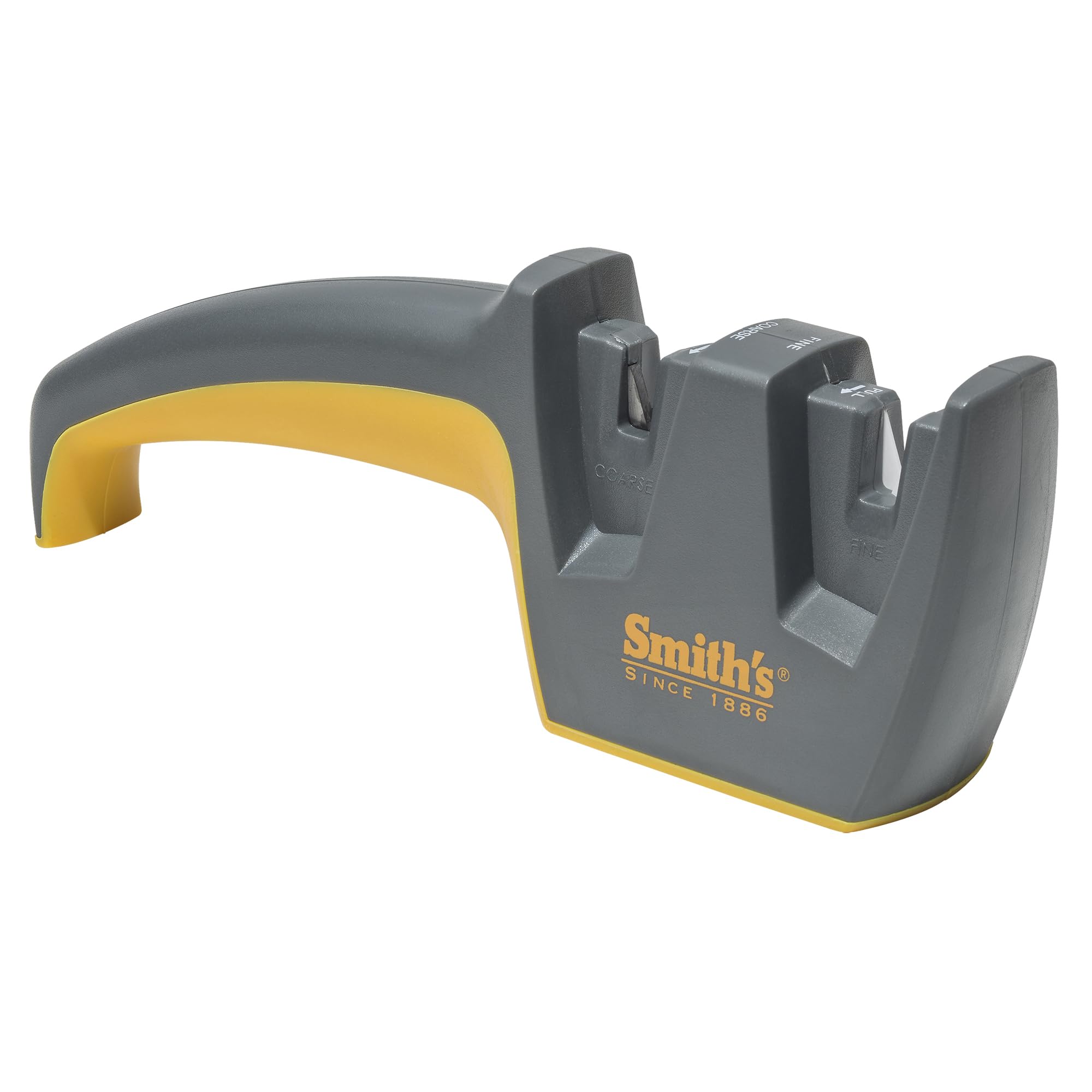
Smith’s pull-through sharpener is the no-brainer choice for anyone who wants a sharp knife in ten seconds without learning angles or soaking stones. The coarse carbide slot sets a new edge on dull blades, and the fine ceramic rods hone and polish in a second pass. Both slots are pre-set to the correct angle, so you simply pull the blade through five or six times and test the edge on a tomato.
The ergonomic soft-grip handle and non-slip rubber base keep the unit stable on the counter, even during fast passes. Users praise it for maintaining the edge on weekly-used kitchen knives and for being safe enough that a novice can grab it without instruction. The ceramic rods are also safe for serrated blades—just use the fine slot only and pull gently to avoid chipping the scalloped edge.
The catch is that the carbide cutters remove more metal than a stone, shortening blade life if overused. This tool works best as a maintenance sharpener for moderately dull blades, not as a repair tool for heavily damaged edges. Replaceable components extend its lifespan, making it a solid long-term investment for the pull-through crowd.
Why it’s great
- Instant sharpening with no learning curve
- Preset angles deliver consistent results
- Replaceable carbide and ceramic components
- Non-slip base and ergonomic handle
Good to know
- Carbide removes more metal than stones
- Not ideal for heavily chipped or damaged blades
- Fine side is ceramic; avoid excessive pressure
5. SHARPAL 191H Knife Scissors Sharpener
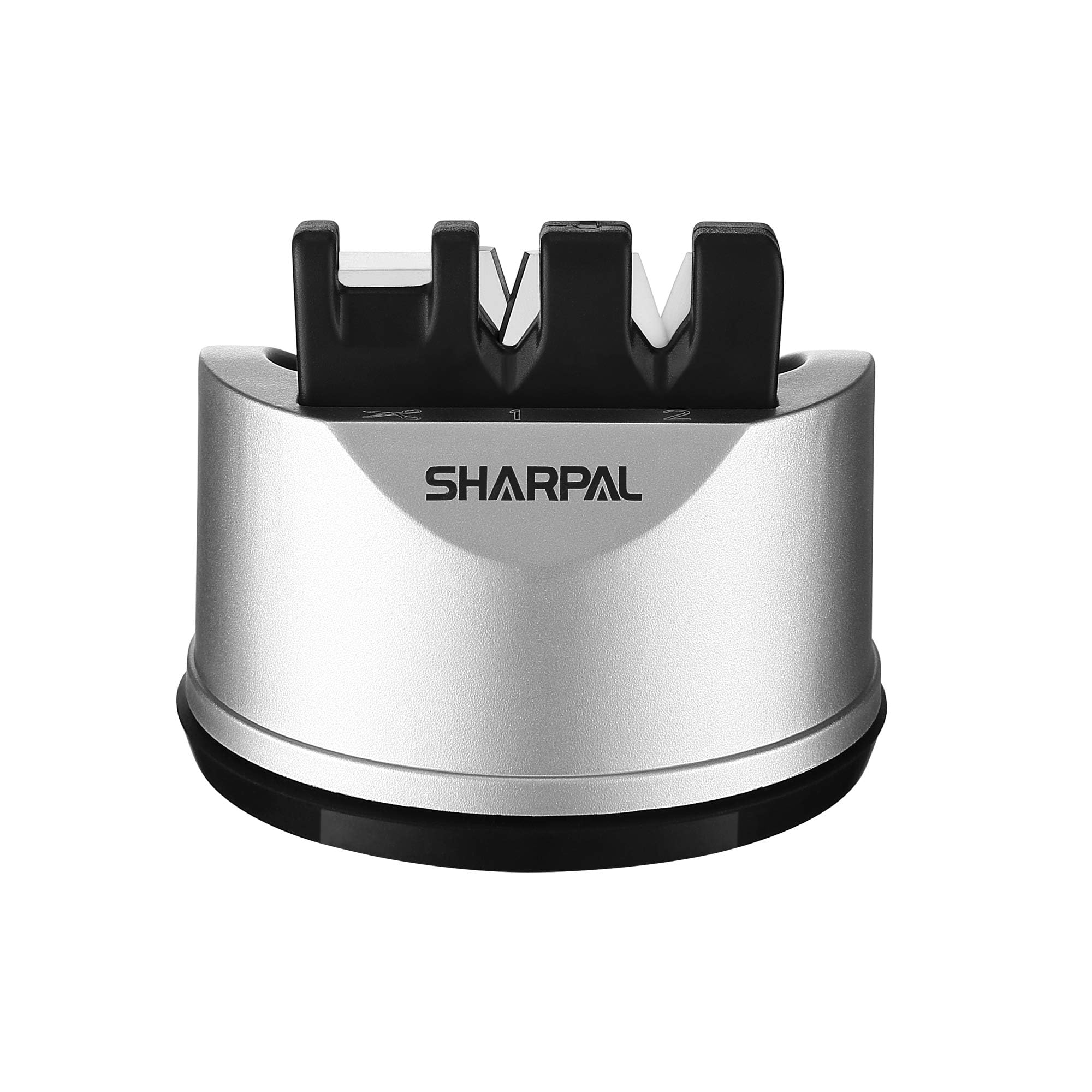
Sharpal’s 191H packs three sharpening stages into a compact block smaller than a smartphone. Tungsten carbide blades set a fresh edge, ceramic rods hone it, and a dedicated carbide slot sharpens scissors—a rare feature in a tool this size. The reinforced suction base holds the unit firmly to the counter, eliminating the sliding that plagues cheaper pull-through sharpeners.
Novices consistently report that the 191H takes their dullest kitchen shears and pocket knives back to factory-sharp condition within minutes, with almost zero blood pressure. The lack of an angle guide does not matter because the slots are factory-angled; you just draw the blade through and trust the geometry. Scissor sharpening works by placing each blade into the dedicated slot and pulling through two or three times.
The trade-off is that the abrasive stages are not replaceable—once the carbide and ceramic wear out, the whole unit must be replaced. Heavy users may burn through the carbide stage faster than on a replaceable system like Smith’s. For occasional kitchen maintenance and emergency scissor repair, however, the Sharpal 191H is the most versatile compact sharpener you can buy at this price.
Why it’s great
- Three-stage system includes dedicated scissor slot
- Suction base is rock-stable during use
- Compact size stores easily in any drawer
- Works for both right- and left-handed users
Good to know
- Abrasive components are non-replaceable
- Not for serrated or ceramic blades
- Suction may fail on textured or uneven surfaces
FAQ
Can a cheap knife sharpener damage expensive Japanese knives?
How many pulls through a cheap sharpener does it take to sharpen a dull knife?
Do cheap knife sharpeners work on serrated blades?
Final Thoughts: The Verdict
For most users, the best cheap knife sharpener winner is the Norton Combination Oil Stone because it delivers durable, consistent sharpening for a lifetime without gimmicks. If you want a complete sharpening system with all the accessories included, grab the S SATC Whetstone Kit. And for instant, push-button sharpening in the kitchen, nothing beats the Smith’s Pull-Thru.

Mo Maruf
I created WellFizz to bridge the gap between vague wellness advice and actionable solutions. My mission is simple: to decode the research and give you practical tools you can actually use.
Beyond the data, I am a passionate traveler. I believe that stepping away from the screen to explore new environments is essential for mental clarity and physical vitality.