Our readers keep the lights on and my smoothie glass nicely filled. As an Amazon Associate, I earn from qualifying purchases.
You want to know exactly how hard your heart is working during a run or ride, but you do not want to spend a fortune or strap yourself into something uncomfortable. A solid, reliable heart rate monitor no longer requires a premium budget. This guide cuts through the noise to find the cheap heart rate monitor that actually gives you trustworthy data, explains the few specs that really matter, and helps you avoid the ones that will frustrate you after a week.
I’m Mohammad Maruf — the co-founder and writer behind WellFizz. This guide is built by comparing the manufacturers’ published specifications and the patterns across verified customer reviews, so you get each pick’s real strengths and trade-offs instead of marketing spin.
The best cheap heart rate monitor for you comes down to a few key choices: chest strap accuracy versus armband convenience, battery life that lasts years versus one you charge every few weeks, and a strap that stays put without chafing. We have laid it all out below.
How To Choose The Best Cheap Heart Rate Monitor
Picking a heart rate monitor on a budget is mostly about deciding between two form factors and one crucial connectivity standard. Here are the three factors that will make or break your experience.
Form Factor: Chest Strap vs. Armband
A chest strap uses an electrical signal (ECG — electrocardiogram, which reads your heart’s electrical activity) to measure your heart rate directly. This is the most accurate method — movement or sweat barely affects it. The catch is that some people find the strap uncomfortable or awkward to put on. An armband uses an optical sensor (PPG — photoplethysmography, which shines light through your skin to detect blood flow). It is easier to slip on and off and is more comfortable for all-day wear, but it can be less accurate during intense intervals or if it shifts on your arm. For zone 2 steady-state cardio, an armband is usually fine; for high-intensity intervals or racing, a chest strap is more reliable.
Connectivity: Bluetooth and ANT+
Most modern devices — phones, tablets, and many gym machines — use Bluetooth (a short-range wireless standard). Almost all heart rate monitors on the market have Bluetooth. ANT+ is a separate wireless standard that is common on sports computers (like Garmin and Wahoo bike computers) and some gym equipment. If you want to connect your monitor to a bike computer or a watch, you need ANT+ support. If you only plan to use your phone, Bluetooth is sufficient. Many budget monitors include both, which gives you the most flexibility.
Battery: Replaceable vs. Rechargeable
Chest strap monitors almost always use a standard CR2032 coin-cell battery (the same flat battery found in many key fobs and small electronics). This battery can last anywhere from 500 to over 1000 hours of use, which means you might only replace it once a year or less. Armband monitors use a rechargeable lithium-ion battery that you charge with a magnetic cable. These usually last between 20 and 110 hours on a single charge. A replaceable battery means you never have to wait for a charge, but you have to buy a new battery occasionally. A rechargeable battery is more convenient day-to-day but will eventually hold less charge over time.
Quick Comparison
On smaller screens, swipe sideways to see the full table.
| Model | Category | Best For | Key Spec | Amazon |
|---|---|---|---|---|
| Magene H603 | Chest Strap | Cyclists and runners who want elite battery life | 1000-hour battery | Amazon |
| CYCPLUS H2Pro | Chest Strap | Runners wanting an ECG-accurate, budget-friendly strap | 500-hour battery | Amazon |
| moofit HR8 | Chest Strap | Beginners on the tightest budget | 500-hour battery | Amazon |
| COOSPO HW9 | Armband | Multi-sport athletes who want long battery and vibration alerts | 35-hour rechargeable battery | Amazon |
| CYCPLUS H1 Armband | Armband | Trail runners and cyclists wanting quick charging | 110-hour rechargeable battery | Amazon |
| COOSPO HW807 | Armband | Gym-goers who want an affordable armband for multiple machines | 20-hour rechargeable battery | Amazon |
| Scosche Rhythm+ 2.0 | Armband | Recovery-focused athletes who need HRV data | 24-hour rechargeable battery | Amazon |
In‑Depth Reviews
1. Magene H603 Chest Strap Heart Rate Monitor

The Magene H603’s claimed 1000-hour battery life makes it the top pick for cyclists and runners who want chest-strap accuracy without ever thinking about battery life again. Its battery offers a 33.3x advantage over the CYCPLUS H1 armband’s 30 hours, and at only 16 grams, it is about a third of the weight of the CYCPLUS H2Pro chest strap (55 grams), so you barely feel it during a ride.
This monitor uses a self-developed algorithm to filter out noise from movement and sweat, outputting real-time data that buyers report matches their athletic watch readings closely. It pairs simultaneously with an ANT+ device (like a bike computer) and a Bluetooth app (like Strava) — so you can record the same workout in two places. The split design means you can detach the sensor from the strap for washing, and the IP67 rating (fully dustproof and waterproof against sweat and rain) helps it survive daily use with just a rinse.
Several owners mention that after about a month the monitor stopped working, with heart rate readings jumping 30–40 beats high before matching correctly, though the majority of reviews are overwhelmingly positive. For the price and that industry-leading battery life, this is the most versatile chest strap you can buy.
Why it’s great
- 1000-hour battery is unmatched in this price range.
- Weighs just 16 grams — barely noticeable on the chest.
- Split design makes the strap easy to wash separately.
Good to know
- Some units apparently fail after a few weeks of use.
- The CR2032 battery is listed as non-replaceable, so the sensor has a finite lifespan.
2. CYCPLUS Heart Rate Monitor Chest Strap H2Pro
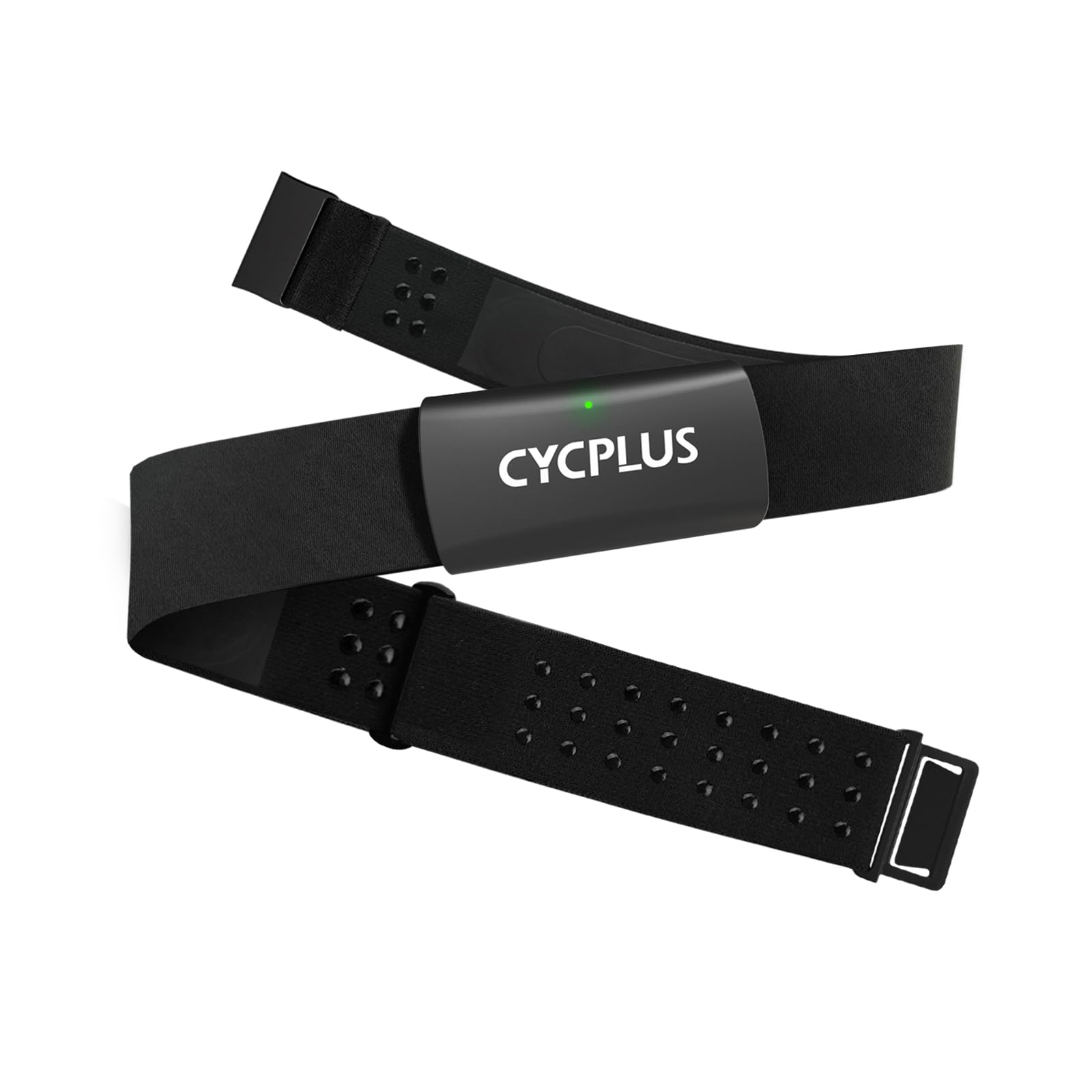
The CYCPLUS H2Pro falls behind the Magene H603 on battery life (500 hours vs. 1000 hours) and is heavier at 55 grams compared to the Magene’s 16 grams, but it matches the Magene’s ECG-level accuracy with a proprietary algorithm that reduces interference from movement and sweat. Where it pulls ahead is user-reported consistency — several reviews say it works as well as a Garmin dual-band strap, and ex-Polar H9 users call it a reliable replacement after their previous monitor became unusable.
It weighs just 21 grams for the sensor alone (34 grams with the strap), and the strap is made of soft, breathable material that adjusts for different body types. It syncs seamlessly with Wahoo bike computers and Zwift for indoor training, and one long-time user says it is “always good to know I am not having a stroke while trying to chase the next rider in Zwift.” The sensor also captures HRV (heart rate variability — tiny variations in the timing of your heartbeat that indicate recovery and stress), which is useful for serious athletes monitoring training load.
A notable catch: customers note that the battery drains if you do not remove the sensor from the band after your workout. If you are okay with that small post-workout habit, the H2Pro delivers near-Garmin accuracy at a budget price. Choose this over the Magene if you prioritize brand consistency and community-tested reliability above raw battery life.
Where it shines
- ECG algorithm provides accuracy that rivals Garmin straps.
- 500-hour battery covers years of regular use.
- Comfortable adjustable strap with breathable material.
Worth noting
- Battery drains if sensor is not removed from the band after use.
- A few users report difficulty pairing with the CYCPLUS app specifically.
3. moofit HR8 Heart Rate Monitor Chest Strap

The moofit HR8 is for someone who just wants to know their heart rate during a run without spending more than they would on a pair of shoes. It claims accuracy within 1 beat per minute and has a CR2032 battery that lasts up to 500 hours — which for someone exercising an hour three times a week means years without a battery swap. One buyer reviewing it as “a useful tool for new runners” says it connects quickly and captures both heart rate and HRV data reliably for the money.
The HR8 uses Bluetooth 5.0 and ANT+ dual-mode, so it connects to your phone’s app (like Strava or Wahoo Fitness) and to a bike computer or gym equipment simultaneously. The strap is adjustable from 63.5 cm to 132 cm with improved electrodes that are supposed to read more consistently through sweat. It is IP67-rated, meaning it is fully dustproof and can handle being submerged in a meter of water for 30 minutes — though the manufacturer says not to swim with it.
The honest trade-off here is reliability: a few reviewers point out that the HR8 “worked for about a week (daily use), now no longer pairs at all with my setup,” and another notes an inconsistent connection to a Peloton after six weeks. But for the lowest price on this list, and with a 500-hour battery and dual connectivity, it is the smartest entry point for a first-time buyer who is not sure they need a long-term investment yet.
What stands out
- Lowest price on the list with dual Bluetooth/ANT+ connectivity.
- 500-hour battery from a replaceable CR2032 coin cell.
- IP67 rating handles sweat and rain without issue.
The trade-offs
- Several reports of the unit dying or losing connection within weeks.
- Not recommended for swimming despite the IP67 rating.
4. COOSPO HW9 Bluetooth 5.0 ANT+ Heart Rate Monitor Armband

If you want armband convenience, the single most important number is battery life between charges — and at 35 hours, the COOSPO HW9 leads the armband field by a significant margin. Its rechargeable lithium battery lasts over a month even with daily training, and it recharges quickly via a magnetic cable. One reviewer who uses it with both an Apple Watch and Zwift says the battery “lasts over a month” with regular use.
The HW9 offers a claimed accuracy of plus or minus one beat per minute using an optical sensor, and it displays your heart rate zone with a five-color LED light that changes as you move through different effort levels. It also has a vibration warning that buzzes when your heart rate exceeds a set maximum — a safety feature that is useful for high-intensity interval training. It supports two simultaneous Bluetooth connections, so you can broadcast to a phone and a bike computer at the same time.
What you give up for that battery life is weight: at only 10 grams, the sensor itself is extremely light, but the strap is reported to stretch out and lose elasticity over time, and there is no auto shut-off, so you have to remember to hold the button to turn it off. For a multi-sport athlete who trains across running, cycling, and gym — and wants one monitor that does it all — the HW9 is the best armband value in the lineup.
The upsides
- 35-hour battery is the longest among armband models on this list.
- Five-color LED shows your heart rate zone at a glance.
- Vibration alert warns you if your heart rate exceeds your set max.
Keep in mind
- No auto shut-off — you have to manually power it down.
- Strap can stretch out and lose its tight fit over time.
5. CYCPLUS Heart Rate Monitor Armband H1

The CYCPLUS H1 armband is the pick for trail runners and cyclists who do not want to think about charging for months. Its 90 milliamp-hour battery lasts 110 hours on a single charge, and it tops up from empty in just 30 minutes — compared to the COOSPO HW9’s 35-hour battery, this gives you more than three times the run time between charges. Reviewers specifically call out that there are no connection issues with a Garmin 840, and one mountain biker says it works great with their Specialized Turbo Levo e-bike.
The H1 uses a patented optical sensor that claims plus or minus one beat per minute accuracy, and it monitors your heart rate zone with a three-color LED (green for under 80 bpm, orange for 80–140 bpm, red for over 140 bpm). It has Bluetooth 5.1 and ANT+ dual-mode connectivity, so it will pair with most phones, GPS bike computers, and smartwatches. The magnetic charger is convenient, though a few users note the charger can be weak and the unit falls off the cable if bumped.
The downside is comfort during aggressive movement: one mountain biker found the Velcro strap came undone while riding, which is a safety concern if you are relying on it for heart rate data on a technical trail. Still, at this price point with 110 hours of battery and a 30-minute full charge, the H1 is the set-it-and-forget-it armband for anyone who logs serious miles.
Why we’d pick it
- 110-hour battery is the longest of any armband here — charge once every few months.
- 30-minute full charge time is extremely fast.
- Three-color LED gives an instant read on your heart rate zone.
A few caveats
- Velcro strap can come undone during aggressive mountain biking.
- Magnetic charger is weak and the unit can fall off easily.
6. COOSPO HW807 Heart Rate Monitor Armband

The COOSPO HW807 is for the gym-goer who wants to connect a heart rate monitor to a Peloton bike, Concept2 rower, or treadmill without spending chest-strap money. It works directly with gym equipment that supports Bluetooth or ANT+, so you can see your heart rate on the machine’s display in real-time. Its 20-hour rechargeable battery is the shortest of any armband on this list, but one reviewer who has had it for a couple of months reports they “haven’t even charged it more than once.”
Accuracy claims also sit at plus or minus one beat per minute using a patented optical sensor. The three-color LED heart rate zone indicator is simple — green for low, yellow for moderate, red for high — though a reviewer notes the green and yellow lights are similar enough that it is hard to tell them apart at a glance. It supports HRV (heart rate variability) tracking if you use it with compatible apps like Elite HRV. The armband comes with two different strap sizes in the box, which is helpful for finding a secure fit on a forearm versus a bicep.
The most common honest complaint is accuracy drift during lower-intensity movement: one reviewer measuring a 120 bpm walk on their Samsung watch saw 175 bpm on the HW807, which is an unacceptable gap for that use case. If you are mainly doing steady-state cardio in the gym and want a simple, cheap armband that talks to your equipment, the HW807 is a solid choice. Pass on it if you need precise readings during light recovery walks.
Strong points
- Works directly with Peloton, Concept2, Bowflex, and other gym machines.
- Comes with two arm strap sizes for a better fit.
- Budget-friendly armband option with Bluetooth and ANT+.
Before you buy
- 20-hour battery is the shortest run time of any monitor on this list.
- Accuracy can be unreliable during low-intensity movement like walking.
7. Scosche Rhythm+ 2.0 Heart Rate Monitor Armband

The Scosche Rhythm+ 2.0 sits in a slightly higher pricing tier than the rest of the field, but it is the only armband here that specifically targets recovery-focused athletes who want RR-interval data (the exact timing between each heartbeat, used for advanced heart rate variability analysis). It pairs directly with apps like HRV4Training, Morpheus Training, and Welltory — giving you insight into sleep quality, daily stress, and training readiness that most cheap monitors cannot touch. It delivers accurate real-time readings for running and cycling, and owners say it solves the wrist-based reliability issues common with Garmin and Samsung watches.
The Rhythm+ 2.0 uses an optical sensor and connects via Bluetooth and ANT+. It has an IP68 rating — fully dustproof and can be submerged in more than 1 meter of water — making it genuinely waterproof for swimming, unlike most of the other monitors here which are only splash-proof. The battery lasts 24 hours on a single charge, which is decent but behind the COOSPO HW9’s 35 hours and the CYCPLUS H1’s 110 hours. The strap is lightweight, breathable, and adjusts to the forearm, bicep, or tricep.
Some users also report random dropouts and wild accuracy swings compared to a Garmin chest strap, though the majority find it accurate and comfortable. If advanced HRV and recovery data matter more to you than absolute battery life, the Scosche Rhythm+ 2.0 offers niche value that other budget armbands do not.
What we like
- Captures RR-interval data for deep HRV analysis — unique at this price.
- IP68 rating makes it genuinely waterproof for swimming.
- Comfortable, adjustable strap that fits arm, bicep, or tricep.
The downsides
- 24-hour battery is notably shorter than armband competitors like the CYCPLUS H1 (110 hours).
- Uses a proprietary charger — if you lose it, you cannot use a standard cable.
Understanding the Specs
Battery Life: Coin Cell vs. Rechargeable
The biggest difference in daily ownership is how you power the monitor. Chest straps use a replaceable CR2032 coin-cell battery that lasts 500–1000 hours — you might change it once a year. Armbands use a rechargeable lithium battery that lasts 20–110 hours per charge. A coin cell means you never have to wait for a charge, but the sensor eventually fails when the non-replaceable battery dies. A rechargeable battery is more convenient day to day, but you will eventually need to replace the whole unit when the battery holds less charge. For most people, a chest strap with a 500-hour battery is the least hassle.
IP Rating: What It Actually Means
IP stands for Ingress Protection, and the two numbers after it tell you exactly what the monitor can survive. The first number (2–6) is dust protection: IP6X means fully dust-tight. The second number (7 or 8) is water protection: IPX7 means it can be submerged in 1 meter of water for 30 minutes, while IPX8 means it can go deeper for longer. Nearly all the monitors here are IP67 (dust-tight and submersible) or IP68 (dust-tight and submersible beyond 1 meter). A chest strap with IP67 can handle heavy sweat during a summer ride, but you should not swim with an IP67 device despite the “waterproof” marketing. Only IP68 monitors, like the Scosche Rhythm+ 2.0, are rated for actual swimming.
ECG vs. Optical Sensors
Chest straps use an ECG (electrocardiogram — a sensor that reads the electrical signals of your heart) to measure your heart rate. This is the most accurate method because it picks up the electrical pulse directly, with almost no interference from movement or sweat. Armbands use an optical sensor (PPG — photoplethysmography — which shines a light into your skin to detect blood volume changes). Optical sensors are more affected by motion, skin tone, and how tightly the band fits. For steady-state cardio (zone 2 running or cycling), an armband is usually fine. For high-intensity intervals or racing where every beat matters, a chest strap is more reliable.
ANT+ vs. Bluetooth: Which One You Need
Bluetooth is the standard radio used to connect your monitor to a phone or tablet. Almost every monitor has it. ANT+ is a separate standard used mainly by sports computers like Garmin and Wahoo bike computers, as well as some gym equipment like Peloton treadmills and Concept2 rowers. If you only use your phone, Bluetooth is all you need. If you own a bike computer or want to connect to gym machines, you need ANT+ support. Many budget monitors include both, which gives you the most flexibility for future gear upgrades.
FAQ
Can I wear a chest strap monitor while swimming?
Why does my armband heart rate monitor sometimes show a wildly wrong number?
How do I connect my heart rate monitor to a Peloton or other gym equipment?
How do I clean my chest strap without damaging the sensor?
What is HRV and why would I track it?
Final Thoughts: The Verdict
For the majority of shoppers, the best cheap heart rate monitor is the Magene H603 because its 1000-hour battery, dual Bluetooth and ANT+ support, and extremely light 16-gram weight make it the most versatile and lowest-hassle chest strap at any budget. If you want an armband for gym equipment and do not want to charge for months, grab the CYCPLUS H1 Armband with its 110-hour battery and 30-minute charge time. And for advanced HRV data and genuine swim-proof durability, the Scosche Rhythm+ 2.0 offers niche value that no other budget monitor can touch.

Mo Maruf
I created WellFizz to bridge the gap between vague wellness advice and actionable solutions. My mission is simple: to decode the research and give you practical tools you can actually use.
Beyond the data, I am a passionate traveler. I believe that stepping away from the screen to explore new environments is essential for mental clarity and physical vitality.