Our readers keep the lights on and my smoothie glass nicely filled. As an Amazon Associate, I earn from qualifying purchases.
Building a home golf simulator on a budget doesn’t mean accepting wildly inaccurate data or fragile equipment. The gap between a cheap, frustrating setup and a reliable practice system comes down to choosing the right launch monitor and enclosure — two components that define your entire experience. With the right combination, you can dial in carry distances, spin rates, and swing tempo without leaving your garage or spare room.
I’m Mohammad Maruf — the founder and writer behind WellFizz. For this guide, I’ve analyzed dozens of launch monitor accuracy reports, net durability tests, and customer reliability scores to separate the truly valuable budget simulators from the ones that waste your time and floor space.
After cross-referencing nine real-world products across entry-level, mid-range, and premium tiers, the best cheap golf simulator for home combines a trustworthy launch monitor, a sturdy enclosure, and the right projection gear for under a thousand dollars.
How To Choose The Best Cheap Golf Simulator For Home
A budget home simulator hinges on three components working in harmony: the launch monitor, the hitting enclosure, and the display. Spend too little on any one piece and the entire system underdelivers. Here’s what matters most when you’re building on a budget.
Launch Monitor Technology: Radar vs. Photometric
Radar-based monitors (like the Garmin R10 and Voice Caddie SC4 Pro) track the ball through the air using Doppler shifts, which works well indoors once you have enough ball flight — typically 10 to 14 feet. Photometric units (like SkyTrak) use high-speed cameras to capture data at impact, so they require less space but demand specific lighting and precise ball placement. For small garages or rooms where you can’t get a full 14-foot flight, a camera-based monitor tends to produce fewer misreads.
Net or Enclosure Build Quality
The enclosure must absorb full-power drives without sagging or tearing. Look for powder-coated steel frames and a separate offset impact screen that attaches in front of the netting — this design drastically reduces ricochet risk. Mesh density matters too: smaller, thicker weaves resist holes from repeated wedge strikes. The Net Return’s 250,000-shot guarantee and the GoSports Range Cage’s six-month warranty set different durability expectations for their respective price tiers.
Projector Brightness and Throw Distance for Small Spaces
A standard home projector often requires 8 to 10 feet to cast a 100-inch image, which can conflict with your hitting zone. A short-throw projector like the BenQ TH671ST casts a 100-inch image from just 5 feet away — critical when your garage length is only 14 to 16 feet. At least 3,000 lumens of brightness is recommended for indoor use with ambient garage lighting, and low input lag keeps the experience responsive.
Quick Comparison
On smaller screens, swipe sideways to see the full table.
| Model | Category | Best For | Key Spec | Amazon |
|---|---|---|---|---|
| Swinora GX-03 | Launch Monitor | Zero subscription practice | 13 metrics, metal body | Amazon |
| Voice Caddie SC4 Pro | Launch Monitor | 3D simulator & target training | ProMetrics Engine, E6 Connect | Amazon |
| Garmin Approach R10 | Launch Monitor | Virtual course play at home | 10 hr battery, 42k courses | Amazon |
| Garmin Approach G80 | Handheld | GPS + tempo training combo | 15 hr battery, 41k courses | Amazon |
| Rapsodo MLM2PRO | Launch Monitor | Spin axis & impact video | Dual camera, 30k courses | Amazon |
| SkyTrak | Launch Monitor | Photometric garage setup | High-speed camera, 4 hr battery | Amazon |
| GoSports Range Cage Elite | Enclosure | Indoor garage enclosure | 8×8 ft, offset screen | Amazon |
| Net Return Home V2 | Hitting Net | Durable daily practice | 250k shot guarantee | Amazon |
| BenQ TH671ST | Projector | Short-throw sim display | 1080p, 3000 lumens | Amazon |
In‑Depth Reviews
1. Swinora GX-03 Launch Monitor
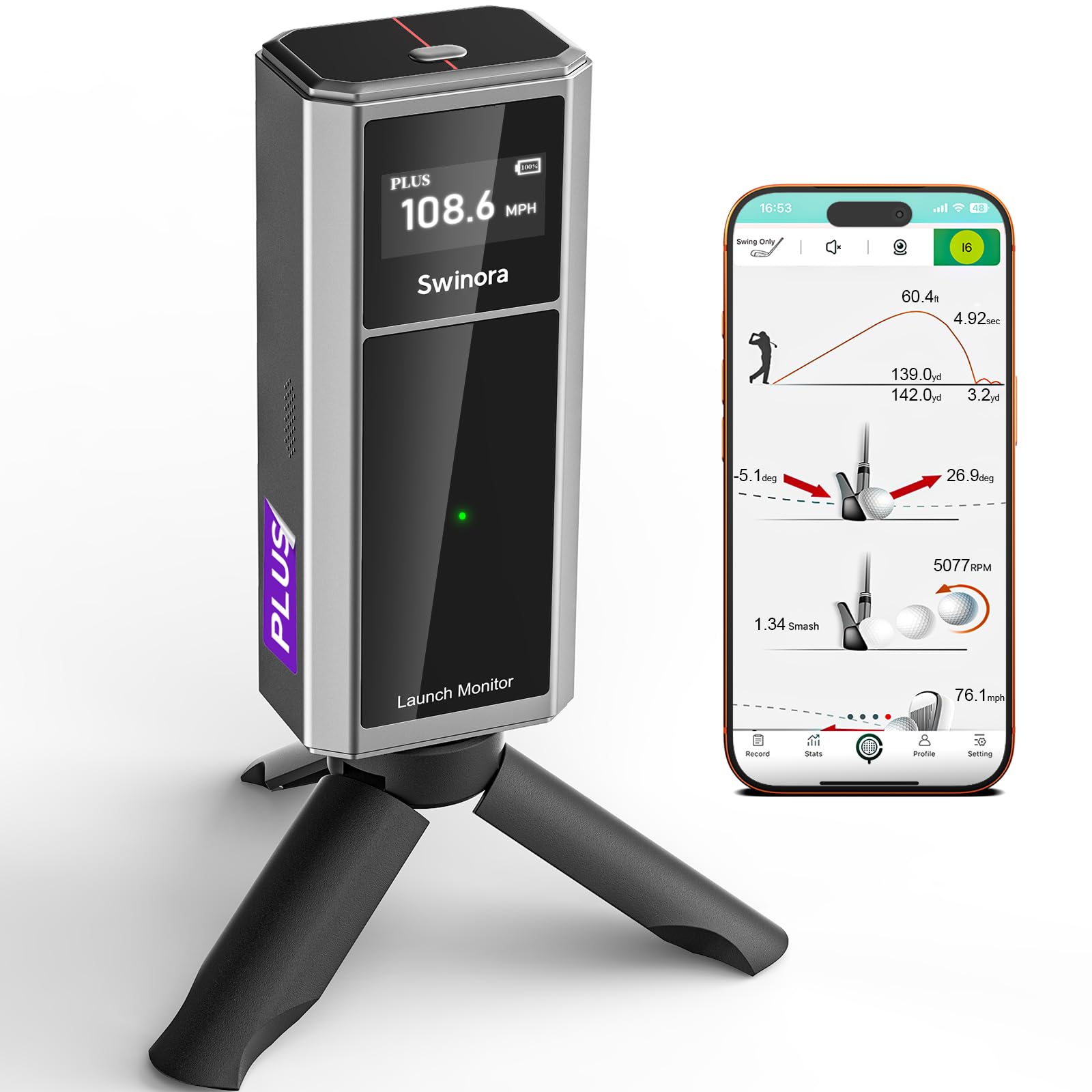
The Swinora GX-03 delivers 13 metrics including attack angle, launch angle, spin rate, and clubface data from a compact aluminum chassis that stows inside a golf bag. Built-in environmental sensors — temperature, humidity, and barometric pressure — automatically adjust shot calculations to real-time conditions, a feature rarely found at this price tier. The app requires zero subscription fees, so all features remain accessible after the initial purchase.
Indoor use requires at least 15 feet of total space: place the monitor 5 feet behind the ball and allow 10 feet of ball flight for the radar to lock onto the shot. When you mishit, the device emits one long and one short beep and captures club speed only, preventing skewed session averages. The 3D driving range displays 45- and 90-degree viewing angles of your ball’s trajectory, and the Distance Compensation slider lets you adjust carry from 80% to 120% per club to match real-world yardages.
Customer reviews consistently praise the instant Bluetooth pairing with iOS and Android phones, the magnetic mount for video recording, and the week-long battery life between charges. A small minority report accuracy discrepancies compared to high-end units, which is expected at this price — but the consistent data for club speed, ball speed, and launch angle makes it a reliable training tool for the majority of users.
Why it’s great
- No subscription or hidden fees — lifetime access included
- Environmental sensors auto-adjust for indoor/outdoor conditions
- Solid aluminum build with OLED display
Good to know
- Requires 15 ft of space for accurate indoor radar capture
- Occasional accuracy variance vs. premium launch monitors
2. Voice Caddie SC4 Pro Launch Monitor

The SC4 Pro tracks from swing through impact to ball flight using Voice Caddie’s ProMetrics Engine, delivering ball speed, club speed, spin rate, launch angle, and carry distance in real time. It includes a free 3D Driving Range and comes with access to E6 Connect for five virtual courses and multiple practice ranges — no additional subscription for the core simulator experience.
The unit works with standard golf balls both indoors and outdoors, and its built-in screen lets you view key metrics without a phone. Multiple training modules — Practice/Target Mode, Speed Training, and 3D Simulator — keep sessions variable. Indoor accuracy improves when you allow at least 14 feet between the net and the hitting position. The lightweight plastic housing is compact enough for a garage bag.
Reviewers highlight the reliable consistency for non-professional use, with many using it paired to a projector and impact screen for a full home sim under budget. Some users report occasional direction and carry discrepancies — one reviewer noted a 40-yard carry variance on a 273-yard shot — so careful alignment and consistent lighting conditions are essential for best results.
Why it’s great
- Free E6 Connect access with 5 courses and driving ranges
- Multiple training modes in one device
- Works with regular balls, no special markers needed
Good to know
- Some carry and direction inaccuracy reported by a subset of users
- Requires consistent net distance and lighting for reliability
3. Garmin Approach R10 (Renewed)
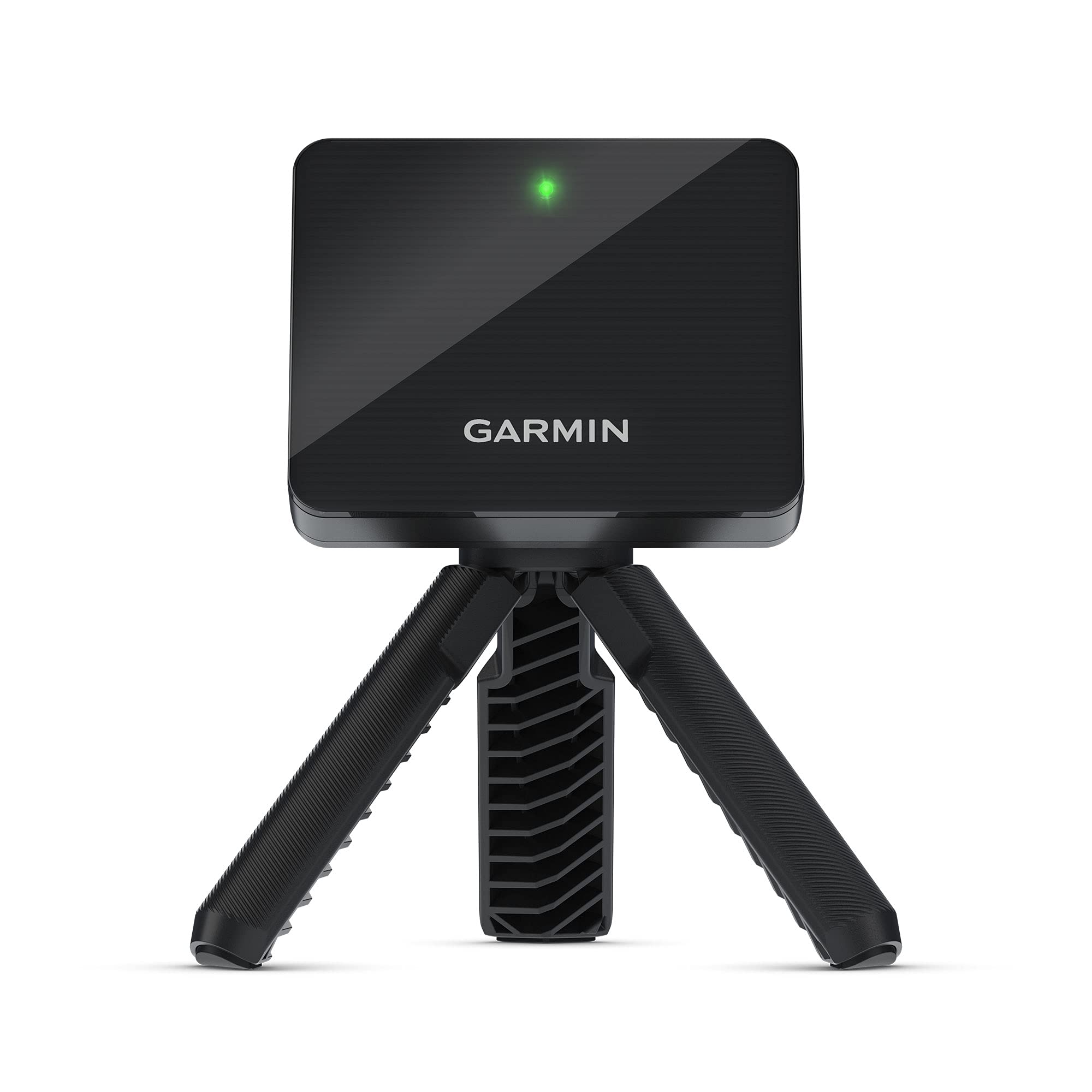
The Garmin R10 is one of the most versatile portable launch monitors in the mid-range, pairing with the Garmin Golf app to track clubhead speed, ball speed, swing tempo, ball spin, and launch angle. An active subscription unlocks over 42,000 virtual courses with full simulation, and the device also records swing video clips that overlay metric data for post-round analysis.
The IPX7 waterproof rating lets you use it confidently on the driving range even in damp conditions, and the 10-hour battery easily covers multiple practice sessions. Setup requires precise alignment — the unit sits on a tripod 7 feet behind the ball and must be level — but once dialed in, accuracy sits around 98 percent compared to premium units according to multiple customer reports. The refurbished model includes all necessary accessories.
Reviews emphasize the reliable distance gapping for irons and the engaging virtual course mode that makes indoor winter practice feel like a real round. The main downsides are the ongoing subscription cost for full course simulation and the lack of club face impact data — a limitation shared by most radar-based monitors in this price bracket.
Why it’s great
- Access to 42,000 virtual courses with subscription
- Waterproof IPX7 for outdoor range use
- Excellent battery life at 10 hours
Good to know
- Subscription required for full course simulation
- No club face impact data
4. Garmin Approach G80

The Garmin G80 is a hybrid device — a full GPS golf handheld with a built-in radar launch monitor. The 3.5-inch sunlight-readable touchscreen displays clubhead speed, ball speed, smash factor, swing tempo, and estimated distance, while the GPS side preloads over 41,000 course maps worldwide. This dual functionality makes it a space-saving option for golfers who want one device for the course and the practice area.
At 15 hours of GPS battery life, it lasts multiple rounds on a single charge. The launch monitor mode works best as a warmup tool — drivers and irons read club speed and ball speed reliably, but actual ball flight distance tends to show a margin of error around plus or minus 5 yards compared to higher-end monitors. The Tempo Trainer helps groove consistent swing timing, and the Spinseeker estimates backspin using radar algorithms.
Customer sentiment is generally positive for the GPS and tempo training value, especially for casual players. Criticisms focus on the flimsy rubber band mounting strap and the lack of data storage or upload for launch monitor sessions — metrics are displayed in real time but cannot be reviewed later. The G80 is best as a course management device with a launch monitor bonus rather than a dedicated simulator engine.
Why it’s great
- GPS and launch monitor in one compact handheld
- Excellent 15-hour battery life for course use
- Sunlight-readable touchscreen display
Good to know
- Ball flight distance accuracy is limited
- No data storage for later swing analysis
5. Rapsodo MLM2PRO Launch Monitor
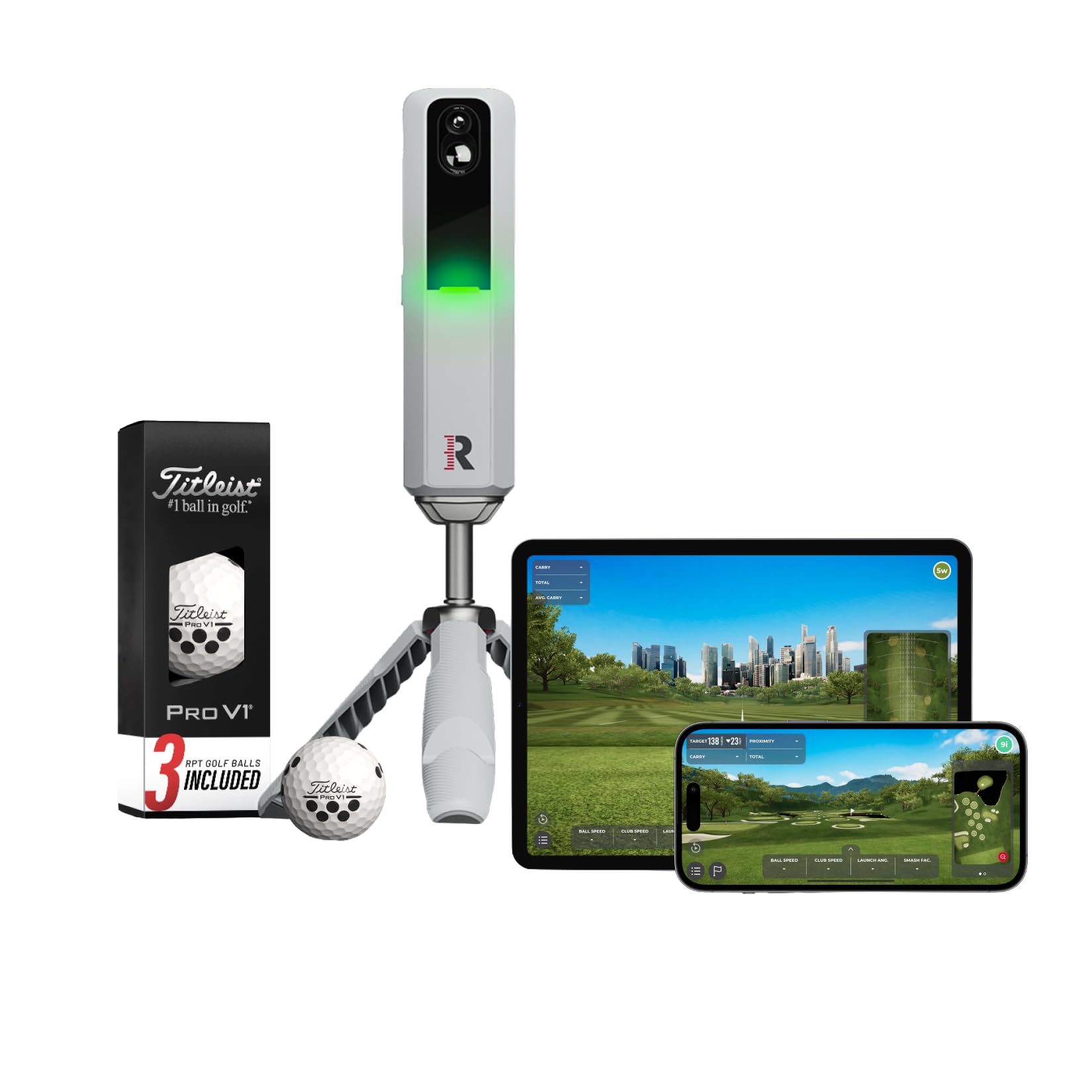
The MLM2PRO combines Doppler radar with dual cameras to capture 15 metrics including spin rate, spin axis, club path, and impact vision — a slow-motion view of exactly where the ball meets the clubface. The 45-day Premium trial unlocks over 30,000 simulated courses, target range modes, and third-party app integration. After the trial, a paid subscription continues access to the full course library.
The unit requires precise level placement and works best with the included RPT balls or marked ProV1s for accurate spin reads. Indoor use requires at least 10 feet of ball flight, and the included tripod provides a stable base. Impact Vision replays provide immediate feedback on strike location, which is invaluable for understanding heel, toe, or center contact patterns.
Reviews consistently praise the accuracy — within 2 to 3 percent of Trackman for most metrics — and the improvement in users’ games, with some reporting 10-15 stroke reductions. Frustrations center on connection stability (WiFi drops during rounds), costly RPT balls that wear out in months, and the occasional failure to read short chips under 10 yards. The MLM2PRO is a performance investment for budget-conscious golfers who prioritize data depth.
Why it’s great
- Dual camera captures spin axis and impact vision
- Accuracy within 2-3% of premium launch monitors
- Extensive course library with 30,000+ virtual rounds
Good to know
- Paid subscription required after trial period
- Short chips under 10 yards often not read
6. SkyTrak Launch Monitor

SkyTrak uses high-speed photometric technology — a camera-based system — rather than radar, which makes it an excellent choice for garages and small rooms where ball flight distance is limited. It captures ball speed, launch angle, spin rates, carry and total distance, and shot shape at the moment of impact. The compact unit connects wirelessly to iOS, Android, or PC and runs up to 4 hours on a rechargeable battery.
The base package includes a 14-day trial of the Game Improvement software, which provides a driving range with club tracking and session history. For full simulator access — including course play — you’ll need an annual subscription. The camera system requires consistent lighting and the ball must be placed 0.5 to 1 inch behind the laser dot for reliable reads.
Long-term users appreciate the accurate distance tracking that closely mirrors on-course yardages, especially for iron practice. Consistently reported issues include occasional misreads or non-reads (estimated at 1-2 percent of shots) and the upfront cost that increases significantly once course simulation subscriptions are added. The protective case is recommended for leveling the unit on uneven garage floors.
Why it’s great
- Camera-based system works well in limited indoor spaces
- Accurate carry distance matching real-world yardages
- Wireless connectivity to mobile and PC devices
Good to know
- Occasional non-reads and alignment sensitivity
- Full course simulation requires additional subscription
7. GoSports Range Cage Elite 8×8 ft
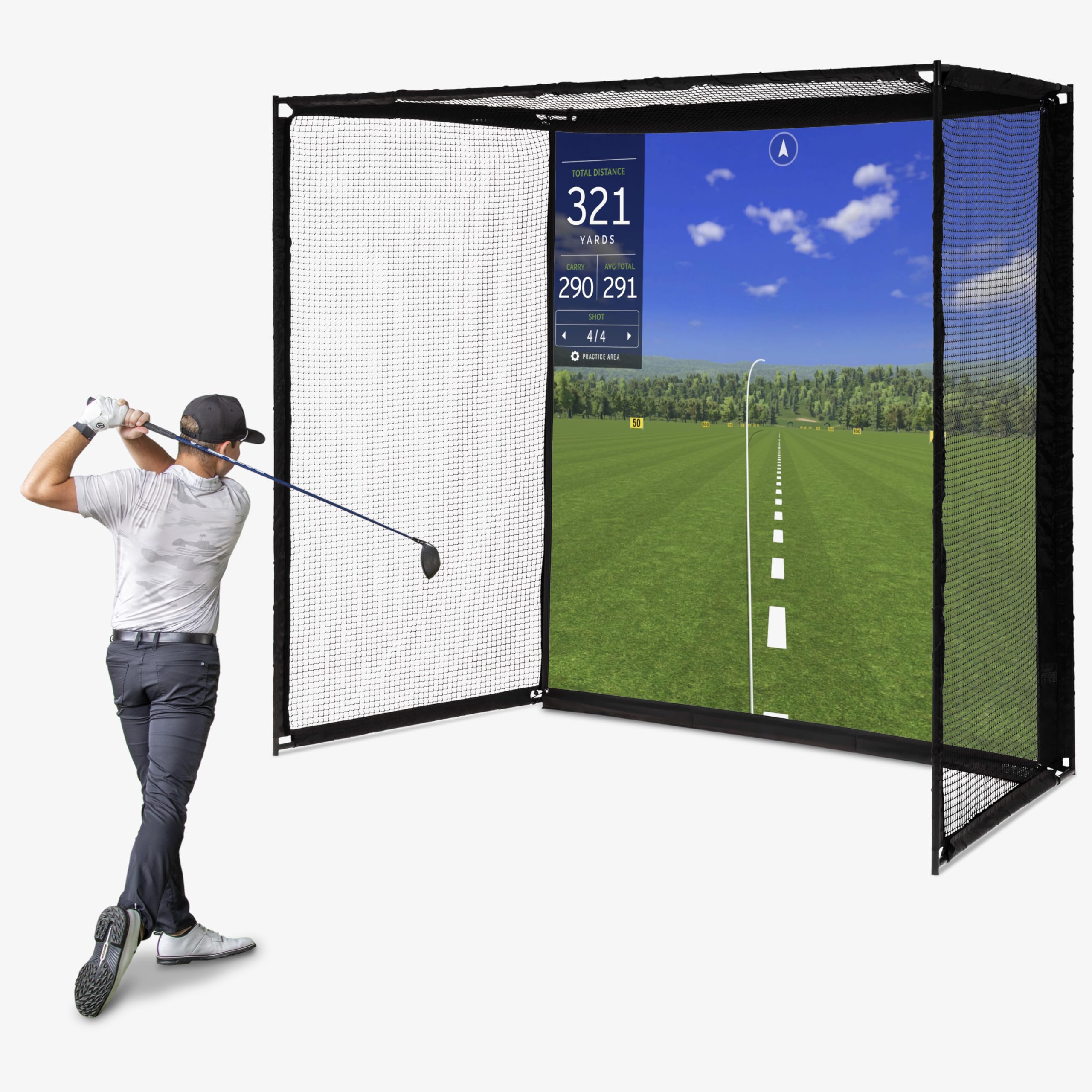
The Range Cage Elite is a pro-style enclosure built around a powder-coated steel frame with a 95 x 93 inch HD impact screen and surrounding netting that catches mishits. The offset design mounts the impact screen in front of the back netting rather than on it, which significantly reduces ricochet — high-lofted wedge shots that hit the screen drop cleanly rather than bouncing back toward the hitter.
The frame dimensions (10 ft long, 8.5 ft high, 5 ft deep) fit comfortably under a 9-foot ceiling, and the 8×8 foot screen area accommodates both right- and left-handed players. Assembly takes about one hour solo, and the cage structure prevents the sagging that plagues unframed nets over time. It works with all major launch monitors and projectors for a complete simulator kit.
Customer feedback highlights the easy assembly and sturdy build, with many users pairing it with a Rapsodo MLM2PRO for a full indoor setup. The main durability concern involves the netting corners — users who shank frequently report that the corner seams can loosen over time. A minority report screen tears within the first few hundred shots, though most units hold up well with center-face striking.
Why it’s great
- Offset screen design minimizes ball ricochet
- Sturdy powder-coated steel frame prevents sag
- Works with all major launch monitors and projectors
Good to know
- Corner netting seams may weaken with frequent shanks
- Some users report screen tearing within first 300 shots
8. Net Return Home V2 Golf Net
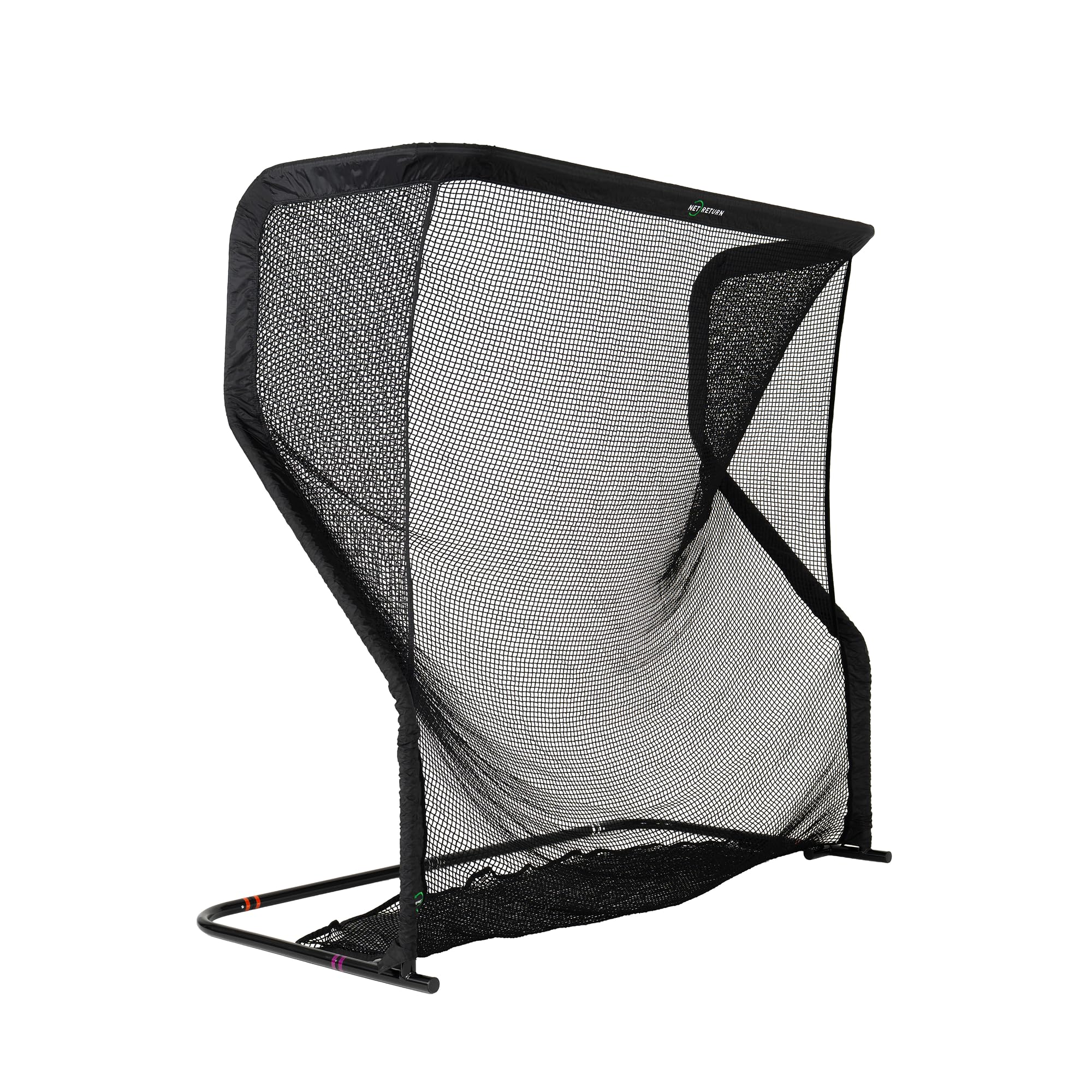
The Net Return Home V2 is the most durable hitting net in this lineup, built with aircraft-grade aluminum framing and UV-shielded netting. Its patented S-Shape return system rolls the ball back to your feet on center strikes, while off-center hits don’t return straight, providing instant shot-shape feedback. The net handles ball speeds exceeding 240 MPH and carries a 250,000-shot guarantee with a 3-year warranty.
Assembly takes 5 to 10 minutes with a push-button color-coded system that requires no tools. At 8 feet wide by 7.5 feet tall, it works with 8.5 feet of hitting distance for most golfers, though taller players or longer clubs need a few extra feet. The lightweight frame is portable enough for a duffle bag, and optional side barriers and simulator screens transform it into a full enclosure.
Reviews overwhelmingly highlight the net’s quiet impact absorption and consistent ball return, with many noting it survived years of daily use without developing dangerous holes — a common failure in cheaper nets. The premium price is the main barrier, but owners consider it a one-time purchase that outlasts multiple budget alternatives. Professional golfer Bryson DeChambeau and world long drive champions use and endorse the Net Return.
Why it’s great
- 250,000-shot guarantee with 3-year warranty
- 5-minute tool-free assembly
- Auto ball return provides instant shot feedback
Good to know
- Premium price point relative to other hitting nets
- Off-center shots do not return straight to the hitter
9. BenQ TH671ST Projector

The BenQ TH671ST is purpose-built for home simulator and gaming setups thanks to its short-throw lens: it casts a 100-inch image from just 5 feet away, preserving the garage or room space needed for your hitting zone. With 3,000 lumens of brightness and native 1080p resolution, it delivers a clear, vibrant image even with ambient garage lighting on. The high 10,000:1 contrast ratio ensures green fairways and hazard details remain sharp.
Gaming-specific features — ultra-fast low input lag and a refresh rate matching Xbox One X and PS4 Pro — keep the simulator experience responsive. Auto vertical keystone correction simplifies ceiling or shelf mounting. The built-in speaker is sufficient for small rooms, though a dedicated audio system improves the immersive feel of course simulation.
Customers using the TH671ST specifically for golf simulators report great picture quality and easy setup in garages. The short throw eliminates the shadow problem that plagues standard projectors placed behind the hitter. Some users wished for higher brightness for daytime rooms, but 3,000 lumens is standard for this sim-focused price tier. The 3-year warranty provides peace of mind for a component that sees heavy daily use.
Why it’s great
- 100-inch image from only 5 feet away
- 3,000 lumens visible with garage lights on
- Low input lag for responsive simulator play
Good to know
- Built-in speaker is basic for immersive audio
- Brightness adequate but not overpowering for well-lit rooms
FAQ
How much room do I need for a cheap golf simulator at home?
Can I use a cheap golf simulator indoors without damaging my walls?
Do budget launch monitors require special golf balls?
Final Thoughts: The Verdict
For most users, the best cheap golf simulator for home winner is the Swinora GX-03 because it delivers 13 usable metrics from a durable aluminum body with zero ongoing subscription fees. If you want immersive virtual course play from a radar monitor, grab the Garmin Approach R10 and pair it with a Garmin Golf subscription. And for a compact garage setup that prioritizes spin data and impact video, nothing beats the Rapsodo MLM2PRO when paired with an offset impact screen enclosure.

Mo Maruf
I created WellFizz to bridge the gap between vague wellness advice and actionable solutions. My mission is simple: to decode the research and give you practical tools you can actually use.
Beyond the data, I am a passionate traveler. I believe that stepping away from the screen to explore new environments is essential for mental clarity and physical vitality.