When the power goes out or you head off-grid, you need a generator that starts, runs quietly, and does not burn through your fuel budget. This guide cuts through the noise to find nine generators that deliver real power without emptying your wallet. You will find a mix of lightweight inverter generators — units that produce clean electricity safe for electronics — that balance price, noise, and fuel efficiency for home backup, camping, and RV trips.
I’m Mohammad Maruf — the co-founder and writer behind WellFizz. This guide is built by comparing the manufacturers’ published specifications and the patterns across verified customer reviews, so you get each pick’s real strengths and trade-offs instead of marketing spin.
The right cheap generator is the one that powers your refrigerator during a storm, sips fuel, and stays quiet enough to not wake the neighbors. The WEN 56477i is the overall best because it delivers 4800 peak watts and 4000 running watts (enough for a whole home) with a built-in CO shutdown sensor at a price that still leaves you money for supplies.
How To Choose The Best Cheap Generator
A generator is a simple machine — an engine spins a magnet to create electricity. But cheap models differ in how cleanly they deliver that power, how long they run, and whether they will damage your phone or laptop. Here are the specs that separate a good deal from a regret.
Peak Watts vs. Running Watts
Peak wattage (surge watts) is the burst of power needed for a split second to start a motor — like a fridge compressor or an RV air conditioner. Running watts (rated watts) is the steady power to keep it running. You need a generator whose peak watts handle the startup surge of your biggest appliance, and whose running watts cover everything running at once. A generator with 2000 peak watts can handle a small fridge, but for a 15,000 BTU (British Thermal Unit) RV air conditioner you need around 3600 peak watts.
Inverter vs. Conventional Generator
The biggest difference for a cheap generator is whether it uses inverter technology. Inverter generators convert the raw AC power to DC and back to a clean AC signal, producing less than 3% THD (Total Harmonic Distortion, a measure of how clean the electricity is). Conventional generators can output 6-12% THD, which is fine for power tools but can slowly damage sensitive electronics like a laptop charger, CPAP machine, or a modern refrigerator’s control board. Inverter generators are also quieter and more fuel-efficient because the engine speed adjusts to the load — so it slows down when you are just running a fan, rather than running at a fixed 3600 RPM (revolutions per minute) all the time.
Noise Level and Portability
Noise is measured in decibels (dBA). A 3 dBA increase doubles the sound energy. A generator below 60 dBA is quiet enough to hold a conversation next to it. Above 70 dBA, you will need hearing protection and the neighbors will complain. Weight matters because generators need to be moved: a 34-pound unit is easy to lift into a truck bed, while a 57-pound unit often stays in the garage. Look for built-in wheels and a telescoping handle on heavier models so you can roll it instead of carrying it.
Fuel Type and Efficiency
Gasoline is the cheapest and most available fuel, but it goes stale in 30 days. Propane (LPG) lasts forever and burns cleaner, but delivers about 10% fewer watts. Dual-fuel generators let you switch — useful when gas is hard to find during a storm. Runtime on a tank of gas at 25% load tells you how long it will run overnight without refueling. Eco-mode (economy mode) automatically adjusts the engine speed to match the load, extending runtime and lowering noise significantly.
Quick Comparison
On smaller screens, swipe sideways to see the full table.
| Model | Category | Best For | Key Spec | Amazon |
|---|---|---|---|---|
| WEN 56477i | Premium | Whole-home backup | 4800 peak / 4000 running watts | Amazon |
| WEN 56360i | Premium | RV and home backup | 3600 peak / 2900 running watts | Amazon |
| PowerSmart 3600W | Mid-Range | RV air conditioner | 3600 peak / 3200 running watts | Amazon |
| Westinghouse 2550 | Mid-Range | Dual-fuel flexibility | 2550 peak / 1900 running watts | Amazon |
| Oxseryn 4400W | Mid-Range | High-wattage on a budget | 4400 peak / 3400 running watts | Amazon |
| Pulsar PG2200BiS | Mid-Range | Dual-fuel camping | 2200 peak (gas) / 1800 running (gas) | Amazon |
| Oxseryn 2800W | Mid-Range | Quiet camping backup | 2800 peak / 2000 running watts | Amazon |
| ERAYAK 2400W | Value | Long runtime camping | 2400 peak / 1800 running watts | Amazon |
| GENMAX GM2000i | Budget | Lightest portable backup | 2000 peak / 1600 running watts | Amazon |
In‑Depth Reviews
1. WEN 56477i

4800 peak watts and 4000 running watts make the WEN 56477i the top pick for anyone who needs whole-home backup for essentials like a refrigerator, freezer, lights, and a TV without stepping up to a massive, noisy industrial unit. Its 224cc 4-stroke engine powers all of that at once, and one buyer reports it ran for 8 hours per tank during a 9-day outage.
A built-in CO sensor automatically turns off the generator if dangerous levels of carbon monoxide build up — a life-safety feature you rarely see at this price. The fuel shut-off valve lets the engine use up the remaining gas in the carburetor before stopping, which prevents gumming and extends engine life. Onboard wheels and a telescoping handle let you roll the 73-pound unit like luggage.
Buyers report it is both quiet and fuel-efficient; one buyer ran a refrigerator and medium freezer flawlessly for a full year with only monthly checks and oil changes every 25 hours. The catch is its 73-pound weight — the heaviest in this guide — so skip it if you plan to carry it into a campsite. For serious home backup power during a multi-day outage, this is the one to buy.
Why it’s great
- Powers a full home — fridge, freezer, lights, TV, and a water pump simultaneously.
- CO sensor shuts off the generator automatically if gas builds up, keeping your family safe.
- Wheels and a telescoping handle make it easy to move despite the 73-pound weight.
Good to know
- At 73 pounds, it is the heaviest in this guide — not for carrying into a campsite.
- Needs monthly oil checks and an oil change every 25 hours of run time.
2. WEN 56360i

This WEN beats the top-pick 56477i on portability — it weighs 46 pounds compared to 73 pounds, yet still delivers 3600 surge watts and 2900 rated watts. That is a 2.1x running-watt advantage over the GENMAX GM2000i, making it the sweet spot for RV owners who need to run a 13,000 BTU air conditioner without the bulk of a full-size generator.
A fuel shut-off valve lets you run the carburetor dry before storage, which prevents the ethanol in modern gasoline from gumming up the jets — a common failure point on cheap generators. It produces inverter-clean power (under 3% THD), so you can safely plug in a laptop, tablet, or CPAP machine (a continuous positive airway pressure device for sleep apnea). The included TT-30R receptacle (a standard 30-amp RV outlet) means no adapter needed for most RVs.
Owners mention it starts in two pulls even in 14°F weather. One reviewer ran their RV air conditioner, lights, and battery charger for 5 hours on roughly one gallon of gas. pass on it if you need to power larger appliances like a water heater or well pump. If you want the WEN reliability and RV-ready power in a much lighter package than the 56477i, choose this one.
Where it shines
- Runs a 13,000 BTU RV air conditioner, furnace fan, and lights on roughly one gallon over 5 hours.
- Weighs 46 pounds — light enough for one person to load into a truck bed.
- Fuel shut-off lets you drain the carburetor before storage, preventing gummed-up jets.
Worth noting
- Cannot run larger appliances like a water heater or well pump.
- Needs an oil change every 25 hours of run time to maintain reliability.
3. PowerSmart 3600W

Picture this: you pull into a sweltering campground after a long drive, and the only thing standing between you and a good night’s sleep is a 15,000 BTU RV roof air conditioner that needs to roar to life. The PowerSmart 3600W handles that single most demanding task with 3600 peak watts and 3200 running watts, delivering a steady 26.7A continuous current that powers through the hard start without bogging down. Pick this if your camping trips demand cool air.
The 1.3-gallon fuel tank provides up to 8 hours of runtime at 25% load, while inverter technology keeps THD under 3% for safe laptop and phone charging. A parallel connection kit (sold separately) allows linking two PowerSmart units to double total wattage, and at 50.7 pounds with an integrated carry handle, it remains manageable for one person to lift.
Reviewers report it is quiet enough for conversation next to it, starts on the first pull, and one buyer ran their entire RV — AC, fridge, coffee pot, and fans — without a hiccup, thanks to the dedicated 30A RV outlet built right into the panel. Note that real-world AC use may cut the 8-hour runtime in half, and it’s not for you if you need a backpack-friendly unit. With 3200 running watts, it beats the Oxseryn 4400W on continuous output despite a smaller peak number.
What stands out
- Runs a 15,000 BTU RV air conditioner at 3200 running watts with a smooth start.
- Parallel capable — link two units to get over 6,000 peak watts when you need more.
- Weighs 50.7 pounds with a carry handle, portable enough for one person.
The trade-offs
- Runs 8 hours at 25% load, but real-world use with an AC might cut that in half.
- Parallel kit is sold separately and costs extra.
4. Westinghouse 2550

2550 peak watts on gasoline (1900 running) is the single number that matters most in this category, and the Westinghouse 2550 delivers it with the added flexibility of dual-fuel operation on gasoline or liquid propane (LPG) — a key advantage when gas stations are down or lines are long. At 43 pounds, it competes directly with the ERAYAK 2400W on portability while adding that propane capability.
Its 52 dBA noise rating is among the quietest in this guide — you can stand next to it and talk normally. The 1.16-gallon gas tank runs up to 12 hours at 25% load on eco-mode, 3 hours longer than the GENMAX GM2000i. A built-in CO sensor automatically shuts it down if carbon monoxide reaches dangerous levels, a feature only shared with the WEN 56477i in this lineup. It comes with oil, a funnel, a propane hose, and a tool kit in the box.
Customers note it starts right up on propane and is “very quiet especially on ECO mode.” Note that the included oil volume is insufficient for the dipstick to read correctly, and the service panel clips may wear over time. For the security of running on propane when gas is unavailable, this Westinghouse offers strong price-to-value over the ERAYAK 2400W.
The upsides
- Runs on gasoline or propane — choose whichever fuel is available during outages.
- At 52 dBA, it is quiet enough for campgrounds with strict noise rules.
- CO sensor shuts off the generator automatically if gas builds up, protecting your family.
Keep in mind
- The included oil is not enough to reach the full mark on the dipstick — buy a separate quart.
- A few units arrive with defects; test immediately and use the 3-year warranty if needed.
5. Oxseryn 4400W
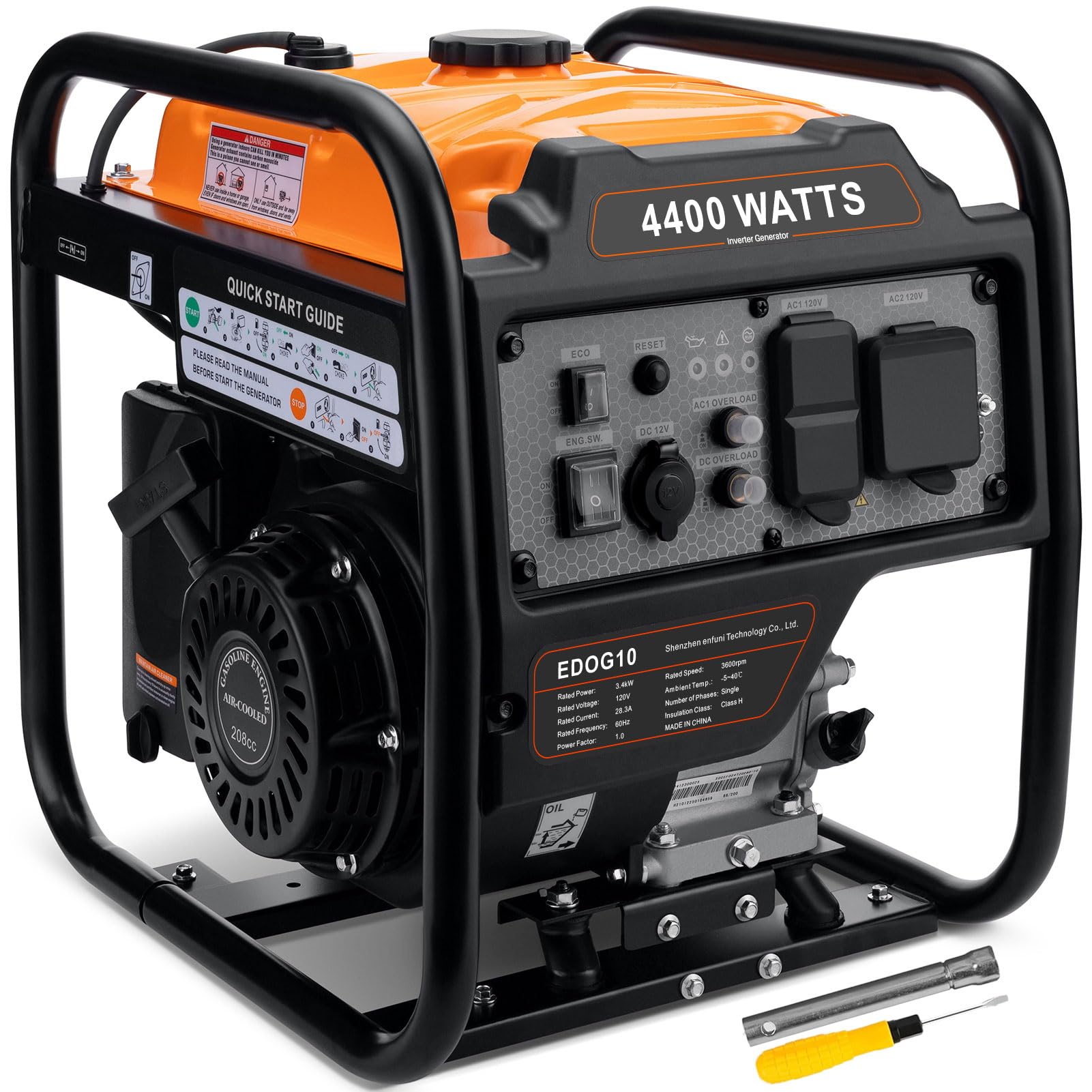
What you actually get at this lower price is 4400 peak watts and 3400 running watts, enough for well pumps, large fridges, and heavy power tools. It includes a 30A RV receptacle, two 120V outlets, and a 12V DC port for charging batteries.
The downside is noise. Reviewers point out it is “slightly louder than I would like” and one reviewer rated it 4/5 specifically because it was too loud for camping. At 57 pounds, it is the second-heaviest unit after the WEN 56477i, so portability is a chore rather than a convenience. The 2-gallon tank is generous, and shoppers say getting roughly 5 hours per gallon with eco-mode, which is decent for its size.
You get inverter-clean power safe for sensitive electronics, a cold-start technology that helps it fire up in lower temperatures, and low-oil shutdown to protect the engine. This one is for the budget buyer who needs high wattage for a workshop or home backup and can live with the extra noise and weight.
Why we’d pick it
- 4400 peak watts handles well pumps, large fridges, and heavy power tools.
- 2-gallon fuel tank provides up to 14 hours runtime at 25% load on eco-mode.
- 30A RV receptacle is built-in — no adapter needed for most campers.
A few caveats
- Open-frame design is louder than enclosed inverter generators — not ideal for quiet camping.
- At 57 pounds, it is heavy enough that you will want two hands and a plan to move it.
6. Pulsar PG2200BiS

This Pulsar is for the buyer who wants dual-fuel capability (gas or propane) in a genuinely compact package. It runs gasoline at 2200 peak watts and 1800 running watts, and propane at 2000 peak watts and 1600 running watts. It is the lightest dual-fuel inverter generator in this guide, making it ideal for recharging solar batteries at a campsite or providing backup power at a cabin where propane storage is easier than hauling gas cans.
The 80cc 4-stroke engine is super quiet at 60 dBA, and the parallel capability lets you link two Pulsars to double your power. It includes a 1.18-gallon fuel tank that runs 8 hours on gas at half load (or just 75 minutes on a 1-pound propane bottle at half load — propane’s energy density is lower per volume). The stable sine wave output (a smooth electrical waveform) keeps your sensitive electronics safe.
Buyers report that the propane adapter diaphragm can stick from sitting — one reviewer found that sucking on the engine end of the propane hose unsticks it. After that, it starts in 3-4 pulls on propane and 1-2 on gas. If you need dual-fuel flexibility in the lightest package possible, the Pulsar is a solid field choice against the Westinghouse 2550 (which is slightly quieter but 10 pounds heavier). Just be aware that the propane adapter diaphragm can stick if the generator sits unused for long periods.
Strong points
- Runs on gasoline or propane from the factory — no conversion kit needed.
- Compact enough to fit in a car trunk for camping or tailgating.
- Parallel capable — link two units to double your available wattage.
Before you buy
- The propane adapter diaphragm can stick after sitting — a simple manual fix is required.
- Only 75-minute runtime on a standard 1-pound propane tank at half load — bring a larger tank.
7. Oxseryn 2800W
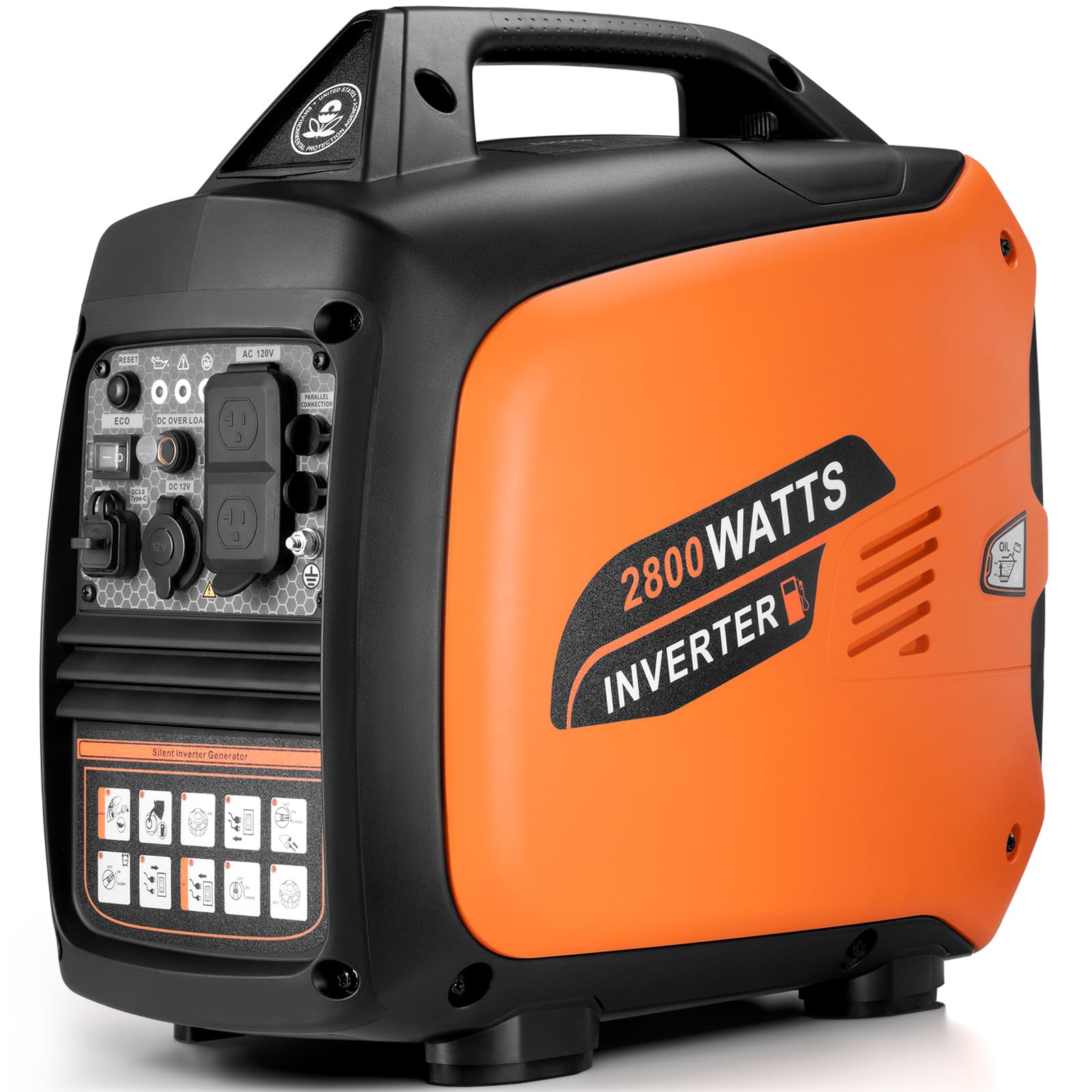
At a lower price than most competitors in this guide, the Oxseryn 2800W delivers a rare combination of quiet operation and enough power for a 15,000 BTU RV air conditioner. Its 79.8cc 4-stroke OHV engine pushes 2800 peak watts and 2000 running watts at under 58 dBA from 23 feet away, making it 10 pounds lighter than the PowerSmart 3600W (40 vs 50.7 lbs) while covering similar wattage for smaller RV needs, and it beats the GENMAX GM2000i on peak power (2800 vs 2000W).
The inverter technology keeps THD under 3%, safe for laptops and CPAP machines, and it includes a USB and Type-C port for direct device charging. The 1.1-gallon tank runs up to 9 hours at 25% load, and owners mention it actually ran 9.3 hours on one tank at full power — longer than the spec sheet promises. A fuel shut-off helps prevent carburetor gumming during storage, and the compact design (17.9″ x 11.2″ x 17.35″) fits in small RV compartments.
One reviewer found excessive metal particles in the oil during the first few changes — a normal break-in process for a new engine, but worth noting for first-time owners. If you want a lightweight, quiet generator that can run an RV air conditioner and charge a power station simultaneously, this is a strong value pick against the GENMAX. The one clear reason to choose it is its ability to power a 15,000 BTU RV AC while staying quiet enough for campgrounds and weighing just 40 pounds.
What we like
- Under 58 dBA — quiet enough for campgrounds and residential neighborhoods.
- At 40 pounds, it is light enough for one person to carry from the truck to the campsite.
- USB and Type-C ports let you charge phones and laptops directly without an adapter.
The downsides
- Break-in oil may contain metal particles; do a few early oil changes to be safe.
- No oil is included in the box — buy a quart of 10W-30 before you run it.
8. ERAYAK 2400W

2400 peak watts and up to 16 hours of runtime at 25% load on eco-mode make the ERAYAK 2400W the top pick for anyone who needs uninterrupted overnight power without refueling. It is ideal for multi-day outages or dry camping where a refrigerator and a few lights must run through two full nights on a single tank.
It produces 2400 peak watts and 1800 running watts from a 79.7cc engine, with THD between 0.2% and 1.2% — among the cleanest power in this guide, safe even for the most sensitive medical CPAP machines or audio equipment. The noise level is just 52.5 dBA at 7 meters (about 23 feet), which is quieter than a normal conversation. It comes with a 3-year limited warranty and lifetime technical support from the brand.
At 42 pounds with compact dimensions (18.82″ x 11.73″ x 18.11″), it is easy to store in an RV compartment or a car trunk. Customers note it is “comparable to a Honda 2000” in terms of quietness and build quality. The trade-off is the smaller peak wattage — it will not start a large RV air conditioner or a well pump. For refrigerators, lights, a laptop, and a phone charger, though, its runtime is unmatched in this guide.
Why it’s great
- Runs 16 hours at 25% load on eco-mode — the longest runtime of any generator in this guide.
- THD between 0.2% and 1.2% is the cleanest power here, perfect for sensitive electronics.
- At 52.5 dBA, it is quieter than a normal conversation — no campground complaints.
Good to know
- 1800 running watts is not enough for a large RV air conditioner or a well pump.
- Some units have been reported with defects; the 3-year warranty is your safety net.
9. GENMAX GM2000i

The GENMAX GM2000i weighs 34 pounds—15 pounds less than the top pick—and costs significantly less while still delivering 2000 peak watts and 1600 running watts with under 3% THD. It is the lightest unit in this guide, making it far easier to carry from the garage to the campsite or toss in a car trunk than the top pick’s heavier frame.
The 79.7cc 4-stroke OHV engine runs at 60 dBA—quiet enough for conversation—and the 1-gallon fuel tank provides up to 8 hours of runtime at 50% load (or more on eco-mode). It includes a CO detect shutdown sensor that automatically turns off the generator if carbon monoxide reaches dangerous levels, a safety feature often missing at this price point. Two USB ports (5V/1A and 5V/2.1A) let you charge phones directly, and the parallel capability means you can link two units for double the power later.
Reviewers point out it runs a camper air conditioner and lights fine, and one reviewer noted it is “quieter than comparable brand” and still runs perfectly after a year of use with ethanol-free gas and carb draining. Note that it may take 7-10 pulls to start after storage if you drain the carburetor—totally normal. Choose the GENMAX GM2000i over the top pick if you prioritize a lighter, more portable generator for light camping, tailgating, or short power outages where you just need to keep the fridge and a few lights running, and you are willing to accept lower wattage and a smaller fuel tank.
Where it shines
- At 34 pounds, it is the lightest generator in this guide — easy for anyone to carry.
- CO detect shutdown sensor turns off the generator if gas builds up, keeping you safe.
- Runs a small camper AC, fridge, lights, and charges devices on a single gallon of gas.
Worth noting
- 1600 running watts is not enough for a large RV air conditioner or a well pump.
- After storage with a drained carburetor, it may take 7-10 pulls to start again.
Understanding the Specs
Peak Watts vs. Running Watts
Peak wattage (also called surge or starting watts) is the extra power needed for a split second when an appliance with a motor first starts up — like a fridge compressor or an air conditioner. Running wattage (or rated watts) is the continuous power needed to keep that appliance running. If your generator’s peak watts do not match the startup surge, the motor will not spin and the generator will overload. Always add the peak wattage of your largest motorized appliance to the running wattage of everything else running at the same time.
Total Harmonic Distortion (THD)
THD measures how cleanly a generator produces electricity. Utility grid power is near 0% THD. Inverter generators produce under 3% THD, which is safe for sensitive electronics like laptops, CPAP machines, TVs, and refrigerator control boards. Conventional generators can produce 6-12% THD, which is fine for power tools and resistive heaters but can slowly damage electronics over time. If you plan to charge a phone or run a computer, you need an inverter generator.
FAQ
What size generator do I need for a refrigerator?
Can I run a generator in the rain or snow?
What fuel should I use in my generator?
Final Thoughts: The Verdict
For most buyers, the cheap generator winner is the WEN 56477i because it combines 4000 running watts, a CO sensor, and onboard wheels in a package that powers an entire home during an outage while staying affordable. If you want RV-ready power with lighter weight, grab the WEN 56360i. And for the longest runtime on a single tank, the standout is the ERAYAK 2400W at 16 hours.

Mo Maruf
I created WellFizz to bridge the gap between vague wellness advice and actionable solutions. My mission is simple: to decode the research and give you practical tools you can actually use.
Beyond the data, I am a passionate traveler. I believe that stepping away from the screen to explore new environments is essential for mental clarity and physical vitality.