Our readers keep the lights on and my smoothie glass nicely filled. As an Amazon Associate, I earn from qualifying purchases.
Specs are compiled from manufacturer listings and verified buyer reviews and can change over time — please confirm the key details on the product page before buying.
You want a crisp 27-inch gaming screen for less, but the real trick is finding one that doesn’t force you into blurry motion or a sluggish refresh rate. A tight budget usually means sacrificing either pixel density or speed, but a few 27-inch models now deliver genuine 1440p clarity (about 3.7 million pixels on screen — 33% more than 1080p) and high frame rates without the premium price tag. This guide cuts through the noise to show you which monitors actually deliver at that tricky intersection of price and performance.
I’m Mohammad Maruf — the founder and writer behind WellFizz. This guide is built by comparing the manufacturers’ published specifications and the patterns across verified customer reviews, so you get each pick’s real strengths and trade-offs instead of marketing spin.
You might prioritize the silky motion of a 240Hz display or the sharpness of a QHD panel, but knowing which spec to chase and which compromise you can live with makes all the difference when choosing the right cheap gaming monitor 27 inch.
Quick Picks
- AOC Q27G41ZE — Best Speed Value
- Acer Nitro XV272U W2bmiiprx — Full Ergo Stand
- KTC H27T27S — Best Overall
- Sceptre C275B-FWT240 — 240Hz Curve
- Alienware AW2725DM — Premium Pick
- LG 27GR83Q-B — Console Ready
- ASUS TUF VG27AQM5A — Speed King
How To Choose The Best Cheap Gaming Monitor 27 Inch
Buying a cheap gaming monitor means making smart trade-offs. You do not need to spend a fortune, but you do need to know which specifications impact your gaming experience the most and where you can save without regret.
Resolution: 1440p vs 1080p
Resolution determines how sharp the image looks. A 27-inch monitor at 1080p (1920×1080) can look a bit soft because the pixels are spread over a larger screen. A QHD (2560×1440) resolution packs about 3.7 million pixels into the same 27-inch space — 33% more than 1080p — so details are noticeably sharper. For a cheap gaming monitor, choosing a 1440p model is the single biggest visual upgrade you can make.
Refresh Rate and Response Time
Refresh rate (measured in Hz) tells you how many times per second the screen updates the image. A 144Hz monitor feels much smoother than a standard 60Hz display. A 240Hz or higher monitor gives a competitive edge in fast-paced shooters. Response time (measured in ms) is how fast a pixel can change color; lower numbers mean less motion blur. For most players, 1ms to 0.5ms is excellent, while a 0.3ms response is top-tier for competitive gaming.
Panel Type: IPS vs VA
Panel type affects color, contrast, and viewing angles. IPS panels offer superior color accuracy and much wider viewing angles, so the image does not wash out when you shift your head. VA panels provide deeper blacks and higher contrast ratios (like 3000:1 or 4000:1), which creates more dramatic shadow detail. For a cheap gaming monitor, an IPS panel is generally the better all-rounder for vibrant colors and image fidelity.
Quick Comparison
| Model | Best For | Resolution | Refresh Rate | Response Time | Amazon |
|---|---|---|---|---|---|
| AOC Q27G41ZE | Competitive Speed | 2560×1440 (QHD) | 240Hz (260Hz OC) | 0.3ms MPRT | Amazon |
| Acer Nitro XV272U | Ergonomic Adjustability | 2560×1440 (QHD) | 240Hz | 0.5ms (GtG) | Amazon |
| KTC H27T27S | Budget 1440p | 2560×1440 (QHD) | 144Hz | — | Amazon |
| Sceptre C275B-FWT240 | Budget 240Hz | 1920×1080 (FHD) | 240Hz | 1ms BR | Amazon |
| Alienware AW2725DM | Premium Value | 2560×1440 (QHD) | 180Hz | 1ms (GtG) | Amazon |
| LG 27GR83Q-B | Console & PC Gaming | 2560×1440 (QHD) | 240Hz | 1ms (GtG) | Amazon |
| ASUS TUF VG27AQM5A | Max Refresh Rate | 2560×1440 (QHD) | 300Hz | 0.3ms (GtG) | Amazon |
In‑Depth Reviews
1. AOC Q27G41ZE
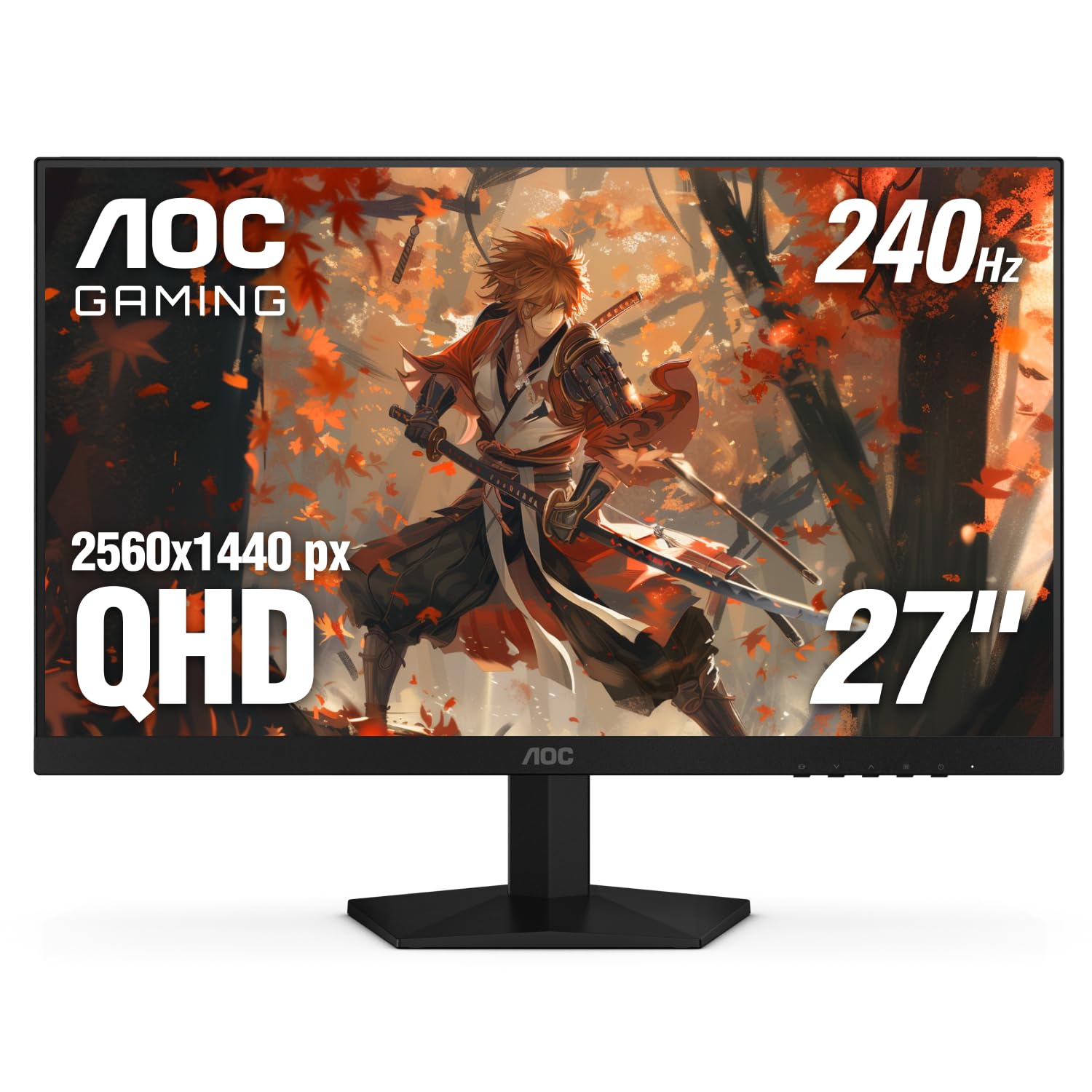
This AOC delivers a competitive 240Hz refresh rate and a blistering 0.3ms response time in a QHD IPS panel — all at a budget-friendly price that makes it a sharper speed pick than the 144Hz KTC H27T27S.
You get a 240Hz refresh rate that you can even overclock to 260Hz via the DisplayPort 1.4 connection, giving you noticeably smoother motion than a 144Hz display. The 0.3ms MPRT (Moving Picture Response Time — a measure of how long a pixel stays visible) is extremely fast, keeping fast-moving objects crisp with minimal blur. The IPS (In-Plane Switching) panel provides vibrant colors and wide viewing angles, so the image stays accurate even when you aren’t sitting dead center.
The QHD (2560×1440) resolution gives you a 33% sharper image than a standard 1080p monitor at the same 27-inch size. It also includes Adaptive-Sync (compatible with both FreeSync and G-Sync) to eliminate screen tearing. However, buyers report the monitor “wobbles slightly on unstable desks,” so a sturdy desk or VESA mount is a smart pairing. Some users also note that the max brightness of 300 nits feels a bit dim in a bright room.
Why It Wins for Speed
- Fastest response time in its class at a 0.3ms MPRT for nearly blur-free motion
- High 240Hz refresh rate that overclocks to 260Hz for silky-smooth gameplay
- Sharp QHD resolution with an IPS panel for accurate colors and wide viewing angles
What to Watch For
- The stand can wobble on unstable desks, so a mount might be needed
- Max brightness of 300 nits could feel underwhelming in sunlit rooms
Grab it for: Competitive gamers who want the lowest motion blur and a fast refresh rate without jumping to the premium tier.
Pass if: You need a bright screen for a sunlit room or a rock-solid stand from the start.
2. Acer Nitro XV272U W2bmiiprx

You get a premium adjustable stand and DisplayHDR 400 certification here — rare perks at this price, plus a 240Hz refresh rate that matches the AOC above.
The Acer Nitro matches the 240Hz refresh rate of the AOC Q27G41ZE, but it has a different draw — its ergonomic stand. You get full tilt, swivel, pivot (rotate to portrait), and a 4.7-inch height adjustment range. This makes it easy to position the screen for long sessions without neck strain. The 400-nit brightness is 33% brighter than the AOC’s 300 nits, and the VESA DisplayHDR 400 certification gives it a noticeable boost in dynamic contrast in HDR content.
The sRGB 99% color gamut delivers excellent color accuracy from the start. However, the response time is 1ms (GtG) with an advertised “up to 0.5ms” mode, which is slower than the AOC’s 0.3ms. A more serious issue is that several reviewers report “severe backlight bleed in bottom corners on two units.” While many units are fine, the quality control on backlight bleed appears inconsistent. At a 1000:1 contrast ratio, this monitor matches the AOC on contrast, but the Acer’s brighter panel and superior stand are its standout features.
The Stand Advantage
- Fully adjustable stand with height, swivel, tilt, and pivot for ideal ergonomics
- Higher 400-nit brightness with DisplayHDR 400 for better HDR visuals
- Rich sRGB 99% color gamut for accurate, vibrant colors
Backlight Bleed Risk
- Notable backlight bleed in the corners reported on some units, a known QC issue
- Response time of 1ms (0.5ms boost) is not as fast as the 0.3ms AOC competitor
Choose this for: The top-tier ergonomic stand and a brighter HDR-capable screen on a budget.
Be aware of: The potential for backlight bleed; inspect the unit on arrival and be ready to exchange.
3. KTC H27T27S
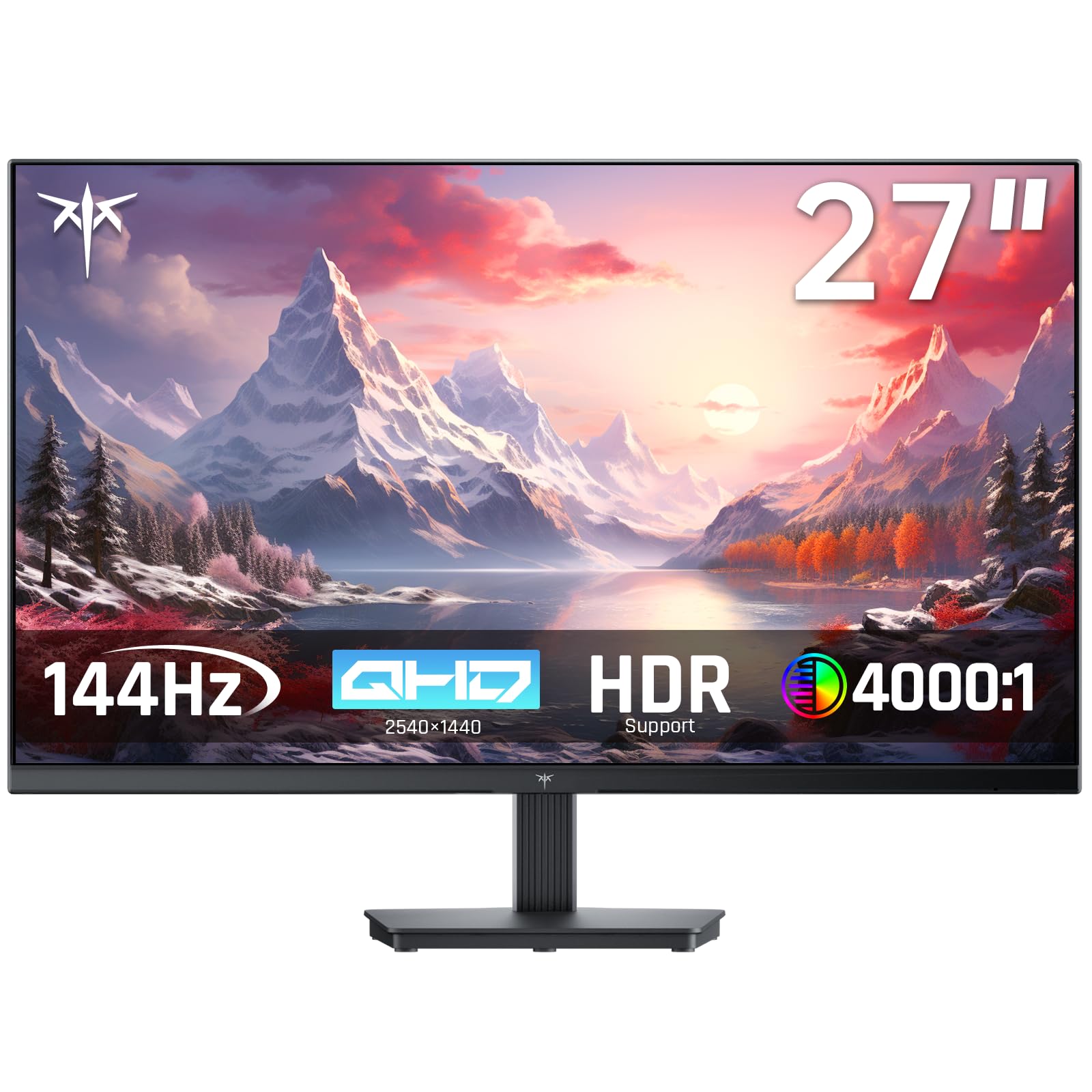
The KTC H27T27S is the best balance of QHD sharpness, high contrast, and affordability — it is the pick for most buyers because its 4000:1 contrast ratio delivers blacks four times deeper than the AOC or Acer.
This monitor uses an HVA panel that delivers a massive 4000:1 contrast ratio — four times the 1000:1 of the AOC or Acer IPS panels. This means blacks look far deeper and shadow details are much more pronounced, giving games a more rich, cinematic feel. Owners mention the image is “sharp, clear, no dead pixels,” and the 129% sRGB color gamut is 30% higher than the Acer’s 99%, so colors appear punchier and more saturated right from the start.
At 144Hz, the refresh rate is slower than the 240Hz options above, but for most single-player and casual games, it feels very smooth. The monitor handles both FreeSync and G-Sync to prevent screen tearing. Buyers should know it has no built-in speakers, no physical on/off switch (you unplug it to power down), and its tilt adjustment range is minimal. It also runs at QHD 75Hz by default with some setups, requiring you to manually set it to 144Hz in your display settings.
The Contrast King on a Budget
- Excellent 4000:1 contrast ratio for deep blacks and rich shadow detail
- Sharp QHD resolution with a wide 129% sRGB color gamut for vibrant images
- Great value for a 1440p monitor; buyers call it “great under “
Missing Features
- No built-in speakers and no physical power button for easy shut-off
- Limited ergonomics with only basic tilt; no height or swivel adjustment
Pick this if: You want a sharp 1440p display with knockout contrast for rich gaming and do not need a high refresh rate for competitive shooters.
skip it if: You need a 240Hz refresh rate, built-in speakers, or a fully adjustable stand from the start.
4. Sceptre C275B-FWT240
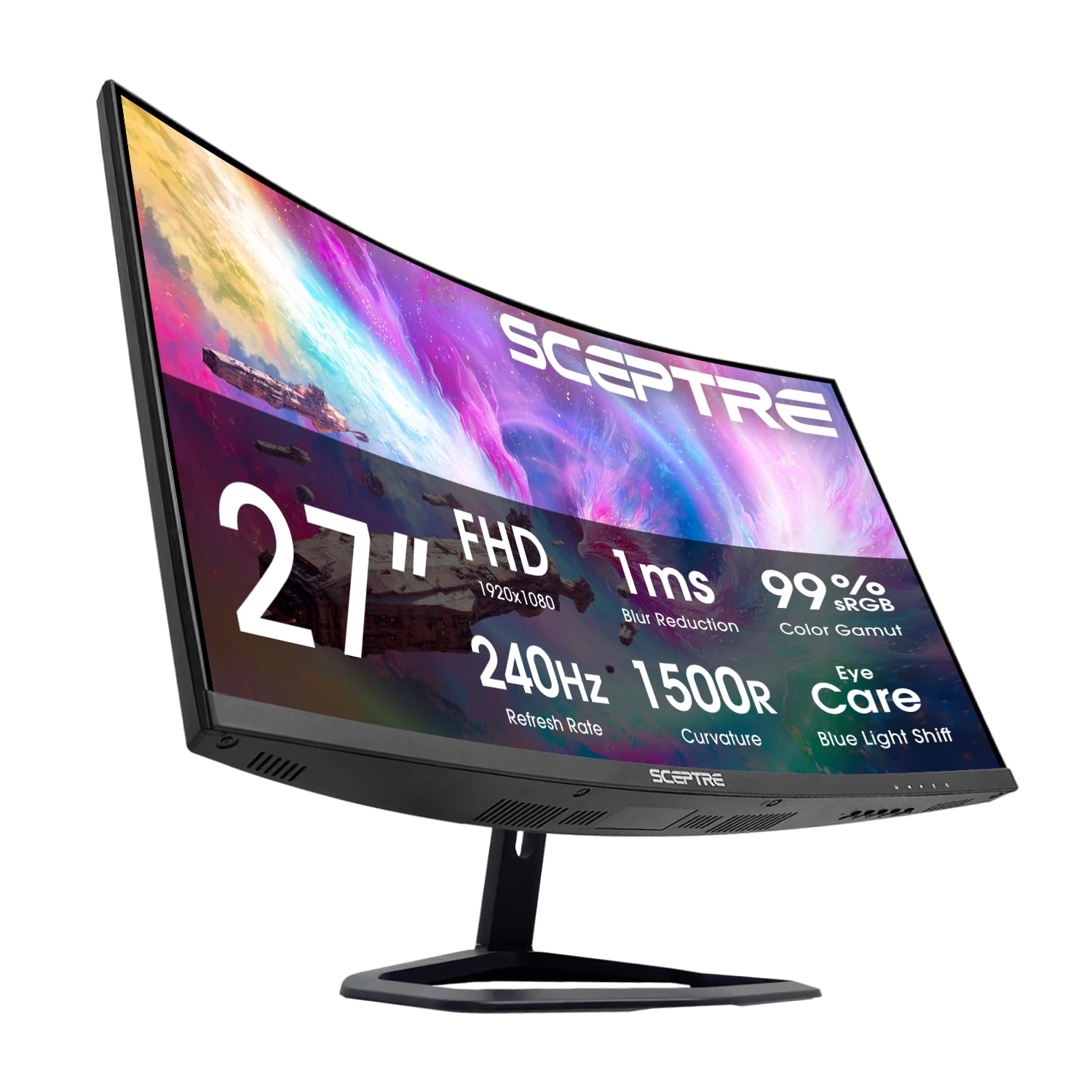
This is the cheapest way to get a 240Hz refresh rate, but the trade-off is a softer 1080p resolution on the 27-inch screen.
The Sceptre is the most affordable entry into a 240Hz gaming experience. It uses a 1500R curved VA panel, which wraps the image slightly around your field of view for a more rich feel. The 3000:1 contrast ratio is excellent, providing deep blacks that are three times the contrast of a typical 1000:1 IPS monitor like the AOC or Acer. The 1ms BR (Blue Response) response time keeps motion reasonably clear at the high 240Hz refresh rate, which one buyer confirms “works flawlessly at 240hz.”
The resolution is only 1080p (1920×1080). On a 27-inch screen, that is 33% less pixel density than the QHD monitors on this list, so text and fine details will look softer. The built-in speakers are a nice convenience for a clutter-free desk, though buyers describe the sound as “awful” and note it is “hard to adjust the volume.” It also supports FreeSync Premium but does not have G-Sync compatibility.
Budget-Friendly Fast Motion
- Cheapest way to get a 240Hz refresh rate for ultra-smooth motion
- Curved 1500R panel with high 3000:1 contrast for deep blacks and immersion
- Includes built-in speakers to save desk space
Low Resolution Trade-off
- 1080p resolution looks soft on a 27-inch screen compared to any QHD monitor
- Speakers have poor audio quality, and on-screen controls are awkward to use
Reach for this when: Your absolute top priority is a 240Hz refresh rate and you want to spend as little as possible to get it.
Look elsewhere if: You care about image sharpness and would prefer a higher-resolution 1440p panel.
5. Alienware AW2725DM

The Alienware combines a premium design with a 180Hz QHD IPS panel and excellent color coverage — it is a color-first pick for gamers who want vibrant visuals over raw speed.
The Alienware focuses on high-fidelity color. It covers DCI-P3 95% of the color spectrum (a wide color standard used in digital cinema), matching the LG below, and carries VESA DisplayHDR 400 certification for dynamic contrast. The 180Hz refresh rate is not as fast as the 240Hz AOC or the 300Hz ASUS, but it strikes a solid balance between smooth motion and demanding QHD resolution. Customers note the “setup was super easy” and call it a “very nice monitor” with “vibrant colors” and a “sleek, premium design.”
The stand is fully adjustable with height, swivel, tilt, and pivot, which is a great feature at this price. It also has a dedicated console mode that syncs the refresh rate appropriately with PS5 or Xbox. A key catch is that you only get the full 180Hz refresh rate via the DisplayPort connection — the HDMI input maxes out at 144Hz. It also lacks USB-C connectivity, which may be inconvenient for some laptop users.
Color & Build Quality
- Covers 95% of the DCI-P3 color gamut for vibrant, accurate colors
- Sturdy, fully adjustable stand with height, swivel, tilt, and pivot
- Console mode for smooth pairing with PS5 and Xbox
Limitations to Know
- 180Hz refresh rate is noticeably slower than the 240Hz and 300Hz competition
- Only 144Hz over HDMI; no USB-C port for single-cable laptop setups
Ideal for: Gamers who want a premium brand, great color accuracy for visually rich games, and a solid ergonomic stand.
Consider alternatives if: Your top priority is the highest possible refresh rate for competitive esports.
6. LG 27GR83Q-B
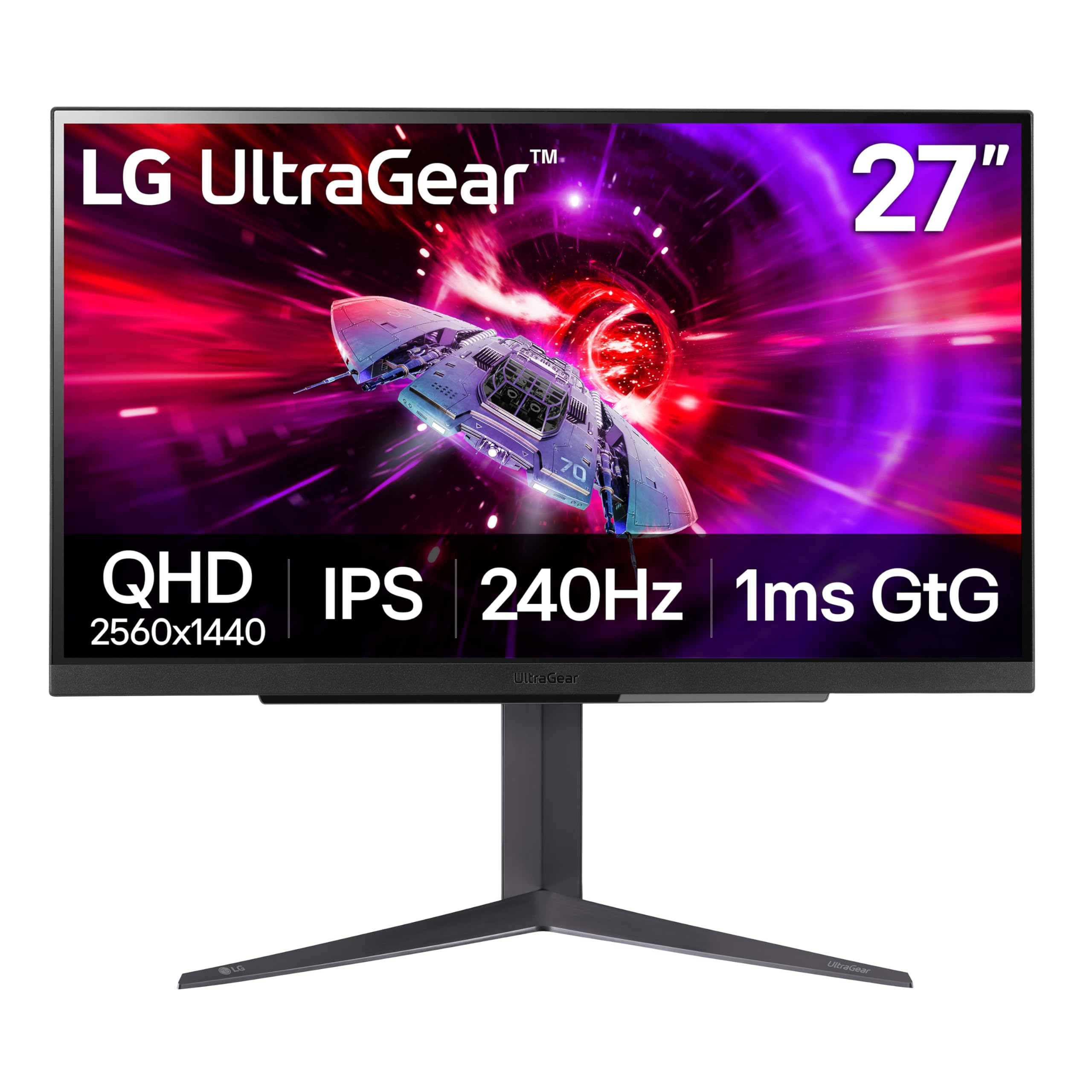
An HDMI 2.1 port and a full ergonomic stand make this LG a top pick for cross-platform gamers — it delivers a full 240Hz to both PC and PS5/Xbox, which the Alienware cannot match over HDMI.
The LG 27GR83Q-B has a standout feature for console gamers: an HDMI 2.1 port that supports a full 240Hz refresh rate. This is a genuine advantage over many monitors where high refresh rates are locked to DisplayPort. It matches the Alienware with DCI-P3 95% color coverage and VESA DisplayHDR 400 for vibrant visuals. The 1ms (GtG) response time keeps motion clear, and both G-Sync Compatible and FreeSync Premium work to eliminate screen tearing.
The stand offers full height, pivot, and tilt adjustment for ergonomic comfort. The monitor also includes a 4-pole headphone jack with DTS Headphone:X for 3D spatial audio over headphones. However, there are recurring reports of sticky and dead pixel issues. Several reviews note finding stuck pixels on arrival, with one buyer saying a second unit also had “5-8 stuck pixels.” While many users have no issues, the quality control on the panel is a known concern for this model.
Cross-Platform Power
- HDMI 2.1 port supports a full 240Hz refresh rate for PS5/Xbox Series X
- Excellent DCI-P3 95% color gamut with DisplayHDR 400 for vibrant HDR
- Fully ergonomic stand with height, pivot, and tilt adjustments
Panel Lottery Risk
- Multiple buyer reports of stuck/dead pixels, indicating inconsistent quality control
- 1ms (GtG) response is slower than the 0.3ms fast IPS competitors
Buy this if: You game on both a high-end PC and a PS5/Xbox and want full 240Hz support from both sources.
Be cautious: Inspect the screen for stuck pixels on arrival; be prepared to exchange if the panel has defects.
7. ASUS TUF VG27AQM5A
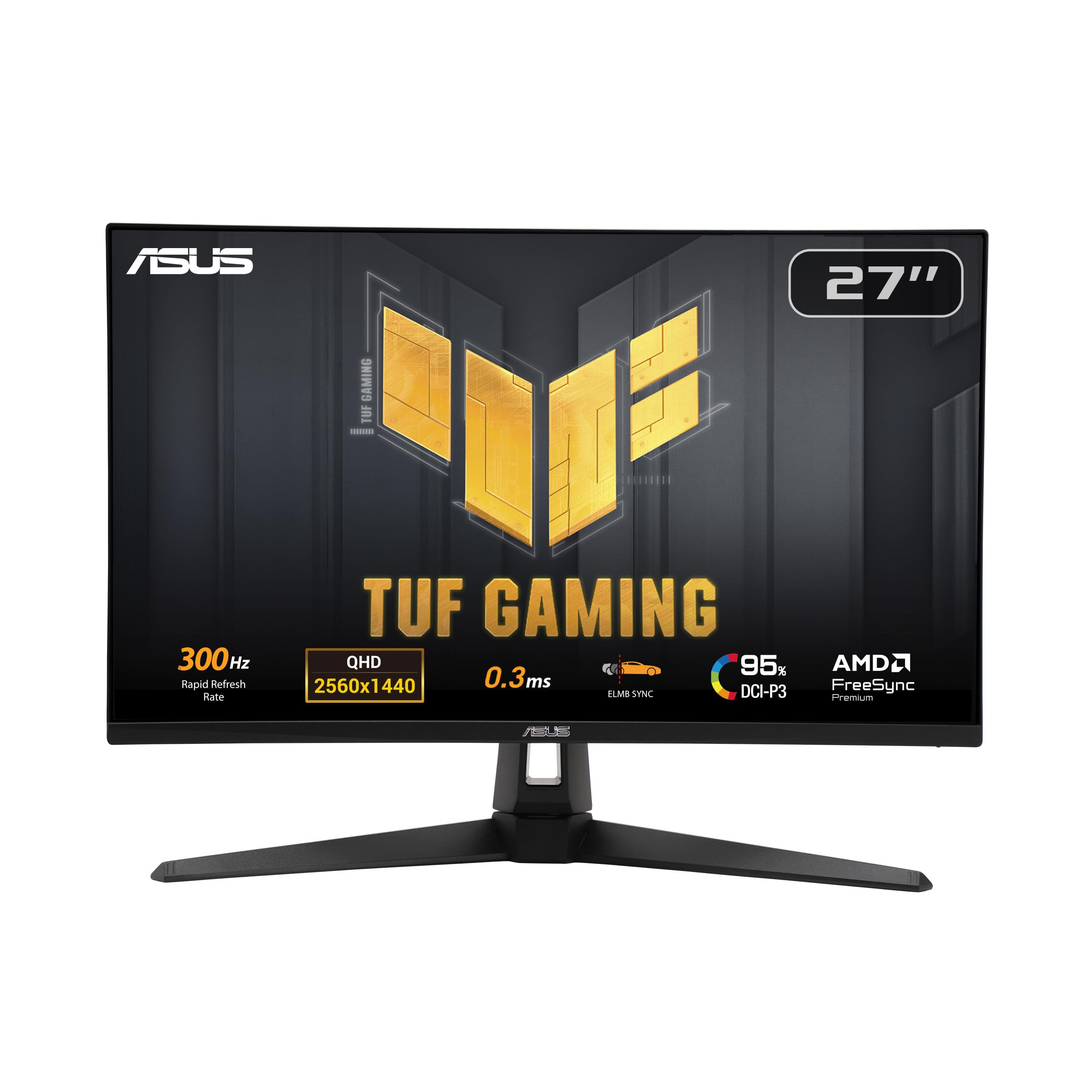
A 300Hz refresh rate with a 0.3ms response time makes this the fastest QHD panel on the list — it is 60Hz quicker than the AOC and a clear pick for competitive esports players.
This monitor pushes the performance envelope for a cheap gaming monitor with a remarkable 300Hz refresh rate at QHD resolution. The 0.3ms (GtG) response time on the Fast IPS panel is as fast as the AOC’s 0.3ms, but at a higher 300Hz refresh rate, delivering even smoother motion for competitive shooters and rhythm games. The ASUS Extreme Low Motion Blur Sync (ELMB Sync) technology eliminates ghosting and tearing simultaneously, a feature many gamers swear by for clarity in fast movement.
The DCI-P3 95% color gamut and 1300:1 contrast ratio are slightly better than the typical 1000:1 found on many IPS panels like the AOC or Acer. It also includes built-in speakers and a DisplayWidget Center software for adjusting settings with a mouse. The main trade-off is the price — it sits at the top of the budget range — and some reviewers point out arriving units with dead pixels or occasional cracking noises from the plastic housing. The OSD (on-screen display) menu is also noted by reviewers as complex.
class-leading Speed
- Class-leading 300Hz refresh rate for the smoothest possible on-screen motion
- Ultra-fast 0.3ms (GtG) response time eliminates nearly all motion blur
- ELMB Sync technology reduces ghosting and tearing at the same time
Premium Price & QC
- Highest price on this list, pushing the definition of “cheap”
- Some reports of dead pixels on arrival and occasional noise from the chassis
Best for: The competitive esports player who needs the absolute highest refresh rate and fastest response time on a QHD panel without going to a professional tier.
Not for: Casual gamers who will not see the benefit of 300Hz and would rather save money for other hardware.
Understanding the Specs
Refresh Rate (Hz)
This number tells you how many times per second your screen redraws the image. A 144Hz monitor updates the picture 144 times every second, which looks much smoother than a standard 60Hz screen. At 240Hz or 300Hz, motion becomes buttery smooth, giving you an edge in fast-paced shooters where you need to track moving targets clearly.
Response Time (ms)
Measured in milliseconds, this is the time a pixel takes to change from one color to another. A faster response time (like 0.3ms or 1ms) reduces motion blur and “ghosting” — the faint trail behind fast-moving objects. For competitive gaming, a 1ms response or faster is ideal; for casual use, 4ms to 5ms is still fine.
Resolution: 1080p vs 1440p
Resolution is the number of pixels on the screen. A 1080p (1920×1080) display has about 2 million pixels. A 1440p (2560×1440) display has about 3.7 million pixels. That 33% increase in pixel count makes text sharper, images more detailed, and fine object edges cleaner. At 27 inches, the difference between 1080p and 1440p is very noticeable.
Panel Type: IPS vs VA
IPS panels give you more accurate colors and much wider viewing angles — the image does not wash out if you look from the side. VA panels have higher contrast ratios (3000:1 or 4000:1 vs 1000:1), which means deeper blacks and more dramatic shadow detail. For gaming and media, IPS is the safer all-rounder; VA is better for dark, atmospheric single-player games.
FAQ
Can a 27-inch 1080p monitor look good for gaming?
Will a 1440p monitor work with a PS5 or Xbox Series X?
Is G-Sync or FreeSync necessary for a gaming monitor?
How much difference does 240Hz make over 144Hz?
What does a 1ms response time actually mean for gaming?
Should I get a curved or flat monitor for gaming?
What is the difference between HDMI 2.0 and HDMI 2.1 on a gaming monitor?
How important is VESA mount compatibility?
Final Thoughts: The Verdict
For most people, the cheap gaming monitor 27 inch winner is the KTC H27T27S because it delivers the best balance of sharp 1440p resolution, a smooth 144Hz refresh rate, and stellar 4000:1 contrast — all at a price that undercuts the competition. If you want the fastest competitive speed for esports, grab the AOC Q27G41ZE for its 260Hz overclock and 0.3ms response. And for console and PC hybrid gamers who need HDMI 2.1 and a full ergonomic stand, the LG 27GR83Q-B is the smart pick.
How We Picked
We do not accept paid placement. Every pick is matched to a real buyer and a real use-case; we do not hands-on test units.
Sources & Methodology
Specifications: manufacturer listings and product documentation. Review insights: verified customer reviews, as of July 2026. Pricing: not shown on this page (it changes often); check the current price via the retailer link.
As an Amazon Associate, WellFizz earns from qualifying purchases. This does not affect which products we feature.

Mo Maruf
I created WellFizz to bridge the gap between vague wellness advice and actionable solutions. My mission is simple: to decode the research and give you practical tools you can actually use.
Beyond the data, I am a passionate traveler. I believe that stepping away from the screen to explore new environments is essential for mental clarity and physical vitality.