Our readers keep the lights on and my smoothie glass nicely filled. As an Amazon Associate, I earn from qualifying purchases.
The biggest myth in the drone world is that a low price tag means a frustrating, unstable toy you’ll lose in the first five minutes. Reality is different — recent entry-level FPV drones pack brushless motors, GPS modules, and 4K cameras that would have seemed impossible at these prices just a few years ago. The actual challenge isn’t budget; it’s finding the model that combines reliable flight stability, useful battery life, and a camera that delivers sharp footage without breaking on the third landing.
I’m Mohammad Maruf — the founder and writer behind WellFizz. This guide is the product of many hours spent cross-referencing real customer flight reports, comparing transmission ranges, battery voltage specs, and GPS acquisition data across seven competing drones so you don’t have to guess which one actually flies straight.
Whether you’re a teenager looking for a first taste of aerial photography or an adult wanting a portable quadcopter for travel, the right cheap fpv drone should give you stable video transmission, enough flight time to actually explore, and a safety net like auto-return that keeps your investment from disappearing over the horizon.
How To Choose The Best Cheap FPV Drone
Finding a capable yet affordable FPV quadcopter means balancing a handful of critical specs that directly affect your flying experience. The cheapest model isn’t always the best value — a drone that loses connection at 100 feet or lands with shaky footage is money wasted regardless of the sticker.
Motor Type: Brushed vs. Brushless
Brushed motors are common on ultra-budget toys, but they wear out after 10–20 flight hours and struggle in any breeze. Brushless motors cost slightly more at the entry level but deliver higher torque, quieter operation, consistent RPM, and a lifespan measured in hundreds of hours. For any drone you actually want to fly more than a few times, brushless is the only smart choice.
GPS vs. Non-GPS: The Safety Floor
A drone without GPS relies entirely on your stick inputs and optical sensors. One gust of wind or a moment of disorientation can send it drifting. GPS modules enable auto-return to home, position hold in moderate wind, and smart flight modes like Follow Me and Waypoint. On a budget build, GPS is the single best insurance policy against losing your drone on the first flight.
FPV Transmission Quality
Real-time video feed clarity depends on both the camera sensor and the transmission protocol. 5GHz WiFi FPV with a dedicated antenna offers lower latency and better resistance to interference than older 2.4GHz systems. Models with an integrated screen on the remote controller eliminate the need for a phone mount and provide a larger, brighter view in direct sunlight.
Flight Time and Battery Configuration
Advertised flight times often combine two batteries, so read the fine print. A single battery lasting 15–18 minutes is average at this tier, while premium budget options push 23–24 minutes per charge. Higher voltage batteries (7.7V vs. the common 3.7V or 7.4V) provide more stable power delivery and longer flight windows under load.
Quick Comparison
On smaller screens, swipe sideways to see the full table.
| Model | Category | Best For | Key Spec | Amazon |
|---|---|---|---|---|
| Oddire HK11 | Premium Budget | Smart flight modes | 48 min total; 7.7V battery; 500m range | Amazon |
| PLEGBLE PL715 | Mid-Range | GPS reliability + long flight | 46 min total; 2700mAh batteries | Amazon |
| Karuisrc X7 | Premium Budget | Built-in screen + EIS | 4.5″ LCD; EIS camera; 25 min per battery | Amazon |
| UFLYTOO LA | Mid-Range | Phone-free screen flying | 4.5″ controller screen; 2x 2200mAh | Amazon |
| SIMREX G29 | Mid-Range | Beginner GPS + small size | 4.8 oz; 40 min total; 500m range | Amazon |
| Ameta S20 Lite | Budget-Friendly | Compact start with 4K claim | 36 min total; 165g; find drone buzzer | Amazon |
| KINGULL K24 | Budget-Friendly | Controller screen on a budget | 4.5″ screen; 64 min total claimed | Amazon |
In‑Depth Reviews
1. Oddire HK11

The Oddire HK11 sits at the top of this list because it delivers a rare combination at this tier: a 7.7V battery system that outperforms the common 3.7V and 7.4V packs, providing a total flight time of 48 minutes across two batteries. Its brushless motors generate level 5 wind resistance, allowing stable hovering even when breeze picks up, and the 5G WiFi transmission module with a signal repeater in the controller pushes FPV range to a tested 500 meters outdoors.
Camera performance is anchored by an F2.15 110° wide-angle lens that adjusts 90° via remote or app, capturing 4096×3072 stills and 2048×1088 video. GPS features include auto-return on low battery or signal loss, GPS Follow, Waypoint flight, and Orbit mode. The drone weighs exactly 249 grams, so no FAA or Remote ID registration is needed. Users report stable hover, durable construction that survives minor crashes, and clear instructions that make first flights straightforward.
The main caveat: the app ecosystem requires downloading “XDRONE GO” rather than the broken default app listed in the manual. Some users also note compass calibration is mandatory before every flight to maintain GPS lock. Despite these minor setup quirks, the HK11 offers the most mature flight experience at this price point.
Why it’s great
- Powerful 7.7V batteries deliver noticeably longer single-battery flight
- GPS auto-return and Follow Me modes work reliably in open areas
- Level 5 wind resistance keeps the camera stable in moderate breezes
Good to know
- Requires mandatory compass calibration before every takeoff
- Default app in manual is broken; must use XDRONE GO app instead
2. PLEGBLE PL715
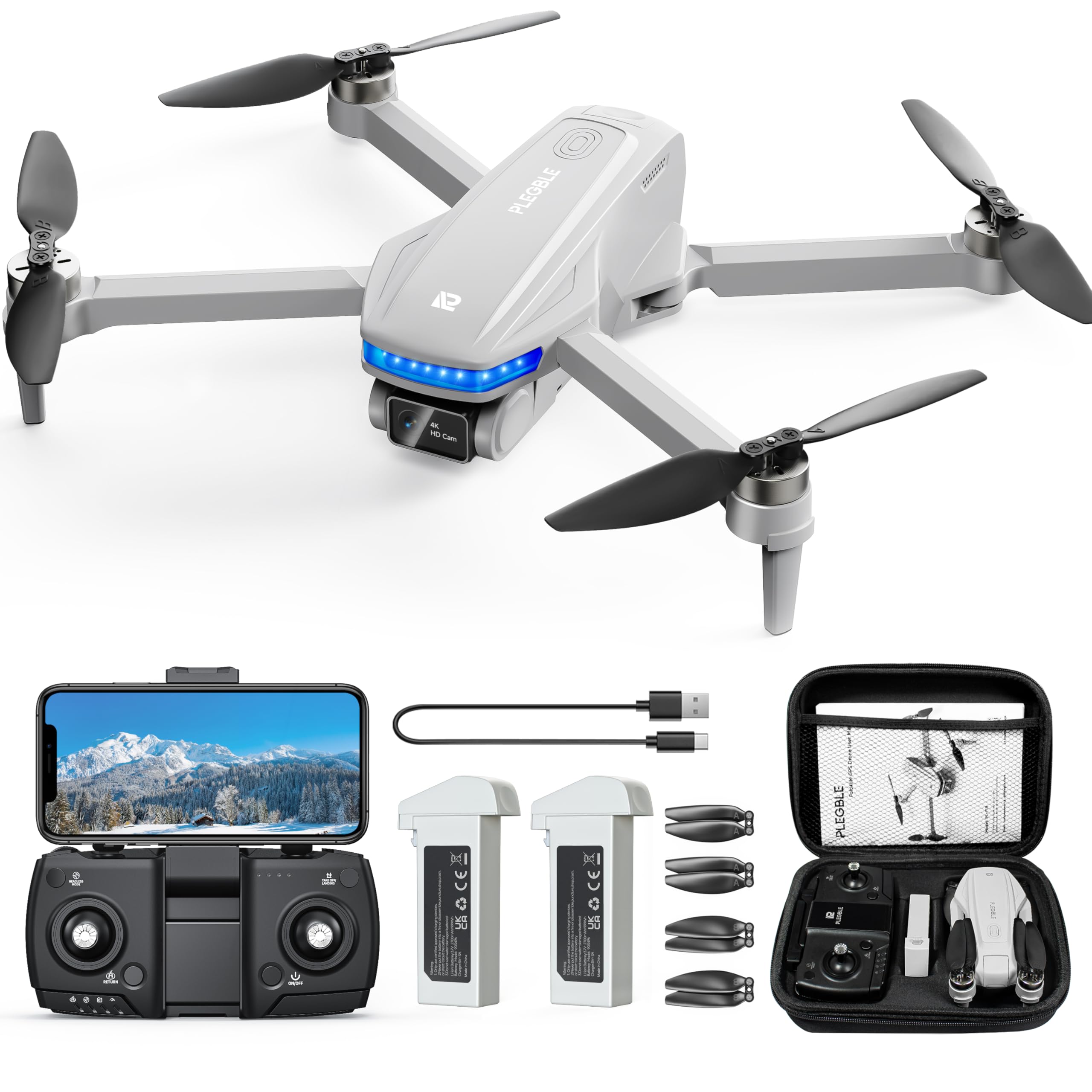
The PLEGBLE PL715 is built around GPS reliability. Its dual 2700mAh intelligent batteries deliver a claimed 46 minutes total (23 minutes per battery), which aligns closely with real user reports of around 20 minutes of aggressive flying per pack. The brushless motors provide stable flight in mild wind, and the 5GHz FPV transmission maintains a clear feed up to the advertised 1,968-foot range under ideal conditions.
Camera specs center on a 4K sensor with a 120° wide-angle lens and 90° mechanical adjustment. User reviews consistently note that the camera is adequate for casual aerial photography and learning framing — colors are punchy in good light but soft in low light, which is expected at this price tier. The GPS feature set includes auto-return on signal loss, Follow Me, Waypoint Flight, and Circle Fly, all of which function reliably after proper compass calibration.
A standout safety feature is Beginner Mode, which restricts flight radius to 30 meters for new pilots and can be toggled off through the app as skills improve. Weighing under 250 grams, the PL715 requires no FAA registration. The main complaint: the remote and batteries charge via mini-USB rather than USB-C, and some users find the calibration procedure slightly finicky on first flights.
Why it’s great
- Large 2700mAh batteries offer among the best total flight time at this tier
- GPS auto-return and Follow Me work dependably after proper setup
- Beginner Mode with 30m radius restriction is ideal for novices
Good to know
- Uses mini-USB charging ports instead of modern USB-C
- Camera softness in low light reduces usable footage after sunset
3. Karuisrc X7
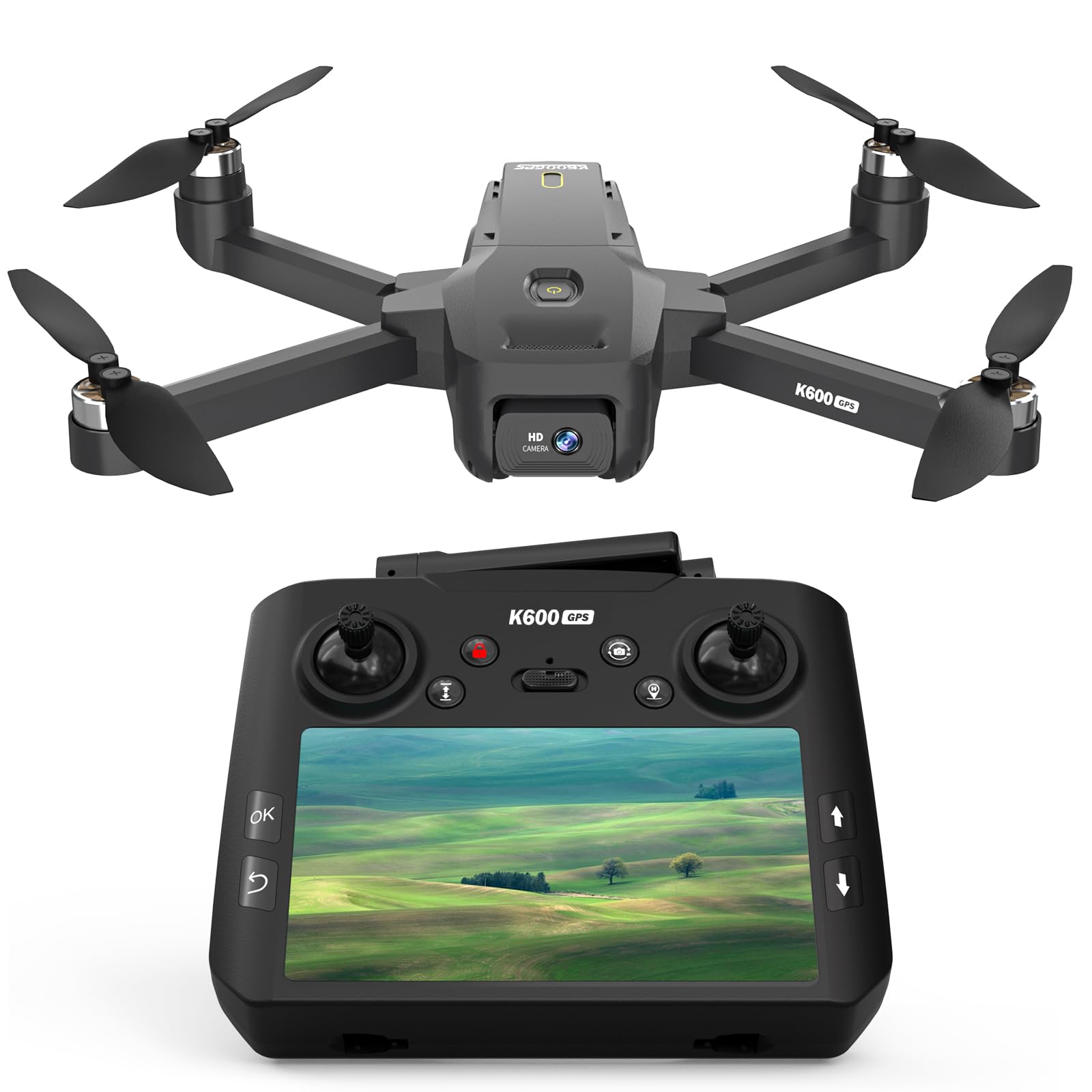
The Karuisrc X7 differentiates itself with a 4.5-inch HD LCD screen integrated directly into the remote controller, eliminating the need for a smartphone mount and reducing setup time to seconds. The screen provides real-time FPV transmission with brightness adequate for outdoor use, and the controller layout keeps all flight controls accessible without juggling a phone.
Camera quality is boosted by Electronic Image Stabilization (EIS), which smooths out the small vibrations and wind-induced wobbles common in sub- drones. The camera delivers crisp footage during gentle flying, and built-in GPS enables Follow Me, Orbit Mode, and Waypoint Navigation through the controller screen. Users report a single-battery flight time of approximately 25 minutes with the 2200mAh pack, and the auto-return function activates promptly when signal drops below threshold.
The matte black foldable frame weighs 205.8 grams, staying under the FAA registration threshold while feeling more substantial in hand than cheaper plastic builds. Some customer reports note that the control distance is realistically closer to 250-300 meters rather than the advertised 400 meters, but the stable GPS lock and clear screen more than compensate for the slightly conservative range in most recreational use.
Why it’s great
- Integrated 4.5″ LCD screen removes phone mounting hassle entirely
- EIS camera significantly reduces jello effect in recorded footage
- GPS auto-return and Follow Me modes are intuitive via the screen UI
Good to know
- Real-world FPV range is closer to 300m than claimed 400m range
- Non-touch screen requires button navigation for settings changes
4. UFLYTOO LA

The UFLYTOO LA targets flyers who want a phone-free experience at a slightly lower price than the Karuisrc X7. Its remote controller also features a 4.5-inch FHD screen for live FPV viewing, and the drone comes with two 2200mAh intelligent batteries that combine for a claimed 45 minutes of total flight time. Brushless motors provide good stability in calm conditions, and the altitude hold system maintains height without constant throttle adjustment.
GPS functions include auto-return to home, which several users describe as working flawlessly, bringing the drone back to the takeoff point even when flown beyond comfortable visual range. The camera is rated for 4K capture, though user feedback suggests the effective resolution is closer to solid 1080p with interpolation — acceptable for social media sharing but not for pixel-level inspection. The included carrying case is well-padded and fits the drone, controller, batteries, and spare propellers neatly.
The primary drawback reported by multiple verified purchasers is the remote controller build quality, specifically the screen visibility in bright sunlight. Some users experienced the screen washing out during midday flights, requiring them to shade the controller with a hand to compose shots. Additionally, a minority of units arrived with GPS calibration quirks that required multiple satellite acquisitions to stabilize the position hold.
Why it’s great
- Phone-free flying with a large, responsive controller screen
- GPS auto-return function consistently brings the drone home
- Well-padded carrying case protects everything during transport
Good to know
- Screen brightness struggles in direct sunlight
- Some units require multiple calibrations for stable GPS lock
5. SIMREX G29
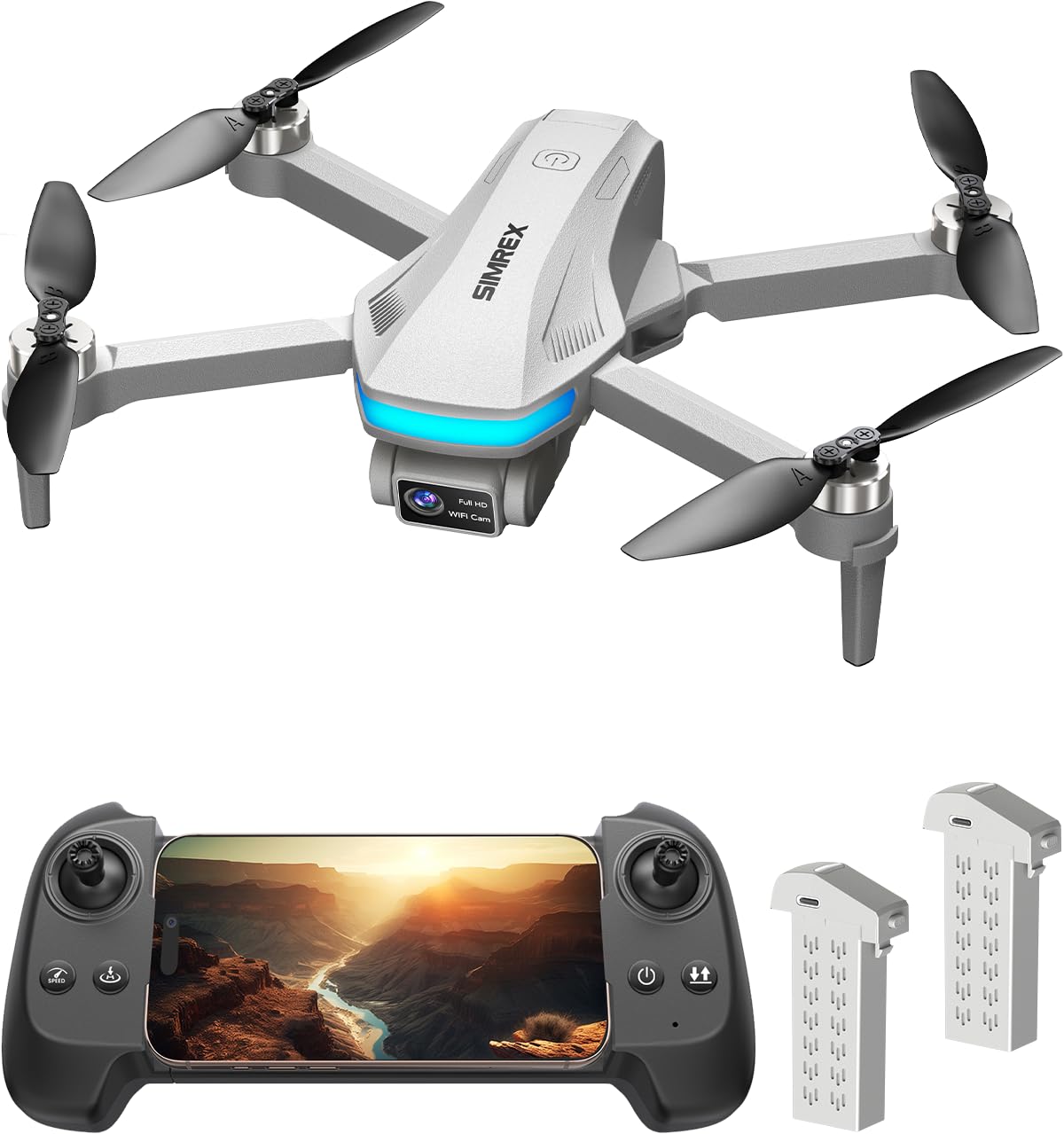
The SIMREX G29 is one of the lightest GPS drones on the market at just 4.8 ounces (136 grams), making it exceptionally portable and fully exempt from any registration requirements in nearly every region. Despite the small frame, it packs brushless motors, a 4K camera with 90° electric tilt, and meaningful GPS features including auto-return, Follow Me, Waypoint Flight, and Circle Fly. Total flight time across two batteries reaches approximately 40 minutes in real-world testing.
The camera supports 5G WiFi FPV transmission up to 500 meters, and the optical flow sensor combined with altitude hold keeps the hover stable enough for clear photos. Gesture control allows hands-free selfies by showing a palm or peace sign to the camera, which is genuinely useful for solo travelers. Foldable arms collapse the drone into a compact shape that fits into a small bag or even a large jacket pocket.
Where the G29 sacrifices is in wind resistance — its ultra-light weight means it gets pushed around noticeably in winds above 10 mph, making it best suited for calm evening flights or indoor practice. The camera, while claiming 4K, delivers roughly 2.7K effective resolution in user reports. Still, for a drone this small with functioning GPS smarts, the tradeoffs are reasonable.
Why it’s great
- Extremely lightweight at 136g without sacrificing GPS features
- Gesture control works reliably for hands-free photo capture
- Foldable design is genuinely pocketable for travel
Good to know
- Struggles in moderate wind due to low weight
- Effective camera resolution is closer to 2.7K than true 4K
6. Ameta S20 Lite
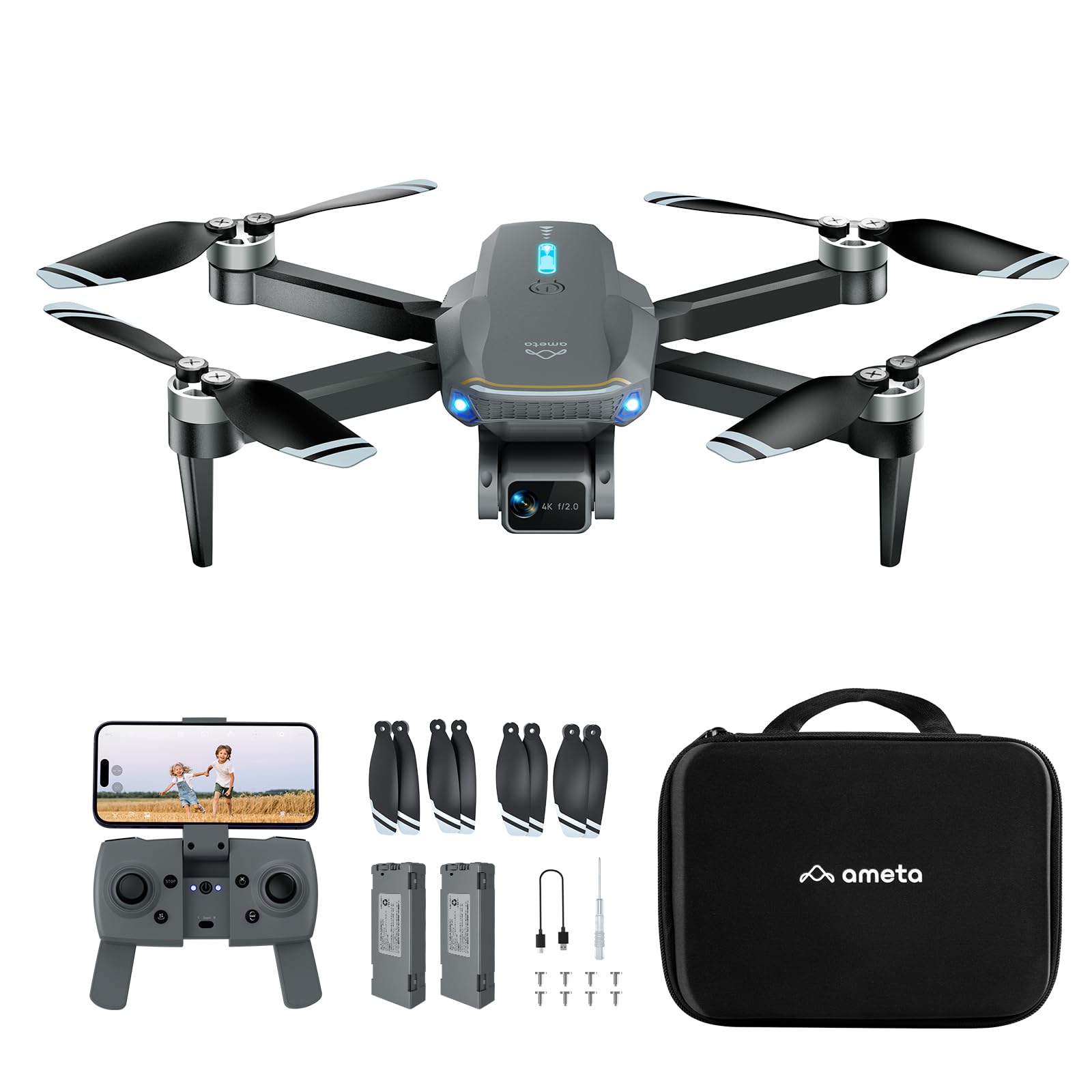
The Ameta S20 Lite represents the entry point where you still get brushless motors and a Sony CMOS sensor, but without GPS. That omission is the defining tradeoff — you lose auto-return, Follow Me, and position hold against wind, but you gain a very compact 165-gram foldable frame and a total flight time of 36 minutes across two 1600mAh batteries. Optical flow positioning provides some hover stability indoors and in dead calm air.
The 12MP Sony CMOS sensor is a genuine highlight at this price, capturing 4096×3072 stills with better color reproduction than generic sensors in the same bracket. The 90° adjustable lens allows flexible framing, and the 5G FPV feed is snappy with minimal latency. A “Find My Drone” buzzer function activates from the controller, a genuinely useful feature since there’s no GPS map to guide you back. Users praise the easy beginner setup with one-key takeoff/landing and headless mode.
The most critical constraint is flight stability — without GPS, the S20 Lite drifts noticeably in the slightest breeze, making it unsuitable for outdoor photography beyond near-windless days. Some verified reviews also note that the 4K claim is partially interpolated, with effective resolution closer to 720p. For pure indoor practice and learning FPV orientation, it works well, but it’s limited as an outdoor camera platform.
Why it’s great
- Genuine Sony CMOS sensor delivers better color than competing budget sensors
- Compact 165g foldable design includes a premium carrying bag
- Find My Drone buzzer helps recover the drone after a crash
Good to know
- No GPS means the drone drifts in any wind over 3-5 mph
- Effective video resolution is significantly below advertised 4K
7. KINGULL K24
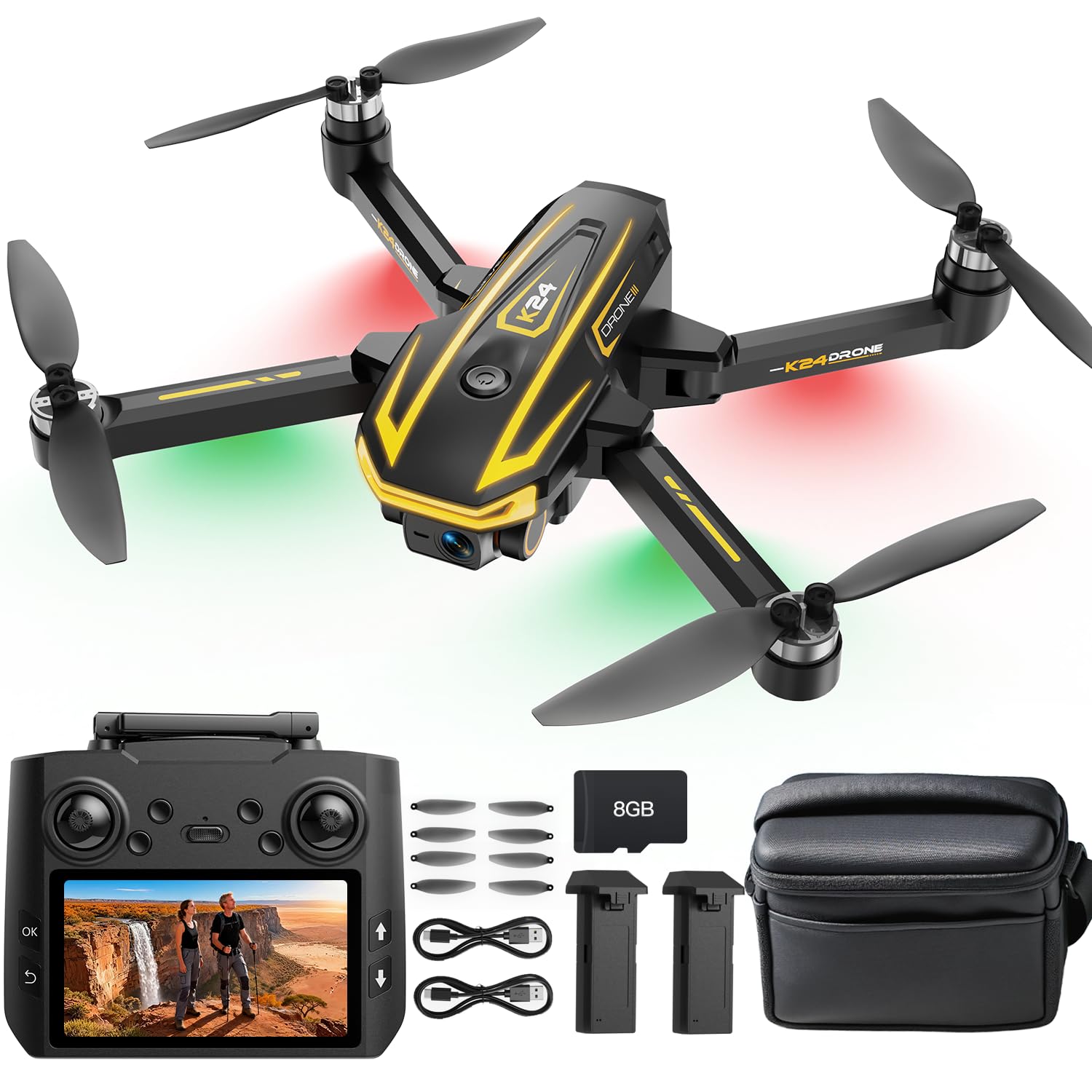
The KINGULL K24 is the lightest drone in this roundup at under 90 grams, making it practically immune to any regulatory restrictions worldwide. Its standout feature is the 4.5-inch HD LCD screen built into the remote controller that displays live FPV video without needing a smartphone. For a flyer who just wants to open the box, turn on the drone, and see the feed instantly, this is the most friction-free option at the lowest price point.
The drone uses optical flow positioning for hover stability, which works reliably indoors and in near-windless outdoor conditions. Two 1800mAh batteries provide a combined flight time that some users report as 32 minutes per battery in careful flying, but real-world aggressive flight with camera recording brings this closer to 18-20 minutes per pack. Auto takeoff and landing are smooth, and headless mode removes orientation confusion for absolute beginners. An SD card is included in the package, saving a small extra purchase.
The risk with the K24 is the absence of GPS. Several verified reviews describe incidents of complete control loss and flyaways at moderate altitude, with the drone disappearing over trees and never returning. Without a return-to-home function, a lost signal means a lost drone. The camera, while described as 4K, delivers soft footage that users rate as adequate for fun but not for any archival purpose. This is a drone for casual indoor flying and low-risk outdoor practice, not for reliable aerial photography.
Why it’s great
- Pre-installed controller screen eliminates phone setup entirely
- Extremely lightweight at under 90g for max portability
- Includes SD card and two batteries out of the box
Good to know
- No GPS means no auto-return — flyaway risk in open areas
- Camera softens significantly in anything other than bright sunlight
FAQ
Do cheap FPV drones require FAA registration in the United States?
Why does my budget FPV drone drift even when I’m not touching the controls?
Is claimed 4K camera resolution on a cheap drone actually 4K?
How long should a single battery last on a budget FPV drone?
Final Thoughts: The Verdict
For most users, the best cheap fpv drone winner is the Oddire HK11 because its 7.7V battery system, GPS safety features, and reliable 5G transmission provide the most polished flight experience without crossing into mid-range pricing. If you want a phone-free flying experience with an integrated screen, grab the Karuisrc X7. And for maximum flight time with dependable GPS auto-return, nothing beats the PLEGBLE PL715 at this budget tier.

Mo Maruf
I created WellFizz to bridge the gap between vague wellness advice and actionable solutions. My mission is simple: to decode the research and give you practical tools you can actually use.
Beyond the data, I am a passionate traveler. I believe that stepping away from the screen to explore new environments is essential for mental clarity and physical vitality.