Our readers keep the lights on and my smoothie glass nicely filled. As an Amazon Associate, I earn from qualifying purchases.
A fixed blade knife under forty dollars shouldn’t feel like a compromise, yet most budget steel arrives dull, poorly heat-treated, or loose in its handle after a single trip. The market is flooded with stamped blades that fail at the first hard task, leaving buyers frustrated and searching for the real deal. This guide cuts through the noise to find the knives that actually perform in the field without breaking your wallet.
I’m Mohammad Maruf — the founder and writer behind WellFizz. I’ve spent hours analyzing blade geometry, handle ergonomics, and heat treat consistency across dozens of budget fixed blade models to find the ones that deliver real performance at a low cost.
Whether you’re skinning small game, processing camp wood, or just need a dependable everyday carry blade, this roundup of cheap fixed blade knife options focuses on edge retention, grip security, and steel quality at the lowest possible cost of entry.
How To Choose The Best Cheap Fixed Blade Knife
When the budget is tight, every feature trade-off matters more. The wrong choice means a blade that chips on a knot, a handle that slips when wet, or a sheath that falls apart in the field. Focus on these three factors to avoid wasting money.
Blade Steel and Heat Treat
Steels like 4116 Krupp, 420HC, and 8Cr13MoV dominate budget territory. What separates them is heat treat consistency. A cheap blade made of decent steel with a poor heat treat will dull quickly. Look for brands known for proper thermal cycling — Cold Steel and Buck are reliable examples. D2 steel at this price point is rare but offers superior edge retention if you find it.
Handle Construction and Grip
A molded Kraton or rubberized handle provides excellent wet-weather grip and comfort. Hard plastic handles may feel cheaper but often lack the tackiness needed for hard use. Finger grooves improve ergonomics but can be uncomfortable for larger hands. Check if the tang is exposed at the pommel — a full tang knife should show steel at the butt for maximum strength.
Sheath Design and Carry Options
A well-designed sheath makes the difference between a knife you carry and one you leave behind. Look for positive retention — the blade should click in and stay put. Leather sheaths are stylish and repairable but can fatigue over time. Nylon or plastic sheaths are lighter and more weather-resistant. Check belt loop size to ensure compatibility with your everyday carry setup.
Quick Comparison
On smaller screens, swipe sideways to see the full table.
| Model | Category | Best For | Key Spec | Amazon |
|---|---|---|---|---|
| Cold Steel Outdoorsman Lite | Mid-Range | Heavy field use & game processing | 6″ 4116 stainless steel blade, 4mm thick | Amazon |
| Gerber Freeman Guide | Mid-Range | Everyday carry & hunting | 4″ 5Cr15MoV blade, full tang | Amazon |
| DRGSKL Japanese Tanto | Value | Bushcraft & heavy chopping | D2 steel blade, full-tang walnut handle | Amazon |
| Smith & Wesson SWF606 | Premium | Self-defense & tactical carry | 4.4″ 8Cr13MoV double-edged blade | Amazon |
| Buck 684 Small BuckLite Max II | Premium | Detail work & small game dressing | 3.25″ 420HC drop point blade, 2.8 oz | Amazon |
In‑Depth Reviews
1. Cold Steel Outdoorsman Lite

The Cold Steel Outdoorsman Lite delivers the kind of performance you’d expect from a knife twice its price. The 6-inch 4116 Krupp stainless steel blade arrives razor sharp out of the box with a 4mm thickness that handles prying and light batoning without flexing. The partially swedged spine gives you a thumb rest for precise carving while the bone breaker ridge on top adds utility for small game processing.
The deeply textured Kraton handle wraps around a fully encased tang and provides a non-slip grip that excels in wet or bloody conditions. At only 6.4 ounces this knife feels light on the belt but substantial in hand. The hard plastic sheath uses a simple friction fit that works reliably for horizontal or vertical carry. Multiple user reports confirm edge retention through hog skinning and deer processing with only occasional touch-ups needed on a stone.
Some users with smaller hands note that the handle runs large and the sheath’s deep seating makes the draw awkward with thick fingers. The molded sheath material also tends to wear at the mouth over extended use. Still, for the price it’s difficult to find a tougher all-rounder for camp and field work.
Why it’s great
- Extremely sharp out of box with good edge retention
- Rust-resistant 4116 steel tested against saltwater exposure
- Lightweight but strong enough for light batoning
Good to know
- Handle is large and may feel bulky for smaller hands
- Sheath mouth tears over time with repeated use
2. Gerber Freeman Guide

The Gerber Freeman Guide is a compact fixed blade that punches well above its weight class. The 4-inch 5Cr15MoV steel blade uses a drop point profile with a glass bead finish that reduces glare during hunting. The full tang construction is fully exposed at the pommel which allows for hard impact tasks like hammering or prying without fear of handle separation. The blade thickness sits at approximately 0.13 inches which makes it nimble for detail work but still tough enough for splitting small kindling.
Deep finger grooves and a TacHide rubber overlay give this knife a locked-in grip that feels natural even during extended skinning sessions. The overall length of 8.38 inches keeps it compact enough for everyday carry while still offering good blade belly for slicing. The formed nylon sheath provides adequate retention with a belt loop that fits standard 1.5-inch belts. Users report this knife gutted and skinned an entire cow elk without needing a sharpening break.
The included sheath is widely considered the weak point with reports of the belt loop stitching failing under heavy use. The handle grooves are also deep enough that users with large fingers may experience pressure points over long periods. Some buyers wish the blade was available in a half-serrated version for cutting fibrous materials.
Why it’s great
- Full tang with exposed pommel for hard use tasks
- Locked-in ergonomic grip with deep finger grooves
- Holds edge well through full game processing
Good to know
- Sheath belt loop has durability concerns over time
- Deep finger grooves may cause discomfort for large hands
3. DRGSKL Japanese Tanto Fixed Blade

The DRGSKL Japanese Tanto stands out in this budget roundup for its use of D2 tool steel — an unusual find at this tier. D2 offers significantly better edge retention and wear resistance compared to the 400-series stainless steels common in cheap knives. The blade geometry features a tanto point with a thick spine designed for piercing and heavy impact tasks like splitting bamboo or prying apart firewood. The full tang walnut handle is ergonomically shaped with a brass end ring that adds balance and prevents the knife from slipping out of hand during hard strikes.
The wooden sheath clicks the blade in with a satisfyingly secure fit and the overall aesthetic is elevated enough to feel like a collector item rather than a beater tool. Users report the blade stays sharp through extended cutting of fresh and dried bamboo up to two inches in diameter. The knife carries significant weight which gives it chopping authority that lighter blades simply cannot match at this price point.
This knife is not designed for delicate slicing — the thick blade geometry makes it a cleaver-style tool more suited to chopping than fine detail work. The minimal guard offers limited protection during hard thrusting and the wooden handle requires oiling to prevent drying and cracking over time. Edge retention on D2 can vary depending on the specific heat treat used in this model which is less consistent than established brands.
Why it’s great
- Premium D2 tool steel for superior edge retention
- Full tang walnut handle with brass end ring for balance
- Wooden sheath with secure click-in retention
Good to know
- Blade is thick and heavy not ideal for slicing precision work
- Wooden handle requires maintenance to prevent drying
4. Smith & Wesson SWF606

The Smith & Wesson SWF606 brings a double-edged spear point blade to the budget fixed blade market for those who prioritize self-defense capability alongside utility work. The 4.4-inch 8Cr13MoV high carbon stainless steel blade measures 3/16 inch thick which gives it substantial rigidity for piercing tasks. The black thermoplastic elastomer handle features finger guards and a lanyard hole that supports neck carry configurations. The center of mass sits just behind the blade which makes the knife feel balanced and quick for thrusting movements.
Included leather sheath uses a full-grain construction with metal-braced snap tab and repairable stitching — a rare find at this entry-level price point. Users consistently report the blade arrives hair-shaving sharp with a rough blueing finish that provides traction for the thumb during detailed cuts. The knife functions well for light outdoor tasks like cutting packaging food prep and camp cordage while also serving as a reliable defensive tool.
The finger guard loop is small — users with large hands report discomfort when trying to use the conventional grip. The double-edged design is also legally restricted in some jurisdictions so check local carry laws before purchasing.
Why it’s great
- Full tang with dual edge for self-defense versatility
- High-quality full-grain leather sheath with repairable stitching
- Hair-shaving sharp out of box with balanced feel
Good to know
- Grind symmetry varies between units
- Finger guard and handle loop too small for large hands
5. Buck 684 Small BuckLite Max II
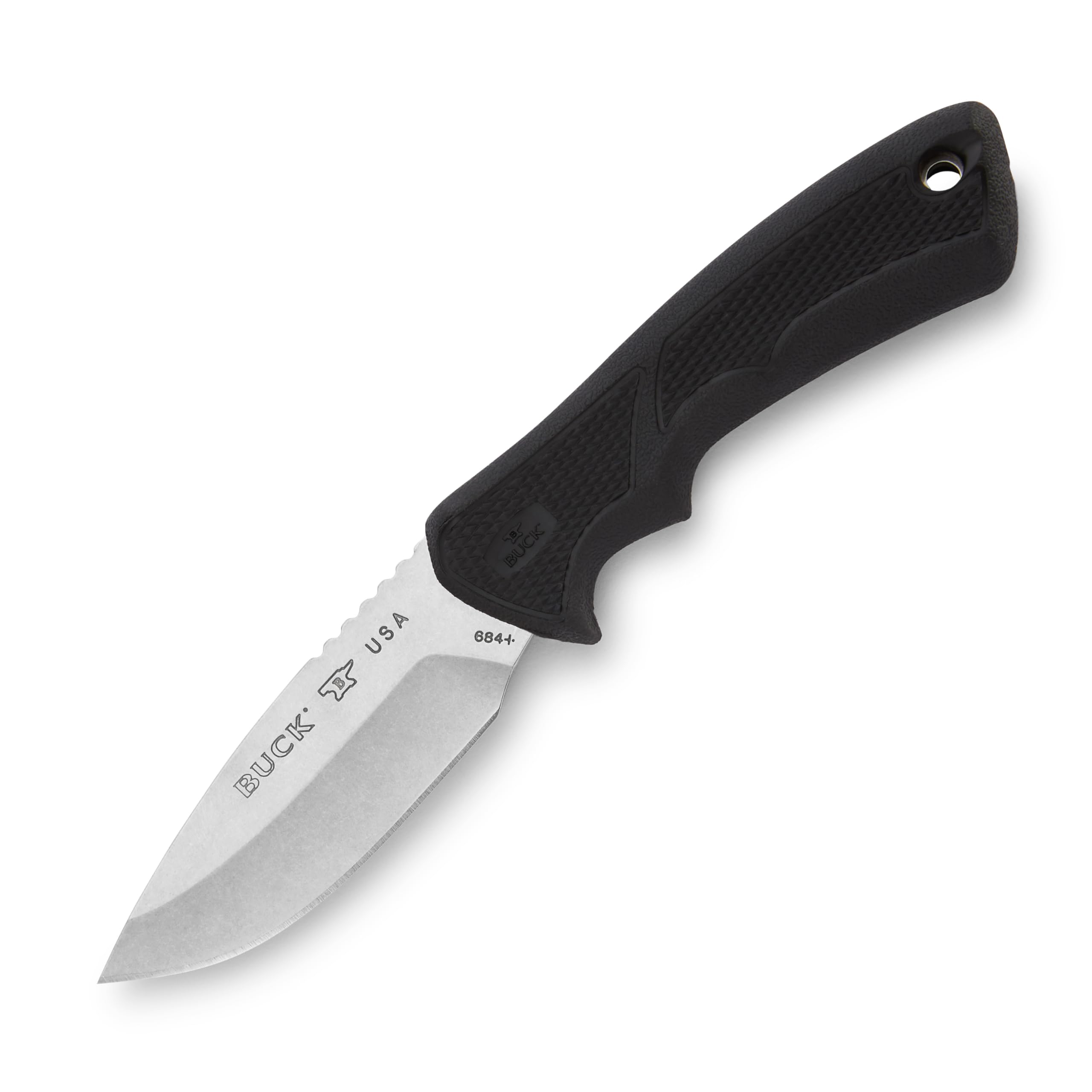
The Buck 684 Small BuckLite Max II proves that a small knife can be a serious tool. The 3.25-inch 420HC stainless steel blade uses a drop point profile that excels at detail work like caping small game trimming sinew and slicing vegetables at camp. Buck’s proprietary heat treat process gives the 420HC steel noticeably better edge retention than generic 420HC found in no-name blades. The full tang construction runs the length of the Dynaflex rubber handle which features integrated finger grooves and top jimping for extra control in wet conditions.
The knife weighs only 2.8 ounces making it practically unnoticeable during everyday carry whether worn on the belt or carried in a pack. The included polyester sheath uses a taco-style design with a belt loop that rides high for discreet carry. Buck’s forever warranty covers this knife for life which significantly reduces the risk of buying on a budget. Users report the blade holds an edge through field dressing multiple small game animals before needing a touch-up on a stone.
The 420HC steel is softer than D2 or 8Cr13MoV which means it dulls faster during heavy use against hard materials like rope or wood. The sheath design uses a foam rubber lining that sheds over time and the retention is loose enough that the blade can fall out if the sheath is inverted. The small blade also limits the knife’s ability to handle larger camp tasks like batoning splitting wood.
Why it’s great
- Lightweight at 2.8 oz perfect for compact everyday carry
- Buck’s forever lifetime warranty reduces purchase risk
- Comfortable ergonomic grip with full tang strength
Good to know
- Sheath retention is loose blade can fall out when inverted
- 420HC steel dulls faster than harder alloys under heavy use
FAQ
Is a fixed blade knife reliable enough for survival tasks?
Should I choose a stainless steel or carbon steel blade at this price?
How do I sharpen a cheap fixed blade knife effectively?
Final Thoughts: The Verdict
For most users, the cheap fixed blade knife winner is the Cold Steel Outdoorsman Lite because it combines a proven heat treat on 4116 steel with a comfortable Kraton grip and versatile 6-inch blade length that handles everything from game processing to camp chores. If you want a compact everyday carry blade, grab the Buck 684 Small BuckLite Max II for its ultra-light weight and lifetime warranty. And for heavy bushcraft tasks that demand D2 steel edge retention, nothing beats the DRGSKL Japanese Tanto Fixed Blade at this price tier.

Mo Maruf
I created WellFizz to bridge the gap between vague wellness advice and actionable solutions. My mission is simple: to decode the research and give you practical tools you can actually use.
Beyond the data, I am a passionate traveler. I believe that stepping away from the screen to explore new environments is essential for mental clarity and physical vitality.