Our readers keep the lights on and my smoothie glass nicely filled. As an Amazon Associate, I earn from qualifying purchases.
Scanning the bottom of an unfamiliar lake without breaking the bank is the actual challenge every budget-minded angler faces. A cheap fish finder that delivers reliable depth readings and fish alerts can transform a blind cast into a confident strike, but the wrong one just adds clutter to your tackle box.
I’m Mohammad Maruf — the founder and writer behind WellFizz. My research into sonar technology, transducer beam angles, and battery efficiency helps me separate the units that actually perform from those that just float.
Whether you are fishing from a kayak, the shore, or through the ice, identifying the right blend of screen clarity, depth range, and portability is critical. This guide cuts through the noise to help you find a cheap fish finder that delivers reliable sonar data without demanding a premium investment.
How To Choose The Best Cheap Fish Finder
Not every affordable fish finder is a good investment. The biggest mistake buyers make is focusing on the number of features instead of the quality of the sonar engine. For a budget device, the transducer’s frequency and beam angle determine whether you see real fish or just clutter. A 90-degree cone at 125 kHz gives wide coverage for shallow water, while a narrower beam is better for deeper structure. Also, consider how you fish: castable sensors are perfect for bank and kayak anglers who need portability, while a fixed-mount transducer with a transom bracket suits a small boat. Screen type matters too — a color LCD with adjustable brightness beats a basic monochrome display when the sun is high. Finally, check the charging method. Units that use USB-C are easier to replace cables for compared to those with proprietary magnetic connectors that are easy to lose.
Depth Range and Sonar Beam Angle
The depth rating is often a marketing number. A budget unit rated for 147 feet will struggle to mark a fish at the bottom of a 40-foot quarry if the transducer’s beam angle is too narrow or the frequency is mismatched. Look for a 125 kHz to 200 kHz frequency range. A wider cone (around 90 degrees) covers more water but loses detail at depth. For lake and river fishing under 50 feet, a 90-degree cone is ideal. For deeper reservoirs, a narrower 45-degree or dual-beam option gives better target separation.
Portability and Power Options
If you fish from a kayak, paddleboard, or the shore, a handheld or castable unit is far more practical than a fixed-mount model. Internal rechargeable batteries are convenient, but pay attention to real-world runtime. Many budget units claim 8-10 hours but deliver 4-5 hours under continuous use. A unit that runs on standard AA batteries gives you the flexibility to swap in fresh cells if you forget to charge. For kayak anglers, a transducer that can be hung over the side or attached to a trolling motor with a simple bracket is a must.
Quick Comparison
On smaller screens, swipe sideways to see the full table.
| Model | Category | Best For | Key Spec | Amazon |
|---|---|---|---|---|
| Garmin Striker 4 | Premium | Boat & Ice Fishing | 1600 ft depth, CHIRP sonar | Amazon |
| HawkEye Fishtrax 1C | Mid-Range | Kayak & Backpacking | 240 ft depth, Color Virtuview | Amazon |
| LUCKY Wireless FF-1108 | Mid-Range | Shore & Kayak Fishing | 492 ft range, TFT color screen | Amazon |
| LUCKY Y2020-CWLA | Mid-Range | Ice & Bank Fishing | 147 ft, waterproof, floating sensor | Amazon |
| Yoocylii XF-08 | Mid-Range | Kayak & Shore Fishing | 164 ft, IP67 waterproof sensor | Amazon |
| DANOPLUS DP-104 | Budget | Canoe & Pond Fishing | 147 ft, attractive lamp sensor | Amazon |
| Hawkeye FishPod 5X | Budget | Portable & Ice Fishing | 199 ft, Bluetooth + AI modes | Amazon |
In‑Depth Reviews
1. Garmin Striker 4

The Garmin Striker 4 is the benchmark in the budget segment because it brings genuine CHIRP sonar technology — a continuous sweep of frequencies that creates crisp fish arches and better target separation than any fixed-frequency unit in this price tier. The 3.5-inch color LCD screen is complemented by a dedicated keyed interface that makes navigation feel intuitive, and the built-in GPS with waypoint mapping lets you mark brush piles, stumps, and docks for return trips. The depth rating of 1,600 feet in freshwater is overkill for most anglers, but it guarantees that even deep reservoir fishing is within reach.
Installation is straightforward with the included tilt/swivel mount, transom mount, and trolling motor mount, so you can swap it between a kayak and a jon boat without buying extra hardware. The IPX7 water rating means it can survive a rain shower or a splash without issue. Users consistently report that the device marks fish and jigs accurately in both open water and ice fishing scenarios, and the DIY-friendly design allows creative mounting solutions like an ammo-can battery box for total portability.
The main trade-off is that the Striker 4 requires an external 12V power source, so it is not a grab-and-go handheld like castable units. The supplied transducer is adequate for most situations, but serious ice anglers may want to upgrade to an ice-specific transducer for better performance in cold water. Still, for this price, you are getting a professional-grade sonar engine that outperforms units costing significantly more.
Why it’s great
- CHIRP sonar provides industry-leading target separation for a budget unit.
- Built-in GPS with waypoint mapping for marking productive spots.
- Incredible depth range of 1600 ft covers all freshwater environments.
- IPX7 water resistance handles rain and splashes.
Good to know
- Requires an external 12V battery — not self-contained for handheld use.
- The included transducer can be tricky to mount on some kayaks without a scupper hole.
2. HawkEye Fishtrax 1C

The HawkEye Fishtrax 1C is the go-to choice for anglers who need a true portable unit that runs on standard AA batteries. The 2.75-inch HD color Virtuview display is surprisingly bright and readable even in direct sunlight, and the interface is menu-driven but simple enough to navigate without a manual. The transducer works well when hung over the side of a kayak or mounted on a hull, and the maximum depth rating of 240 feet is realistic for most inland lakes and rivers. Users have reported accurate depth and temperature readings straight out of the box with minimal setup.
What sets this unit apart is its versatility. It includes a flasher mode that works passably for ice fishing, and the ability to use standard lithium AA batteries means you can carry spares for multi-day backcountry trips. The metal threaded mount and captured battery screws speak to a build quality that feels more durable than many units in its price range. The customer service experience is also a standout — HawkEye has a reputation for responsive support and will replace defective units promptly.
The downsides are that the flasher mode is not as responsive as a dedicated ice flasher, and the transducer struggles to perform well in water shallower than 3 feet. A few users also noted that the battery life in cold conditions with standard alkalines is closer to 4-5 hours rather than the advertised 10-12. Despite these quirks, for kayak and backpacking anglers who prioritize portability and ruggedness, this is a top contender.
Why it’s great
- Runs on standard AA batteries, offering easy field replacement.
- Rugged build with metal mount and captured screws.
- Accurate depth and temperature readings out of the box.
- Versatile flasher mode for basic ice fishing.
Good to know
- Flasher mode less responsive than dedicated ice flashers.
- Poor performance in water under 3 feet deep.
- Battery life can drop significantly in cold weather with standard cells.
3. LUCKY Wireless FF-1108
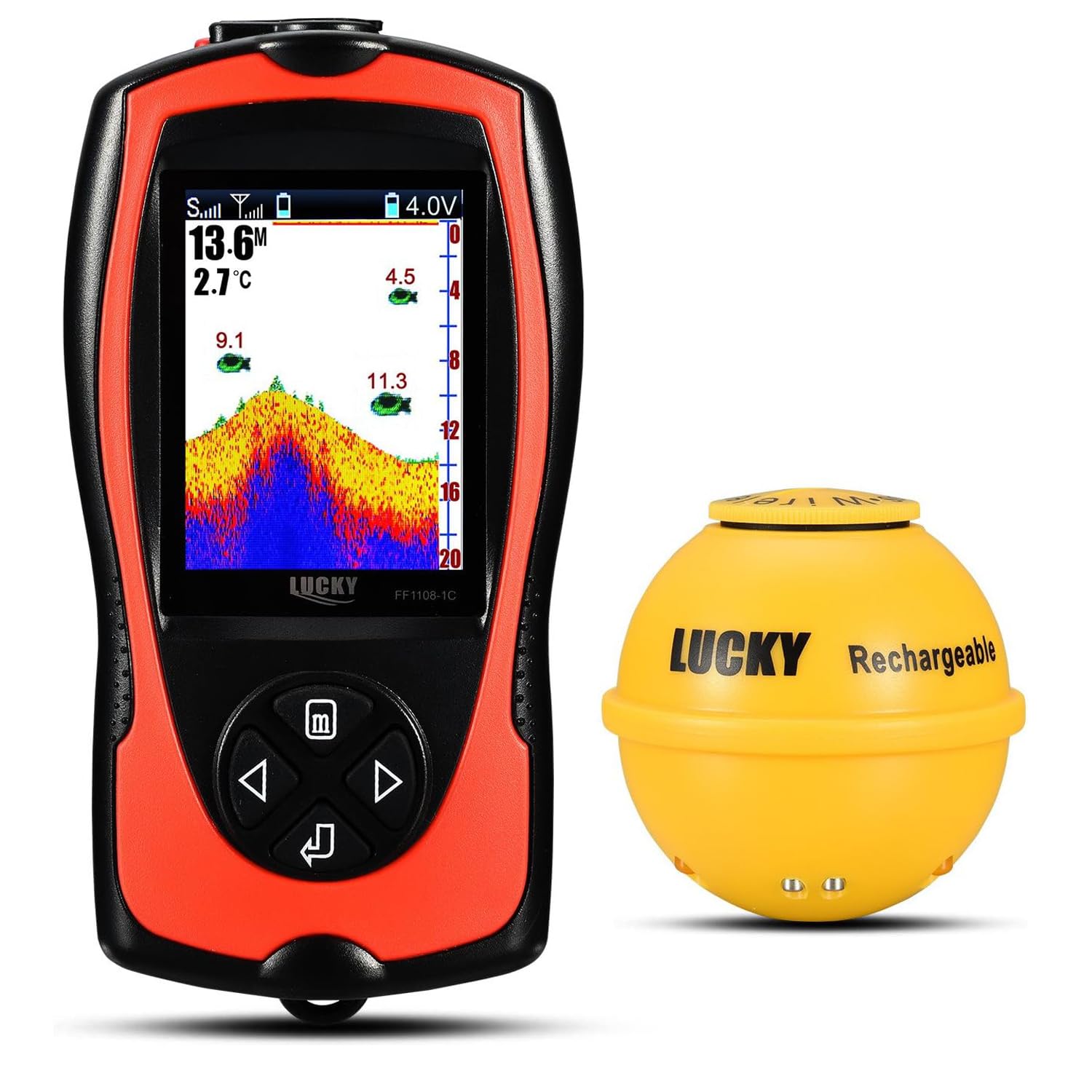
The LUCKY FF-1108 delivers one of the longest wireless operating ranges in the budget segment, with a stated 492 feet between the handheld display and the sonar transducer. The 2.4-inch TFT color LCD screen is clear and offers 21 operating languages, adjustable sensitivity, brightness, and depth range settings. The transducer uses a fish-attracting lamp that glows in the dark, which is a nice bonus for night fishing sessions. The depth detection is rated at 147 feet, and user tests confirm it provides accurate readings in calm, shallow water environments.
Portability is a strong suit here. Both the handheld unit and the sonar sensor are rechargeable via USB cable, and the handheld lasts about 4 hours while the sensor can go up to 10 hours on a single charge. The device includes a simulation mode that lets you practice settings on land, which is helpful for beginners. The antenna on the handheld must be pulled out to achieve the full wireless range, which is a minor but important setup detail.
The biggest concern is that the sonar struggles to distinguish fish from debris or vegetation, leading to false alarms in weedy environments. A few users also reported that the proprietary magnetic charger is easy to lose, and the unit uses a non-standard charging connection. The battery life of 4 hours for the handheld can feel limiting on a full day trip, especially if you forget to charge overnight. For bank anglers who value long wireless range and don’t mind occasional false positives, this is a solid option.
Why it’s great
- Industry-leading 492 ft wireless range for castable convenience.
- Rechargeable sensor with 10-hour runtime for extended sessions.
- Simulation mode helps beginners learn settings without being on the water.
- Fish-attracting lamp on sensor aids night fishing.
Good to know
- Sonar often fails to distinguish fish from weeds and debris.
- Proprietary magnetic charger is easy to misplace.
- Handheld battery life is only 4 hours under moderate use.
4. LUCKY Y2020-CWLA

The LUCKY Y2020-CWLA focuses on endurance and resilience. The transducer floats and is waterproof, so even if you drop it into the river, you can retrieve it from the surface. The wireless operating range is listed at 656 feet, and the depth detection is 147 feet, which matches the other LUCKY unit but with a more robust power management system. In battery save mode, users report runtimes exceeding 10 hours, which is exceptional for a castable fish finder. The display shows fish size in three categories (small, medium, big) along with water temperature and bottom contour.
Setup is straightforward. The transducer has a small hole for tethering with fishing line, allowing you to cast it out from the shore or dock. The display unit is splash-proof (not submersible) but can handle rain without issues. Users who fish from the bank or dock appreciate that the device works reliably up to about 35 feet away in real-world conditions, which is sufficient for most shore-based fishing scenarios. Depth readings are accurate to within 1 foot, and the big fish alert is genuinely useful for identifying active areas.
The main drawbacks are that a few units have developed charging issues after a couple of months — the battery stops holding a charge or the sonar sensor stops transmitting. Quality control seems inconsistent. The price is also on the higher side of the budget spectrum, and for that cost, some users expect better reliability. If you get a good unit, the battery life is best-in-class, but there is a risk of getting a lemon.
Why it’s great
- Exceptional battery life over 10 hours in power-saving mode.
- Floating, waterproof transducer is easy to retrieve if dropped.
- Accurate depth readings within 1 foot of true depth.
- Big fish alert helps identify active feeding areas.
Good to know
- Some units develop charging or transmission failures after a few months.
- Price point is high for the budget category.
- Floating sensor can drift away if not tethered properly in windy conditions.
5. Yoocylii XF-08
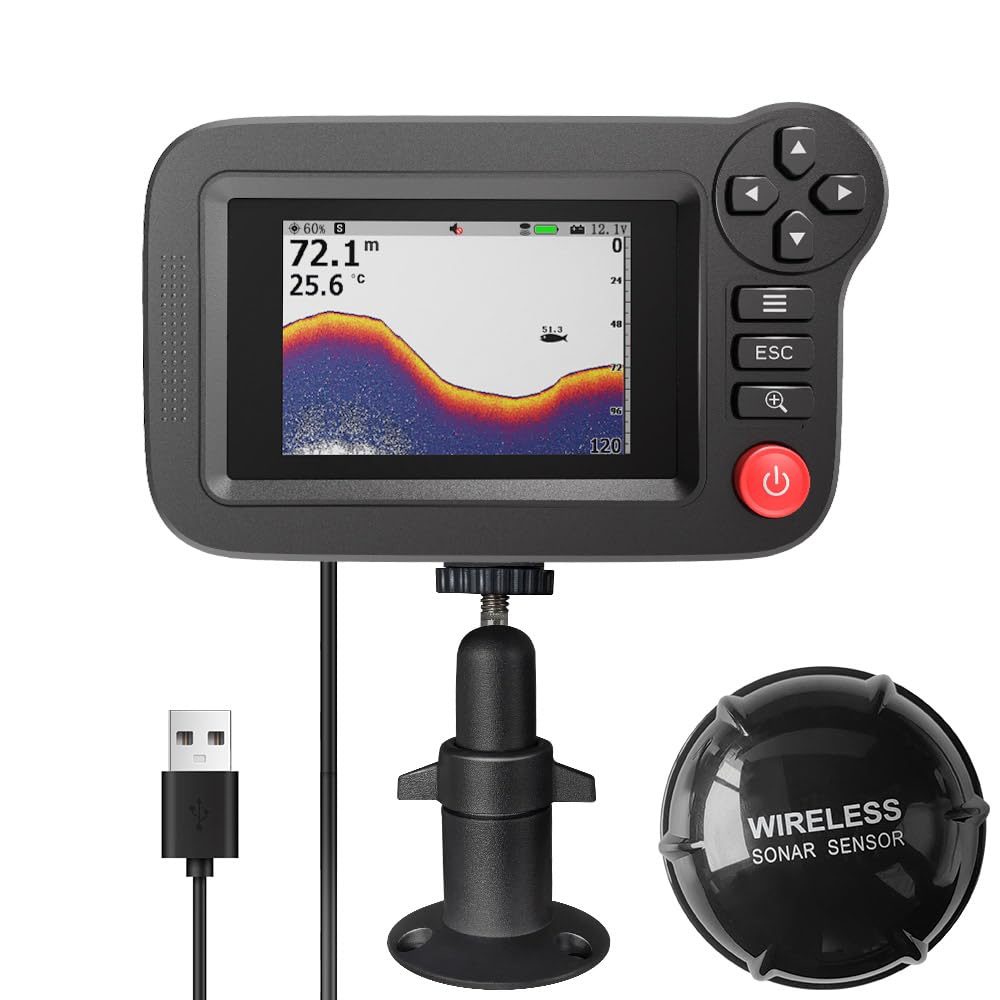
The Yoocylii XF-08 distinguishes itself with a 3.5-inch color LCD screen that offers 480×320 resolution, making it one of the largest displays in the cheap fish finder category. The screen is sunlight-readable, which is a real advantage when you are squinting at a tiny display under the midday sun. The 125 kHz sonar sensor is rated for 164 feet of depth and covers a 90-degree beam angle, which is ideal for scanning wide areas in shallow to moderate-depth lakes. The wireless range of 328-656 feet gives you flexibility whether you are on a kayak or fishing from the shore.
The IP67 waterproof rating on the probe means it can survive submersion, and the water-activated auto-power feature turns the sensor on when it hits water and off when it is removed, saving battery life. The included mounting bracket and lanyard make it easy to attach to a kayak or keep tethered to your wrist. Users have reported that the device is easy to operate, with a fish alert that works reliably in practice. The depth reading is consistent, and the screen remains clear even when the transducer is floating a good distance away.
The key issues are build quality concerns — a few users experienced the locking nut stripping out quickly and the antenna joint breaking under normal folding. The unit also runs through batteries relatively fast if you don’t use the auto-off feature consistently. The lack of bottom contour detail compared to more expensive models means you won’t get a highly detailed map of the lakebed, but for basic fish finding, it performs well.
Why it’s great
- Large 3.5-inch color LCD with 480×320 resolution for clear viewing.
- IP67 waterproof probe is submersible and rugged.
- Water-activated auto-power feature preserves battery life.
- Good 90-degree beam angle for wide coverage in shallow water.
Good to know
- Build quality issues with locking nut and antenna hinge reported.
- Battery drain is noticeable without the auto-off feature.
- Lacks detailed bottom contour graphics seen in premium units.
6. DANOPLUS DP-104

The DANOPLUS DP-104 is an entry-level castable fish finder that punches above its weight in terms of ease of use and value. The 2.4-inch color LCD screen supports 21 languages and displays fish size icons, depth, water temperature, and bottom contour. The attractive lamp on the sonar sensor automatically turns on when it touches water, which helps lure fish and also makes the sensor visible in low light. The depth detection of 147 feet is adequate for most ponds, lakes, and inshore saltwater environments, and the 90-degree sonar beam covers a wide area for scanning.
Setup is remarkably simple — both the handheld and the sensor come pre-charged out of the box, so you can start fishing immediately. The sensor connects wirelessly, and users report that it maintains a stable connection at distances up to 50 feet. The device includes a fish alarm that alerts you when fish pass through the transducer’s coverage area, along with the depth and approximate size of the fish. For canoe, kayak, and shore fishing, the portability is excellent, and the unit weighs only 5.28 ounces.
The biggest frustration is the proprietary magnetic charger. Users who lose the charger cannot replace it with a standard USB-C cable, which is a major inconvenience. Some users also noted that the unit occasionally confuses underwater vegetation with fish, leading to false alarms. The charging port cover on the sensor can also fail, potentially leading to water damage over time. Despite these issues, for the price, it delivers reliable basic functionality.
Why it’s great
- Easy setup with pre-charged batteries out of the box.
- Attractive lamp on sensor helps lure fish in low light.
- Lightweight design (5.28 oz) ideal for backpack and canoe trips.
- Fish alarm with size and depth alerts for hands-free monitoring.
Good to know
- Proprietary magnetic charger is easy to lose and not replaceable with USB-C.
- False alarms from weeds and debris are common in vegetated waters.
- Charging port cover on sensor can fail, risking water ingress.
7. Hawkeye FishPod 5X

The Hawkeye FishPod 5X is a unique entry in the budget category because it uses a Bluetooth connection to pair with your smartphone rather than a dedicated display. The sonar pod itself is compact and castable, using AI-powered algorithms to filter out clutter and false echoes with its FishEcho mode. The 4-preset operating modes (BottomScan, Vertical Flasher, FishEcho, Standard) allow you to tailor the sonar view to your specific fishing technique, whether that is trolling, ice fishing, or bottom bouncing. The maximum depth range is 199 feet, which is generous for a castable unit.
The real advantage here is that you get a full-color, high-resolution view on your phone screen, which is much larger than any budget fish finder’s built-in display. The app is well-designed and includes multiple viewing modes that are genuinely useful for serious anglers. The TraxNut mounting system lets you attach the pod to a standard 1/4 x 20 bracket, so you can use it with a kayak mount or a float tube arm. Users report accurate readings for depth, temperature, and current speed, and the battery life is respectable for a Bluetooth device.
The downsides are that you are dependent on your phone’s battery life, and the Bluetooth connection can drop out occasionally if the pod drifts too far away or if there is interference. The sonar pod itself has a limited standalone battery life of about 2 hours when trolling, which is significantly less than some competitors. The lack of a built-in display also means you cannot use it as a standalone device if you forget your phone or if the phone gets wet. It is a great tool for tech-savvy anglers but less ideal for those who want a dedicated, all-in-one device.
Why it’s great
- Smartphone app provides a large, full-color display with multiple modes.
- AI-powered FishEcho reduces false readings from debris.
- TraxNut system allows mounting on a wide variety of platforms.
- Accurate depth, temperature, and current speed data.
Good to know
- Bluetooth connection can drop at longer ranges or with interference.
- Pod battery life is only about 2 hours while trolling behind a kayak.
- No built-in display — completely dependent on a smartphone.
FAQ
Can I use a cheap fish finder in saltwater?
How does the attractive lamp on a sonar sensor actually work?
Why does my budget fish finder show false fish alerts?
Final Thoughts: The Verdict
For most users, the cheap fish finder winner is the Garmin Striker 4 because it packs genuine CHIRP sonar and GPS waypoint mapping into a rugged, install-friendly package that outperforms everything else in this price tier. If you want a truly portable unit that runs on AA batteries for kayak or backpacking trips, grab the HawkEye Fishtrax 1C. And for bank and dock anglers who need a long wireless range with excellent battery endurance, nothing beats the LUCKY Y2020-CWLA.

Mo Maruf
I created WellFizz to bridge the gap between vague wellness advice and actionable solutions. My mission is simple: to decode the research and give you practical tools you can actually use.
Beyond the data, I am a passionate traveler. I believe that stepping away from the screen to explore new environments is essential for mental clarity and physical vitality.