Our readers keep the lights on and my smoothie glass nicely filled. As an Amazon Associate, I earn from qualifying purchases.
Specs are compiled from manufacturer listings and verified buyer reviews and can change over time — please confirm the key details on the product page before buying.
Getting into film photography on a budget means finding a camera that actually works without costing a month’s rent. The real trick is a reusable point-and-shoot that can give you 72 photos from a 36-exposure roll, so you learn and experiment without burning cash on film and development. This guide walks you through the best affordable options that balance price, usability, and image quality.
I’m Mohammad Maruf — the founder and writer behind WellFizz. This guide is built by comparing the manufacturers’ published specifications and the patterns across verified customer reviews, so you get each pick’s real strengths and trade-offs instead of marketing spin.
You want a cheap film point-and-shoot that actually takes good photos while staying affordable. The Kodak EKTAR H35N is the best value because its half-frame format gives you 72 shots from a 36-exposure roll, and its coated glass lens is sharper than the plastic lenses on other budget cameras.
Quick Picks
- Kodak EKTAR H35N Half Frame Film Camera — Best Overall
- Kodak EKTAR H35 Half Frame Film Camera (Bundle with 24exp Film) — Best Value
- to Be Continued (TBC) Reusable 35mm Film Camera – Transparent Design — Style Pick
- 1 Shot Point and Shoot 35mm Film Camera, Reusable Retro Half Frame — Indoor Specialist
- RETO Ultra Wide and Slim 35mm Reusable Daylight Film Camera — Ultra-Wide Budget
How To Choose The Best Cheap Film Point-And-Shoot
A cheap film point-and-shoot should be simple, reliable, and affordable to feed with film. Since these cameras are often plastic and basic, the real choices come down to format, lens, and flash capability.
Half-Frame vs Full Frame 35mm
A half-frame camera (like the Kodak EKTAR H35) exposes only half the standard 35mm frame per shot, which means a 36-exposure roll gives you 72 photos. That gives you 72 photos instead of 36 from the same roll. Full-frame cameras use the whole negative, giving sharper individual images but fewer shots per roll. If you are just starting out or want to shoot freely without worrying about cost, half-frame is a smart move.
Lens Focal Length and Aperture
Most cheap film point-and-shoots have a fixed focus lens. A 22mm ultra-wide lens (such as on the RETO) puts more into the frame, good for landscapes and groups. A 50mm lens (like on the 1 Shot) is tighter, closer to what your eye sees, and works well for portraits and details. Aperture matters too: an F5.6 aperture lets in more light than an F8, making it easier to shoot indoors without a flash.
Built-in Flash Matters More Than You Think
Many budget film cameras perform poorly in low light. A built-in flash with a reasonable recycle time (10-15 seconds) makes the camera usable at night, indoors, and in dim conditions. If you plan to shoot parties, evening street scenes, or indoor gatherings, skip any camera without a flash.
Build Quality and Real-World Durability
At this price point, you are getting a plastic body. The main failure point buyers report is the film winding mechanism. Look for cameras with solid-feeling advance wheels and rewind cranks. Avoid designs where the rewind release button feels fragile — a broken winder ruins the whole roll.
Quick Comparison
| Model | Best For | Format | Lens (Focal Length) | Aperture | Amazon |
|---|---|---|---|---|---|
| Kodak EKTAR H35N | Best Overall | Half-frame | Coated Glass (approx. 28mm) | — | Amazon |
| Kodak EKTAR H35 Bundle | Best Value | Half-frame | Plastic (approx. 28mm) | — | Amazon |
| to Be Continued (TBC) | Style & Portability | Full frame 35mm | 28mm | F8 | Amazon |
| 1 Shot Point and Shoot | Portrait & Indoors | Half-frame | 50mm | F5.6 | Amazon |
| RETO Ultra Wide and Slim | Ultra-Wide Shots | Full frame 35mm | 22mm | — | Amazon |
In‑Depth Reviews
1. Kodak EKTAR H35N Half Frame Film Camera

The half-frame that doubles your film roll and adds creative tricks.
You get 72 shots on a standard 36-exposure roll with this half-frame — that is 72 photos for the price of one roll, making learning film photography genuinely cheaper. The coated glass lens (one element) keeps images noticeably sharper across the frame than the plastic lenses on competitors like the RETO, which have softer focus away from center.
A built-in star filter creates a four-beam flare on tiny light sources, which is a creative touch you do not see at this level. The bulb function lets you do long exposures to capture light trails at night, and a tripod hole (1/4-inch standard thread) keeps the camera steady for those slow shots. Owners mention the camera feels solid despite lightweight plastic, though one noted the film advance wheel is stiff at first and the battery door could be more sturdy.
Unlike the Kodak EKTAR H35 bundle, this N version adds the star filter, bulb mode, and a coated lens — improvements that justify the small premium if you want more creative control. The camera must be held vertically for a horizontal photo (since each exposure is a half-frame vertical slice), so pay attention to orientation.
What Stands Out
- Coated glass lens element for sharper-than-plastic images
- 72 shots per 36-exposure roll saves real money on film
- Built-in star filter and bulb mode for creative effects
- Accepts 30.5mm filters (ND, yellow for B&W)
Trade-offs
- Shutter is slow — needs a steady hand or surface
- Film advance wheel reported as stiff initially
- Plastic build — not rugged for heavy abuse
Who it fits: Beginners who want 72 shots per roll and a camera that can do more than snap — the star filter, bulb mode, and tripod mount make it a creative tool, not just a toy.
Who might skip it: If you only need a basic point-and-shoot and never use extra features, the standard EKTAR H35 is cheaper and does the same half-frame job without the extras.
2. Kodak EKTAR H35 Half Frame Film Camera (Bundle with 24exp Film)

The half-frame workhorse that cuts film cost in half and keeps it simple.
This bundle comes with one roll of Kodak Ultramax 400 24exp film so you can start shooting immediately. The half-frame design means that 24-exposure roll will yield around 48 photos — double the shots. Unlike the 1 Shot camera which needs a battery and has a 50mm tighter lens, the EKTAR H35 is ready to go with just film and a AAA battery (not included).
Buyers consistently praise it as perfect for beginners. One owner reported that the half-frame format “gives 72 photos per 36-exposure roll,” making it incredibly economical for learning. The built-in flash is activated by turning a silver ring around the lens, and it works both indoors and outdoors. Several customers note the camera is lightweight and easy to carry everywhere, with one saying it makes photography “more intentional than a phone.” The cheap plastic build means it is not built like a tank, but for the price, it is considered an excellent entry point.
Compared to the pricier H35N, this model lacks the star filter, bulb mode, and coated glass lens — it uses a standard plastic lens. If you just want a simple half-frame camera to learn on and save film, this is the better value. The catch is that the plastic lens does not produce as sharp images as the H35N’s glass element, and the camera struggles in bright indoor light without flash.
What You Get
- 48 photos per 24-exposure roll (72 per 36-exp roll) — saves film cost
- Includes one roll of Kodak Ultramax 400 film — start right away
- Built-in flash with simple ring activation
- Lightweight and pocket-sized for daily carry
Trade-offs
- Plastic lens — not as sharp as the H35N’s glass element
- Struggles in bright indoor light without flash
- Plastic build feels cheap, not for rough handling
Perfect for: A first-timer who wants to try film without spending much — the included film and half-frame economy make it the cheapest way to start.
Not for: Anyone wanting sharper images or creative features; you would be better off with the H35N or a vintage SLR.
3. to Be Continued (TBC) Reusable 35mm Film Camera – Transparent Design
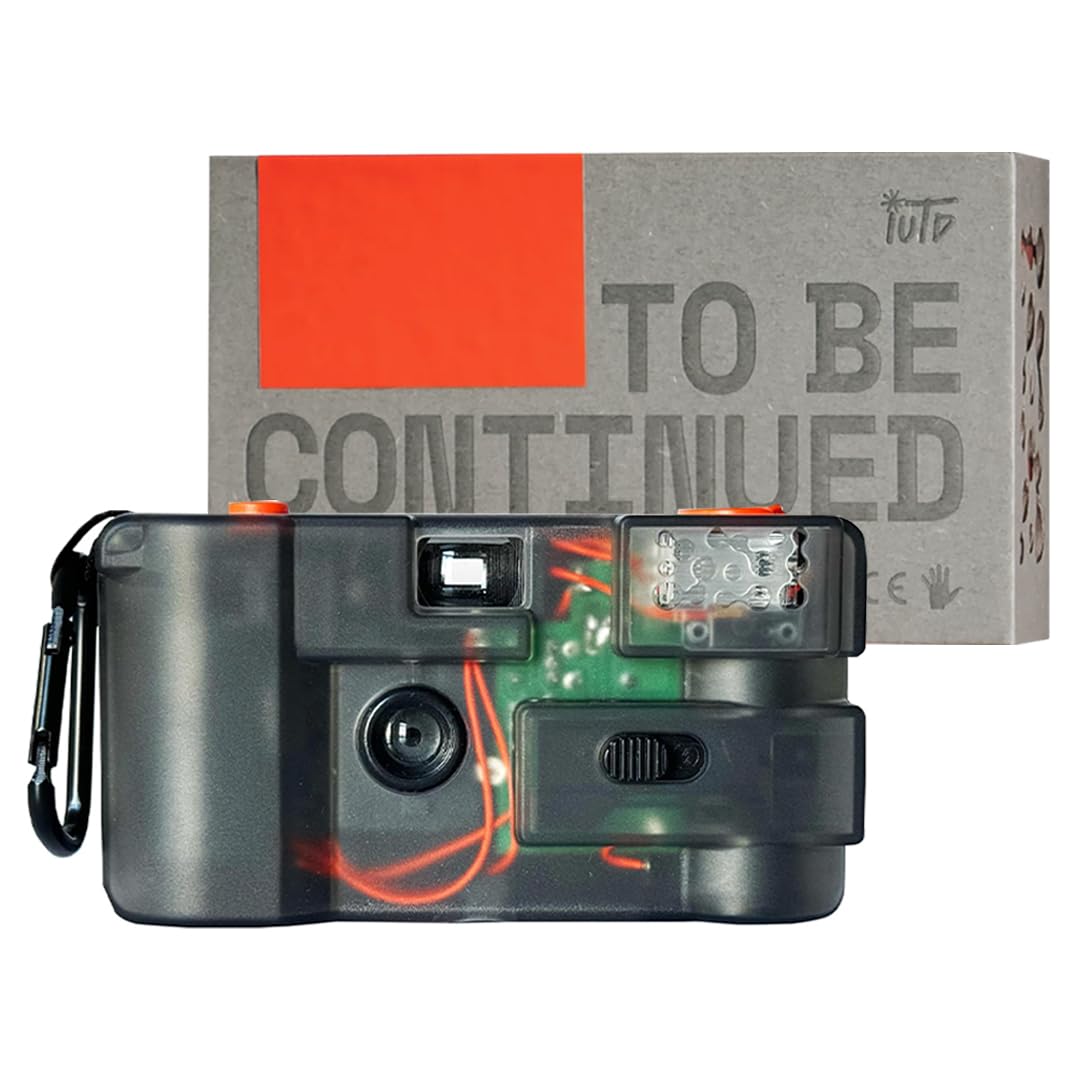
The fully transparent camera that doubles as a style accessory.
A 28mm wide lens at F8 aperture gives you bright, vintage-style results for landscapes and street scenes. The camera is fully transparent, showing all inner mechanics, which reviewers point out gets lots of compliments. It includes a carabiner so you can clip it to your belt, bag, or keychain — making it wearable, not just carryable.
The 1/120s shutter speed keeps most daytime shots sharp for beginners. However, the F8 aperture is tighter than the 1 Shot’s F5.6, meaning the TBC needs more light to get a good exposure. Shoppers say the rewind release button is very sensitive and feels like it could break. One reviewer who loved the results warned: “WATCH OUT FOR THE FILM REQIND BUTTON!!! ITS VERY SENSITIVE.” Another noted it did not survive a kid’s backpacking trip, calling it a “reusable camera that feels disposable.”
Unlike the RETO’s 22mm ultra-wide lens, the TBC’s 28mm is slightly less wide but still captures generous frames. The transparent design is the main reason to pick this one — it looks unique and draws attention. One reviewer who took it to Japan said, “I recommend this over a disposable for sure.”
Why You Might Want It
- Fully transparent design shows inner mechanics — a conversation starter
- 28mm wide lens for landscape and street photography
- Carabiner makes it wearable and always accessible
- Beginner-friendly — load any 35mm film and shoot
Where It Falls Short
- F8 aperture needs lots of light — indoor shots without flash will be dark
- Rewind release button is fragile, buyers report it is easy to break
- Plastic build feels disposable, not built for abuse
Best for: Someone who values style and portability — the transparent look and carabiner clip make it a fun accessory that also takes photos.
Skip if: You need a durable camera that can take knocks; the fragile build and sensitive rewind button mean it is better treated gently.
4. 1 Shot Point and Shoot 35mm Film Camera, Reusable Retro Half Frame

The 50mm lens and F5.6 aperture make it the indoor king among budget picks.
This half-frame camera has a 50mm lens and an F5.6 aperture. Compared with the TBC’s F8, that wider aperture means it can work better indoors with less reliance on flash. That wider aperture means you can shoot indoors with less reliance on flash, and the 50mm focal length is closer to a natural human perspective, making it better for portraits and detailed shots. The 1/120s shutter speed keeps motion blur low in good light.
It comes with one roll of ASA/ISO 400 black and white film with 18 exposures, and because it is half-frame, you get 36 shots from that roll. A built-in flash with 10-15 seconds recycle time (using one AAA alkaline battery, not included) makes night and party shooting possible. One reviewer noted the flash is needed even indoors during the day: “the aperture does mean it needs a lot of light so I’d recommend keeping the flash on if you’re indoors at all.”
The catch, as owners mention: “because of the price, it’s cheap, and I did unfortunately have some trouble rolling up one of my rolls of film, and it got stuck and so I had to open the camera up to get it out, which ruined some of the pictures.” The plastic winding mechanism is the weak point. Another buyer reported all photos came out “super dark, even with flash,” suggesting occasional shutter issues. If you get a good unit, the 50mm F5.6 combo beats other budget options for indoor and portrait work.
Strengths
- 50mm lens and F5.6 aperture — more light and natural perspective
- Half-frame gives 36 shots from an 18exp roll
- Includes black and white film to start immediately
- Built-in flash with 10-15 second recycle time
Weaknesses
- Film winding mechanism can jam and ruin the roll (buyer reports)
- Aperture still needs flash indoors even during daytime
- Quality control issues — some units have shutter problems
Reach for this if: You shoot mostly indoors or want a portrait-friendly lens at a very low price — the 50mm F5.6 is a rare combo in this budget range.
Look elsewhere if: You need reliability; the winding jams and occasional dark exposures make it a gamble. For guaranteed performance, the Kodak H35 or H35N is safer.
5. RETO Ultra Wide and Slim 35mm Reusable Daylight Film Camera

The 22mm ultra-wide lens fits more in every frame than any other camera here.
At only 68.8 grams (about 2.4 ounces), this is the lightest camera in the roundup — truly pocketable and easy to forget you are carrying it. The 22mm ultra-wide lens captures wide views, putting more into every picture than the TBC’s 28mm or the 1 Shot’s 50mm. This makes it perfect for landscapes, architecture, and group shots where you want everything in the frame.
The camera is focus-free and automatic — you just point and shoot. It is designed for daylight use, best for street snapshots in bright conditions. Customers note it is a clone of the original Vivitar Ultra Wide and Slim, with good colors and decent durability if not abused. However, the cheap build is a real issue: one reviewer wrote, “Cheaply made; winding part broke easily,” while another warned, “Film winding mechanism fails, ruining entire roll. Not recommended if photos matter.” A back film door that can come loose is fixable with a tape tab, per one buyer.
Unlike the half-frame Kodaks, the RETO uses full-frame 35mm, so you get standard-sized negatives but only the standard number of shots per roll. There is no flash, no exposure control, no hotshoe — it is as bare-bones as it gets. The image brightness depends heavily on what film you load, as one buyer mentioned.
Why It Is Worth It
- 22mm ultra-wide lens — much wider than any other pick here
- Weighs 68.8g — barely noticeable in a pocket
- Focus-free and fully automatic — true point-and-shoot simplicity
- Daylight street snapshots produce good colors with right film
Why You Might Regret It
- Winding mechanism breaks easily — multiple buyer reports of ruined rolls
- No flash, works only in good daylight
- Back film door can come loose; some units need a tape fix
- No exposure control or advanced features
Grab it for: An ultra-light, ultra-wide travel companion for daytime street photography when you do not care about losing a roll — the lens is unique at this price.
Skip it for: Any situation where the photos matter to you; the winding failures and lack of flash make it unreliable for important memories.
Understanding the Specs
Half-Frame vs Full Frame 35mm
A half-frame camera takes photos at half the standard 35mm negative size (18x24mm instead of 24x36mm). That means a 36-exposure roll becomes 72 photos. The trade-off is smaller negatives, which means slightly less detail when zooming in or making large prints, but for social media sharing and 4×6 prints, the quality is still great.
Aperture (F-stop)
The aperture is the hole that lets light into the camera. A lower number, like F5.6, means a wider opening and more light reaching the film — better for indoor or low-light shooting. A higher number, like F8, means a smaller opening and less light, requiring brighter conditions. A camera with F5.6 is noticeably more versatile in dim indoor settings than one with F8.
Focal Length (mm)
Measured in millimeters, focal length tells you how wide or narrow the view is. A 22mm lens is ultra-wide — it captures a large scene, good for landscapes and groups. A 50mm lens is a “normal” perspective, similar to what your eye sees, making it natural for portraits and everyday shots. The shorter the number, the wider the view.
Built-in Flash and Recycle Time
A built-in flash lets you shoot in low light. Recycle time is how long the flash takes to be ready for the next shot — 10-15 seconds is average for cheap cameras. A slower recycle time means you might miss spontaneous moments. Without a flash, a cheap film camera is effectively a daylight-only tool.
FAQ
What film does a cheap film point-and-shoot use?
Is half-frame better for saving money on film?
Do I need a battery for these cameras?
How long does a cheap film point-and-shoot last?
Can I use these cameras indoors?
What is the difference between the Kodak EKTAR H35 and H35N?
Will 200 ISO or 400 ISO film work better in a cheap point-and-shoot?
How do I avoid film winding problems?
Can I use a cheap film point-and-shoot for professional work?
Is it worth buying a cheap film camera or should I buy a disposable?
Final Thoughts: The Verdict
For most people, the best cheap film point-and-shoot is the Kodak EKTAR H35N because its half-frame format gives you 72 shots from a 36-exposure roll, the coated glass lens is sharper than plastic alternatives, and the star filter and bulb mode give you creative options beyond just pointing and shooting. If you want the absolute best value and are happy with a simple plastic lens, the standard Kodak EKTAR H35 bundle is a smart choice. And for those who prioritize a unique look and ultra-portability over reliability, the transparent to Be Continued (TBC) camera with its carabiner clip is the most wearable option in the lineup.
How We Picked
We do not accept paid placement. Every pick is matched to a real buyer and a real use-case; we do not hands-on test units.
Sources & Methodology
Specifications: manufacturer listings and product documentation. Review insights: verified customer reviews, as of July 2026. Pricing: not shown on this page (it changes often); check the current price via the retailer link.
As an Amazon Associate, WellFizz earns from qualifying purchases. This does not affect which products we feature.

Mo Maruf
I created WellFizz to bridge the gap between vague wellness advice and actionable solutions. My mission is simple: to decode the research and give you practical tools you can actually use.
Beyond the data, I am a passionate traveler. I believe that stepping away from the screen to explore new environments is essential for mental clarity and physical vitality.