Our readers keep the lights on and my smoothie glass nicely filled. As an Amazon Associate, I earn from qualifying purchases.
Specs are compiled from manufacturer listings and verified buyer reviews and can change over time — please confirm the key details on the product page before buying.
You do not need a premium driver to hit the fairway. A budget-friendly driver can fix a slice, add yards, and lower your score when matched to your swing. This guide looks at six of the best cheap driver options and explains who each one fits and where the real trade-offs are.
I’m Mohammad Maruf — the founder and writer behind WellFizz. This guide is built by comparing the manufacturers’ published specifications and the patterns across verified customer reviews, so you get each pick’s real strengths and trade-offs instead of marketing spin.
The goal here is simple: help you find the best cheap driver that delivers real distance and forgiveness without the price tag attached to the big-brand models you see on tour.
Our Picks at a Glance


How To Choose The Best Cheap Driver
Choosing a budget-friendly driver differs from shopping for a premium model. You trade material quality and adjustability for solid on-course performance. Focus on key specs to avoid wasting money.
Loft angle matches your swing speed
The loft of the clubhead determines how high and how far the ball travels. A 10.5-degree driver is the most common for beginners and mid-handicappers, especially if your swing speed sits between 80 and 90 miles per hour. A 12-degree loft gives you extra lift, which helps slower swings and senior players carry the ball farther in the air. Higher swing speeds usually call for a 9.5-degree or 10-degree head to keep the trajectory lower and reduce spin.
Clubhead size and forgiveness
A 460cc driver head is the maximum volume allowed by USGA rules (the governing body of golf in the US). That full-size head pushes weight to the perimeter of the club, which creates a larger balance. When you miss the center of the face — and you will — a 460cc head still delivers usable distance and keeps the ball closer to the fairway. Anything smaller sacrifices forgiveness you will want on off-center hits.
Shaft flex and weight
The shaft is the club’s engine. Budget-friendly drivers almost always use a graphite shaft, which keeps the total weight low and helps you generate more clubhead speed. A regular flex suits most amateur swings. A senior or ladies flex is softer and better for slower tempos. The wrong flex sends the ball left or right regardless of clubhead design, so match flex to your actual swing speed.
Offset hosel vs standard
If your most common miss is a slice that curves hard to the right, an offset hosel can help. That small bend in the neck delays the clubface slightly at impact, giving it a split second more to square up. Some budget drivers use a closed face and heel weighting to counteract a slice.
Quick Comparison
| Model | Best For | Loft | Clubhead Volume | Shaft Material | Amazon |
|---|---|---|---|---|---|
| Powerbilt TPS Supertech★ Best Overall | Entry-level durability | 10.5° | 460cc | Graphite | Amazon |
| WENGH Golf DriverAlso Great | All-around distance | 10.5° | — | Graphite | Amazon |
| Speed System Golf Titanium Driver | Lightweight swing speed | 11.5° | 460cc | Graphite | Amazon |
| Orlimar Slice Killer | Fighting a slice | 12.5° | 460cc | Graphite | Amazon |
| MAZEL Titanium Driver | Forgiveness on mis-hits | 10.5° | 460cc | Graphite | Amazon |
| COOLO Golf Driver | Senior and women golfers | 12° | 460cc | Graphite | Amazon |
In‑Depth Reviews
1. Powerbilt TPS Supertech Golf Driver
The starter driver that proves you do not need a big brand to play well.
The Powerbilt TPS Supertech is a no-frills driver that just works. The head uses military-grade aluminum instead of titanium, a cost-saving material choice, but it still has a large 460cc face that looks identical to more expensive models. The club length is 45 inches, slightly shorter than the 45.5-inch standard on many competitors like the WENGH. That shorter shaft can actually help beginners control the clubhead more easily through the swing, reducing wild misses.
Buyers are overwhelmingly positive about the value. One verified reviewer who took up golf using thrifted clubs said this driver “has been such a blast to use” and called it “100% a great club to start with.” Another called the distance “significant” for the price. At just 1 pound (about 0.45 kilograms), it is lighter than most other drivers in this list, meaning you can swing it all day without fatigue. The catch is reliability: at least one customer observed the “head broke right off” after five uses, and the return window had closed. The packing also came with no protective padding, according to another reviewer. The one-year manufacturer warranty covers defects, but shipping damage and wear are on you.
What Makes It A Good Start
- Very light 1-pound weight reduces swing fatigue
- Shorter 45-inch shaft improves control for new players
- Headcover included for clubhead protection
The Possible Downsides
- Military-grade aluminum head is less durable than titanium
- Inconsistent quality control; some shoppers say head separation
- Bare-bones packaging offers no impact protection during shipping
A solid choice if: you are just starting out and want a cheap driver that lets you learn the feel of the club without a big investment. The lighter weight and shorter shaft make it more forgiving for a new swing.
Not for you if: you play multiple rounds per week or swing hard enough to stress the shaft. The metal fatigue risk is real based on buyer reports.
2. WENGH Golf Driver
The budget driver that adds real yards while keeping the ball in play.
Buyers report that this driver adds 20 to 30 yards on their drive compared to their previous club (one reviewer noted, “I love this club gave me like 20-30 yards more on my drive”). That gain comes from the Variable Face Thickness (VFT) club face — a design where the face is thinner in specific areas so it flexes more at impact, delivering higher ball speed without you swinging harder.
The 10.5-degree loft is a versatile middle ground that works for most amateur swings. The graphite shaft keeps the total weight down to 0.89 kilograms, versus the Speed System driver at 0.98 kilograms. That lighter feel helps you accelerate through the ball. The anti-glare matte finish also cuts down on reflections, which helps when you tee off into a low afternoon sun. This driver does not come with an adjustable hosel (the part that lets you change the loft angle), so what you buy at 10.5 degrees is what you play — but for the price, owners mention the trade-off is fair.
Why It Earns The Top Spot
- VFT face delivers extra ball speed on center and off-center hits
- Anti-slip rubber grip keeps the club secure through a wet swing
- Included headcover protects the face during transport
The One Trade-Off
- No loft adjustment sleeve; you are locked into the 10.5° setting
Grab it if: you want a do-everything driver that adds noticeable distance without introducing a nasty slice. It suits right-handed players with a regular swing speed who want a clean, no-gimmick club.
Look elsewhere if: you need adjustable loft or a senior flex shaft to compensate for a slower tempo.
3. Speed System Golf Titanium Driver
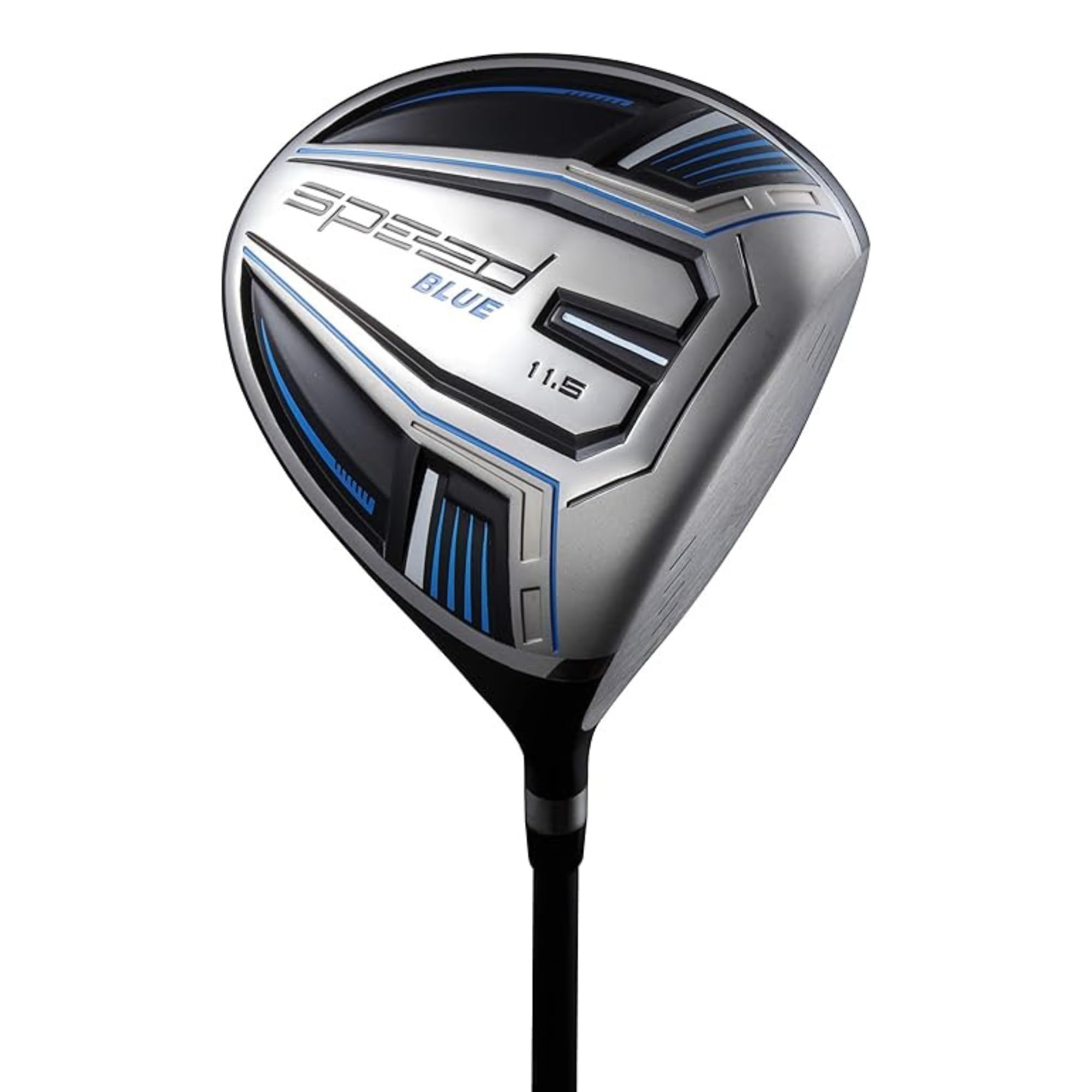
A lightweight titanium head that makes slow swings feel fast.
This driver is for golfers who want easy clubhead speed. The 100% graphite shaft weighs under 60 grams, which is noticeably lighter than the standard shafts on most budget drivers. That lower mass lets you whip the club through impact without muscling it. The 11.5-degree loft (the angle of the clubface) launches the ball higher, ideal for players with a swing speed below 90 mph — so the ball carries farther in the air. One buyer summed it up directly: “I will not hit the ball and it further with a driver for sure.”
The oversized titanium balance (the area of the face that produces the most ball speed) lives up to its name. Off-center hits still travel a respectable distance rather than falling out of the air. The club includes a deluxe see-through headcover, a small but welcome extra at this price tier. The main drawback? Some buyers noted a “too cheap feeling” build quality (one 3-star review expressed disappointment with the overall materials). The aluminum-like sound at impact is also less satisfying than a premium forged face, but the distance results still impress.
What Stands Out
- Ultra-lightweight shaft (under 60g) helps slower swings generate speed
- 11.5° loft gives higher launch for better carry distance
- Fully USGA conforming for tournament play
Watch Out For
- Some customers note a “cheap” feel in the build quality
- Face produces a louder, less crisp sound at impact
Best suited for: senior players or beginners with a moderate swing who want a light, easy-to-swing club that launches the ball high without extra effort.
Not the right fit if: you are a strong swinger who needs a stiff shaft and a muted, premium feel at contact.
4. Orlimar Slice Killer Offset Golf Driver

The anti-slice engineering that turns a banana ball into a fairway finder.
The Orlimar Slice Killer attacks a slice from three directions at once. The clubface sits 7 degrees closed at address, which physically tilts the face left of the target line before you even swing. The offset hosel (a bend in the neck that delays the face) gives it a split second more time to square up through impact. And the heel-weighted screw adds draw-biased spin. According to the brand, independent robot testing claims 29.7 yards of slice prevention — a claim that matches what many reviewers point out in real play. One buyer mentioned it “cured my slice and golfed my best round ever,” while another noted that the “7° offset driver keeps ball in fairway” with “comparable distance to TaylorMade M2 but straighter.”
The head is a full 460cc titanium construction, not the cheaper aluminum alloy you sometimes see at this price tier. The senior flex shaft is soft, which helps even the most aggressive swing feel under control. The trade-off is that the 12.5-degree loft can launch the ball too high for faster swing speeds, robbing you of penetrating roll. A few buyers also reported the clubhead detaching from the shaft under heavy use (one review mentioned failure “on swing 62 at driving range”). For moderate use a few times a month, this driver delivers slice correction that pricier brands often charge double for.
Why It Works
- Multidirectional anti-slice design (closed face, offset hosel, heel weight)
- Full 460cc titanium head provides genuine forgiveness
- Included headcover protects the club between rounds
Known Issues
- Occasional reports of clubhead separation from the shaft
- 12.5° loft may balloon the ball for faster swing speeds
Reach for this if: your most common miss is a slice that costs you fairways and strokes. It is a serious slice-correction tool for right-handed golfers who are tired of playing from the trees.
skip it if: your swing speed is high (over 95 mph) or you need a standard loft to keep the trajectory lower and the roll longer.
5. MAZEL Titanium Golf Driver for Men

CNC-milled cup face that forgives your worst mis-hits without losing speed.
The MAZEL driver packs engineering features normally reserved for clubs costing three times as much. The CNC Cup Face (Computer Numerical Control — a precision machining process) is a one-piece construction where the face and part of the body are milled together, which increases the rebound area across the face. That means when you catch the ball near the heel or the toe, the ball still leaves the face at a usable speed. The 460cc deep face expands the balance, and the low center of gravity (CG) — achieved by moving weight from the crown down into the back of the head — helps launch the ball with less spin for a flatter, more penetrating flight.
The Speed Channel is an engineered trench that surrounds the face. It thins out the face edges so the center can flex more, which directly boosts ball speed. Buyers consistently praise the forgiveness. One reviewer called it “great club for reducing slices and improving drives vs. older Ping.” But the same reviewer noted that “the gold finish wears off quickly (bottom/face).” The club still functions well after a year with cosmetic wear, per the review. Another caution: the shaft may break after heavy use (one owner reported it broke after “~15 games (first driver, some abuse)”). The loud aluminum bat sound at impact is also a common complaint.
Where It Shines
- CNC Cup Face delivers high ball speed even on off-center strikes
- Speed Channel increases face flex for more distance
- Low CG produces a lower-spinning, penetrating ball flight
Known Limitations
- Gold cosmetic finish wears off quickly on the sole and face
- Loud metallic “aluminum bat” sound at impact
- Shaft durability may be an issue under frequent or aggressive use
A strong pick for: the budget-conscious golfer who wants pro-level face technology (CNC cup face + speed channel) in a forgiving 460cc head. It is forgiving enough to help a 20-handicapper and fast enough to satisfy a single-digit player.
Think twice if: the cosmetic wear on the finish would bother you, or if you need a club that survives a 100-round season without any shaft issues.
6. COOLO Golf Driver for Beginner and Average Golfer

A 12-degree driver that brings fairway accuracy back to slower swings.
The COOLO driver is specifically designed for beginners and average golfers, but its real balance is senior players whose swing speed has naturally slowed. The 12-degree loft option (the other choice is 10.5 degrees) launches the ball high and soft, helping it carry farther even when you are not generating much clubhead speed. The shaft is shorter and lighter than standard men’s drivers, which makes the club easier to control through the entire swing arc. One 78-year-old buyer explained exactly why this matters: “I bought the 12 Degree for better lift than my 10.5 Degree. I am 78 and this is a good club if you use a slow back-swing and speed up when you near the ball.”
The 460cc head volume is maxed out for forgiveness. The orange head color is a personal preference, but it is easy to spot in the bag. Another buyer noted that “distance reduced from 300+ yds, but fewer strokes to green, better scores, no lost balls.” That is the honest reality of a seniors-flex driver: you give up peak distance in exchange for staying in the fairway and scoring lower. The main limitation is that the 12-degree ladies flex is too soft for anyone with a regular or fast swing speed. Swingers over 85 mph will find the shaft whippy and lose control. This is a niche tool, but within that niche it delivers exactly what it promises.
Who It Helps Most
- 12° loft provides high launch for slower swing speeds
- Lightweight, shorter shaft improves control for seniors and petite women
- 460cc head keeps off-center hits in play
Who Should Pass
- Ladies flex is too soft for swing speeds above 85 mph
- 12° loft may balloon the ball for stronger swingers
Perfect for: senior golfers, women, and anyone with a slower, smooth swing who wants to find the fairway more often. It trades some top-end distance for accuracy, which is often a winning trade.
Move on if: you have a moderate or fast swing. The soft flex and high loft will produce uncontrolled ballooning rather than the penetrating flight you are after.
Understanding the Specs
Loft Angle (Degrees)
This is the angle of the clubface relative to the shaft. A higher number (like 12 degrees) tilts the face upward more, which launches the ball higher and helps it carry farther in the air when your swing speed is slow. A lower number (like 9.5 or 10.5 degrees) produces a flatter trajectory with more roll after the ball lands. Matching the loft to your swing speed is the single most important decision when picking a cheap driver. If you swing at 80-90 mph, a 10.5-degree driver is the safest starting point. Slower than 80 mph, consider 12 degrees. Faster than 90 mph, look at 9.5 or 10 degrees.
Clubhead Volume (CC)
This measurement tells you how large the head is in cubic centimeters. A 460cc driver head is the maximum allowed by the USGA rules for tournament play. A larger head has a wider balance (the area of the face that produces the most ball speed). When you miss the balance — and most amateurs do — a 460cc head still gives you a usable shot instead of a short, ugly slice. Every driver in this list uses a 460cc head, which is the forgiveness standard you should look for in any budget-friendly driver.
FAQ
What does a 460cc driver head do for my game?
What loft angle should a beginner choose?
Is a graphite shaft better than steel for a cheap driver?
Will a cheap driver last for several seasons?
Can a cheap driver fix a slice?
What does the flex of a shaft mean for my swing?
Does a heavier driver head give more distance?
What is the difference between a 10.5 and 12 degree driver for a senior player?
Final Thoughts: The Verdict
Across the board, the best cheap driver winner is the WENGH Golf Driver because it combines a VFT club face, a lightweight graphite shaft, and a 10.5-degree loft that fits the widest range of swing speeds — all while adding noticeable distance without introducing a slice. If you are a senior or slower swinger looking for maximum lift, grab the COOLO Golf Driver. And for a slice-correction tool that keeps the ball in the fairway round after round, the Orlimar Slice Killer Offset Driver delivers the most targeted anti-slice engineering in this price range.
How We Picked
We do not accept paid placement. Every pick is matched to a real buyer and a real use-case; we do not hands-on test units.
Sources & Methodology
Specifications: manufacturer listings and product documentation. Review insights: verified customer reviews, as of July 2026. Pricing: not shown on this page (it changes often); check the current price via the retailer link.
As an Amazon Associate, WellFizz earns from qualifying purchases. This does not affect which products we feature.
Related Guides

Mo Maruf
I created WellFizz to bridge the gap between vague wellness advice and actionable solutions. My mission is simple: to decode the research and give you practical tools you can actually use.
Beyond the data, I am a passionate traveler. I believe that stepping away from the screen to explore new environments is essential for mental clarity and physical vitality.