Our readers keep the lights on and my smoothie glass nicely filled. As an Amazon Associate, I earn from qualifying purchases.
Specs are compiled from manufacturer listings and verified buyer reviews and can change over time — please confirm the key details on the product page before buying.
You want real optical zoom (the lens moves to magnify the scene) that your phone cannot fake, plus dedicated controls and a device that just takes photos while staying affordable. But spending hundreds on a new camera feels risky when all you need is something simple for trips, family moments, or everyday snapshots. This guide cuts through the noise on cheap digital point-and-shoot cameras, focusing on what matters for real-world use — not marketing hype.
I’m Mohammad Maruf — the founder and writer behind WellFizz. This guide is built by comparing the manufacturers’ published specifications and the patterns across verified customer reviews, so you get each pick’s real strengths and trade-offs instead of marketing spin.
Here is the straightforward breakdown of the cheap digital point-and-shoot camera market right now — no fluff, just the facts that help you decide.
Our Picks at a Glance

How To Choose The Best Cheap Digital Point-And-Shoot Camera
Picking the right budget camera depends on knowing which specs matter for your actual needs. Here is the short version of what to keep in mind, so you do not get lost in numbers that do not affect your daily shooting.
Optical Zoom vs. Digital Zoom
You want the lens itself to zoom in — that is optical zoom (the glass moves inside the camera to magnify the scene). Digital zoom is just the camera cropping and stretching the image, which makes it look blurry and pixelated. A 4X or 5X optical zoom range is a solid start for most casual shooting, letting you frame subjects near and far without losing quality.
Battery Type Matters More Than You Think
Some budget cameras run on standard AA batteries, which are easy to replace anywhere in the world. Others use a rechargeable lithium-ion (li-ion) battery that you charge with a cable. AA-powered cameras are great for travel where outlets are scarce, but you will want to buy a set of rechargeable AAs to avoid running through disposables. Li-ion cameras offer a cleaner all-in-one experience but leave you dependent on a charger.
Resolution (Megapixels) Is Not Everything
Higher megapixel counts let you print larger photos or crop more aggressively, but once you are past 16MP, the difference is small for standard 4×6 prints and social media sharing. A 16MP sensor with good optics will produce sharper images than a 44MP sensor with a cheap lens and poor processing. Focus on image sensor size and lens quality in reviews rather than chasing the biggest megapixel number.
Bundles Save Money If You Need the Extras
Some cameras come as a kit with a memory card, carrying case, batteries, or a card reader. These bundles often save you compared to buying each accessory separately. If you do not already own an SD card or a case, a bundle is a practical way to start shooting the moment the package arrives.
Quick Comparison
| Model | Best For | Megapixels | Optical Zoom | Battery Type | Amazon |
|---|---|---|---|---|---|
| Kodak PIXPRO FZ55-BKAlso Great | Best Overall Value | 16MP | 5X | Rechargeable Li-Ion | Amazon |
| Minolta 48MP (Rear Selfie) | Selfie & Video Capture | 48MP | 16X (Digital) | Rechargeable Li-Ion | Amazon |
| Kodak PIXPRO FZ45-WH | Entry-Level Simplicity | 16MP | 4X | AA | Amazon |
In‑Depth Reviews
1. Kodak PIXPRO FZ55-BK 16MP CMOS Sensor Digital Camera (Black)
The most balanced budget shooter, mixing optical zoom with a built-in rechargeable battery.
This camera gives you a 16MP CMOS sensor (CMOS is a common image-capture chip that balances quality and battery life) for everyday clarity and a 5X optical zoom that lets you get closer without losing sharpness — notably a 25% wider optical reach than the 4X zoom on the FZ45 models. The 28mm wide-angle lens handles group shots indoors, and the 1080p Full HD video recording keeps your clips at a usable resolution. Buyers report that the compact size makes it easy to take anywhere and battery life is solid, lasting through a full day of moderate shooting.
Unlike the AA-powered models in this list, the FZ55-BK uses a rechargeable li-ion battery (a lithium-ion battery you charge via USB, not with disposable cells) that charges via USB, so you never hunt for alkaline cells. It also packs 9 autofocus points (9 spots the camera uses to lock onto a subject) compared to the single point on the Minolta MND20, making focus faster for moving subjects. The 2.7-inch LCD screen is adequate for composing shots, and the camera supports SD cards up to 512GB for plenty of storage.
The catch is that the built-in flash and digital image stabilization (software that tries to reduce blur from shaky hands) work well in good light but struggle in very dim settings — a common limit at this price. A reviewer also mentioned that if you are looking for a high-quality digital camera that will last you many years, the FZ55 is a very affordable and quality option that they recommend without hesitation.
The Real Strengths
- 5X optical zoom beats the 4X zoom on cheaper Kodak models for framing distant subjects
- Rechargeable li-ion battery eliminates the need to buy AA batteries
- 9 autofocus points provide faster and more accurate focus than 1-point systems
The Honest Trade-offs
- Low-light performance is limited — expect noise (grainy speckles) in dim settings
- 2.7-inch screen feels small for reviewing detail shots
- Digital zoom should be turned off for best quality
Reach for this if: you want the most well-rounded budget point-and-shoot with optical zoom, a rechargeable battery, and strong beginner-friendly performance.
Look elsewhere if: you need a super long zoom (40X+) or prefer the simplicity of AA batteries for international travel.
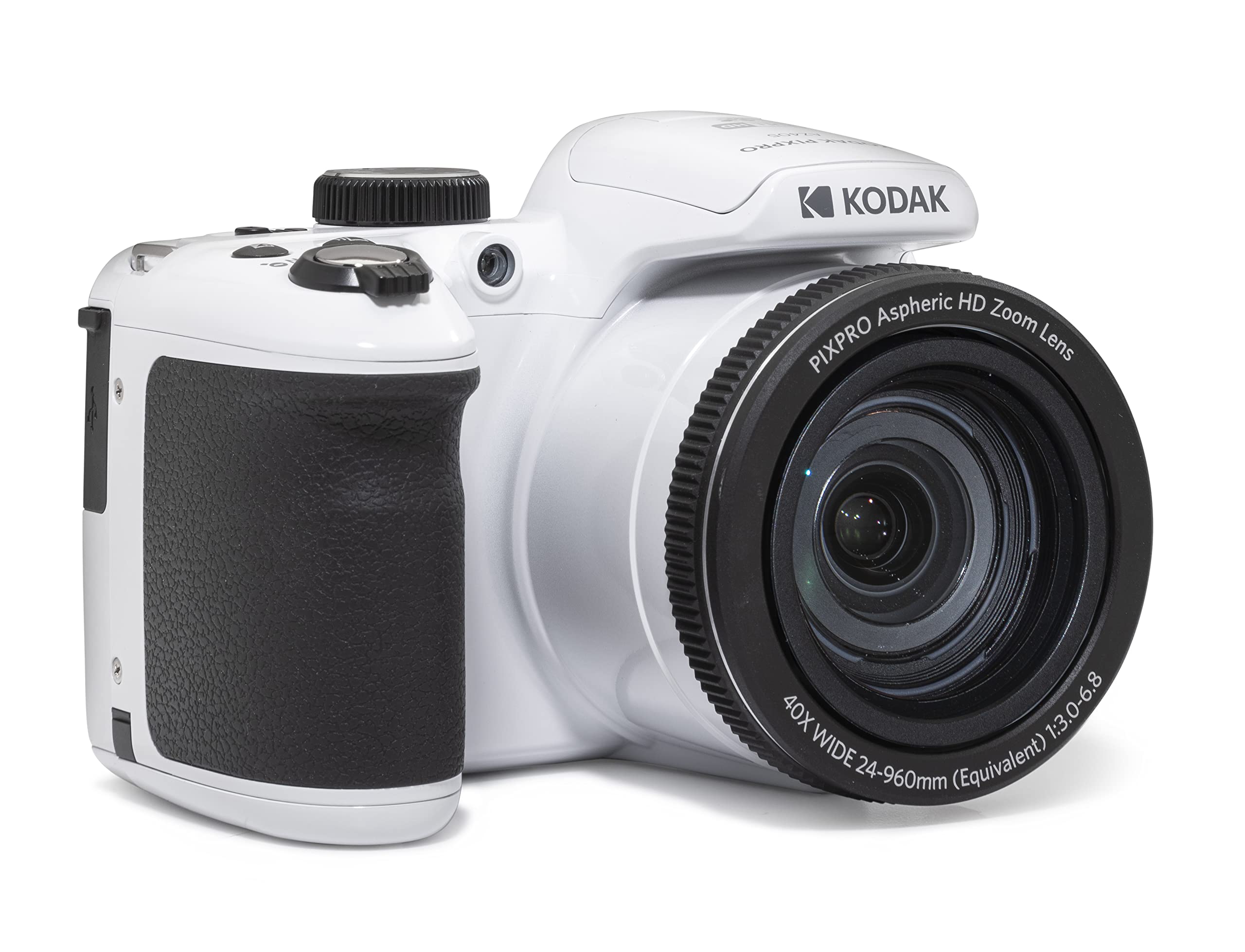
2. Kodak PIXPRO AZ405-WH 20MP Digital Camera (White)
A high-resolution option that packs 44MP into a lightweight silver body for detailed shots.
If you want the ability to crop heavily or print large, the MND20’s 44MP CMOS sensor delivers the highest resolution in this roundup — a 2.75 times jump over the 16MP sensors on most Kodak models here. At only 8 ounces, it is one of the lightest options, making it easy to carry all day. The 2.9-inch LCD screen is the largest among the budget picks, giving you a slightly bigger viewfinder for composing and reviewing shots. The camera records 2.7K Quad HD video (2720×1530 pixels, sharper than 1080p but not true 4K), which sits between standard 1080p and 4K for sharper footage than most budget cameras offer.
Features include 16X digital zoom (the camera crops the image, not the lens moving), anti-shake stabilization, time lapse mode (interval shooting to make a fast video), face detection, and built-in color filters. However, it is important to note that the autofocus uses a single point — compared to 9 points on the Kodak models — and the zoom is entirely digital, meaning you lose quality as you zoom in. Buyers appreciate the lightweight design but some report slow responsiveness and image quality that lags behind expectations at this resolution.
The MND20 also lacks autofocus entirely, relying on fixed focus (the lens stays at a set distance, so you must physically move closer or farther for sharpness), which means you need to be mindful of your distance to the subject for sharp results. It is a mixed bag — great for those who prioritize resolution and a light body, but the single-point focus and digital-only zoom are clear compromises.
What It Delivers
- 44MP resolution offers the highest pixel count here for detailed enlargements
- 2.9-inch LCD screen is the largest for composing shots easily
- Lightweight at 8 ounces — comfortable for all-day carry
Where It Falls Short
- Single autofocus point limits focus speed and accuracy
- Digital zoom degrades image quality compared to optical zoom
- No autofocus means careful distance management is needed for sharp shots
Go for it if: you absolutely need the highest megapixel count for large prints and do not mind sacrificing autofocus speed and optical zoom.
skip it if: you want fast, reliable autofocus and true optical zoom — cameras like the FZ55 offer a more balanced daily experience.
3. KODAK PIXPRO FZ55 16MP Digital Camera Bundle (Red)

A selfie-friendly shooter that records 4K video and packs 48MP resolution.
This Minolta distinguishes itself with a built-in rear selfie lens (a small second lens on the back so you can see your face while taking a selfie), making it easy to frame yourself without guessing where the lens points — a feature none of the Kodak models here offer. The 48MP sensor captures more pixels than any other camera in this guide (three times the resolution of the 16MP models), and the 4K Ultra HD video delivers the highest video resolution available here. The 2.8-inch LCD screen provides good framing, and the package includes a 32GB memory card, rechargeable battery, USB cable, wrist strap, and pouch. Phase detection autofocus (a faster focus method that measures light split through the lens) is designed to keep subjects sharp, and the F/2.2 aperture (the lens opening size: smaller numbers let in more light, so F/2.2 is bright) lets in more light than the F/3.5 apertures on many budget cameras, helping in dim conditions.
Reviewers point out that the camera worked well on a trip to Paris, with battery lasting throughout the day sightseeing, and that picture quality is excellent for the price. Another reviewer noted that the value for money is big in a small package. However, the 16X digital zoom is not optical, so every zoom step cuts into the sensor’s resolution. The shutter lag (the delay between pressing the button and the camera taking the picture) is noticeable — one customer observed that the responsiveness is very slow, and the battery life is poor at approximately 140 images at highest quality without the flash.
The 48MP resolution is real for cropping, but the image processing may not match the sharpness you expect from that number, especially in low light. It is a decent value-packed option if you prioritize selfies and 4K video, but the shutter lag and battery runtimes are genuine downsides for daily use.
Unique Pluses
- Rear selfie lens makes self-portraits and group shots without the guesswork
- 4K video recording beats the 1080p and 2.7K found on other budget models
- Complete bundle includes 32GB card, case, and strap — no extras to buy
Honest Weaknesses
- Shutter lag makes capturing fast-moving subjects frustrating
- Battery yields only ~140 images at highest quality without flash
- Digital zoom degrades detail — optical zoom absent here
Choose this if: you take lots of selfies or vlog-style videos and want 4K resolution without spending hundreds more.
Pass if: you need fast responsiveness for action shots or a battery that lasts through a day of heavy shooting.
4. Kodak PIXPRO Friendly Zoom FZ45-WH 16MP Digital Camera (White)

The simplest, most affordable true point-and-shoot with a traditional AA-powered design.
This is the entry-level Kodak that cuts the complexity — a 16MP CMOS sensor, 4X optical zoom with a 27mm wide-angle lens, and 1080p Full HD video all controlled through a basic menu system. It uses two AA batteries, which are easy to find anywhere, and supports SD, SDHC, or SDXC memory cards up to 512GB. The 2.7-inch LCD screen is standard for the category. Owners mention that the batteries last 1 to 2 months with 30-minute use if you remove them when idle, but the included AA alkaline cells are low quality and die quickly, so stock up on rechargeable batteries. One shopper added that the camera looks great in various light settings and is better than the FZ55 in certain lighting conditions, producing excellent photo quality for the price.
The 4X optical zoom offers 25% less reach than the 5X zoom on the FZ55, so you need to be slightly closer to distant subjects. The camera has 9 autofocus points and contrast detection for reasonable focus, but the video quality is poor — one reviewer called it terrible, with no 4K support. The recharge time between shots can be 5 to 10 seconds, which is slow for capturing action, though using Program AE mode (a semi-automatic mode where you set the ISO while the camera picks shutter speed and aperture) can shorten this. If you want a genuinely cheap, straightforward digicam that takes good stills in good light and runs on universally available batteries, this is the most affordable entry point.
Simple Strengths
- Affordable price makes it the cheapest true point-and-shoot here
- AA batteries are available at any store worldwide for power on the go
- Excellent photo quality for the price — better than expected in good light
Clear Compromises
- 4X zoom is the least reach among Kodak options here
- Slow 5–10 second recharge between shots is frustrating for quick sequences
- Video quality is poor — do not buy this for recording videos
Grab this if: your budget is absolutely tight, you want the simplest camera possible, and you only shoot stills in good light.
Step up if: you need 5X zoom, a rechargeable battery, or better video quality — the FZ55 is worth the extra investment.
Understanding the Specs
Optical Zoom
This is the lens physically moving inside the camera to magnify the scene without losing quality. Higher numbers (like 5X or 40X) let you fill the frame with subjects far away while keeping the image sharp. Digital zoom, which is often listed alongside it, just crops the sensor — avoid using it if you want clear results.
Sensor Resolution (Megapixels)
A 16-megapixel (MP) sensor captures 16 million individual pixels per image, which is more than enough for crisp 4×6 prints, social media posts, and decent laptop screens. Higher resolutions like 48MP give you more room to crop the image without losing detail, but the lens and processing quality matter just as much. Do not chase megapixels alone — a 16MP camera with a good lens often outperforms a cheap 44MP camera with a poor one.
FAQ
Will a cheap digital point-and-shoot take better photos than my phone?
What is the difference between 4X and 5X optical zoom?
AA batteries vs rechargeable li-ion — which is better for a cheap camera?
Can I use a micro SD card in these cameras?
How do I transfer photos from a cheap digital camera to my phone?
Is 16MP enough for printing photos?
Do I need a memory card, or is storage built in?
What does “digital image stabilization” mean?
Are budget digital cameras good for kids?
Final Thoughts: The Verdict
For the majority of shoppers, the best cheap digital point-and-shoot camera is the Kodak PIXPRO FZ55-BK because it balances 5X optical zoom, a rechargeable li-ion battery, and reliable 16MP image quality at a price that does not scare first-time buyers. If you need a super long zoom for wildlife or sports, grab the Kodak PIXPRO AZ405-WH with its 40X reach and AA battery convenience. And for the tightest budget where every dollar counts, the Kodak PIXPRO FZ45-WH gives you a simple, AA-powered shooter that still captures excellent daylight stills.
How We Picked
We do not accept paid placement. Every pick is matched to a real buyer and a real use-case; we do not hands-on test units.
Sources & Methodology
Specifications: manufacturer listings and product documentation. Review insights: verified customer reviews, as of July 2026. Pricing: not shown on this page (it changes often); check the current price via the retailer link.
As an Amazon Associate, WellFizz earns from qualifying purchases. This does not affect which products we feature.
Related Guides

Mo Maruf
I created WellFizz to bridge the gap between vague wellness advice and actionable solutions. My mission is simple: to decode the research and give you practical tools you can actually use.
Beyond the data, I am a passionate traveler. I believe that stepping away from the screen to explore new environments is essential for mental clarity and physical vitality.