Our readers keep the lights on and my smoothie glass nicely filled. As an Amazon Associate, I earn from qualifying purchases.
Specs are compiled from manufacturer listings and verified buyer reviews and can change over time — please confirm the key details on the product page before buying.
You want better sound in your car without spending a lot, but you worry that cheap gear means weak bass, a buzzing amp, or a touchscreen that lags. The truth is, you can get clean power, wireless smartphone mirroring, and punchy bass for a low price if you pick the right pieces. This guide skips the marketing talk and focuses on the few products that actually deliver on those promises.
I’m Mohammad Maruf — the founder and writer behind WellFizz. This guide is built by comparing the manufacturers’ published specifications and the patterns across verified customer reviews, so you get each pick’s real strengths and trade-offs instead of marketing spin.
The ability to transform your car’s cabin without burning your wallet depends on a few key specs, and this roundup of the best cheap car audio gear focuses on exactly those numbers — RMS power, channel counts, and the features that actually make a difference in your everyday listening experience.
Our Picks at a Glance

How To Choose The Best Cheap Car Audio
When every dollar counts, you need to know exactly which specs separate a smart buy from a paperweight. Here are the three factors to lock in before you add anything to your cart.
RMS power vs peak power — ignore the big number
Peak wattage is the flashy number on the box, but RMS (Root Mean Square — a measure that tells you the continuous, real-world power an amp can deliver) is the spec that actually drives your speakers cleanly. A 2000-watt peak amp might only put out 400 watts RMS, which is the number you want when matching it to your subwoofer or door speakers. Always compare RMS, not peak.
Channel count — match it to your plan
A monoblock (a single-channel amp designed for subwoofers) powers only a sub. A 4-channel amp can run two door speakers and a sub in bridged mode (combining two channels into one for more power), or four speakers for a full-range setup. If you plan to add more speakers later, a 4-channel amp gives you room to grow.
Head unit connectivity — CarPlay or Bluetooth
Wireless Apple CarPlay and Android Auto let you use navigation and music apps hands-free without plugging in. If your car is older and just needs streaming music, a solid Bluetooth-only single-DIN stereo (a standard single-slot car radio) with a detachable face for security might be all you need — and it costs a lot less than a full touchscreen double-DIN model.
Quick Comparison
| Model | Best For | RMS Power | Channels | Weight | Amazon |
|---|---|---|---|---|---|
| Taramps TS 400×4★ Best Overall | Compact full-range | 400W RMS | 4 | 0.99 lbs | Amazon |
| AUDIOZERONE ZE1000.1Bass Champion | Hard bass on a budget | 1000W RMS x 1 (1-ohm) | 1 | 6.6 lbs | Amazon |
| Kissound KS9702 | Wireless CarPlay upgrade | 240W Max | 5 | — | Amazon |
| Pioneer GM-A6704 | Reliable 4-channel power | 60W RMS x 4 (4 ohms) | 4 | 4.9 lbs | Amazon |
| Kenwood KMM-BT332U | Simple single-DIN streaming | 50W x 4 | — | 1.3 lbs | Amazon |
| Pioneer DEH-S4220BT | CD + Bluetooth combo | 50W x 4 | — | — | Amazon |
| Taramps TS 1200×4 | Maximum 4-channel RMS | 1200W RMS | 4 | 2.73 lbs | Amazon |
In‑Depth Reviews
1. Taramps TS 400×4
A featherweight 4-channel amp that tucks behind your dash and still rocks.
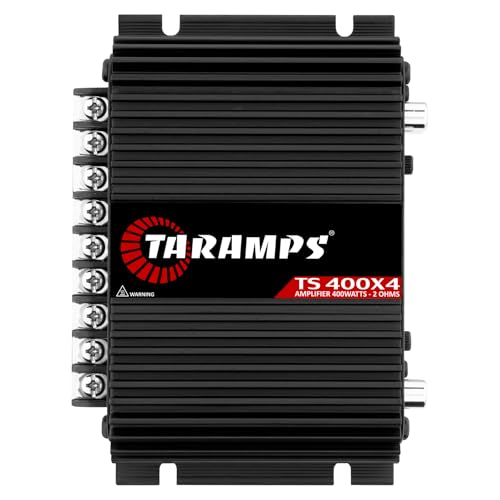
At 0.99 pounds, this Taramps amplifier is absurdly small for a 400W RMS unit, and buyers report it fits in tight spots like a vintage Porsche 911 footboard. Each of the four channels delivers 100 watts RMS at 2 ohms, meaning you get clean power for door speakers and tweeters without needing a separate subwoofer amp right away. The high-level input with automatic activation means you can skip buying adapters if your head unit lacks RCA pre-outs.
Where it really punches above its weight is the built-in crossover — fixed high-pass at 90Hz and low-pass at 90Hz plus a full-range option give you flexibility to dial in the sound for a 4-speaker setup. The main trade-off against the bigger Taramps TS 1200×4 is that the 400×4 tops out at 400W RMS total, so it’s not the choice if you plan to drive power-hungry subwoofers later.
Compared to the Pioneer GM-A6704, the Taramps delivers 400W RMS versus the Pioneer’s 60W RMS x 4 at 4 ohms. But the Pioneer is a trusted Class AB design that runs cooler, while the Taramps is Class D and more efficient for the same output.
Fits where others don’t: Its compact 0.99-pound chassis makes it ideal for behind-dash installs in smaller cars or trucks where space is at a premium.
Reach for this if: you need a powerful, space-saving 4-channel amp for a clean full-range speaker upgrade.
Look elsewhere if: you plan to run a high-power subwoofer — this is a multichannel amp, not a dedicated subwoofer monoblock.
2. AUDIOZERONE ZE1000.1
A monoblock that pushes 2000 watts peak with reliable 1-ohm stability for cheap.
If you want hard-hitting subwoofer bass without paying premium-brand money, this AUDIOZERONE delivers 1000 watts RMS at 1 ohm in a Class D monoblock that runs cool enough for daily use. Owners mention it has “delivered claimed power reliably for 2 years” and produces “clean, hard bass with a 10″ sub.” Compared to the Pioneer GM-A6704’s 1000W max output, this amp also claims 2000 watts max — but because it’s a single-channel monoblock, it’s strictly for subwoofer duty and not for powering door speakers.
The amplifier includes thermal, overload, and short circuit protection, which is critical when running a demanding 1-ohm load that could overheat a lesser amp. At 6.6 pounds, it has a solid, weighty feel that reviews call “beastly,” though one report says the speaker wire terminals can pull out, so make sure you seat them firmly.
The honest limit is that this is an entry-level monoblock — some customers note failure after 2 months, with the replacement clipping at low volume. But with 711 ratings and a 4.4 average, the majority of users get long life out of it for the price.
What works
- Genuine 1000W RMS at 1 ohm for powerful, clean bass
- Class D design keeps heat and power draw low
- FCC-certified with built-in protection circuits
What to watch
- Some units fail within months — check return policy
- Speaker wire terminals can pull loose if not fully seated
Buy this for: getting maximum subwoofer output on a strict budget — the 1000W RMS at 1 ohm is tough to top at this price.
Skip if: you need a 4-channel amp — this is a monoblock, designed only for subwoofers.
3. Kissound KS9702 Double Din Car Stereo

A touchscreen that brings wireless CarPlay to your old car for less than a dinner out.
The Kissound KS9702 packs wireless Apple CarPlay and Android Auto, a responsive 7-inch IPS touchscreen at 1024×600 resolution, and a built-in DSP processor with a 10-band EQ — features you’d expect on a head unit. Reviewers point out that “the responsiveness of wireless Apple Car Play is as good as any Pioneer I’ve had or my 2024 Toyota’s onboard audio system,” which is high praise for a unit at this price point. Compared to the single-DIN Kenwood KMM-BT332U, the Kissound offers 5 channels versus the Kenwood’s 1 for audio routing, giving you subwoofer RCA outputs plus speaker-level outputs for a complete system.
Installation is straightforward for standard double-din slots, and it comes with an 8-LED backup camera with a 19.7-foot cable. The Bluetooth chip pairs quickly, and the built-in dual microphones keep your voice clear on highway calls. The catch is that some vehicles need a dash kit and wiring adapter sold separately, and the two physical buttons on the unit feel “slightly cheap” according to one reviewer — but the touchscreen is so responsive that you rarely use them.
What stands out
- Wireless Apple CarPlay / Android Auto with fast pairing
- Built-in DSP, 10-band EQ, and subwoofer RCA outputs
- Includes a backup camera with 19.7-ft cable
What to note
- Physical buttons feel less premium than the touchscreen
- May need dash kit and wiring adapter for some vehicles
Reach for it if: you want a full-featured double-din head unit with wireless smartphone mirroring and modern audio controls at an entry-level price.
Skip if: you only need basic streaming and don’t want to install a double-din chassis — a single-DIN unit like the Kenwood is simpler.
4. Pioneer GM-A6704

A Class AB 4-channel that runs cool and sounds clean for years.
Pioneer’s GM-A6704 is the classic entry-level 4-channel amp that does one thing well — deliver clean, reliable power. It puts out 60 watts RMS x 4 at 4 ohms, or 190 watts RMS x 2 in bridged mode, which is enough to drive a set of door speakers plus a small subwoofer. Shoppers say it “works great after 3 years” and offers “good bass, treble, and sound boost controls.” Unlike the Taramps TS 400×4, the Pioneer uses a Class AB design that produces less distortion but more heat — though at 4.9 pounds with a 14-inch chassis, it has enough heatsink to stay cool in most installations.
The 1000W max power rating on the box is its peak figure, but the real story is its clean sound. With variable high-pass and low-pass filters, you can fine-tune which frequencies go to your door speakers versus a bridged sub. The trade-off is that it’s physically larger (8.5 x 14 x 2.38 inches) than more compact Class D competitors like the Taramps TS 1200×4, so installation space is something to check.
Compared to the AUDIOZERONE ZE1000.1, the Pioneer’s RMS output is much lower — 60W RMS vs 1000W RMS — but that’s because it’s a multi-purpose 4-channel, not a dedicated subwoofer amp. If you need to power door speakers and a sub, the Pioneer’s bridging feature gives you more versatility than the single-channel AUDIOZERONE.
Long-term reliability: Buyer reports note it works reliably after several years, which is a strong track record for an entry-level amp.
Ideal for: anyone who wants a proven 4-channel amp that can power door speakers and a small sub, and values reliability over max wattage.
Skip if: you need a compact amp for tight spaces — the Pioneer is larger than most Class D alternatives.
5. KENWOOD KMM-BT332U

A single-DIN powerhouse that streams high-res FLAC through a 13-band EQ.
If you don’t want a large touchscreen and just need a solid single-DIN head unit with modern features, the Kenwood KMM-BT332U covers the basics and more. It plays high-res FLAC and WAV files from a USB drive, has a built-in Bluetooth chip that can pair with two phones at once, and delivers 50 watts per channel through four channels. The detachable face is a nice security feature — you pop it off and take it with you to deter theft.
Buyers report it’s a “great upgrade for a 2004 Aveo” and praise the excellent sound quality, direct amp connection, and Alexa built-in for voice control. The 13-band equalizer with digital time alignment (a feature that lets you adjust the timing of each speaker so the sound reaches your ears at the same moment) gives you studio-level audio tuning that you don’t get with most single-DIN units. Compared to the Pioneer DEH-S4220BT, the Kenwood lacks a CD player but makes up for it with Hi-Res audio support and a lighter 1.3-pound weight.
The honest catch is the small monochrome LCD display — it’s hard to read in direct sunlight, and there’s no navigation or large screen. If you want modern features in the classic single-DIN form factor, this is the best pick. Compared to the Kissound KS9702, the Kenwood has 1 channel vs 5, so it lacks dedicated subwoofer outputs — you’ll need an amplifier with built-in crossover for a sub.
Audio nerd’s single-DIN: The 13-band EQ and digital time alignment make this a rare find for sound-tuning flexibility in a budget head unit.
Get this if: you want a compact single-DIN unit with excellent sound tuning, Bluetooth, and detachable face security.
Consider another if: you need a visible, modern display or wireless CarPlay — this is a monochrome LCD without navigation.
6. Pioneer DEH-S4220BT

A rare single-DIN CD player that still brings Bluetooth and FLAC support.
For anyone who still has a CD collection and wants to keep it in the dash, the Pioneer DEH-S4220BT is a standout. It combines a physical CD player with built-in Bluetooth for hands-free calling and audio streaming, plus a USB port and an AUX input. Pioneer’s Advanced Sound Retriever technology intelligently restores audio details lost during compression, so your streamed MP3s and Bluetooth audio sound clearer than they would on a standard head unit. Owners mention it has “consistent Pioneer quality,” with an easy-to-navigate UI and “great sound” from its 50W x 4 amplifier.
The DEH-S4220BT also includes Pioneer Smart Sync — an app that expands the receiver’s features using your connected smartphone, and MIXTRAX technology that creates DJ-style transitions between tracks. One downside some owners note is that Bluetooth pairing requires using Pioneer’s app rather than connecting directly, which takes an extra step. But if you value CD playback and a proven brand with 825 ratings averaging 4.6 stars, this is a solid, durable choice.
Compared to the Kenwood KMM-BT332U, the Pioneer adds a CD player but doesn’t support Hi-Res FLAC playback the same way — the Kenwood is more of an audiophile streamer. If you use physical media, this Pioneer wins; if you’re all-digital, the Kenwood is better.
Why it lasts: With consistent brand reliability and a simple, proven interface, customers note it works great even after years of daily use.
Perfect for: anyone who still listens to CDs and wants Bluetooth for hands-free calls and streaming without buying a double-din.
Look elsewhere if: you want wireless CarPlay or a full touchscreen — this is a button-and-knob single-DIN head unit.
7. Taramps TS 1200×4

A weightless 1200W RMS 4-channel that powers an entire system from one chassis.
The Taramps TS 1200×4 is the big brother of the TS 400×4, delivering 1200 watts RMS total — 300 watts RMS per channel at 2 ohms — from a Class D 4-channel amplifier that weighs only 2.73 pounds. That’s an astounding power-to-weight ratio, giving you enough juice to drive door speakers, tweeters, and even smaller subwoofers from a single unit. Compared to the Pioneer GM-A6704, the Taramps gives you 1200W RMS versus 60W RMS per channel, so it’s a massive upgrade in headroom.
Buyers call it a “small amp with a lot of power” and it’s a best-seller for Taramps, performing well with subwoofers, two-way speakers, and super tweeters. The fixed crossover (high-pass, low-pass, full-range options) simplifies setup, and the recommended 60A circuit breaker keeps your system protected. The compact dimensions (5.43″ x 1.89″ x 9.84″) mean it fits in tight spots where a larger Pioneer would not.
One honest caveat: like any entry-level high-power amp, there are reports of units failing within a month or developing a whining noise. The majority of 635 ratings are at 4.4 stars, but budget for a reliable install and check the return window.
Best value proposition: Getting 300 watts RMS per channel in a 2.73-pound chassis is remarkable for the price — one buyer even bought a second one for their setup.
Buy it for: maximum 4-channel RMS power in a compact footprint — it rivals amps costing significantly more.
Skip if: you need proven long-term reliability and are willing to pay more — the Taramps has a higher failure rate than brand-name competitors.
Understanding the Specs
RMS power — the real wattage number
RMS (Root Mean Square) measures the continuous power an amplifier can deliver to your speakers without distorting. This is the number you should match to your speaker’s RMS rating. Peak power is a brief burst that means very little in real-world use. For example, a 2000-watt peak amp might only output 1000 watts RMS — that’s the spec that drives your subwoofer. Always compare RMS, not peak, when deciding between amps.
Channel count and bridging
A monoblock (1 channel) is for subwoofers only. A 2-channel amp can run a pair of speakers or one bridged subwoofer. A 4-channel amp gives you the most flexibility: run four speakers, or bridge two channels for a sub while using the other two for door speakers. Bridging means combining two amplifier channels into one for double the power — useful when you want to drive a subwoofer from a multichannel amp.
FAQ
Do I need a monoblock or a 4-channel amplifier for my setup?
What is the difference between Class A/B and Class D amplifiers?
Will a cheap car audio amplifier damage my car’s electrical system?
Can I use a cheap car audio head unit with an external amplifier?
Is wireless Apple CarPlay worth it on a budget head unit?
How do I know if a double-din stereo will fit my car?
What gauge power cable do I need for my car audio amplifier?
Is a single-DIN stereo with a detachable face more secure than a double-DIN?
Final Thoughts: The Verdict
For the majority of shoppers, the best cheap car audio winner is the Taramps TS 400×4 because it packs 400W RMS into a 0.99-pound chassis that fits anywhere and powers an entire speaker setup while staying affordable. If you want hard subwoofer bass on a strict budget, grab the AUDIOZERONE ZE1000.1. And for a full smart-head-unit upgrade with wireless CarPlay, the standout is the Kissound KS9702 — it brings modern connectivity to your dash without requiring a premium budget.
How We Picked
We do not accept paid placement. Every pick is matched to a real buyer and a real use-case; we do not hands-on test units.
Sources & Methodology
Specifications: manufacturer listings and product documentation. Review insights: verified customer reviews, as of July 2026. Pricing: not shown on this page (it changes often); check the current price via the retailer link.
As an Amazon Associate, WellFizz earns from qualifying purchases. This does not affect which products we feature.
Related Guides

Mo Maruf
I created WellFizz to bridge the gap between vague wellness advice and actionable solutions. My mission is simple: to decode the research and give you practical tools you can actually use.
Beyond the data, I am a passionate traveler. I believe that stepping away from the screen to explore new environments is essential for mental clarity and physical vitality.