Our readers keep the lights on and my smoothie glass nicely filled. As an Amazon Associate, I earn from qualifying purchases.
The hunt for a budget-friendly camera often leads to a dead end of blurry images, frustrating autofocus, and devices that feel more like toys than tools. You want real optical zoom, a dependable sensor, and solid image quality without draining your wallet.
I’m Mohammad Maruf — the founder and writer behind WellFizz. I analyze the specifications, sensor sizes, and real-user feedback of entry-level and mid-range digital cameras to separate genuine value from inflated marketing claims.
After digging through the specs and user experiences on dozens of models, I’ve pinpointed the options that actually deliver. This guide cuts through the noise to help you find the best cheap camera that balances price with real-world performance for beginners, travelers, and content creators.
How To Choose The Best Cheap Camera
When your budget is capped, every dollar spent on marketing fluff is a dollar stolen from sensor quality or lens optics. You need to know exactly what technical trade-offs are acceptable and which ones are deal-breakers.
Prioritize Optical Zoom Over Digital Zoom
Digital zoom is simply cropping the image inside the camera, which degrades resolution almost instantly. A true optical zoom lens, like the 6X lens found on several models in this list, physically moves glass elements to magnify the subject. This preserves detail you can actually print or crop later. If you intend to shoot anything beyond arm’s length, avoid any camera that only lists a digital zoom figure.
Read Between the Megapixel Lines
Many budget cameras advertise absurdly high megapixel counts through software interpolation. A 44MP or 88MP claim on a sub- camera is almost always an upscaled version of a much smaller native sensor resolution. Look for the native sensor specification (like 16MP or 24.1MP) in the fine print. A genuine 16MP CMOS sensor from a known brand like Kodak or Canon will produce cleaner, more accurate images than an interpolated 88MP from a generic sensor.
Check for Functional Autofocus
Fixed-focus lenses are a common corner cut in the cheapest tiers. They rely on a small aperture and deep depth of field to keep everything semi-sharp, but they cannot lock onto a subject or adjust for movement. A camera with contrast-detection or phase-detection autofocus, even a basic system, will give you sharper results for portraits, vlogging, and action shots. Reviews that mention blurry photos often point to a failed or absent autofocus system.
Quick Comparison
On smaller screens, swipe sideways to see the full table.
| Model | Category | Best For | Key Spec | Amazon |
|---|---|---|---|---|
| Canon EOS R100 | Mirrorless | Learning Photography | 24.1MP APS-C Sensor | Amazon |
| FlyFrost 8K | Point & Shoot | Vlogging & WiFi Sharing | 8K Video / 88MP Photo | Amazon |
| XNSIAKXA 8K | Point & Shoot | Multi-Mode Creativity | 8K Video / 79 AF Points | Amazon |
| Kodak PIXPRO AZ255 | Superzoom Bridge | Long Distance Shots | 25X Optical Zoom | Amazon |
| Canon EOS Rebel G | Film SLR | Analog Photography | 35mm Film / 35-80mm Lens | Amazon |
| Saneen 4K | Point & Shoot | Touchscreen Controls | 4.0″ Touch Screen | Amazon |
| Nsoela 5K | Point & Shoot | WiFi & Compact Design | 6X Optical Zoom | Amazon |
| Jukanur 5K | Point & Shoot | Best Value Starter | 6X Optical Zoom | Amazon |
| Minolta MND20 | Point & Shoot | Novice / Fun Camera | 16X Digital Zoom | Amazon |
In‑Depth Reviews
1. Canon EOS R100 Mirrorless Camera Kit

This is the outlier on the list in the best way possible. The Canon EOS R100 uses a genuine 24.1MP APS-C CMOS sensor and a DIGIC 8 processor, which places it in a completely different class of image processing compared to the entry-level point-and-shoots. You get the RF mount, meaning you can swap lenses down the road, and the Dual Pixel CMOS AF system with 143 AF zones provides fast, reliable focusing that budget cameras simply cannot match.
The kit includes the RF-S 18-45mm f/4.5-6.3 IS STM lens, which handles general photography, family portraits, and travel landscapes with optical stabilization built right into the lens. It records Full HD 60p video, and while it does shoot 4K 24p, that mode introduces a crop factor. The 2.36m-dot OLED electronic viewfinder is a huge bonus for composing shots in bright sunlight, a feature absent from almost every other camera on this list.
Battery life is solid on the LP-E17 pack, and the inclusion of a bag and 64GB card in this bundle makes it a complete starter kit. The plastic body is lightweight but feels engineered, not fragile. If your goal is to actually learn photography with a system you can grow into, this is the best foundation you can buy without jumping to a much higher price bracket.
Why it’s great
- True 24.1MP APS-C sensor delivers professional-level image quality
- Dual Pixel CMOS AF with 143 zones is fast and accurate
- Interchangeable RF lens mount for future upgrades
- Includes EVF, bag, lens, and 64GB card
Good to know
- No built-in flash requires an external unit
- 4K video mode has a significant crop factor
- Highest price point on this list
2. FlyFrost 8K Digital Camera
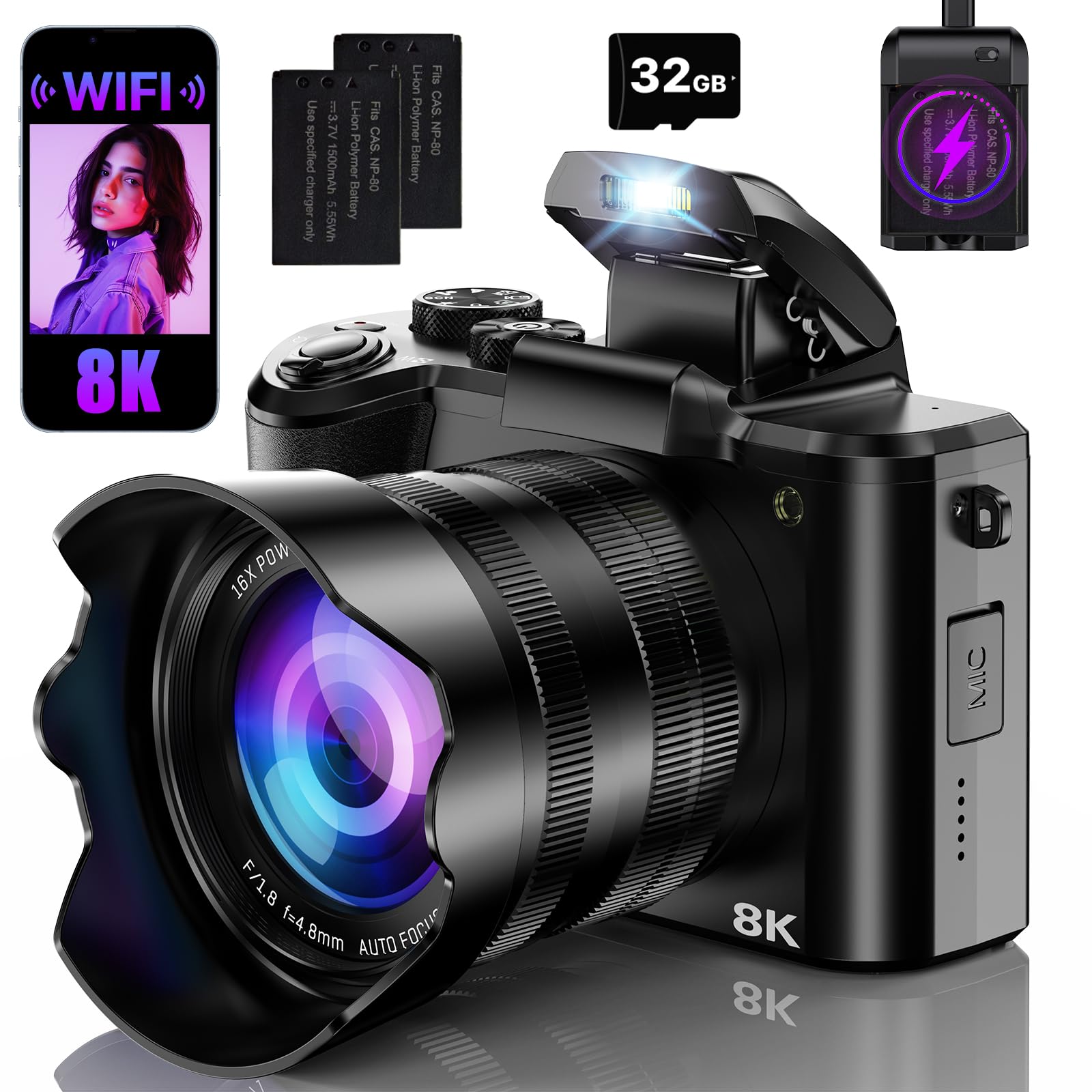
The FlyFrost 8K packs an impressive spec sheet for a mid-range price. It claims an 8K video resolution and 88MP photos, which is software-interpolated, but the native image quality in good light is sharp with vibrant colors. The fixed lens uses a 16X digital zoom, but the real value here is the feature set: built-in WiFi for instant sharing via the iSmart DV2 app, a 3.2-inch IPS touchscreen, and a dual-lens setup for selfie and vlog shooting.
What sets this model apart from cheaper options is the hardware bundle. You get two large-capacity rechargeable lithium polymer batteries and a dedicated charging stand, which eliminates the hassle of swapping single batteries through a camera port. The 6-axis stabilization noticeably smooths handheld video, and the 360-degree rotary dial lets you switch between shooting modes like time-lapse, slow motion, and portrait presets without diving into menus.
Low-light performance is the biggest trade-off. The F2.2 aperture helps, but the sensor struggles in dim conditions, producing noticeable noise. The body feels a bit plasticky, but the lightweight design is excellent for travel. For a beginner or vlogger who wants 8K resolution and WiFi connectivity without spending on a flagship, this is a balanced pick.
Why it’s great
- Includes two batteries and a charging stand for all-day shooting
- WiFi transfer for quick social media sharing
- Dual lens and flip screen ideal for vlogging
- 6-axis stabilization reduces handheld shake
Good to know
- Low-light image quality is noisy and soft
- Plasticky build feel
- Digital zoom only, no optical zoom
3. XNSIAKXA 8K Digital Camera
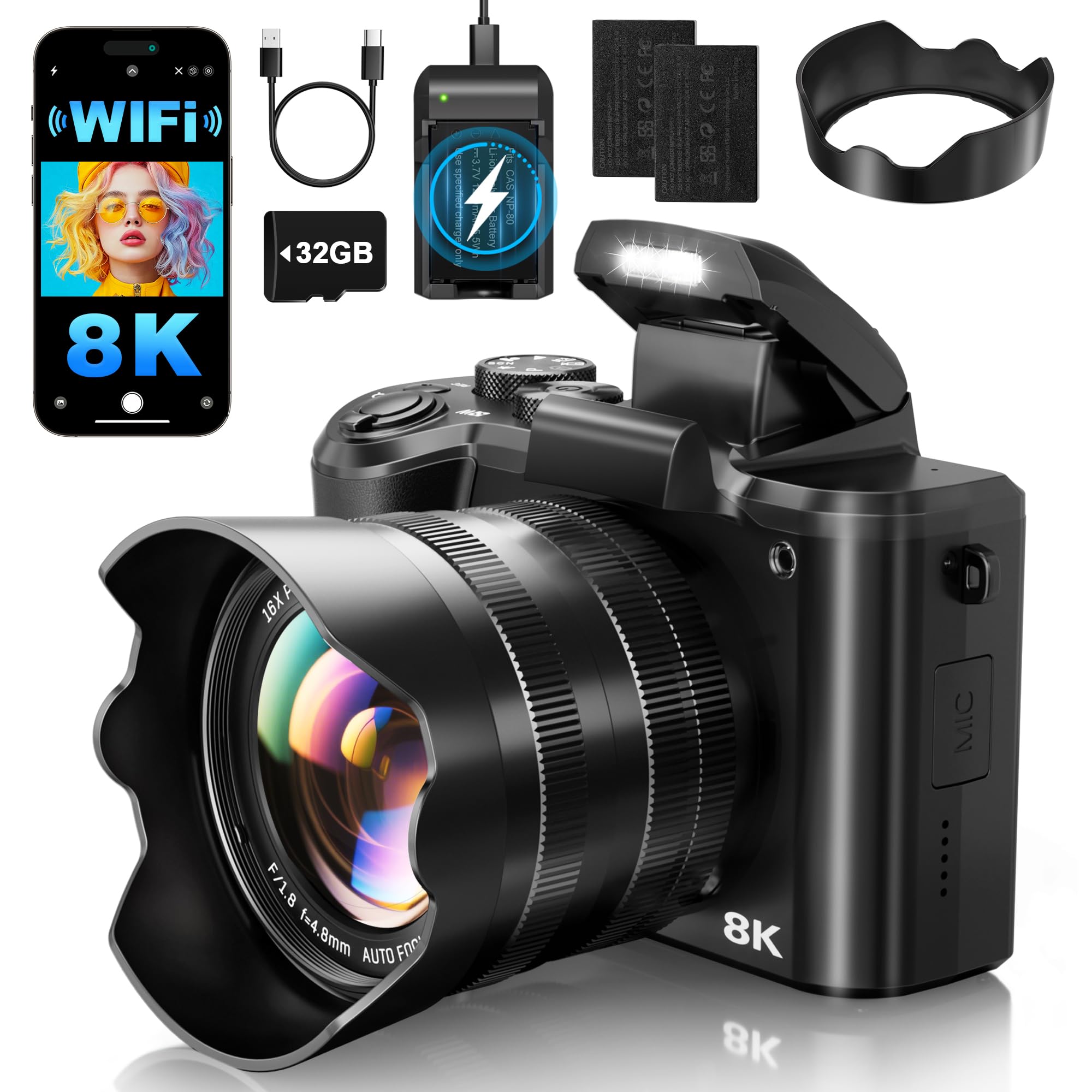
The XNSIAKXA 8K camera earns its spot by offering a surprisingly robust autofocus system for this price tier. It lists phase detection, contrast detection, face detection, and eye detection — a combination that usually only appears on much more expensive bodies. Users consistently report fast, accurate AF in well-lit conditions, which is the first thing that fails on cheap cameras. The 8K video and 88MP photo outputs follow the same interpolated pattern as other models, but the real-world sharpness is a step above.
The 3.2-inch IPS touchscreen is responsive, and the 360-degree rotary dial makes mode switching intuitive. It supports timelapse, slow motion, and a variety of scene presets. The dual-lens design and included 32GB SD card, two batteries, lens hood, and camera bag make this a complete grab-and-go solution. The 6-axis stabilization helps, and the built-in LED flash is effective for close-range low-light shots.
The primary downsides are the lack of any manual focus ring and a battery that lasts around 150 minutes on a full charge, which is average for this class. A few users reported autofocus inconsistency in dim lighting. For the price, the combination of fast AF and 8K capability is rare. This is the best option if you want a cheap camera that prioritizes autofocus speed for capturing moving subjects like kids or pets.
Why it’s great
- Advanced autofocus with phase, face, and eye detection
- Includes two batteries, lens hood, and carrying bag
- Intuitive 360-degree rotary dial for quick mode changes
- Solid sharpness in good lighting conditions
Good to know
- No manual focus option limits creative control
- Battery life is adequate but not exceptional
- Autofocus struggles in low light
4. Kodak PIXPRO AZ255-BK

The Kodak PIXPRO AZ255 is a bridge camera that genuinely belongs in the “superzoom” category. A 25X optical zoom is an entirely different animal from the 16X digital zoom found on other budget models, and it is the standout feature here. You can capture wildlife at a distance, stage performers, or detailed landscape shots without losing image quality. The 24mm wide-angle end is useful for group shots and architecture. Optical image stabilization (OIS) helps keep those long shots steady.
The 16MP CMOS sensor is a real, non-interpolated sensor, producing clean 16:9 and 4:3 images. It records 1080p Full HD video, which is standard for this price band, but the footage is sharp due to the optical zoom. The 3-inch LCD screen is adequate for composition. It operates on AA batteries, which is a trade-off: battery life is shorter than a lithium pack, but you can swap in fresh AAs anywhere, which is incredibly convenient for long trips where charging is not an option.
Do not expect professional low-light performance; the small sensor and variable aperture lens need good daylight to shine. The camera is larger than a compact and will not fit in a pocket. It is not a vlogging camera. But if the primary need is raw optical reach on a budget, the AZ255 is unmatched on this list. The zoom quality reviewers describe as “clean without distortion” confirms this is a purpose-built tool for distance shooting.
Why it’s great
- 25X optical zoom is exceptional for this price range
- Genuine 16MP sensor without interpolation
- Optical image stabilization for steady telephoto shots
- AA batteries are easy to replace on the go
Good to know
- No autofocus system — fixed-focus lens
- Large body won’t fit in a pocket
- Low-light performance is limited
5. Canon EOS Rebel G (35mm Film)

This is not a digital camera. The Canon EOS Rebel G (sold as the EOS Kiss in Japan) is a 35mm film SLR from the 1990s. For the growing number of photographers returning to film for its unique color rendering and discipline, this is a fantastic entry point. It is a renewed model that includes the 35-80mm EF lens, meaning it uses the same EF mount as Canon’s professional film and digital SLRs, giving you access to a huge ecosystem of used lenses.
The Rebel G features reliable autofocus for its era, a built-in flash, and multiple shooting modes including aperture and shutter priority. This gives you control over depth of field and motion blur without needing a fully manual process. The ISO range of 100-3200 covers most daylight and indoor situations. The camera runs on a single 2CR5 battery, which is still widely available. Users consistently report the renewed units arrive in excellent condition with working electronics and clean lenses.
The obvious catch is that you need to buy and develop film, which adds a recurring cost. There is no LCD screen to review shots. You will not get instant results. But the image quality from a real 35mm negative with an optical EF lens is superior in dynamic range and grain character to any sub- digital camera on this list. If the tactile process of film photography is your goal, this is the most rewarding cheap camera on the market.
Why it’s great
- Full-frame 35mm image quality with beautiful natural grain
- Uses Canon EF lenses — huge, affordable second-hand selection
- Works well as a mechanical backup camera
- Built-in flash and reliable autofocus for the era
Good to know
- Ongoing cost of film and development
- No instant review or image preview
- Renewed product — cosmetic wear may be present
6. Saneen 4K Digital Camera

The Saneen 4K stands out for its 4.0-inch touchscreen, which is larger and more responsive than the typical 2.8 or 3.2-inch screens on competing budget cameras. This makes navigating menus, reviewing photos, and framing shots noticeably easier, especially for older users or beginners who prefer touch controls over physical buttons. It records in 4K and multiple lower resolutions, and captures photos at claims up to 64MP with selectable lower options for saving storage.
The included 3000mAH lithium battery is a significant advantage. While the camera body uses a fixed focal length lens with an average aperture, the battery life supports full-day shooting for casual use. The camera doubles as a webcam via USB, and the WiFi function pairs with a phone app for quick transfers. The bundle includes a lens hood, 32GB card, and a carrying bag, adding practical value without extra cost.
Image quality is average for the price — good in daylight but soft in low light, and some users reported that final images on a computer lack the sharpness seen on the camera screen. The touchscreen responsiveness is excellent, making this a strong pick for those who value ease of use and screen quality above absolute image performance. It is a comfortable, user-friendly device for daily snapshots and family documentation.
Why it’s great
- Large 4.0-inch touchscreen for easy navigation
- High-capacity 3000mAh battery for extended use
- Functions as a USB webcam for streaming
- Complete bundle with bag, hood, and card
Good to know
- Image softness and noise in low light
- Images on computer may look worse than on screen
- Fixed focal length lens limits framing flexibility
7. Nsoela 5K WiFi Digital Camera
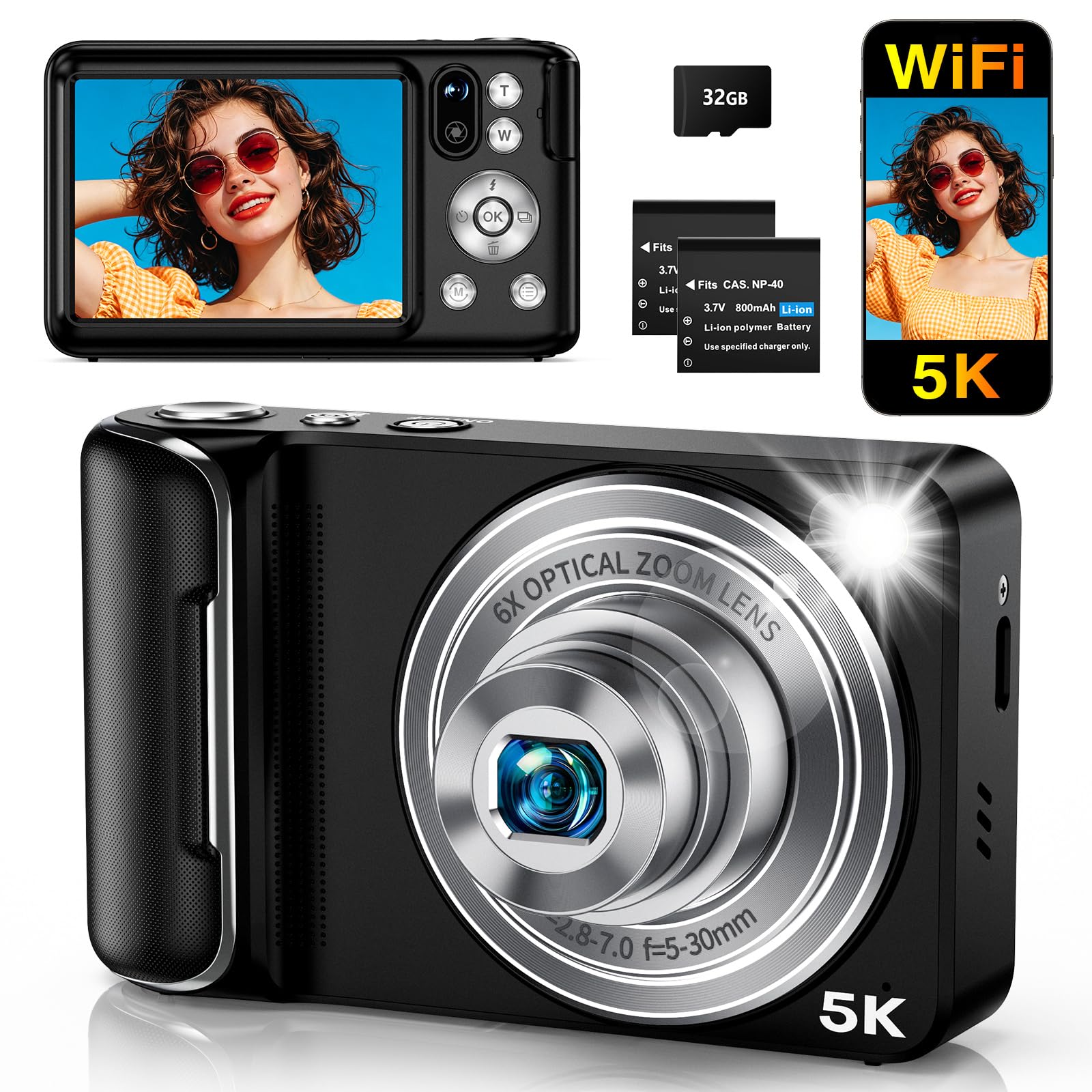
The Nsoela 5K packs a true 6X optical zoom lens into a compact body that is genuinely pocketable. This optical zoom, combined with a 5K (5120×2880) video standard and 64MP stills, puts it above the pure digital-zoom alternatives. The built-in WiFi is a major convenience, allowing you to transfer original-quality photos and videos to your phone via the Viipulse app without needing a card reader. The 2.8-inch IPS touchscreen is smaller than the Saneen but still supports pinch-to-zoom gestures for easy review.
The kit comes with two rechargeable lithium-ion batteries and a 32GB card, ensuring you can shoot all day without running out of power or storage. The dual-lens design makes selfie and vlog shooting straightforward, and the dust-resistant lens cover auto-opens, removing the hassle of a separate cap. The record-while-charging feature is rare at this level and allows continuous recording when connected to a power bank, which is excellent for time-lapse or long events.
Some units have reported autofocus inconsistency and an occasional zoom mechanism jam, but the majority of reviews praise the image quality, ease of use, and value. The WiFi implementation works reliably, which cannot be said for all budget cameras. This is the best option for travelers who want optical zoom, wireless file sharing, and a truly portable form factor.
Why it’s great
- Genuine 6X optical zoom for detailed distance shots
- WiFi for instant photo transfer to smartphone
- Record-while-charging for uninterrupted video
- Includes two batteries, 32GB card, and auto-lens cover
Good to know
- Occasional autofocus reliability issues reported
- Zoom mechanism may jam on some units
- Smaller screen than some competitors
8. Jukanur 5K Digital Camera
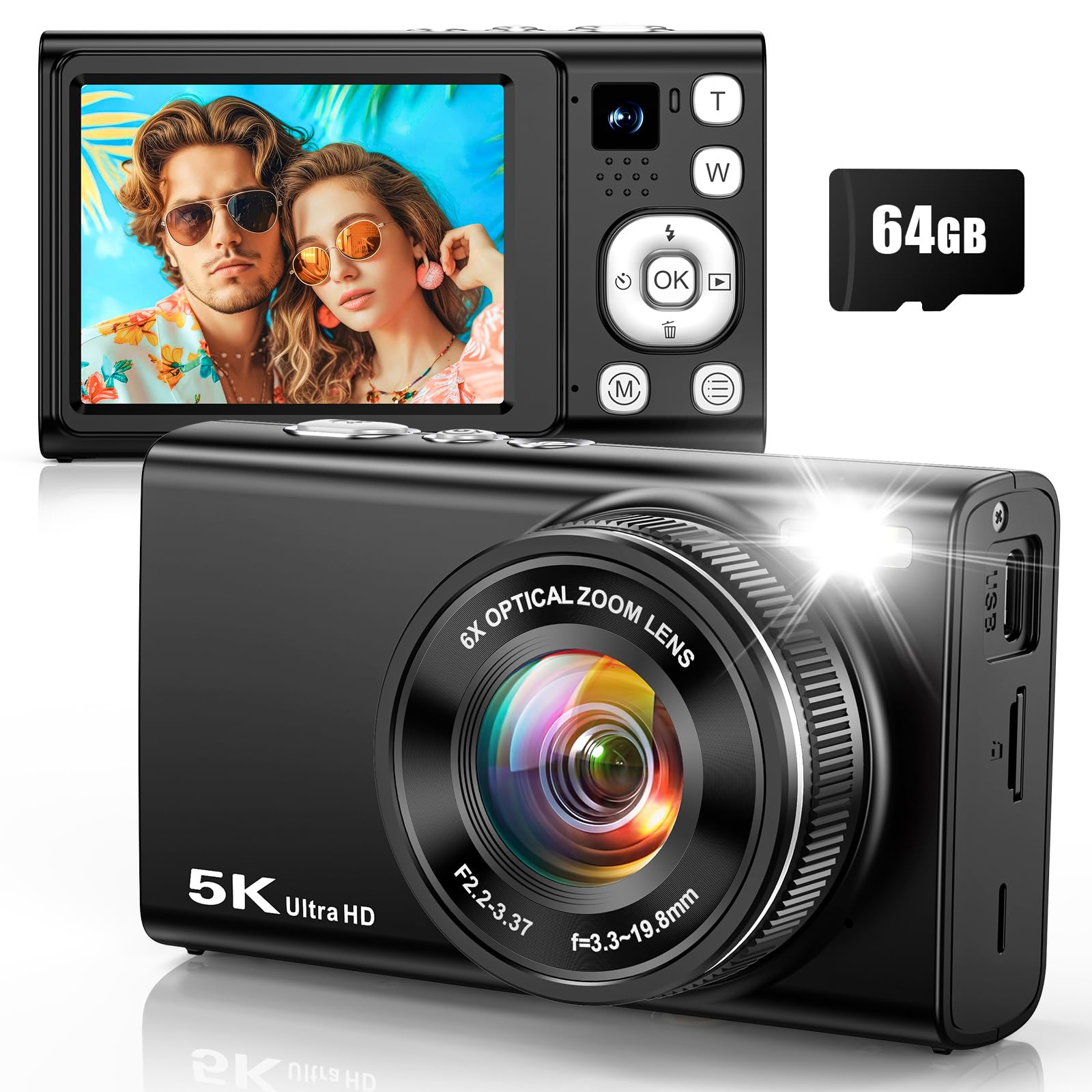
The Jukanur 5K is the entry-level champion of this list. It combines a 6X optical zoom lens with an IMX415 CMOS sensor that records true 5K video and captures stills up to 96MP via interpolation. For the price, the value proposition is undeniable. The dual-lens design supports selfie shooting, and the built-in flash plus anti-shake make it usable in low-light and fast-motion situations without immediately failing. The camera supports webcam mode, time-lapse, and slow-motion recording.
This model ships with a 64GB micro memory card, which is double the capacity of most competitors at this price. The battery is built-in and charged via the included adapter and USB cable, so there is no separate battery to install or misplace. The body is incredibly lightweight and compact, designed for slipping into a bag for travel, camping, or daily carry. All core controls are accessible through a straightforward interface that reviewers describe as beginner-friendly and easy to master quickly.
The main compromises are the fixed lens and the built-in battery that cannot be swapped when it drains. Some users report that battery life is limited to a couple of hours of active use, which is acceptable for casual outings but not for all-day events. The autofocus is contrast-detection and can struggle in very dim conditions. For the absolute lowest cost of entry with a real optical zoom lens, this is the most feature-complete package available.
Why it’s great
- 6X optical zoom preserves detail at a distance
- Includes a generous 64GB memory card
- Ultra-lightweight and travel-friendly design
- 5K video resolution for this price point is rare
Good to know
- Non-removable battery limits shooting time
- Autofocus struggles in low-light settings
- Fixed lens with no interchangeable option
9. Minolta MND20 Digital Camera
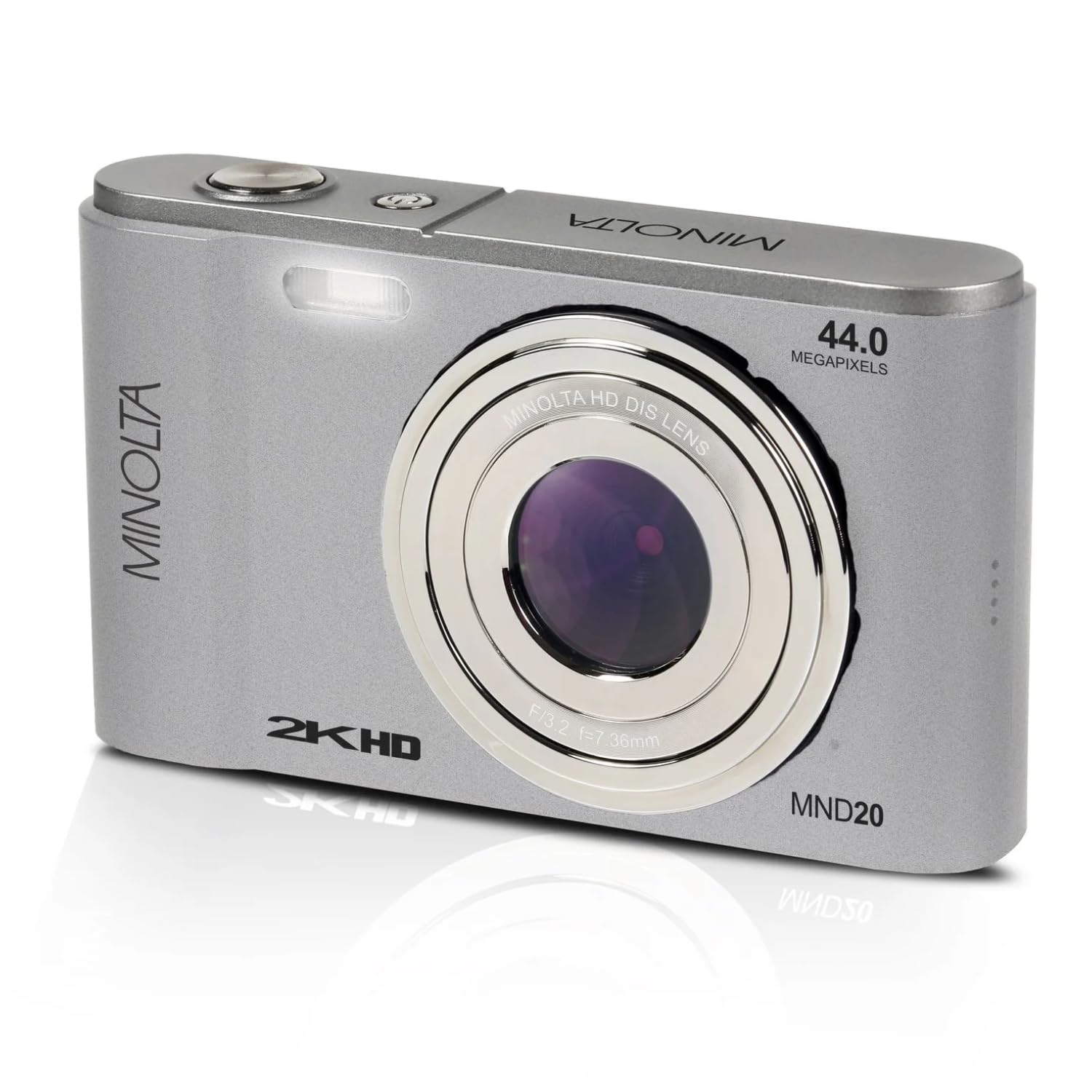
The Minolta MND20 is a pure entry-level novelty camera. It offers a 44MP interpolated sensor, 16X digital zoom (which is just cropping), and 2.7K Quad HD video recording. It is not a tool for serious photography, but as a fun, low-stakes camera for kids, teens, or complete beginners, it has a simple appeal. The articulating 2.9-inch LCD screen is a nice touch, allowing for creative angles and selfies without a separate selfie lens.
The camera features built-in digital image stabilization, face detection, time-lapse, and a selection of color filters. These are all the kinds of features a younger or casual user will play with immediately. The body weighs only 8 ounces, making it one of the lightest on the list. It includes a built-in flash and runs on the included battery, though users report the battery drains faster than average. The 16X digital zoom is basically useless for any serious distance work, as it just degrades the image.
The real-world performance is significantly below the advertising. Actual image metadata shows a native 12MP sensor, not 44MP. Low-light photos are noisy, and the fixed F3.2 aperture lens limits its versatility. It is not a replacement for an old smartphone or a decent point-and-shoot. For an adult wanting a primary camera, skip this. But as an inexpensive, lightweight, and feature-stuffed gadget for a child’s first camera, it is functional and easy to use.
Why it’s great
- Very lightweight and compact for easy carrying
- Articulating screen for flexible composition
- Includes fun features like filters and time-lapse
- Very low cost of entry for a dedicated camera
Good to know
- Native sensor is only 12MP, not 44MP as advertised
- Digital zoom degrades image quality significantly
- Poor low-light performance with heavy noise
- Short battery life
FAQ
Is a 5K or 8K cheap camera actually recording in true 5K or 8K?
Why do cheap cameras often blur my photos?
Can I use a cheap camera as a webcam?
Final Thoughts: The Verdict
For most users, the best cheap camera winner is the Canon EOS R100 because it offers a true 24.1MP APS-C sensor and an interchangeable lens mount, providing the highest image quality and room to grow at the top end of the budget. If you want long-distance optical reach without breaking the bank, grab the Kodak PIXPRO AZ255. And for the absolute best value starter pack with a real optical zoom and a huge 64GB card, nothing beats the Jukanur 5K.

Mo Maruf
I created WellFizz to bridge the gap between vague wellness advice and actionable solutions. My mission is simple: to decode the research and give you practical tools you can actually use.
Beyond the data, I am a passionate traveler. I believe that stepping away from the screen to explore new environments is essential for mental clarity and physical vitality.