Our readers keep the lights on and my smoothie glass nicely filled. As an Amazon Associate, I earn from qualifying purchases.
Specs are compiled from manufacturer listings and verified buyer reviews and can change over time — please confirm the key details on the product page before buying.
Starting a YouTube channel on a tight budget means every dollar has to pull double duty. You need a camera that delivers clean video, doesn’t terrify you with complicated menus, and won’t leave you scrambling for a charger mid-shoot.
I’m Mohammad Maruf — the founder and writer behind WellFizz. This guide is built by comparing the manufacturers’ published specifications and the patterns across verified customer reviews, so you get each pick’s real strengths and trade-offs instead of marketing spin.
You want a camera that makes your YouTube videos look good without costing a fortune. These picks give you clear, watchable footage for your first vlog or travel content, and each one earns its spot for a specific reason.
Our Picks at a Glance
How To Choose The Best Cheap Camera For YouTube
A budget YouTube camera has to balance resolution, battery stamina, and ease of use. Here is what to focus on before hitting add to cart.
Video Resolution and Frame Rate
You want 4K resolution at 30fps (frames per second) for a cheap YouTube camera — that resolution lets you crop and reframe your shot in editing without losing sharpness. 8K sounds better, but at this budget it usually drops to a very low frame rate like 15fps, which makes motion look choppy. Stick with 4K at 60fps or 30fps for smooth video that is ready to upload.
Battery Life and Included Storage
The biggest hidden cost with budget cameras is buying extra batteries and memory cards later. Check if the camera comes with at least two batteries and an SD card. A camera that claims 7 hours of recording saves you from needing a power bank on a full day of shooting.
Stabilization and Gimbal
Handheld YouTube footage without stabilization looks distracting. You have two options: electronic image stabilization (EIS) built into the camera, or a physical 3-axis gimbal that keeps the camera level as you move. A built-in gimbal delivers smoother results for walking and panning shots, while EIS can introduce a slight crop to your frame.
Quick Comparison
| Model | Best For | Max Resolution | Battery Life | Stabilization Type | Amazon |
|---|---|---|---|---|---|
| OLESIT 8K Camcorder★ Best Overall | Studio & Tabletop Recording | 8K (7168x4032p) / 15fps | Two 1500mAh batteries | Anti-shake (EIS) | Amazon |
| Eddioklp 8K CameraBest Value | Travel Vlogging | 8K | 200 minutes | Anti-shake (EIS) | Amazon |
| SJCAM C400 | POV & Outdoor Action | 4K UHD | 7 Hours | 6-Axis EIS | Amazon |
| Xtra Muse | Cinematic Handheld Vlogs | 4K / 120fps | 161 minutes | 3-Axis Gimbal | Amazon |
| Canon PowerShot V10 | Pocket-Sized Simplicity | 4K / 30fps | ~1-2.5 hours (user reports) | Movie IS (Optical/EIS) | Amazon |
In‑Depth Reviews
1. OLESIT 8K 64MP Video Camera Camcorder
The surprise 8K camcorder that delivers far more than its price suggests.
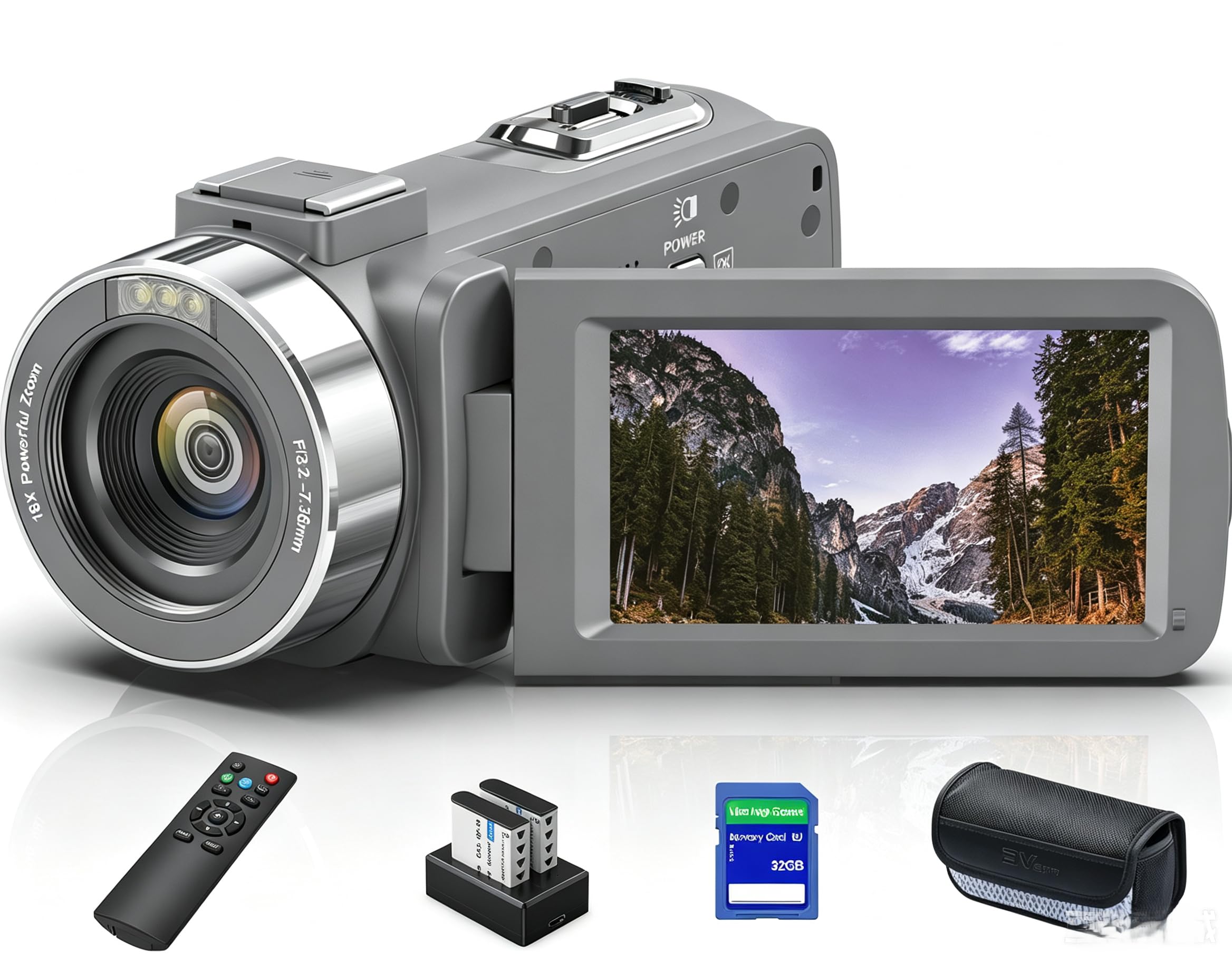
The OLESIT is the crowd favorite, with every owner review rating it at the top. It shoots at a real 8K resolution (7168x4032p), though the frame rate sits at 15fps, so it is more suited to stationary tabletop videos or talking-head content than fast action. Drop down to 4K at 60fps and you get smooth, detailed footage that looks terrific for a camera in this price bracket.
The kit is aggressively generous. You get two 1500mAh lithium batteries, a 32GB SD card, a 2.4G remote control, and a camera bag. One battery runs down and you swap in a fresh one without hunting for a wall socket — a real time-saver during a long recording session. The 3.0-inch IPS touch screen flips around for vlogging, and the included infrared night vision works well enough to capture clear black-and-white footage in a dark room.
The catch is the digital zoom — at 18X, you are not getting optical reach, so image quality drops the further you push in. Owners call it “great quality” and “worth the money,” praising its good color quality and extended runtime from dual batteries. For indoor, tripod-based, or controlled setups, this camera punches above its weight.
What Wins People Over
- 8K and 4K/60fps recording options give you flexibility in editing.
- Two included batteries plus a 32GB SD card mean you are ready to shoot immediately.
- Infrared night vision and a fill light let you record in low-light environments without extra gear.
- WiFi support and a remote control make hands-free operation simple.
The Real Trade-Off
- 8K mode runs at just 15fps, so fast motion appears choppy.
- Digital zoom degrades image quality — stick to optical framing for best results.
- Requires a Class 10 SD card (or above) for reliable 4K recording, though one is included.
Perfect for: beginner YouTubers shooting from a desk or tripod who want maximum resolution for the lowest cost.
Think twice if: you need smooth handheld walking shots or fast autofocus — the digital zoom and EIS are not a gimbal replacement.
2. Eddioklp 8K Digital Camera with WiFi & 180° Flip Screen
A lightweight travel companion with a bright F1.8 lens and a generous included memory card.
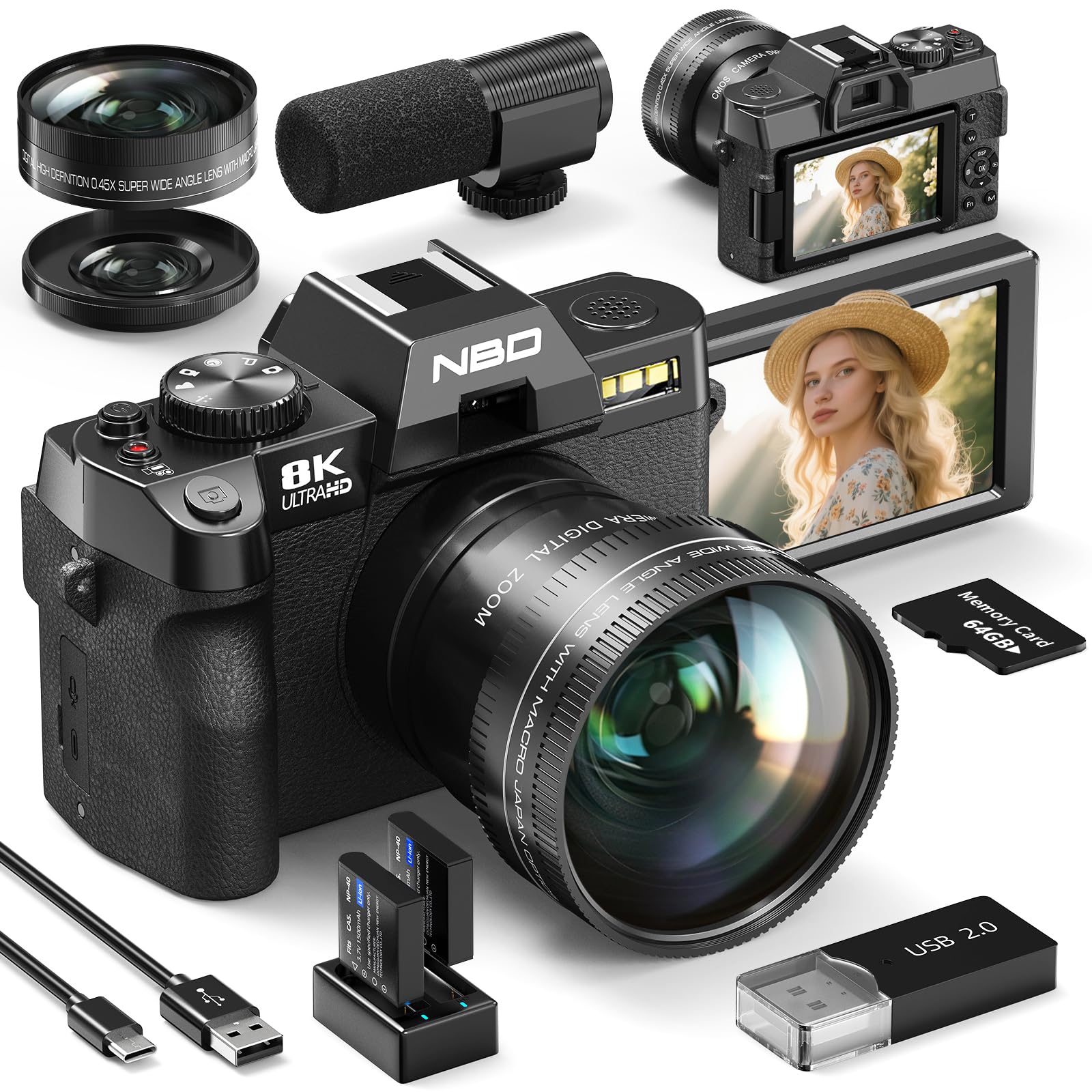
The Eddioklp is priced almost identically to the OLESIT but targets a different shooter — the person who wants to carry their camera in a backpack all day. It weighs very little, feels compact, and the 180-degree flip screen makes self-recording straightforward. The F1.8 aperture lens lets in a lot of light, so you get usable footage in dim indoor settings without reaching for a studio lamp.
This camera ships with a 64GB TF card, so you can start recording the moment you open the box. The battery is rated for 200 minutes of continuous recording, and the included USB Type-C charging port means you can top it up with the same cable your phone uses. The 16X digital zoom, combined with wide-angle and macro modes, makes this a more versatile pick for travel vlogs where you might shoot a landscape one minute and a close-up of a menu the next.
The WiFi and companion app let you transfer files to your phone for a quick edit on the go, though the transfer speed is not as fast as the SJCAM’s 5G WiFi. On the video side, it records 8K and 4K, and buyers report that the autofocus is quick and the button layout is easy to learn. Buyers describe it as a “good camera for school trips” and a “perfect camera for travel” — the common thread is that it is simple, lightweight, and works without frustration.
Standout Feature: the F1.8 aperture is rare at this price — it gives you noticeably brighter footage in ordinary room light than the competition.
Watch Out: the camera has no built-in flash, so if you need to freeze a scene in total darkness, you will need an external light source.
Grab this if: you want the most complete starter bundle — a large memory card, flip screen, and a fast lens for low-light shooting.
skip it if: you rely on flash photography or need the rugged waterproofing of an action camera for outdoor vlogs.
3. SJCAM C400 4K Travel Vlogging Camera
The action-camera-style vlog rig that keeps running from sunrise to sunset.
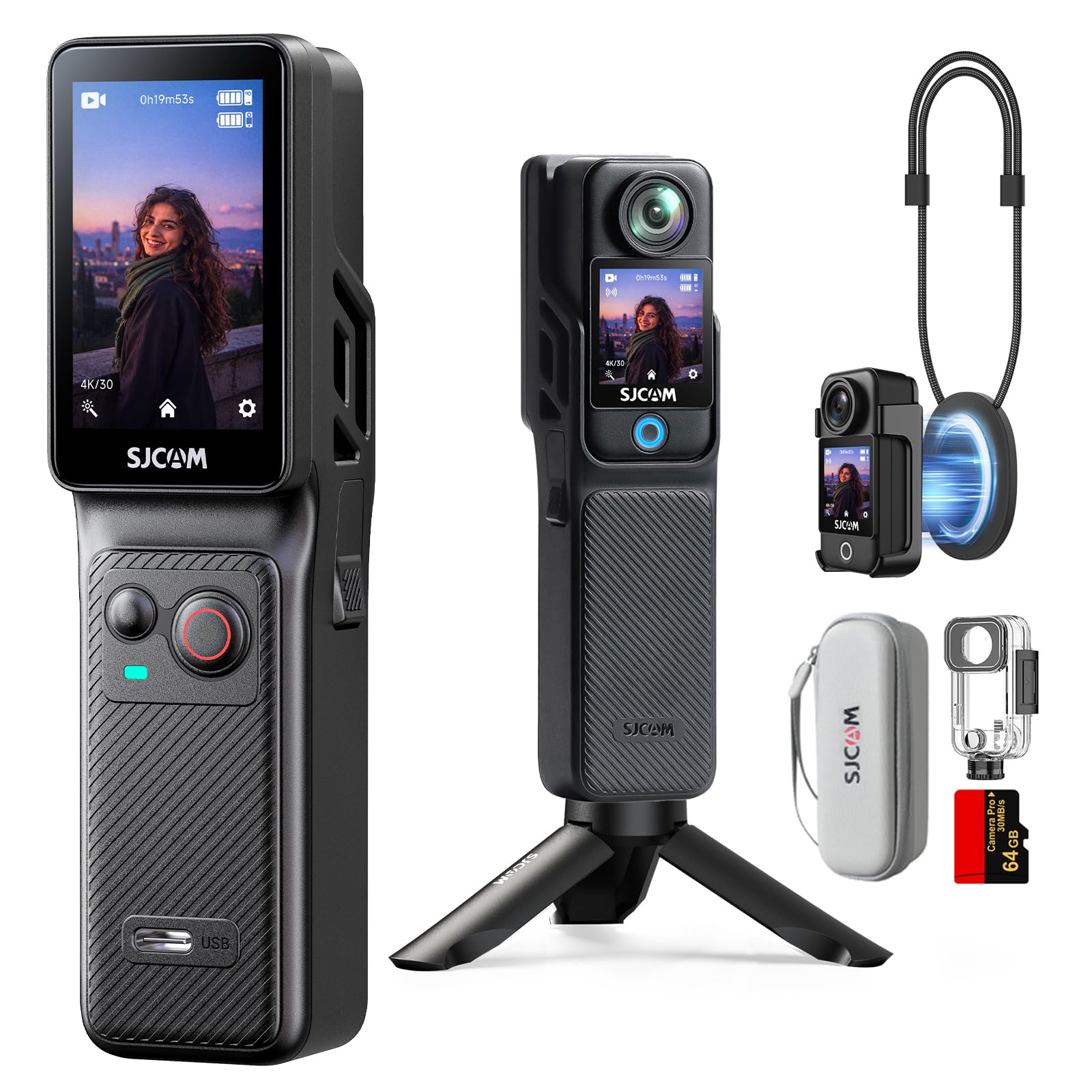
The SJCAM C400 takes a completely different approach. It is an action camera form factor — small, wearable, and waterproof to 30 meters — but it is designed specifically for vloggers and content creators. The headline feature is the 7-hour (460-minute) battery life, which genuinely lets you shoot a full day of POV footage without stopping. If you record walking tours, outdoor adventures, or hands-free cooking videos, this is the one that keeps rolling.
Video quality is 4K Ultra HD through a 154-degree distortion-free wide-angle lens with an f/2.0 aperture. The 6-axis electronic image stabilization (EIS) smooths out the shake from walking or biking, and the horizon correction keeps your footage level even when the camera tilts. It also comes with a detachable handheld controller that lets you preview and adjust settings wirelessly — useful when the camera is mounted on a helmet or chest strap and you cannot reach the buttons.
Connectivity is a strength here: the 5G WiFi module transfers large 4K files to your phone noticeably faster than the standard 2.4GHz WiFi on most budget cameras. The included accessory kit (waterproof housing, handlebar mount, helmet base) means you can take it straight into the water or onto a bike without buying extra parts. The trade-off is that audio quality gets mixed feedback — some owners find it fine after adjustment, others describe it as poor. An external microphone is a smart addition if sound matters to your channel.
What the reviews reveal: camera quality is the most-praised aspect by a wide margin, and the value for money ranks second. Reliability and audio quality are more mixed, so check the return policy if you are sensitive to sound.
Heads up: the SD card slot can be finicky — a few owners found the card would not click in until they pushed it firmly with a tool. It works, but it is not the smoothest mechanism.
Best suited for: outdoor creators, travel vloggers, and anyone who records POV content where changing a battery is impractical.
Not your camera if: you prioritize studio-quality audio or need a traditional camcorder grip for desk-based recording.
4. Xtra Muse Vlogging Camera with 1″ CMOS & 3-Axis Gimbal

Pocket-sized 4K with a built-in gimbal that rivals cameras costing twice as much.
The Xtra Muse packs a 1-inch CMOS sensor and a physical 3-axis gimbal into a pocket-sized body. The 3-axis gimbal mechanically stabilizes the camera during walking, running, or spinning, producing footage that rivals far pricier rigs. The 1-inch sensor also captures more light than the smaller sensors in the other budget picks, which translates to cleaner video in dusk or indoor environments.
It records 4K video at up to 120fps, which lets you slow down footage by 4x in editing for smooth, cinematic slow-motion. The face and object tracking is reliable — you mount it on a tripod, start recording, and the camera follows you as you move around the frame. The 2-inch touch screen is intuitive, and the 10-bit X-Log color mode gives you a flat color profile that holds up well in post-production grading.
The battery lasts 161 minutes, which is shorter than the SJCAM’s 7 hours, so a power bank or charging during a break is wise on a full day of shooting. Owners consistently praise the build quality and video sharpness, calling it a near-identical experience to a popular DJI model. The gimbal earns the most praise for its smooth operation.
What improve It
- Physical 3-axis gimbal eliminates the jitter that EIS cannot fully correct.
- 1-inch CMOS sensor and 4K/120fps deliver pro-grade slow-motion capability.
- Face and object tracking keeps you in the frame automatically.
- 10-bit X-Log color profile allows professional color grading in editing.
The Catch
- Battery life at 161 minutes is solid but not all-day — plan a midday charge.
- Microphone connectivity is a mixed area; some owners found it finicky without an update.
- It is the most expensive pick in this list, so it stretches the “cheap” definition.
Choose this for: the smoothest handheld footage you can get without spending big — the gimbal makes walking shots look like they were on tracks.
Look elsewhere if: your budget is strictly under or you need a camera for hours of continuous, unplugged recording in the rain.
5. Canon PowerShot V10 Compact Vlogging Camera

Canon’s pocket vlogger with a 1-inch sensor and a built-in stand — no tripod required.
The Canon PowerShot V10 is the most famous name on this list, and it earns its reputation with a 15.2-megapixel 1-inch back-illuminated CMOS sensor that delivers excellent low-light performance. It is also the smallest camera here — it fits in a fanny pack — and the built-in folding stand means you can set it on a table and start recording without hunting for a tripod. The fixed 19mm wide-angle lens (35mm equivalent) captures a broad field of view, perfect for a single-person vlog where you are the frame.
Video recording tops out at 4K at 29.97fps with 8-bit color, and the three image stabilization modes (IS Off, IS On, IS Enhanced) are available after a firmware update. It has a pair of stereo microphones plus a third center mic that helps filter out background noise, and there is an external microphone auxiliary port (3.5mm) for better audio. The retractable front-facing 2.0-inch touch screen flips up so you can see yourself while recording — a simple but crucial feature for solo creators.
The biggest limitation is the lack of a zoom lens — it is a fixed wide-angle, so you cannot zoom in on a subject without cropping in post. Battery life is another point where opinions diverge: some owners mention it is good for a full day of short clips, while others say it dies within 1 to 2.5 hours of continuous recording. Owners consistently praise the video quality and compact size, and the common verdict is that it is an easy, high-quality starter camera that is “best for recording videos.”
The standout spec: the 1-inch back-illuminated CMOS sensor is the same size found in much more expensive cameras, giving you noticeably cleaner footage in low light than the 1/2.3-inch sensors in the other budget options.
Know this going in: no optical zoom and no included memory card — you will need a microSD card and a separate case or lens cover (the exposed lens picks up fingerprints easily).
Ideal for: absolute beginners who want a dead-simple vlogging camera from a trusted brand, no tripod required, and who prioritize portability above all else.
Not for: anyone who needs zoom reach, shoots longer than 2.5 hours straight, or wants a built-in memory card in the box.
Understanding the Specs
Sensor Size: 1-Inch vs 1/2.3-Inch
The image sensor is the part of the camera that captures light. A 1-inch CMOS sensor (found in the Xtra Muse and Canon V10) is physically larger than the 1/2.3-inch sensors in most budget camcorders. A larger sensor lets in more light, which means cleaner, less grainy video when you are shooting indoors or at dusk. The trade-off is that cameras with 1-inch sensors tend to cost more and are often more specialized — you get better image quality, but you might lose features like a zoom lens.
Stabilization: Gimbal vs EIS
Stabilization keeps your video from looking like an earthquake hit it. Electronic Image Stabilization (EIS) uses software to crop and smooth the frame — it works, but it can make your footage look a little wobbly during fast movement. A 3-axis gimbal (like the one in the Xtra Muse) is a physical motorized mount that keeps the camera level. It costs more but delivers much smoother results for walking, running, or panning shots. For a YouTube channel with handheld footage, a gimbal is the upgrade that makes the biggest visible difference.
FAQ
Can I really use an 8K camera for YouTube on a budget?
How important is a flip screen for vlogging?
Do I need an external microphone with these cameras?
Which camera has the longest battery life for a full day of shooting?
Is a gimbal worth paying extra for on a cheap YouTube camera?
Will a cheap camera limit my video quality for YouTube?
What memory card speed do I need for 4K recording?
Can I use these cameras as a webcam for live streaming?
Final Thoughts: The Verdict
For most people, the best cheap camera for YouTube winner is the OLESIT 8K Camcorder because it packs the highest resolution, a complete starter kit with two batteries, and the strongest owner satisfaction in this price range. If you want smooth handheld footage without spending big, grab the Xtra Muse for its gimbal and 1-inch sensor. And for all-day outdoor POV content, the SJCAM C400 is the one to reach for — its 7-hour battery and waterproof design let you shoot from sunrise to sunset without a single pause.
How We Picked
We do not accept paid placement. Every pick is matched to a real buyer and a real use-case; we do not hands-on test units.
Sources & Methodology
Specifications: manufacturer listings and product documentation. Review insights: verified customer reviews, as of July 2026. Pricing: not shown on this page (it changes often); check the current price via the retailer link.
As an Amazon Associate, WellFizz earns from qualifying purchases. This does not affect which products we feature.
Related Guides

Mo Maruf
I created WellFizz to bridge the gap between vague wellness advice and actionable solutions. My mission is simple: to decode the research and give you practical tools you can actually use.
Beyond the data, I am a passionate traveler. I believe that stepping away from the screen to explore new environments is essential for mental clarity and physical vitality.