Our readers keep the lights on and my smoothie glass nicely filled. As an Amazon Associate, I earn from qualifying purchases.
The difference between a muddy, bitter cup of coffee and a bright, flavorful one comes down to one thing: how evenly your beans are ground. Blade grinders chop beans into random shards, while a burr grinder produces uniform particles that extract consistently. The challenge is finding that burr mechanism at an accessible price point without sacrificing the core mechanics that make burr grinding worthwhile.
I’m Mohammad Maruf — the founder and writer behind WellFizz. I’ve spent countless hours digging through build specs, burr geometries, and customer feedback to separate the true value contenders from the ones that just look like a deal.
Whether you are upgrading from a blade grinder or starting your home brewing journey, this guide breaks down the real-world performance and durability of every best cheap burr grinder option worth considering right now.
How To Choose The Best Cheap Burr Grinder
When the budget is tight, every component decision matters more. A cheap burr grinder is not just a small appliance — it is the single most impactful upgrade you can make to your coffee routine. But not every affordable option deserves your counter space. Here is what separates a real keeper from a frustrating paperweight.
Conical vs. Flat Burrs
Nearly every entry-level burr grinder uses conical burrs. They are cheaper to manufacture and produce a consistent grind that works well for pour-over, drip, and French press. Flat burrs are more common in high-end espresso grinders because they create a very narrow particle distribution, but they also cost more and generate more heat. For this price range, conical burrs are the right choice — just look for stainless steel rather than ceramic, as steel burrs stay sharp longer and resist chipping.
Grind Adjustment Range and Precision
The number of settings matters less than whether those settings are actually usable. A grinder with 40+ click stops means nothing if the steps are so wide that you cannot dial in between a fine drip and a medium pour-over. Look for a clear adjustment mechanism — either a numbered dial or a stepped ring that clicks into place. Manual grinders in this tier often give you finer control per dollar than electric ones, because the mechanism is simpler and has fewer loose tolerances.
Build Quality and Material Choices
At a lower price point, the grinder’s body tells you everything about its lifespan. All-metal construction — aluminum or stainless steel — resists cracking and keeps the burrs aligned over time. Plastic housings can flex under pressure, especially in manual grinders, which leads to uneven particle sizes. Check the central shaft too: dual ball bearings provide smoother, wobble-free rotation than plastic bushings. A grinder that feels solid in the hand will still be grinding evenly two years from now.
Quick Comparison
On smaller screens, swipe sideways to see the full table.
| Model | Category | Best For | Key Spec | Amazon |
|---|---|---|---|---|
| SHARDOR CG018 | Electric | Espresso & Multi-Brew | 51 grind settings | Amazon |
| TIMEMORE Chestnut C2S | Manual | Precision Manual Grinding | 38mm steel burr | Amazon |
| Tuni G1 | Electric | Versatile Home Brewing | 48 grind settings | Amazon |
| OXO Brew Compact | Electric | Space-Saving Counter Use | 15 settings + micro-adjust | Amazon |
| Cuisinart DBM-8P1 | Electric | High-Volume Drip Coffee | 18-position grind dial | Amazon |
| Alpaca Ventures Manual | Manual | Travel & Outdoor Use | Dual bearing design | Amazon |
| NewlukPro M6 | Manual | Budget Entry-Level Grinding | Hexagonal steel burr | Amazon |
In‑Depth Reviews
1. SHARDOR Conical Burr Espresso Coffee Grinder CG018

The SHARDOR CG018 punches far above its tier with a 40mm stainless steel conical burr and 51 precise grind settings that span from Turkish-fine to French press-coarse. Its touchscreen interface and precision timer allow you to dial in dose duration down to 0.1-second increments, which is rare at this price point. Users report consistent, clump-free grounds even with dark, oily beans, and the anti-static technology keeps the chute remarkably clean between uses.
The included portafilter cradle is a real time-saver for espresso workflows — you can grind directly into a 54mm or 58mm basket without using a dosing cup. After a year of near-daily use, the burrs show no wobble and the motor remains quiet and cool. The metal clips holding the hopper are the only fragile point, but the manufacturer honors warranty replacements without hassle.
For anyone who wants an electric burr grinder capable of proper espresso grinding without jumping to triple-digit pricing, the SHARDOR CG018 is the most feature-dense option available. It does what entry-level electrics should do — consistent particle size, easy cleaning, and reliable electronics — and nothing it does feels cheap.
Why it’s great
- 51 settings cover the full brew spectrum from espresso to cold brew
- Anti-static design keeps grounds from scattering across the counter
- Portafilter cradle enables direct dosing for espresso machines
Good to know
- Hopper retention clips feel lighter than the rest of the build
- Timer display is bright and cannot be dimmed
2. TIMEMORE Chestnut C2S Manual Coffee Grinder

The TIMEMORE Chestnut C2S is the upgraded version of the wildly popular C2, swapping the plastic top cap for a full metal unibody that eliminates the breakage issue of the original. At its heart sits a 38mm S2C stainless steel conical burr, CNC-machined to a 55–58 HRC hardness, which produces remarkably uniform particles with very few fines. The double bearing central axis keeps the handle spinning smoothly — so smoothly that it continues to rotate for a moment after you let go.
Grind adjustment uses a stepped nut with about 36 click positions, and the markings are easy to read against the black body. In practice, the C2S grinds 18g of beans for a V60 pour-over in roughly 30 seconds with minimal effort, and espresso-fine grinding takes about twice as long. The 25g capacity is perfect for single-batch brewing, and the whole unit weighs only 700g, making it genuinely portable for camping or travel.
The build quality here rivals manual grinders costing twice as much. The stainless steel burrs stay sharp, the grip is comfortable even for smaller hands, and disassembly for cleaning requires no tools. If you want manual grinding that feels precise and will not wear out, the Chestnut C2S is the benchmark for this price range.
Why it’s great
- Full metal unibody is more durable than the original C2 design
- Double bearings deliver wobble-free rotation and even grind
- Compact and lightweight enough for travel without losing stability
Good to know
- Adjustment nut is less convenient for frequent grind size changes
- 25g capacity requires refilling for larger batches
3. OXO Brew Compact Conical Burr Coffee Grinder

The OXO Brew Compact is built for people who want a quiet morning routine. At 11 inches tall and only 4 inches wide, it occupies remarkably little counter space, and its stainless steel conical burrs generate a low growl rather than the high-pitched shriek typical of blade grinders. The 15 main settings plus 29 micro-adjustments give you 44 total positions, allowing very fine control between standard brew methods — setting 7 is a reliable starting point for pour-over.
The hopper holds 50g of beans, enough for about six cups of coffee, and both the upper and lower burrs are removable for a thorough cleaning. Users note that a quick spritz of water on the beans before grinding nearly eliminates static cling, which is the only real mess factor with this model. The grounds container uses Tritan Renew material made from recycled content, which is a nice sustainability touch for the price.
Where the OXO Compact really shines is its daily-driver reliability — it is simple enough to operate without a manual, consistent enough to produce good results from the first grind, and quiet enough that you will not wake anyone up. For mid-range drip and pour-over drinkers who prioritize a small footprint and low noise, this is the electric grinder to beat.
Why it’s great
- Compact footprint saves counter space without sacrificing burr quality
- Quiet operation compared to most electric burr grinders
- Micro-adjustments allow fine-tuning between standard grind steps
Good to know
- Some static cling requires a spritz of water to fully control
- Not ideal for espresso grinding without some trial and error
4. Cuisinart DBM-8P1 Electric Burr Coffee Grinder
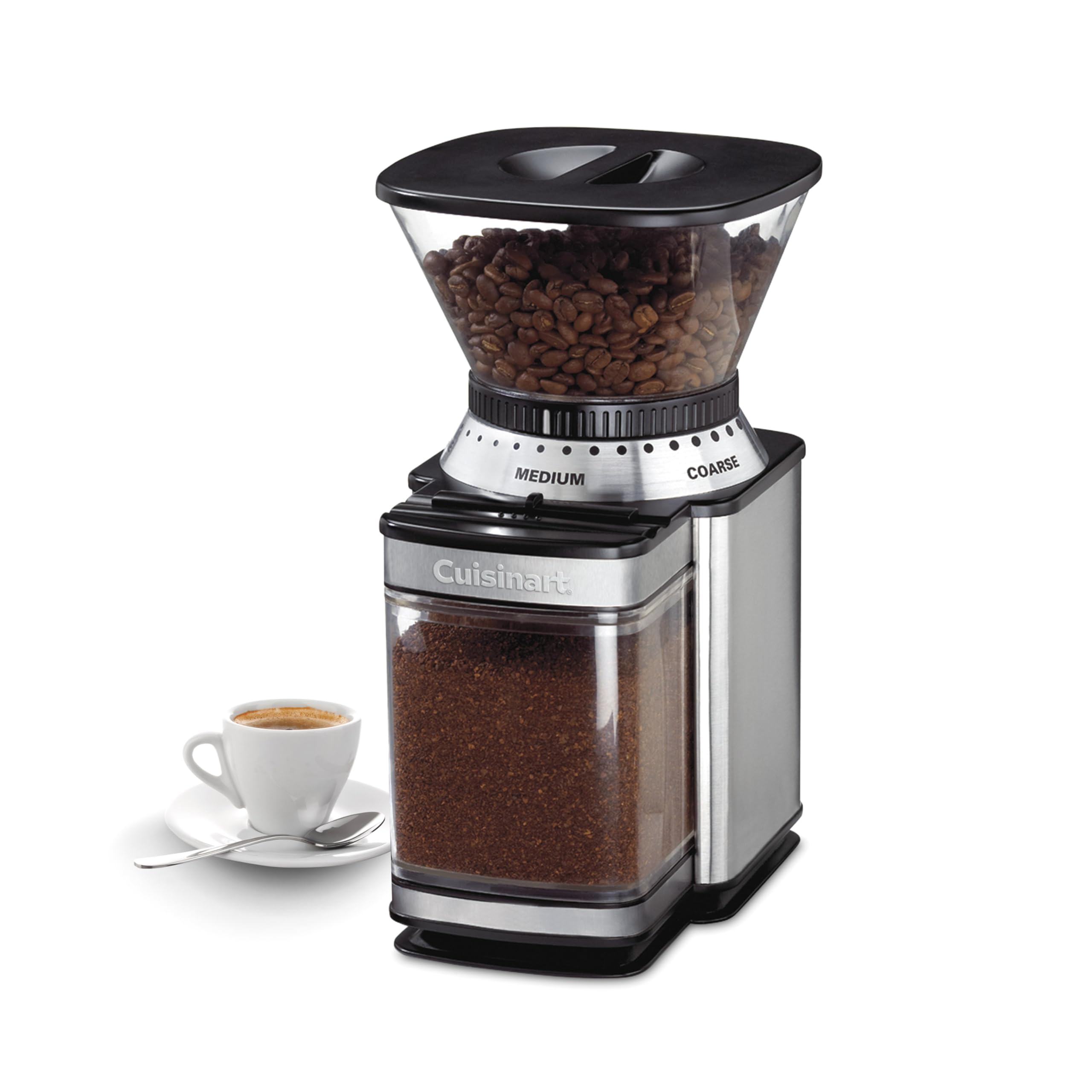
Its 18-position slide dial lets you go from ultra-fine to extra-coarse, and the 8-ounce bean hopper holds enough for a full family-sized pot. The grind chamber collects grounds for 4 to 18 cups, which is generous, and the one-touch power bar with auto shutoff makes operation foolproof.
Customer reviews consistently report a service life of 8 to 12 years with regular use, which is exceptional for an electric grinder at this tier. The grind consistency is noticeably better than any blade grinder, and the flat burr design delivers a more uniform particle size than some conical grinders at similar prices. The motor is loud — no way around it — and the plastic grind bin generates static that makes a mess, but a drop of water on the beans solves the static issue quickly.
For anyone brewing large batches of drip coffee or cold brew, the Cuisinart DBM-8P1 offers a proven track record of reliability that is hard to argue with. It is not the most refined grinder on the market, but it has outlasted multiple competitors in its class and remains the go-to choice for high-volume home brewers on a budget.
Why it’s great
- Proven long-term reliability with many units lasting 8+ years
- 18-position grind selector covers fine to extra-coarse effectively
- Large capacity is perfect for brewing 10+ cup carafes
Good to know
- Plastic grind bin creates static cling that scatters fines
- Operates loudly compared to newer models
5. Tuni G1 Conical Burr Coffee Grinder

The Tuni G1 brings a surprising level of precision to the entry-level electric segment. Its 40mm patented conical burr spins at a low 450 RPM, which minimizes heat transfer and static buildup — a common headache in cheap electric grinders. The 48 grind settings are clearly numbered, and the LED touchscreen lets you select between time-based and cup-based dosing with 0.5-second increments, up to 40 seconds total.
The 250g bean hopper is generously sized for a compact body, and the 75g dosing cup works well for single batches. A detachable portafilter holder accommodates 54–58mm baskets, making it espresso-ready for most home machines. Users report very low retention — around 0.1 to 0.2 grams — which is excellent at this price, and the included bellows help purge any remaining grounds from the chute. The stainless steel body features an anti-fingerprint finish that actually works.
For home brewers who want an electric burr grinder with espresso capability, a large hopper, and modern convenience features like a touchscreen and programmable timer, the Tuni G1 delivers remarkable value. It is slightly taller than the OXO Compact, but the extra hopper capacity and finer adjustment range make it a strong contender for households with multiple brew methods.
Why it’s great
- 48 grind settings provide unusually fine control for this price tier
- Low 450 RPM speed reduces heat and static compared to faster motors
- Portafilter holder works with standard 54-58mm espresso baskets
Good to know
- Light roast beans may need a DIY shim for proper fine grinding
- Touchscreen is bright and cannot be dimmed for dark kitchens
6. Alpaca Ventures Premium Manual Coffee Grinder

The Alpaca Ventures manual grinder uses a 420 stainless steel conical burr paired with a dual bearing system that keeps the cranking motion smooth and consistent. The handle is lengthened to provide extra leverage, which reduces the effort needed to grind through medium and dark roast beans. It offers 12 click settings arranged on a numbered dial, covering everything from Turkish fine to French press coarse.
The all-metal construction — aluminum body with stainless steel burrs — gives it a premium feel that belies its price. Disassembly requires a simple twist to separate the parts for cleaning, and the included brush reaches into the burr chamber effectively. Users report that 50 to 60 turns at setting 10 produce a consistent drip grind, and the burrs show no signs of misalignment after months of daily use.
One limitation is the lack of a rubber base, so the grinder can slide on smooth countertops if you do not hold it steady. It is also heavier than many manual grinders at this size, which actually helps with stability during grinding but makes it less ideal for ultralight backpacking. For car camping, weekend trips, or as a backup to an electric grinder, the Alpaca Ventures unit is a solid, affordable manual option.
Why it’s great
- Dual bearing design keeps the handle stable and the grind consistent
- 420 stainless steel burrs resist rust and stay sharp with regular use
- Easy twist-apart cleaning without needing tools
Good to know
- Lacks a rubber base, so it can slide on smooth surfaces
- Disassembly for deep cleaning is more involved than expected
7. NewlukPro M6 Manual Coffee Grinder
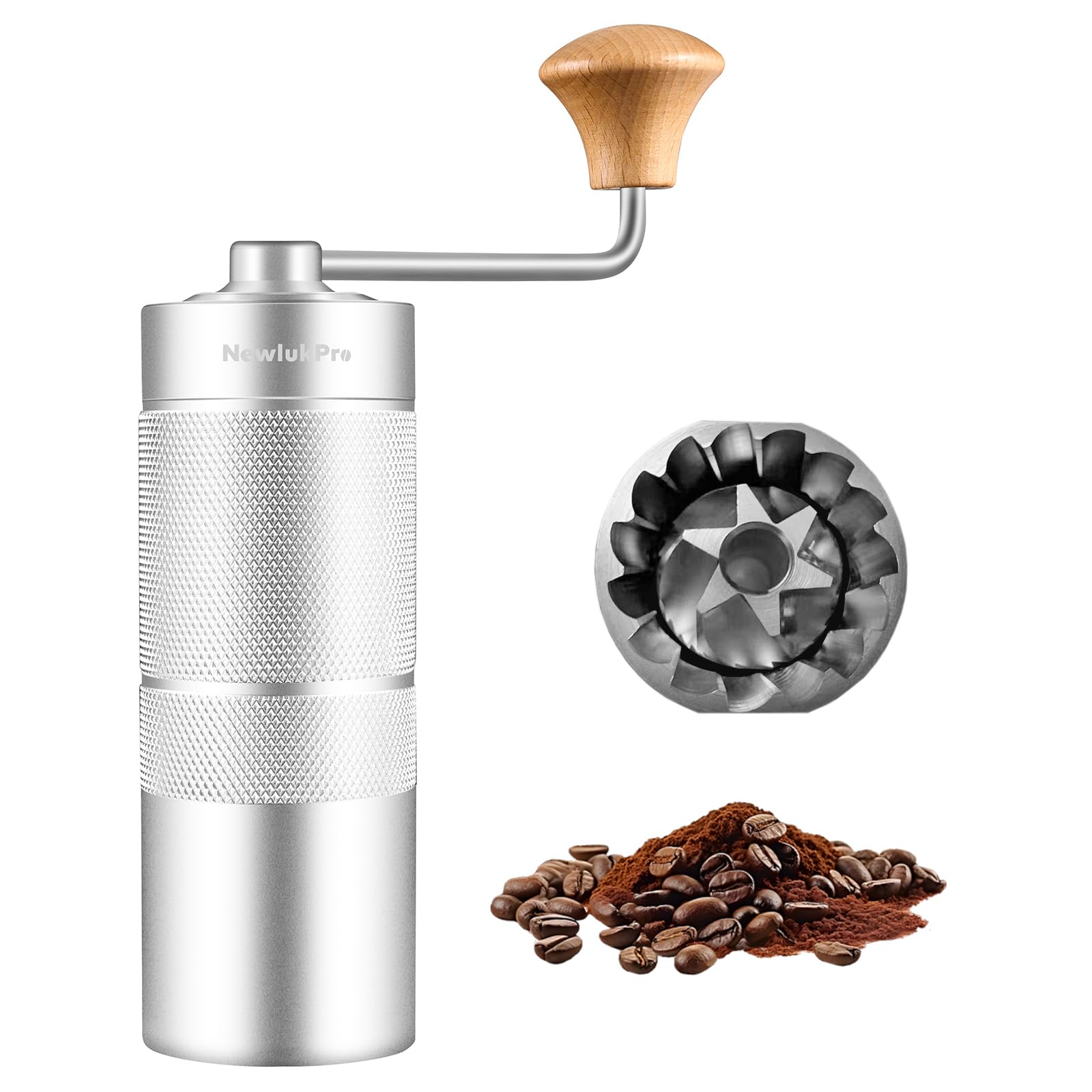
The NewlukPro M6 is the lowest-cost option that still delivers a genuine conical burr experience. Its hexagonal SUS420 stainless steel burr and double bearing axis provide a noticeably smoother grind than ceramic burr grinders at similar prices. The aluminum alloy body feels solid and has a knurled grip that keeps your hand from slipping during cranking, and the 25g capacity matches the standard single-batch size for pour-over or two espresso shots.
Grind adjustment is controlled by a built-in knob at the bottom, with roughly 30 click positions accessible by turning the adjustment ring. Users report that settings 8 to 9 produce a consistent espresso-fine grind, while the coarser end works well for AeroPress and French press. The M6 is also small enough at 6.1 inches tall to pack into a carry-on bag or camping kit, and the threaded cap seals the bean chamber securely during transport.
The primary trade-off at this entry-level price is grinding speed — achieving an espresso-fine grind takes roughly twice as long as higher-end manual grinders. The included instructions are essential for first-time users, as reassembling the bearing stack in the wrong order can cause alignment issues. For someone taking their first step away from blade grinders and pre-ground coffee, the M6 offers a legitimate burr mechanism at a near-floor price.
Why it’s great
- Hexagonal stainless steel burr outperforms ceramic options at this price
- Double bearings eliminate wobble and extend mechanical lifespan
- Compact and lightweight for portable use with a solid aluminum body
Good to know
- Espresso-fine grinding is noticeably slower than premium manual grinders
- Assembly requires careful attention to spring and washer order
FAQ
Can a cheap burr grinder actually grind fine enough for espresso?
How often should I clean a burr grinder?
Is a manual burr grinder better than an electric one at this price?
Final Thoughts: The Verdict
For most users, the best cheap burr grinder winner is the SHARDOR CG018 because it delivers 51 grind settings, anti-static operation, and a portafilter cradle at a price that undercuts every comparable electric grinder. If you want the quietest electric option with the smallest footprint, grab the OXO Brew Compact. And for manual grinding with build quality that rivals grinders three times the price, nothing in this range beats the TIMEMORE Chestnut C2S.

Mo Maruf
I created WellFizz to bridge the gap between vague wellness advice and actionable solutions. My mission is simple: to decode the research and give you practical tools you can actually use.
Beyond the data, I am a passionate traveler. I believe that stepping away from the screen to explore new environments is essential for mental clarity and physical vitality.