Our readers keep the lights on and my smoothie glass nicely filled. As an Amazon Associate, I earn from qualifying purchases.
Building a home theater or a simple stereo system usually hits a wall when you see the prices of major-brand AV receivers. The jump from a basic setup to true surround sound can feel like an expensive leap, but the key is knowing which features you actually need and where the budget brands have closed the gap on performance. A smart shopper can get clean amplification, modern Bluetooth, and even 4K video switching without breaking their planned spend.
I’m Mohammad Maruf — the founder and writer behind WellFizz. My focus here is on parsing the real-world specs and user experiences of budget-tier audio receivers to separate the hidden gems from the units that just look good on paper.
The goal of this guide is to help you navigate the trade-offs and find the most capable option, making it your definitive resource for the best cheap audio receiver for your specific setup and needs.
How To Choose The Best Cheap Audio Receiver
Finding a budget-friendly receiver means understanding where corners can be cut without sacrificing the core listening experience. You don’t need 11 channels of amplification or the latest HDMI 2.1 standard if you are powering a simple 5.1 setup in a living room. Focus on the amplifier’s real power, the input types your sources require, and the ease of daily use.
RMS Power vs. Peak Power
Manufacturers often advertise a huge “peak” wattage number, but that is a momentary burst, not a sustainable output. Look for the RMS (Root Mean Square) rating — this tells you the continuous power the receiver can deliver to your speakers. A receiver rated at 50 watts RMS per channel will drive most bookshelf and tower speakers to satisfying room-filling levels. If you plan on powering low-sensitivity speakers, aim for at least 75 watts RMS to avoid distortion at higher volumes.
Essential Connectivity for a Modern Setup
HDMI inputs are critical if you are connecting a TV, game console, or streaming device. The most valuable feature to look for is HDMI ARC or eARC, which sends audio from your TV’s apps (Netflix, Disney+) back down to the receiver over a single cable. Bluetooth 5.0 or later is the minimum for reliable wireless music streaming from your phone. If you are a vinyl listener, a built-in phono input saves you the cost and clutter of an external preamp.
Quick Comparison
On smaller screens, swipe sideways to see the full table.
| Model | Category | Best For | Key Spec | Amazon |
|---|---|---|---|---|
| Donner MAMP4 | Value 5.1 | Karaoke & Multi-room | 60W x 2 + 25W x 3 RMS | Amazon |
| Donner 1000W | Compact 4-Ch | Small room & Karaoke | 25W x 4 RMS / 1000W Peak | Amazon |
| JBL MA310 | Entry AV | 4K HDR Movie Setup | 60W x 5 RMS | Amazon |
| Yamaha RX-V385 | Best Value | Entry-level 5.1 Surround | 5.1 Ch, 4K HDR, Bluetooth | Amazon |
| Yamaha RX-V4A | Streaming Hub | Multi-room Music & 8K | 5.2 Ch, MusicCast, HDMI 2.1 | Amazon |
| Denon AVR-S670H | Budget Premium | Phono Input & 8K Ready | 75W x 5 RMS, 8K Passthrough | Amazon |
| Onkyo TX-NR7100 | Enthusiast | Serious Atmos & Dirac Live | 9.2 Ch, 100W RMS, THX | Amazon |
In‑Depth Reviews
1. Yamaha RX-V4A 5.2-Channel AV Receiver

The Yamaha RX-V4A sits at the sweet spot where modern connectivity meets reliable amplifier performance. It offers 5.2 channels of processing and includes HDMI 2.1 inputs with support for 4K120 and 8K60 pass-through, making it future-proof for the latest gaming consoles and streaming hardware. The inclusion of MusicCast lets you stream to other Yamaha wireless speakers around the house, a feature typically reserved for more expensive units.
Users consistently praise the clean, detailed sound it extracts from towers and bookshelf speakers, with the YPAO auto-calibration quickly optimizing the soundstage for your room. The on-screen menus via HDMI simplify the setup process, though the remote control is small and lacks a backlight, which is a common minor complaint. The built-in Wi-Fi and AirPlay 2 support make it a seamless hub for a multi-room audio system.
For a mid-range investment, this receiver delivers the best balance of power, modern video features, and streaming flexibility in this list. It drives a 5.1.2 Atmos setup without strain, and the MusicCast app provides a reliable control interface. The few reports of HDMI handshake issues are not widespread and often resolved with a firmware update.
Why it’s great
- 8K/4K120 HDMI 2.1 inputs for next-gen gaming
- MusicCast multi-room audio with Wi-Fi and AirPlay 2
- YPAO room calibration delivers accurate surround sound
Good to know
- Remote control is small and not backlit
- Setup menus can feel unresponsive at first
2. Denon AVR-S670H 5.2 Ch Home Theater Receiver

The Denon AVR-S670H packs a rare combination for a budget-friendly receiver: a dedicated phono input for turntables and 8K HDMI pass-through. With 75 watts per channel into 5 channels, it has enough headroom to drive a pair of energy-hungry floor-standing speakers without breaking a sweat. The Audyssey room calibration is a step above basic auto-setup, fine-tuning the EQ and subwoofer integration for a balanced soundstage.
Setup is straightforward, especially if you use the on-screen assistant, and the single HDMI ARC connection handles audio return from your smart TV effortlessly. The HEOS built-in streaming allows for multi-room music, though users note it can be slightly less reliable than dedicated platforms like Spotify Connect. The unit feels solid and runs cool even during long movie sessions.
This is the pick for the listener who values a clean, traditional AVR experience with modern video specs and the convenience of a built-in phono preamp. It works seamlessly with KEF, Polk, and other popular speaker brands, providing a clear, dynamic sound that justifies its position as a top-tier entry-level option.
Why it’s great
- Built-in phono input for vinyl enthusiasts
- 8K/4K120 HDMI 2.1 pass-through
- Audyssey room calibration for precise sound
Good to know
- HEOS streaming app can be temperamental
- Only 5 HDMI inputs (4 in / 1 out)
3. Yamaha RX-V385 5.1-Channel 4K Ultra HD AV Receiver

The Yamaha RX-V385 is a no-nonsense, reliable workhorse that has been a staple in the entry-level surround sound market for years. It delivers 5.1 channels with support for 4K Ultra HD video (HDR10, Dolby Vision), and its Bluetooth connectivity is simple and effective. The YPAO calibration includes a physical microphone to tune the speakers to your room, ensuring you get a balanced sound even from an imperfect speaker placement.
Users highlight its warm, clear sound signature that outperforms similarly priced Sony competitors. The binding posts accept banana plugs, which makes connecting speaker wire much cleaner. The front-panel buttons serve as a reliable backup if the remote is misplaced, a detail often overlooked on budget models. Its 4 HDMI inputs are a bit limited for a modern console-heavy setup, but adequate for a TV and one or two external sources.
If you want a straightforward, reputable brand receiver that sounds great right out of the box without a complicated app setup, this is the one. It lacks Wi-Fi and advanced streaming features, but for a pure surround sound foundation, the RX-V385 remains a benchmark of value and reliability.
Why it’s great
- Proven Yamaha reliability and warm sound
- YPAO auto-calibration with included mic
- Binding post terminals for banana plugs
Good to know
- Only 4 HDMI inputs, no eARC support
- No built-in Wi-Fi or streaming apps
4. JBL MA310 5.2 Channel 4K AV Receiver

The JBL MA310 enters the budget market with a focus on simplicity and modern aesthetics. Its shallow chassis design is a practical advantage for fitting into tighter media consoles, and the 60 watts per channel across 5 channels is sufficient for a living room theater setup. It decodes Dolby and DTS formats natively, and the 4 HDMI inputs (including one with ARC) handle all your sources cleanly.
A standout feature is its straightforward HDMI ARC integration, which powers on the receiver automatically with your TV and allows control via a single remote. Users driving Polk in-wall and tower speakers report impressive clarity for the price point. The setup process, however, is fully dependent on the on-screen menu, and the initial firmware update can be sluggish. The remote control is not backlit, making navigation in a dark theater room frustrating.
For someone building a clean, modern 5.1 system and prioritizing HDMI-CEC ease of use over advanced features like Wi-Fi streaming or multi-zone, the JBL MA310 delivers exactly what it promises: reliable, good-sounding amplification without a complex setup.
Why it’s great
- Shallow chassis fits easily in tight spaces
- Native Dolby and DTS decoding
- Seamless HDMI ARC auto on/off with TV
Good to know
- Remote is not backlit; bright front display
- Initial firmware setup can be a hurdle
5. Donner MAMP4 5.1 Channel Audio Amplifier
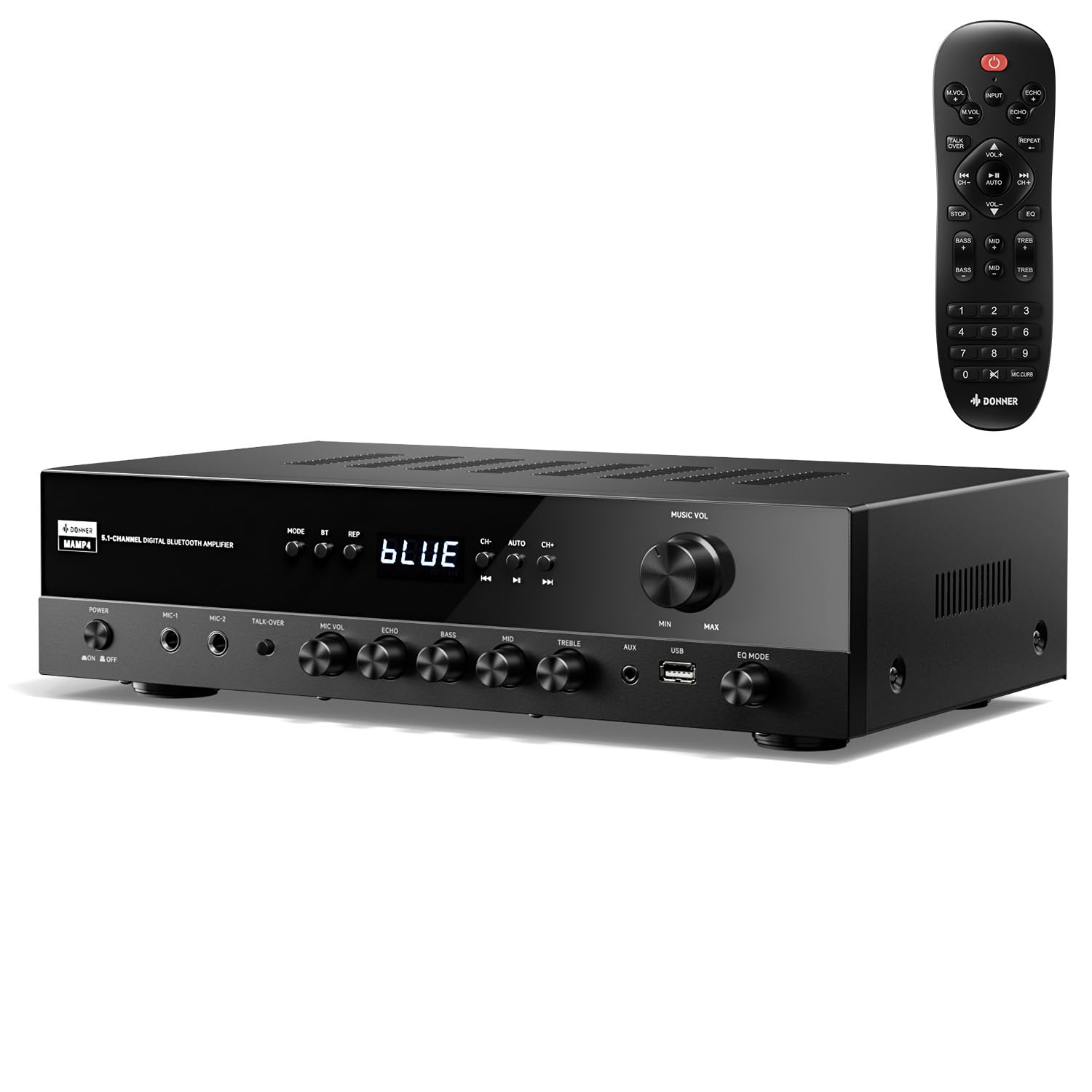
The Donner MAMP4 is the most affordable way to get true 5.1 channel surround sound, offering a dedicated subwoofer output and a center channel. It pushes 60 watts RMS to the main left and right speakers, and 25 watts to the center and surrounds, which is enough to fill a medium-sized room. The inclusion of Bluetooth 5.3 and digital optical/coaxial inputs expands its usefulness far beyond a simple stereo amp, allowing it to connect directly to modern TVs.
Customers replacing older, failing Onkyo or Sony receivers are often surprised by the clean sound quality and the full bass, midrange, and treble EQ adjustments. The dual microphone inputs with echo control make it a functional karaoke machine as well. However, the FM tuner is basic and loses presets when unplugged, and the Bluetooth range is limited to around ten feet according to some users. Build quality feels appropriate for its low cost, but it is not built to the same rugged standard as the Yamaha or Denon.
This is the ultimate pick for the budget-conscious shopper who refuses to compromise on a true 5.1 channel layout. It is perfect for a guest room, a garage theater, or for anyone wanting to dip their toes into surround sound without a significant financial commitment.
Why it’s great
- True 5.1 channel output with subwoofer port
- Full EQ control (bass, mid, treble) via remote
- Includes digital optical/coaxial inputs for TV
Good to know
- Build quality is entry-level; potential for defects
- FM tuner loses presets on power loss
6. Donner 1000W Stereo Receiver 4-Channel Amplifier

This Donner model is a 4-channel amplifier that can power up to 8 speakers in parallel, making it a versatile choice for multi-room audio or a large karaoke party. It advertises a 1000W peak power, but the real-world RMS is 25 watts per channel. While that is not enough to drive demanding tower speakers at high volumes, it works very well with efficient bookshelf or outdoor speakers in a smaller space. The unit includes digital inputs (optical, coaxial) which is a welcome addition at this price point.
Users who pair it with modest speakers are often impressed by its loudness and the flexibility of the independent volume knobs for each channel. The dual microphone inputs with echo and Talkover functions make it a hit for parties and announcements. However, the speaker connections are confusing for some — the binding posts are organized as 4 left and 4 right sets, not as 4 distinct channels. A few users report that the amplifier struggles with 4-ohm loads, so matching it with 8-ohm speakers is advisable.
This receiver is not a replacement for a proper surround sound AVR, but it is an outstanding, low-cost solution for a simple stereo setup that needs to reach multiple rooms or support a microphone. Its compact size hides a surprisingly loud amplifier for a small gathering room.
Why it’s great
- Drives up to 8 speakers for wide coverage
- Dual mic inputs with echo and Talkover for karaoke
- Digital optical and coaxial inputs included
Good to know
- Only 25W RMS per channel; not for power-hungry speakers
- Speaker binding posts can be confusing to set up
7. Onkyo TX-NR7100 9.2-Channel AV Receiver
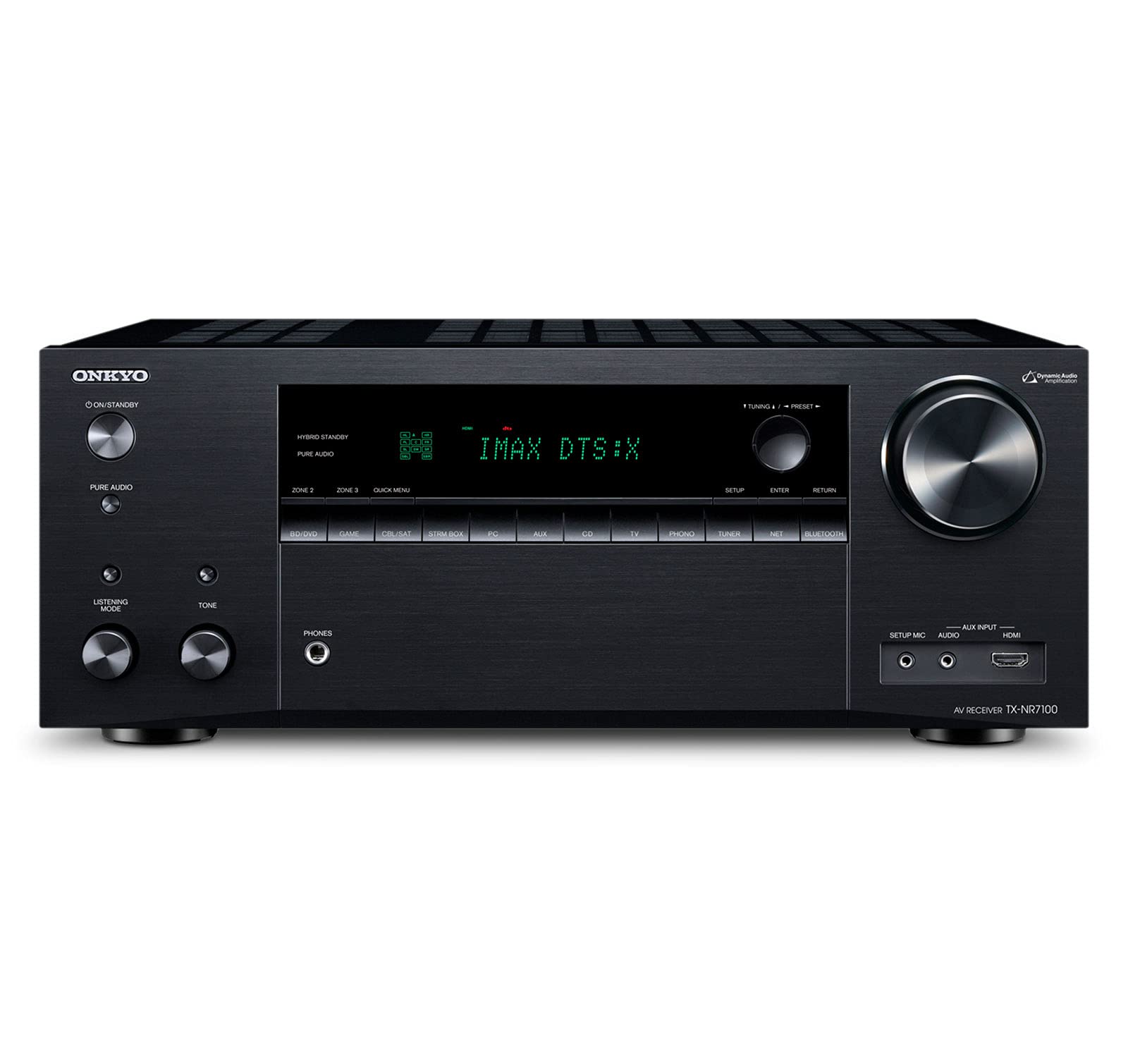
The Onkyo TX-NR7100 is the most feature-rich and powerful receiver on this list, targeting the enthusiast who demands the best room correction and a true 9.2-channel Atmos setup. It includes Dirac Live out of the box, which is widely considered the industry standard for automatic room calibration, far surpassing basic EQ systems. With 100 watts RMS per channel and THX Certification, this unit drives even demanding speakers with authority and precision.
Connectivity is generous with 6 HDMI 2.1 inputs supporting 8K/60Hz and 4K/120Hz, making it ready for the highest-end gaming PCs and consoles. It also features bi-directional Bluetooth (aptX HD), AirPlay 2, Chromecast built-in, and it is Works with Sonos Certified for seamless integration into an existing Sonos ecosystem. Users praise the dynamic, clean sound it produces with Klipsch and KEF Atmos systems.
The price reflects its high-end capabilities, but for a shopper who wants to build a serious home theater that will last for years, it represents exceptional value. The main downsides are the non-backlit remote and the complexity of the Dirac Live setup, which requires a PC or Mac for the full calibration. For those who want the absolute best sound without jumping to separates, this is the ultimate destination.
Why it’s great
- Dirac Live room correction for studio-grade calibration
- THX Certified with 100W per channel RMS
- 6 HDMI 2.1 inputs with 8K/4K120, VRR, ALLM
Good to know
- Remote control is not backlit
- Full Dirac calibration requires a computer setup
FAQ
Can a cheap audio receiver power a pair of tower speakers?
Do I need an HDMI ARC port on a budget receiver?
Final Thoughts: The Verdict
For most users, the best cheap audio receiver winner is the Yamaha RX-V4A because it balances modern HDMI 2.1 features, reliable amplification, and the MusicCast multi-room ecosystem at a price that does not overreach. If you want a built-in phono input and the absolute most future-proof video specs for an 8K TV, grab the Denon AVR-S670H. And for a true 5.1 channel setup on a shoestring budget, nothing beats the value of the Donner MAMP4.

Mo Maruf
I created WellFizz to bridge the gap between vague wellness advice and actionable solutions. My mission is simple: to decode the research and give you practical tools you can actually use.
Beyond the data, I am a passionate traveler. I believe that stepping away from the screen to explore new environments is essential for mental clarity and physical vitality.