Our readers keep the lights on and my smoothie glass nicely filled. As an Amazon Associate, I earn from qualifying purchases.
Waking up with a stuffy nose, itchy eyes, and that familiar scratch in your throat isn’t just miserable; it signals that your indoor air is loaded with pollen, dust mites, and pet dander. A dedicated air purifier is the single most effective tool for breaking this cycle, but finding one that actually works without emptying your wallet requires knowing exactly which specs matter and which marketing claims to ignore.
I’m Mohammad Maruf — the founder and writer behind WellFizz. I’ve spent hundreds of hours analyzing the filter grades, CADR ratings, decibel levels, and real-world user feedback for over 40 sub- air purifiers to separate the genuine allergen-trapping machines from the overhyped plastic shells.
This guide covers the seven models that deliver measurable relief without the premium price tag, organized around the measurable specs and filtration science that actually determine whether a cheap air purifier for allergies will keep your bedroom air clean or just annoy you with noise.
How To Choose The Best Cheap Air Purifier For Allergies
When your budget sits under the mark, every dollar must go toward actual filtration performance rather than decorative lights, smart app connectivity, or oversized room claims. The following three specifications will determine eighty percent of your allergy relief results.
True HEPA Certification Over Generic “HEPA-Type”
True HEPA is a specific standard — the filter must capture 99.97% of particles sized 0.3 microns. Many budget units label their filters as “HEPA-type” or “HEPA-style,” which means they haven’t passed independent testing. For allergy sufferers, this distinction is everything: a True HEPA filter will trap pollen, mold spores, dust mite debris, and pet dander, while a non-certified filter may allow most of those particles to recirculate. Look for the words “True HEPA” explicitly on the product page or certification like AHAM Verifide to confirm real performance.
Room Size Matching and CADR
A purifier rated for 1,200 square feet does you no good in a 150-square-foot bedroom if its CADR (Clean Air Delivery Rate) for pollen or dust is below 100. The CADR number tells you how quickly the machine cleans the air in a given space. For a standard bedroom, aim for a CADR of at least 100 for pollen and dust. If you place an undersized unit in a large room, you’ll run it on high constantly — defeating the purpose of a quiet sleep environment and burning through filter life faster.
Filter Replacement Availability and Cost
The upfront price is only half the equation. Some budget-friendly purifiers rely on proprietary filter cartridges that cost nearly as much as the unit itself every three to six months. Others, particularly those with washable pre-filters and standard filter shapes designed to fit multiple brands, keep long-term costs low. Before buying, search for replacement filters for that specific model and note the estimated annual replacement spend — a machine with filters every four months becomes expensive fast.
Quick Comparison
On smaller screens, swipe sideways to see the full table.
| Model | Category | Best For | Key Spec | Amazon |
|---|---|---|---|---|
| Levoit Core Mini-P | Compact | Small bedrooms and desktops | AHAM Verifide Certified | Amazon |
| ECOSELF HAP609 | Smart | Large rooms with auto mode | 360° Air Intake, PM2.5 Sensor | Amazon |
| VEWIOR 2-Pack | Multi-Room | Covering two spaces at once | PM2.5 Display, Washable Filter | Amazon |
| GermGuardian AC4825E | Tower | Asthma and severe allergies | 0.1 Micron HEPA + UV-C | Amazon |
| MOOKA H13 | Value | Ultra-quiet sleep with aroma | 13dB Noise, 4W Power | Amazon |
| ECOSELF HAP604 | Budget | Small rooms, tight budget | 20dB Sleep Mode, 360° Intake | Amazon |
| Holmes HAP706-NU-1 | Entry | Very small spaces under 80 sq ft | 55 CADR, Washable Pre-Filter | Amazon |
In‑Depth Reviews
1. Levoit Core Mini-P
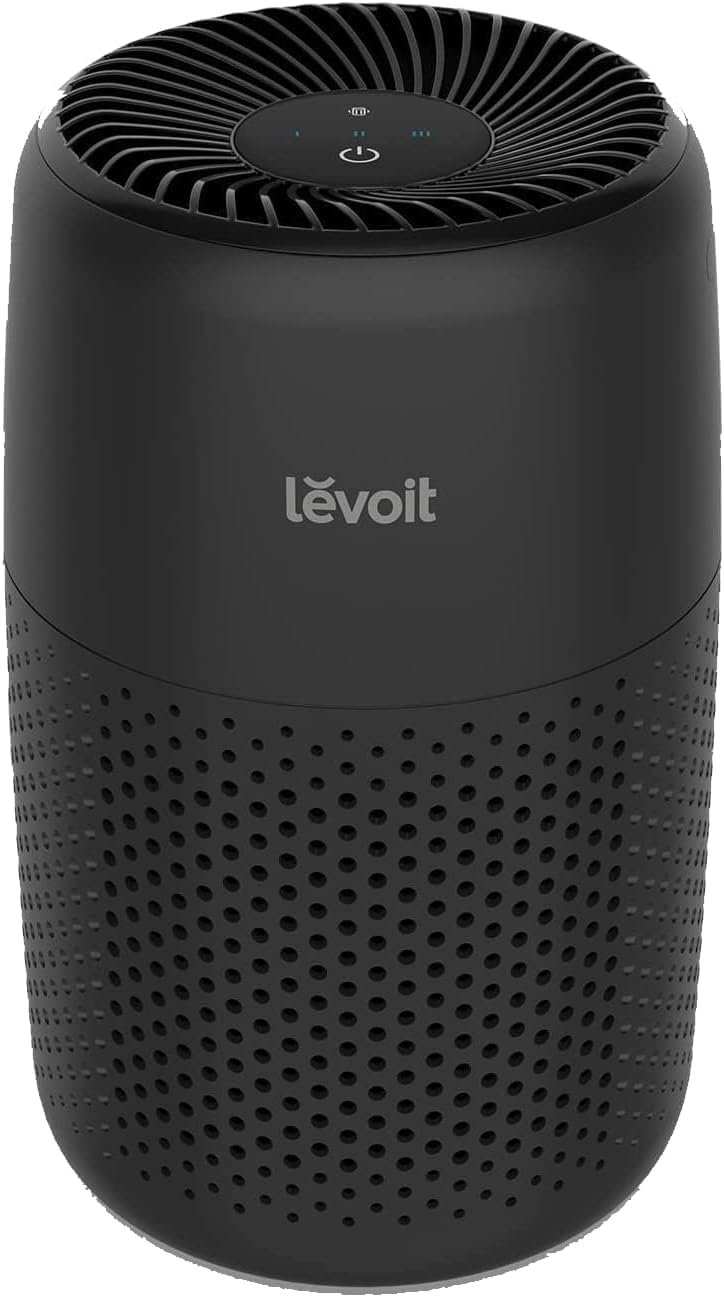
The Levoit Core Mini-P is the most reliable entry in this category because it carries the AHAM Verifide seal — independent third-party testing that confirms its True HEPA filter captures 99.97% of allergens down to 0.3 microns. Users report measurable reductions in dust accumulation and noticeable relief from hay fever symptoms in bedrooms and small offices, with several reviews specifically noting improved breathing for pets with dust mite allergies.
At just 2.2 pounds and measuring roughly 7.7 inches on each side, this unit fits on a nightstand or desktop without dominating the space. Its three-speed fan settings range from near-silent on low to a noticeable but not disruptive hum on high, and the included aroma pad adds optional scent diffusion without limiting filtration performance.
One limitation is its coverage area — the Core Mini-P is designed for small rooms only, roughly up to 150-200 square feet. Users who place it in larger living areas report underwhelming airflow. The replacement filter, while reasonably priced, requires swapping every 6 to 8 months depending on usage, and there is no smart connectivity or auto mode.
Why it’s great
- AHAM Verifide certification guarantees genuine True HEPA performance, not just marketing language
- Compact footprint fits easily on desks and nightstands, making it versatile for small space allergy relief
- Aroma pad adds calming scents without compromising filtration efficiency
Good to know
- Coverage is strictly limited to small rooms — ineffective in open-plan or large master bedrooms
- No auto mode or air quality sensor, so manual speed adjustments are required
2. ECOSELF HAP609
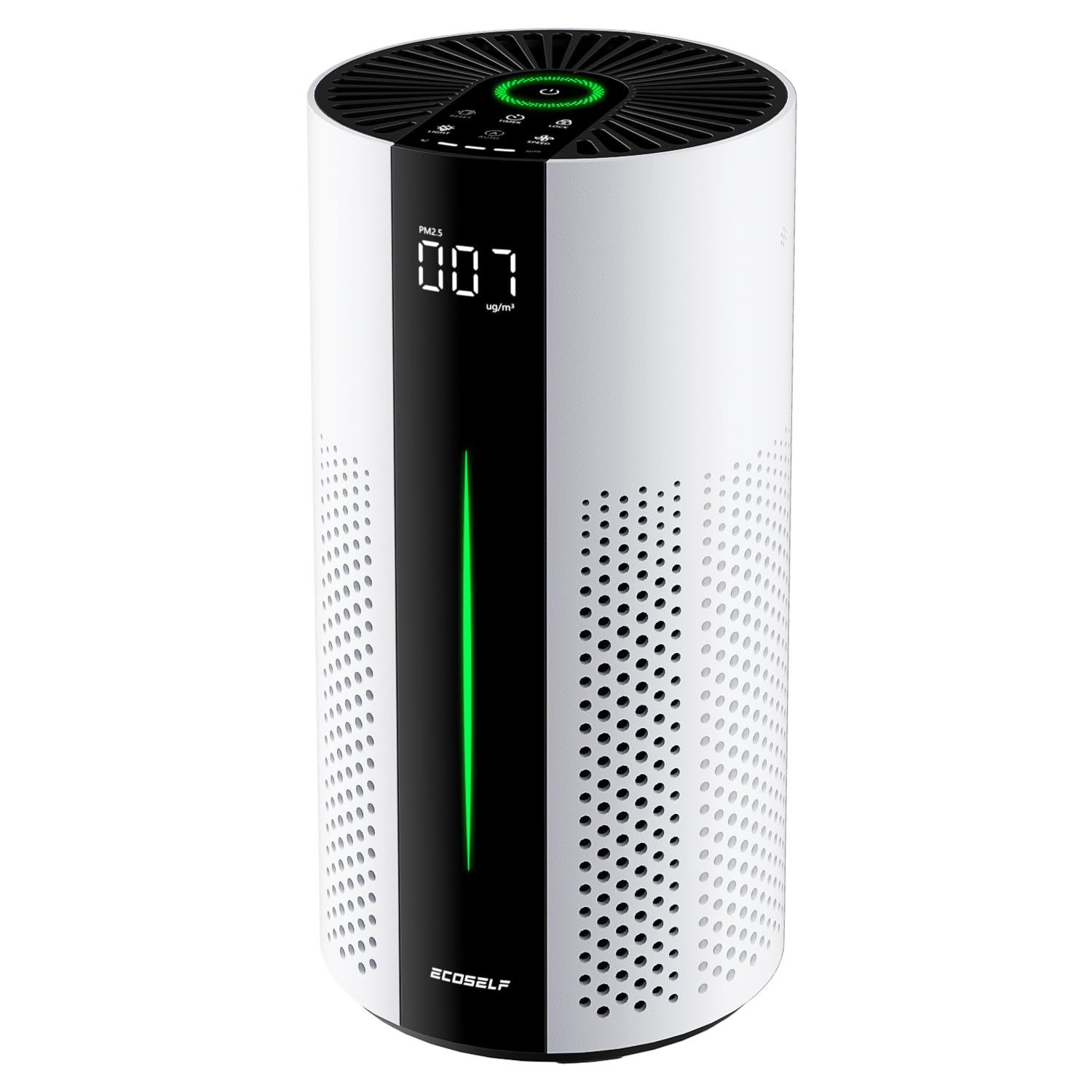
The ECOSELF HAP609 brings premium-level intelligence to the budget tier by featuring a built-in PM2.5 sensor with auto mode — a rarity at this price point. The machine continuously monitors airborne particle concentration and automatically boosts fan speed when it detects smoke, pollen, or pet dander spikes, then drops back to whisper-quiet operation once the air clears. Real-world users report dramatic improvements in kitchen odor elimination and allergy symptom reduction in spaces up to 1,800 square feet.
Its 360-degree air intake design and 7.2-inch cylindrical body allow it to pull air from every direction, making placement near walls or corners less problematic than with traditional front-inlet purifiers. Sleep mode reduces noise to 20 dB — genuinely inaudible beyond a few feet — and shuts off all indicator lights, which is a critical feature for light-sensitive sleepers.
While the smart features are excellent, the filter replacement schedule of 3-6 months means annual consumable costs can add up. The unit lacks an aromatherapy function, and the touch controls, while intuitive, show fingerprints easily on the glossy surface. The child lock is a nice safety addition for households with toddlers.
Why it’s great
- Real-time PM2.5 display and auto mode remove all guesswork from speed selection, adjusting automatically to allergy-triggering particle spikes
- 360-degree air intake allows flexible placement and efficient coverage of large rooms without dead zones
- Sleep mode is genuinely silent, with no glowing lights to disturb rest
Good to know
- Filters must be replaced every 3-6 months, creating recurring cost
- Touch control panel shows smudges and requires frequent wiping
3. VEWIOR 2-Pack
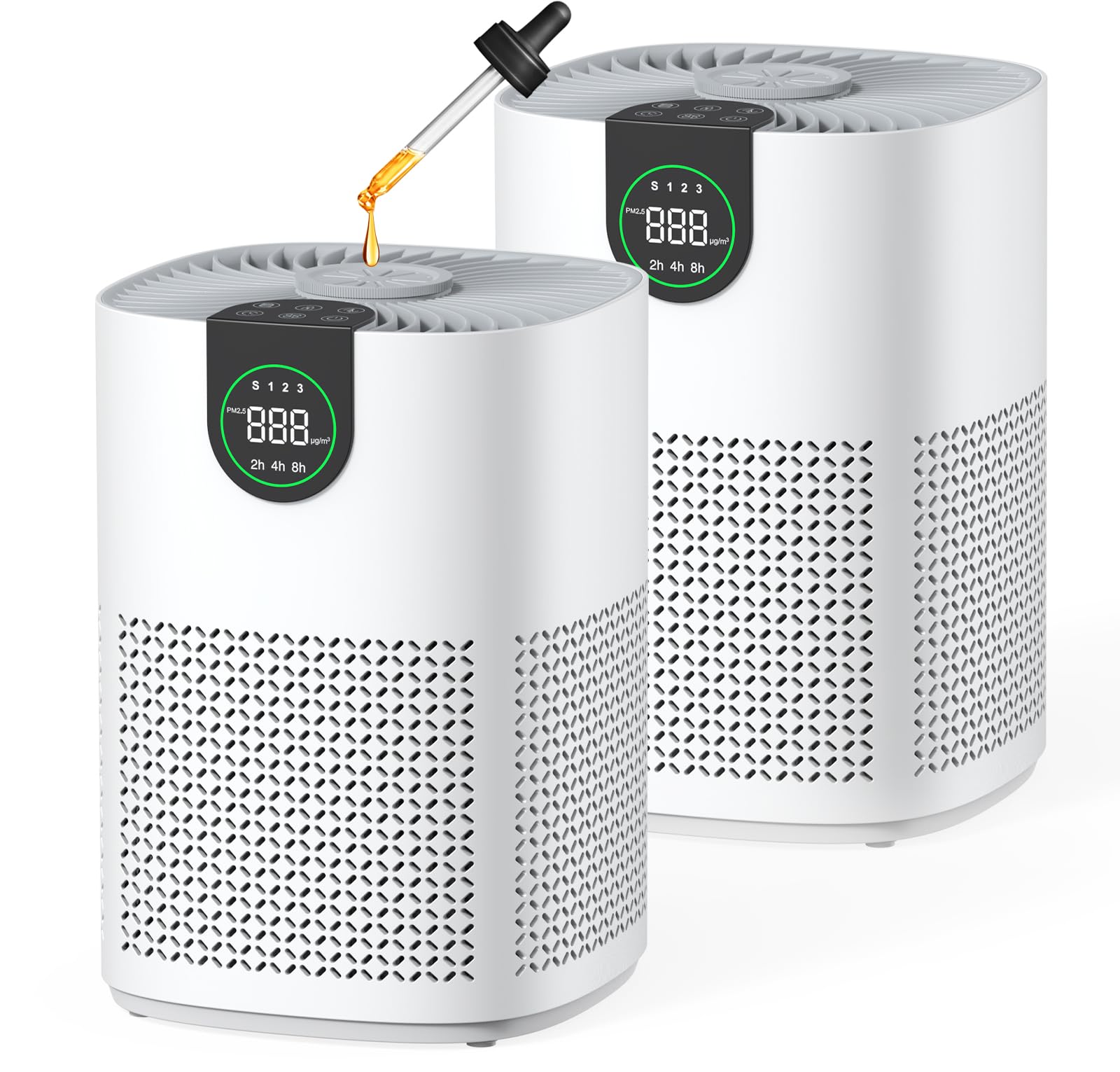
The VEWIOR 2-Pack solves a fundamental problem for budget buyers: covering two rooms without buying two separate premium units. Each purifier uses a three-stage system — washable pre-filter, H13 HEPA filter, and activated carbon layer — and includes a real-time PM2.5 display that switches between green, blue, amber, and red to indicate air quality. Users with multi-room homes report dividing the units between a bedroom and living area and seeing consistent allergen reduction in both spaces.
The washable pre-filter is a standout cost-saving feature: vacuuming or rinsing it every few weeks extends the life of the main HEPA filter, reducing replacement frequency. Sleep mode drops noise to 15 dB, and the panel lights automatically darken. The built-in aromatherapy pad lets you add essential oils, though the effect is subtle compared to dedicated diffusers.
Auto mode is reactive but based on the PM2.5 sensor, which is tuned for particulate matter rather than gases or VOCs. Some users note that the high fan setting is loud enough to be distracting in quiet workspaces, and the lack of a remote control means adjusting settings requires walking to the unit. The child lock is a practical inclusion for pet-owning households.
Why it’s great
- Two units in one package provide whole-home coverage for about the same price as a single competitor machine
- Washable pre-filter significantly reduces long-term consumable costs and filter replacement frequency
- Color-coded PM2.5 display makes air quality visible and engages users in their environment
Good to know
- High fan speed is loud enough to interfere with conversation or focused work
- No remote control included, so all adjustments require physical access to the unit
4. GermGuardian AC4825E

The GermGuardian AC4825E has been a staple in the allergy community since 2011, and for good reason — its True HEPA filter captures particles down to 0.1 microns, exceeding the standard 0.3 micron requirement. This makes it particularly effective for capturing ultrafine pet dander particles and smoke that smaller-pore filters might miss. Numerous long-term reviewers with asthma report that this unit eliminated their need for nightly antihistamines and reduced asthma flare-ups triggered by cooking fumes and nail polish odors.
The 22-inch tower design stands taller than the competition, allowing it to draw air from higher above the floor and push cleaned air at an angle that promotes better room circulation. The three-speed dial and separate UV-C light switch offer straightforward, tactile control without relying on touch panels or apps. The washable pre-filter captures large particles like cat hair and dust bunnies, extending the main filter’s life to approximately one year for many users.
Its main downsides are noise and size. On high speed, the unit produces a pronounced whoosh that some users find intrusive in quiet bedrooms, making it better suited for living rooms or open spaces. At 8.55 pounds, it is heavier and less portable than most budget alternatives. The UV-C light, while marketed as a germ-killing feature, adds minimal value for routine allergy management and consumes extra electricity.
Why it’s great
- 0.1 micron filtration catches ultrafine allergens that standard True HEPA filters may allow through
- Tower height and angled airflow provide superior room circulation compared to compact cube designs
- Long filter life with washable pre-filter means lower annual replacement cost
Good to know
- High speed is loud and may disturb sleep — better for daytime or living-area use
- UV-C light feature adds cost and energy use without meaningful benefit for allergy relief
5. MOOKA H13 True HEPA
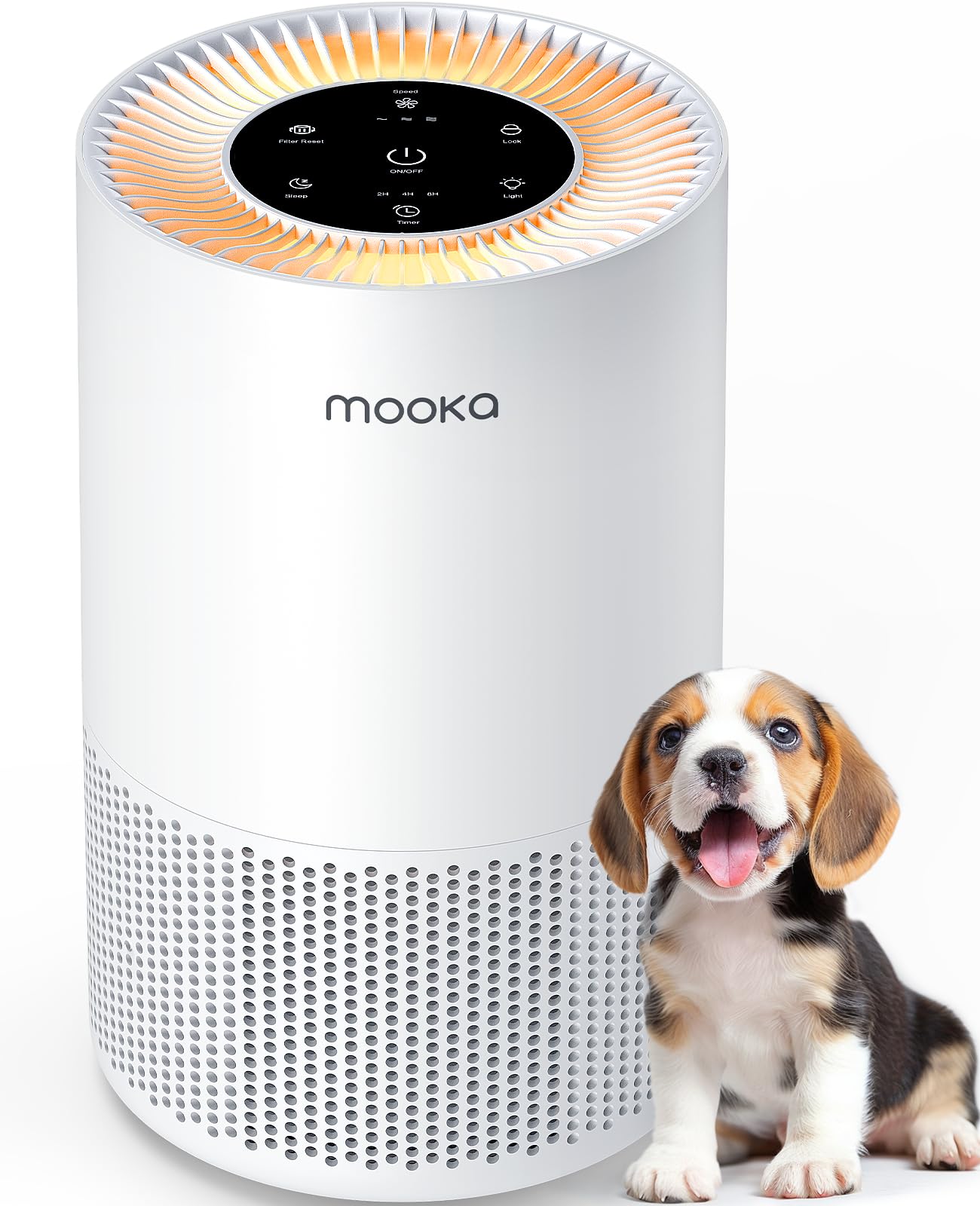
The MOOKA H13 is engineered specifically for noise-sensitive allergy sufferers. Its brushless DC motor produces an audited 13 dB on low — barely above the threshold of human hearing — making it the quietest unit in this comparison by a significant margin. Users with dust mite allergies and pollen sensitivities report that running this purifier on sleep mode throughout the night eliminated morning congestion without introducing any distracting hum or whir.
Despite its 3.41-pound lightweight build, the unit claims coverage up to 1,200 square feet with a 300-square-foot refresh time of 10 minutes. The included essential oil sponge adds a gentle fragrance layer that helps mask musty smells without competing with the HEPA filtration. Child lock, timer settings (2/4/8 hours), and a filter replacement indicator add convenience for daily use.
The 4-watt power draw is exceptionally low, meaning it costs pennies per month to run continuously. However, some users find the overall airflow on low barely perceptible — the near-total silence comes at the cost of noticeable air movement. The H13 HEPA filter is effective, but the unit lacks a pre-filter layer, so larger dust and pet hair can reach the main filter faster, potentially shortening its lifespan.
Why it’s great
- Industry-leading 13 dB operation makes it virtually inaudible for undisturbed sleep in the bedroom
- Extremely low 4-watt power draw lets you run it 24/7 for less than a dollar per month
- Essential oil aromatherapy slot adds pleasant scents without any hardware modifications
Good to know
- No pre-filter means the main HEPA element captures large particles directly, accelerating wear
- Airflow on the lowest setting is minimal, which may feel insufficient in larger or poorly sealed rooms
6. ECOSELF HAP604
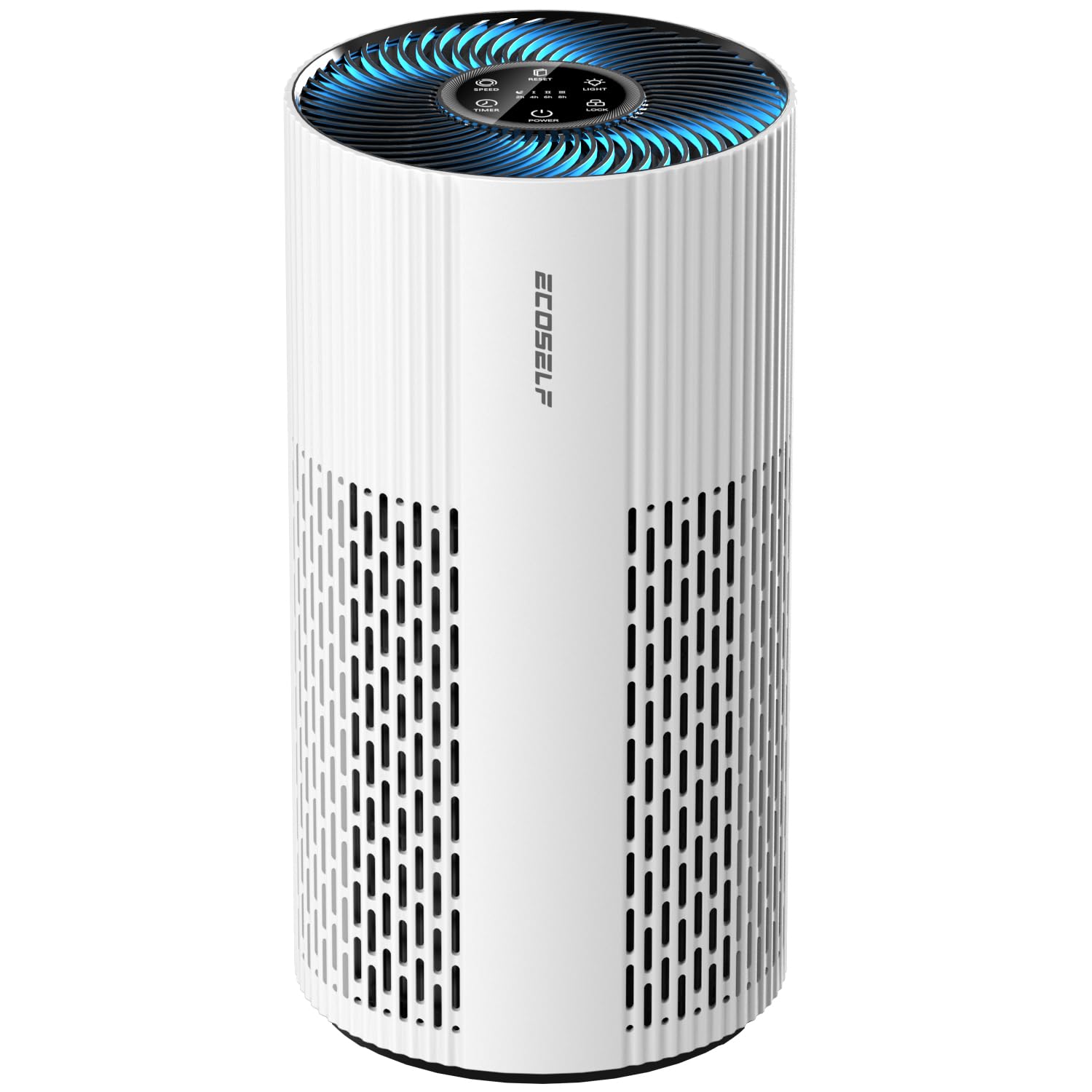
The ECOSELF HAP604 delivers impressive specs for the budget end of the market: 360-degree air intake, a 20 dB sleep mode, and a claimed coverage of 1,500 square feet per hour. In practice, this cylinder-shaped unit is best suited for single bedrooms and small living spaces, where its four fan speeds allow you to find a balance between noise and purification speed. Users transitioning from stuffy-room mornings report that even running it on speed two overnight noticeably reduced allergy symptoms by morning.
Its 7.17-inch diameter and 13.86-inch height make it slightly taller and narrower than the MOOKA, giving it a smaller footprint on a nightstand. The 7-color ambient light can be turned off for sleep, and the child lock prevents pet or toddler interference. A 2/4/6/8-hour timer provides scheduling flexibility without needing smart home integration.
The biggest trade-off is that on higher settings (speed three and above), the unit produces a distinct whooshing noise that users describe as “sounding like an AI data center.” This limits its usability during quiet activities. The filter replacement interval of 3-6 months is standard for this price tier, and ECOSELF sells genuine replacements that are fairly priced compared to proprietary competitors.
Why it’s great
- 360-degree intake design maximizes air capture from all sides, improving real-world efficiency in small rooms
- Sleep mode at 20 dB with fully dimmable lights creates a sleep-friendly environment at a very accessible price
- Compact footprint fits conveniently on bedside tables without sacrificing performance
Good to know
- Higher fan speeds produce significant noise, making them unsuitable for quiet relaxation or conversation
- No auto mode or air quality sensor — all speed changes require manual button presses
7. Holmes HAP706-NU-1

The Holmes HAP706-NU-1 is the entry-level anchor of this guide, representing the most affordable path to True HEPA filtration for ultra-small spaces up to 80 square feet. Its CADR of 55 means it will cycle a small bedroom’s air roughly four times per hour, which is adequate for a single occupancy room. Users consistently report that it resolved morning stuffiness and eliminated cooking and smoke odors in dorm rooms and compact apartments when run continuously.
The washable pre-filter traps large particles before they reach the main HEPA element, extending filter life and reducing maintenance cost. The three-speed fan and optional ionizer give basic control, though the ionizer should generally be left off — it produces trace ozone and adds little benefit for standard allergy management. The tower form factor, at 15.66 inches tall, fits neatly against walls without dominating the room.
Reliability is the primary concern here. Multiple long-term reviews report units failing after 6-12 months, with one user describing a sparking incident that caused minor burns. The filter replacement cost can approach the price of the unit itself, and the limited coverage area means it serves only one small room effectively. For the price, it works — but the competition at slightly higher price points offers significantly better build quality and coverage.
Why it’s great
- Lowest entry point for genuine True HEPA filtration, making allergy relief accessible on the tightest budgets
- Washable pre-filter extends main filter life and reduces the frequency of replacement purchases
- Compact tower design fits into very small spaces where larger purifiers won’t physically fit
Good to know
- Multiple reports of units stopping after months of use raise durability concerns
- Coverage is strictly limited to 80 square feet — unsuitable for standard bedrooms or living rooms
FAQ
Will a cheap air purifier make a noticeable difference in my allergy symptoms?
How often do I need to replace the filter on a budget air purifier?
Is an ionizer helpful for allergy relief in a budget purifier?
What is the minimum CADR I should look for in a cheap allergy purifier?
Final Thoughts: The Verdict
For most users, the cheap air purifier for allergies winner is the Levoit Core Mini-P because it combines independent AHAM Verifide certification, whisper-quiet operation, and a compact design that fits seamlessly into any small bedroom or office. If you need smarter monitoring and automatic speed adjustment based on real-time particle levels, grab the ECOSELF HAP609. And for covering two rooms simultaneously without doubling your spending, nothing beats the VEWIOR 2-Pack.

Mo Maruf
I created WellFizz to bridge the gap between vague wellness advice and actionable solutions. My mission is simple: to decode the research and give you practical tools you can actually use.
Beyond the data, I am a passionate traveler. I believe that stepping away from the screen to explore new environments is essential for mental clarity and physical vitality.