Our readers keep the lights on and my smoothie glass nicely filled. As an Amazon Associate, I earn from qualifying purchases.
A cheap 5.1 surround sound system is the gateway to cinematic immersion—explosions echo from behind, dialogue cuts through the center, and the subwoofer presses bass into your chest—all without draining your bank account. The challenge is separating the true budget champions from the flimsy setups that promise the world but deliver distortion and blown drivers within weeks.
I’m Mohammad Maruf — the founder and writer behind WellFizz. Over many hours of research and spec analysis, I’ve dug into the real-world performance, build quality, and common failure points of these systems to find the ones delivering genuine surround sound for the least money.
Whether you are upgrading from TV speakers or building a first home theater on a strict budget, this guide helps you find the best cheap 5.1 surround sound system for your space and how you watch.
How To Choose The Best Cheap 5.1 Surround Sound System
Every budget system makes trade-offs, usually in raw power, satellite speaker build, or the subwoofer’s ability to hit deep frequencies. Knowing where to compromise and where to hold the line separates a smart buy from a frustrating one.
True 5.1 Channel Separation
Not every system that says “5.1” actually processes five discrete channels. Some accept a stereo source and fake the surround effect by blending audio across all speakers. Look for systems that accept six independent RCA inputs or at minimum a digital optical or HDMI connection that can pass Dolby Digital 5.1. Without discrete channels, the rear speakers are just repeating what the fronts play.
Subwoofer Size and Power
The subwoofer is the heart of any 5.1 system. For budget setups, a subwoofer diameter of 8 inches or larger generally delivers satisfying low-end pressure down to around 35–40 Hz. Smaller 6.5-inch subs can still work in bedrooms or small dens, but larger rooms demand the deeper displacement an 8-inch or bigger driver provides.
Connectivity and Source Compatibility
Cheaper systems often rely on RCA connections, which older TVs may lack. If your TV has only optical or HDMI ARC output, you will need a system that accepts those digital audio formats and can decode Dolby Digital. Some budget systems only decode 2.1 PCM over optical, meaning you will need an external converter to enjoy true 5.1 from streaming apps or Blu-rays.
Quick Comparison
On smaller screens, swipe sideways to see the full table.
| Model | Category | Best For | Key Spec | Amazon |
|---|---|---|---|---|
| ULTIMEA Skywave X50 | Premium Soundbar | True Dolby Atmos at home | 760W peak power, 8″ sub | Amazon |
| Rockville HTS56 | Traditional 5.1 | Karaoke and LED atmosphere | 1000W peak, 8″ subwoofer | Amazon |
| LG S40TR | 4.1 Soundbar | Simple wireless surround | Wireless sub & rear speakers | Amazon |
| Klipsch Reference Cinema 5.1.4 | Passive System | Audiophile upgrade path | Dolby Atmos up-firing satellites | Amazon |
| TCL Q85H | High-End Soundbar | Large room, 7.1.4 immersion | 860W peak, 7.1.4 channels | Amazon |
| ULTIMEA Skywave X40 | Mid-Range Soundbar | Dolby Atmos on a budget | 530W peak, GaN amplifier | Amazon |
| Hisense AX5140Q | Mid-Range Soundbar | Room calibration and EQ | 5.1.4ch, up-firing speakers | Amazon |
| Acoustic Audio AA5210 | Entry-Level 5.1 | Budget gaming & small rooms | 600W peak, LED light show | Amazon |
| ULTIMEA Aura A40 | Entry-Level Soundbar | Compact virtual surround | 330W peak, 121 EQ presets | Amazon |
In‑Depth Reviews
1. ULTIMEA Skywave X50
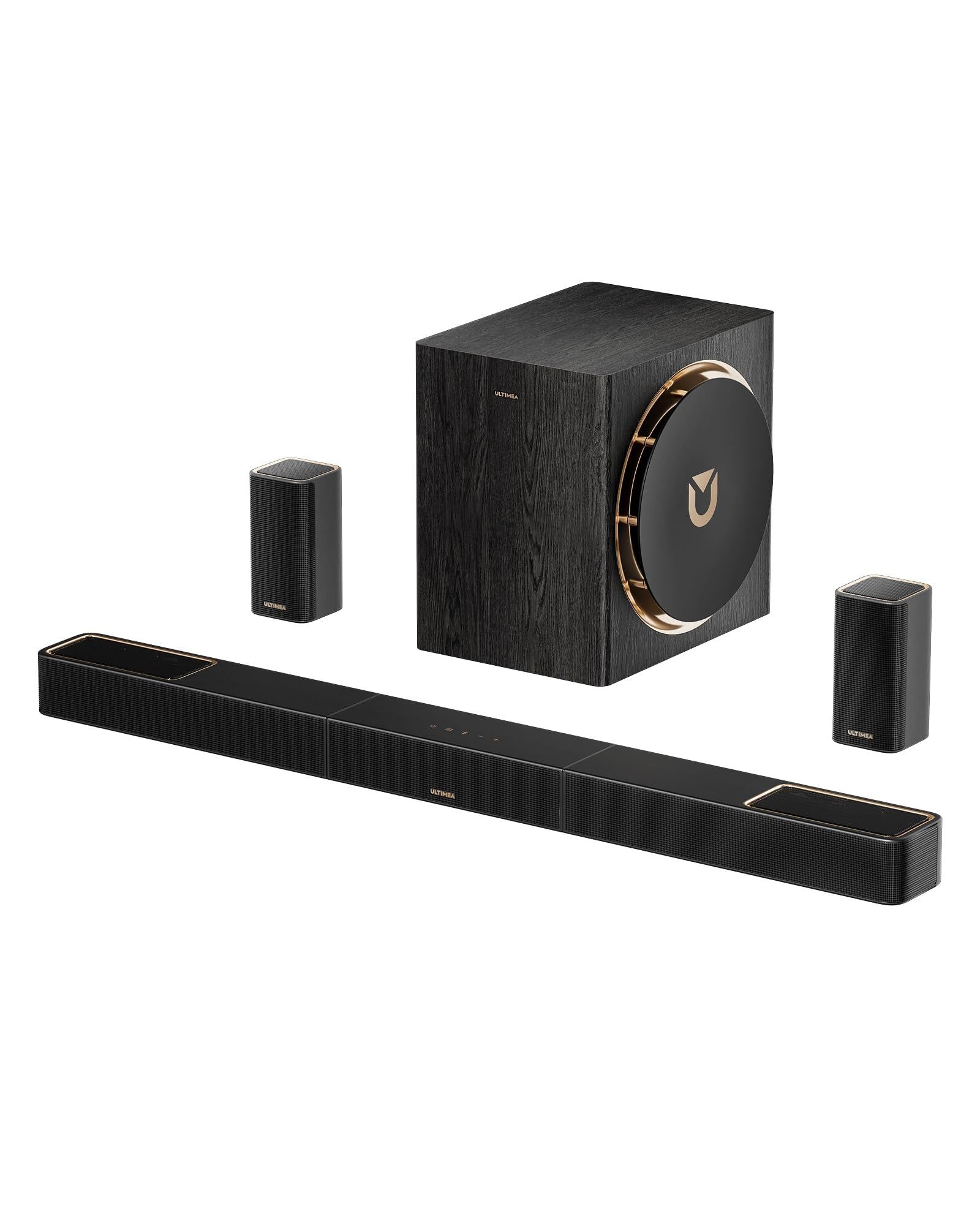
The Skywave X50 brings Dolby Atmos into the affordable tier without stripping away the key elements that make height channels transformative. Its dual 5GHz wireless transmission keeps the 8-inch subwoofer and rear satellite speakers connected without dropouts—a rare achievement at this level. The 760W peak rating is among the highest in this guide, and the GaN amplifier ensures that power is delivered cleanly with minimal heat buildup during long movie sessions.
What makes the X50 special is the Gravus ultra-linear bass technology that extends response down to 28 Hz. Low rumbles from action sequences press into the room with tactile pressure, and the wood-crafted subwoofer enclosure reduces cabinet resonance. The NEURACORE multi-channel engine processes 24-bit/192 kHz audio, providing precise spatial imaging that makes footsteps and overhead effects feel convincing rather than muddy.
Setup is genuinely plug-and-play. Rear speakers and sub pair automatically when powered on, requiring no manual sync through the remote. The app provides detailed EQ customization, including surround level control and individual channel trimming. For anyone wanting a true height-channel experience without spending premium dollars, the X50 is the clear winner.
Why it’s great
- Full 5.1.4 Dolby Atmos with up-firing rear speakers
- Deep 28 Hz bass performance from the 8-inch subwoofer
- GaN amplifier reduces heat and delivers clean peak power
Good to know
- Rear speakers and sub need separate power outlets
- App interface can feel less intuitive for rapid EQ changes
2. Rockville HTS56

The Rockville HTS56 is a traditional 5.1 setup with a powered subwoofer, five passive satellite speakers, and a central receiver unit that handles all amplification and input switching. Its peak power rating of 1000W is among the highest in this price tier, and the 8-inch subwoofer produces room-shaking low-end for action movies and bass-heavy music. The satellite speakers mount to walls with included brackets, making placement flexible even in small living rooms.
Unique for a budget system, the HTS56 includes dual microphone inputs with echo control and a five-band EQ, making it a viable option for karaoke at home. The LED subwoofer display offers multiple light modes, including a spectrum analyzer that pulses with the audio—adding visual flair to late-night listening sessions. Connectivity covers Bluetooth, USB, SD card, RCA, and optical, so nearly any TV, phone, or computer can feed it audio.
A critical limitation is that the HTS56 cannot decode 5.1 Dolby Digital over its optical input—it only processes 2.1 PCM. To get true discrete surround from a streaming device or Blu-ray player, you need an external digital-to-analog converter that handles Dolby Digital decoding. Owners who pair it with a DAC report excellent separation across the five channels, but the box alone is best for stereo-derived surround.
Why it’s great
- Very high peak power delivers loud, room-filling sound
- Built-in karaoke mics with echo control for parties
- LED spectrum analyzer adds a fun visual element
Good to know
- Optical input only decodes 2.1 PCM, not true 5.1 Dolby Digital
- Speaker wires can be short for larger rooms
3. LG S40TR

Technically a 4.1 system—lacking a dedicated center channel—the LG S40TR still creates an impressively wide soundstage through its smart up-mixer that converts two-channel audio into multi-channel output. The wireless subwoofer and rear speakers free you from running long RCA cables across the floor, making it one of the cleanest-looking budget setups available. Setup takes about ten minutes: plug in the soundbar, power the sub and rears, and pair them automatically.
Dolby Audio compatibility and Clear Voice Plus ensure that dialogue remains crisp even during explosive scenes. The WOW Orchestra feature lets the soundbar work in tandem with compatible LG TV speakers for added fullness, and the WOW Interface displays soundbar controls on your LG TV screen. The LG Soundbar App provides a three-band EQ for bass, midrange, and treble adjustments from your phone.
The rear speakers require their own power outlets, which can be a nuisance if furniture doesn’t have nearby sockets. The 4.1 layout means you miss the pinpoint center-channel dialogue that a dedicated fifth speaker provides, but for small to medium rooms the virtual center imaging holds up well. This system is best for users who prioritize wireless convenience and tight integration with an LG TV over absolute channel count.
Why it’s great
- Completely wireless rear speakers and subwoofer
- Clear Voice Plus keeps dialogue intelligible
- Seamless LG TV integration with one remote control
Good to know
- Only 4.1 channels—no dedicated center speaker
- Rear satellites need individual power outlets
4. Klipsch Reference Cinema 5.1.4

The Klipsch Reference Cinema is not a soundbar or an all-in-one receiver unit—it is a set of passive speakers that requires an external AV receiver to power them. This is a deliberate trade-off: you buy it knowing you already have or plan to purchase a receiver, and in return you get proper horn-loaded tweeters with Tractrix 90° x 90° technology that deliver crisp, extended high frequencies with low distortion. Every satellite, including the center channel, includes an upward-firing Dolby Atmos driver for height effects from both the front and rear.
The four satellites produce surprisingly strong bass for their compact size, thanks to well-tuned ported enclosures. The 300W powered subwoofer is a sealed design that provides controlled, tight low-end rather than boomy overflow. Owner reports note that the crossover points need manual setting through the AV receiver—90 Hz for the center, 100 Hz for satellites, and 120 Hz for the up-firing drivers—to achieve seamless blending between the sub and the horn tweeters.
Because this system is entirely passive, it opens upgrade possibilities: you can swap the subwoofer, add more satellites, or replace the speakers over time while keeping your receiver. The spring-loaded binding posts do not accept standard banana plugs easily, so thinner 16-gauge wire or pin connectors work best. If you want a foundation for a growing home theater rather than a disposable black box, this is the move.
Why it’s great
- Up-firing Atmos drivers on all four satellites
- Horn-loaded tweeters provide clear, wide sound dispersion
- Passive design allows future component upgrades
Good to know
- Requires a separate AV receiver to operate
- Binding posts do not fit standard banana plugs easily
5. TCL Q85H

The TCL Q85H is a complete soundbar-based 7.1.4 system that includes a wireless subwoofer and upgraded rear speakers equipped with both front-firing and up-firing drivers. With an 860W peak rating, it fills large living rooms with distortion-free sound at high volume. The rear speakers create convincing overhead effects and precise surround placement, making it one of the few budget systems that can truly reproduce the bubble of sound intended by Dolby Atmos and DTS:X mixes.
AI Sonic optimization is a standout feature: it analyzes your room acoustics and seating position during a one-time setup through the TCL app, automatically adjusting the balance of each channel. The system also separates dialogue, bass, and effects across purpose-built drivers so that whispered conversations remain clear during chaotic battle sequences. HDMI eARC support passes 4K video without stripping HDR metadata, keeping your picture quality intact.
Non-Atmos content can sound thin at default settings—the system works best when fed an object-based audio stream. The center channel can feel quiet relative to the powerful subwoofer, requiring a boost through the app’s equalizer. Rear speakers need their own power outlets, which limits placement flexibility if your seating area lacks accessible sockets.
Why it’s great
- Full 7.1.4 channel count with up-firing rear drivers
- AI room calibration optimizes sound for your space
- Very high peak power for large room volumes
Good to know
- Dialogue to bass balance may need app EQ adjustment
- Non-Atmos content can sound less impressive
6. ULTIMEA Skywave X40
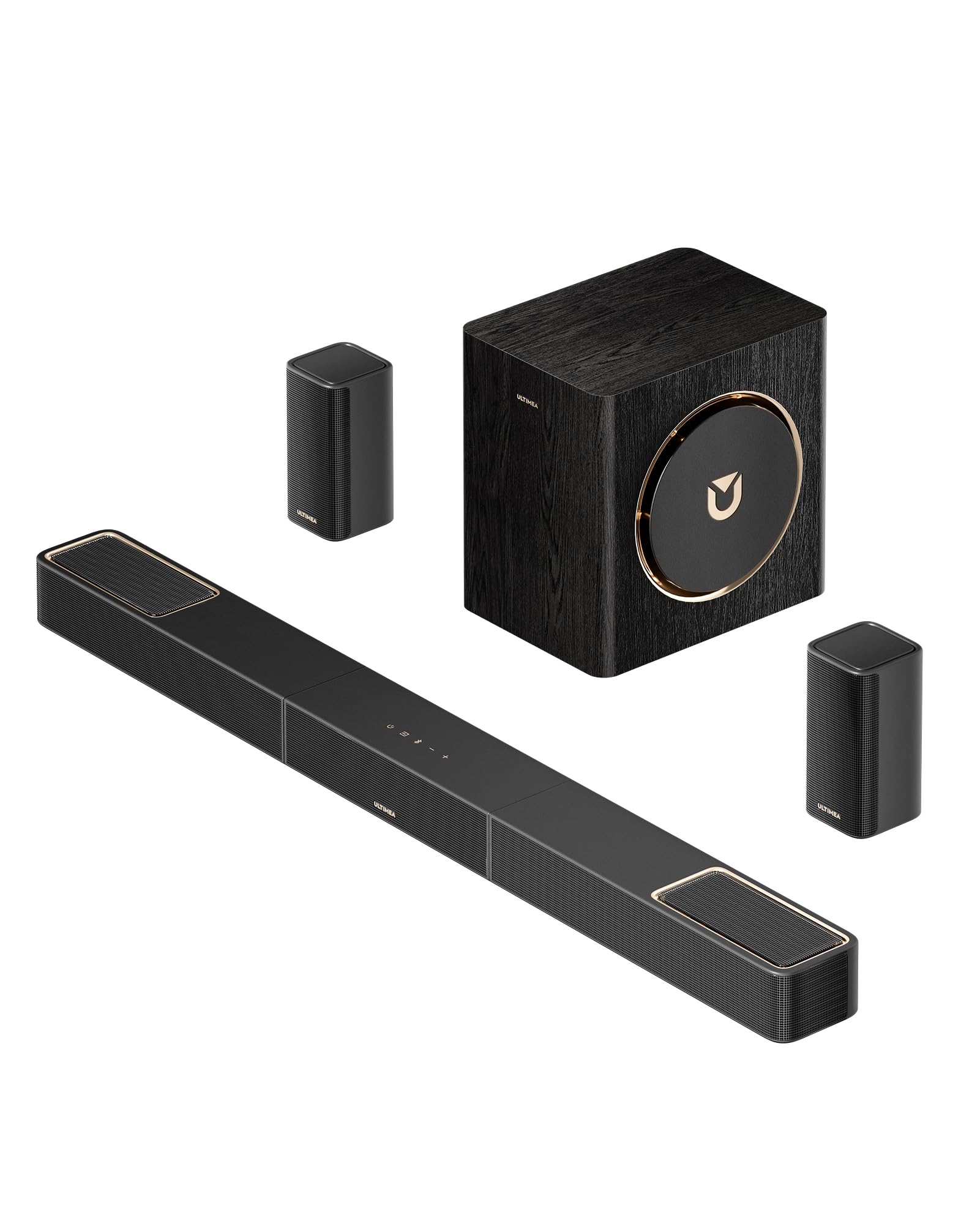
The Skywave X40 shares the same GaN amplifier architecture and wireless protocol as its bigger X50 sibling but steps down to a 5.1.2 configuration with a 6.5-inch subwoofer. This makes it a more compact solution for bedrooms or media dens where the full 5.1.4 channel layout would overwhelm the space. The 530W peak power is still generous, and the Gravus ultra-linear bass technology extends response down to 35 Hz, providing satisfying depth for its size.
SurroundX technology coordinates the four surround speakers (two wired front, two wireless rear) to create a virtual sound field that extends beyond the physical speaker positions. The included remote and app give you control over 121 preset EQ matrices and a 10-band custom equalizer, so you can dial in everything from cinema-heavy bass to vocal-forward music profiles. HDMI eARC passthrough supports 4K HDR without degradation.
Occasional Bluetooth dropouts have been reported after extended use, and the rear speakers require power outlets despite being wireless for audio. The subwoofer, while punchy, cannot match the low-end extension of the 8-inch driver in the X50—rooms over 250 square feet may find the bass lacking at high volume. At its price point, however, the X40 delivers the most feature-rich Atmos experience for smaller spaces.
Why it’s great
- GaN amplifier provides clean power with minimal heat
- Very few wires needed thanks to 5GHz rear speaker connection
- Extensive EQ tuning options via app and remote
Good to know
- Occasional Bluetooth dropouts reported after long use
- 6.5-inch subwoofer may not fill larger rooms
7. Hisense AX5140Q
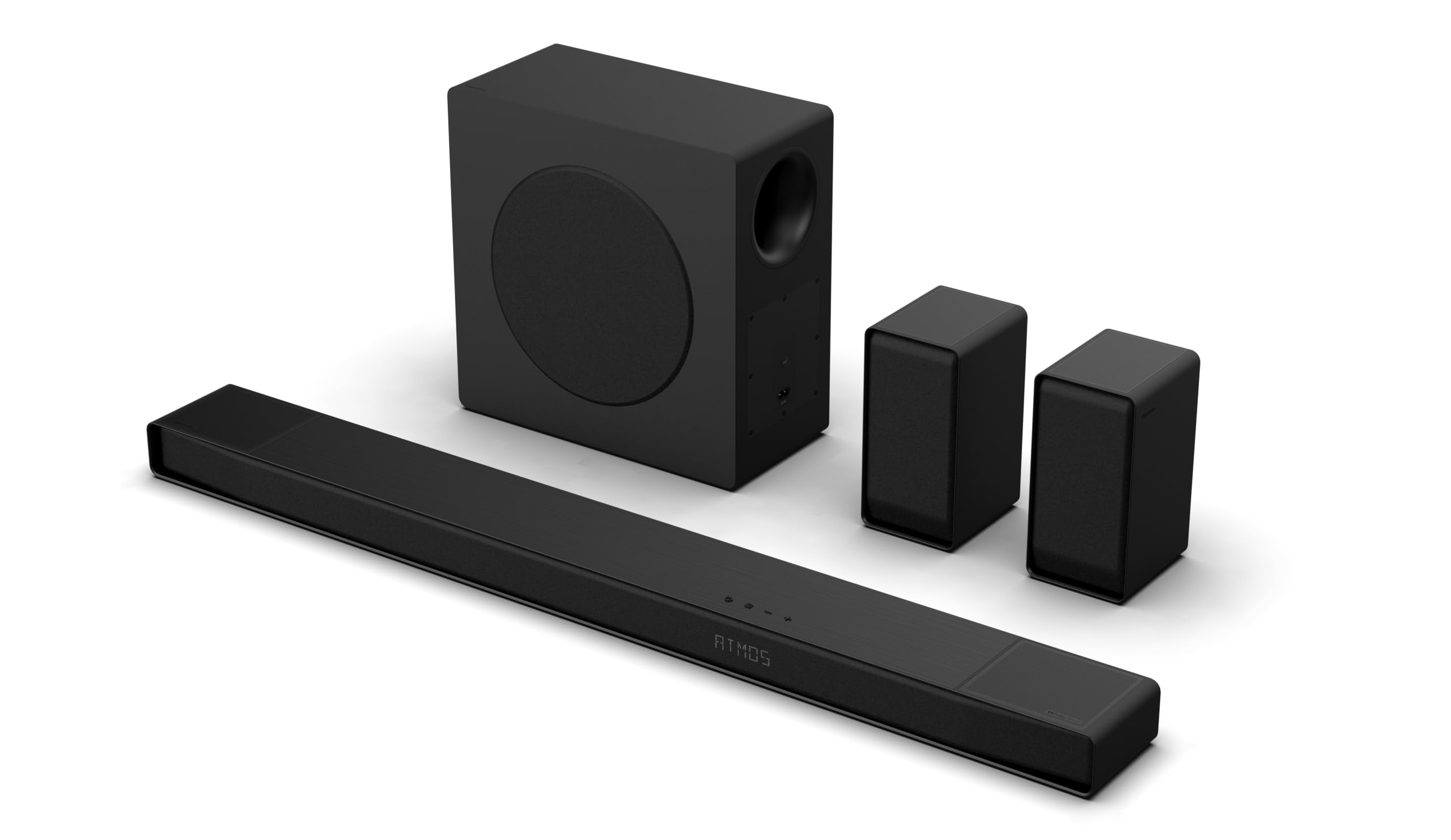
The Hisense AX5140Q offers a 5.1.4 configuration with six front-firing drivers, two up-firing drivers for height effects, and a wireless 6.5-inch subwoofer that produces bass down to 40 Hz. What sets it apart in the budget Atmos crowd is the built-in room calibration that automatically adjusts speaker levels and timing based on your room’s dimensions and furniture placement. Quick Touch EQ modes let you switch between seven presets optimized for movies, music, news, sports, games, night listening, and voice clarity.
Dolby Atmos and DTS:X both deliver noticeable overhead sound—helicopter flyovers and rain effects have distinct height placement that budget soundbars often miss. The wireless subwoofer pairs automatically during setup and can be placed anywhere within 30 feet of the soundbar without cable routing. HDMI eARC provides single-cable connection to your TV, allowing one remote to control volume and power across both devices.
Rear speakers, while wireless, need their own AC power sources, and their surround output can feel underpowered in rooms larger than 300 square feet. Bluetooth 5.3 streaming is stable across a 30-foot range, though some iPhone users have reported occasional audio garbling during complex passages. For most medium-sized living rooms, the AX5140Q provides clear, balanced sound that competes with systems costing significantly more.
Why it’s great
- Room calibration tailors sound to your specific space
- Dolby Atmos and DTS:X create convincing overhead audio
- Seven EQ presets cover all common content types
Good to know
- Rear speakers require separate power outlets
- Some Bluetooth connectivity quirks reported with iPhones
8. Acoustic Audio AA5210

The Acoustic Audio AA5210 is about as bare-bones as a 5.1 system gets—and that is not necessarily a bad thing for the price. It includes a powered subwoofer, five passive satellite speakers, and a central control unit with RCA inputs for each channel. The 600W peak rating provides enough headroom for moderate-volume movie watching and gaming in small to medium rooms. The subwoofer features multi-color LED illumination with patterns that pulse to the beat, adding a visual dimension for party environments.
Bluetooth streaming works reliably from phones and tablets, and the USB and SD card slots allow direct playback of music files without a separate source. The rear speakers come with 12-foot cables, which is generous for a budget system and lets you place them behind a couch without extension cords. Wall-mount brackets are included for all five satellites, giving you flexibility to mount them at ear level for better imaging.
Build quality is the price you pay for the low cost—multiple owners report units failing after a few months, with the subwoofer amplifier smoking or ceasing output. The remote control is also a weak point: it adjusts each speaker’s volume individually rather than offering a master volume control, making level changes tedious. The AA5210 is best approached as a disposable entry point for someone who wants to experiment with surround sound before committing to a more reliable system.
Why it’s great
- LED subwoofer light show adds visual excitement
- Long 12-foot cables on rear speakers for easy placement
- USB and SD card direct playback without a PC
Good to know
- Subwoofer amplifier has a notable failure rate after a few months
- Remote requires per-speaker volume adjustment, no master control
9. ULTIMEA Aura A40

The ULTIMEA Aura A40 takes a different approach: instead of a traditional 5.1 layout, it uses a 7.1 virtual surround algorithm processing through a soundbar and four satellite speakers. The system includes 2 wired front surround speakers and 2 wireless rear satellites, all driven by a 330W peak amplifier. SurroundX technology aims to create an immersive sound field that extends well beyond the physical speaker locations, and 13 adjustable surround levels let you tailor the width of the virtual stage.
Where the A40 truly shines is its software ecosystem. The Ultimea Home app provides 121 preset EQ matrices across four sonic preferences—Bass, Pop, Classical, and Rock—along with a 10-band equalizer for fine-tuning. Midrange adjustments are effective at bringing dialogue forward, and the Voice EQ mode cleans up muddy soundtracks without sacrificing bass impact. OTA firmware updates mean the system can improve over time rather than staying frozen at launch performance.
The virtual surround effect works best with content that already has good channel separation; pure stereo sources can sound phasey. The rear satellites need power outlets despite being wireless for audio, and the subwoofer’s output is modest compared to dedicated 8-inch units. For users who want app-driven customization and a clean aesthetic that avoids running speaker wire across the room, the A40 delivers a compelling package at the entry-level price point.
Why it’s great
- Extensive EQ control with 121 presets and 10-band customization
- Wireless rear speakers reduce visible cable runs
- OTA firmware support keeps the system current
Good to know
- Virtual surround can sound phasey with stereo-only content
- Rear satellites still need AC power for operation
FAQ
Can I get true Dolby Atmos from a cheap 5.1 system?
Do I need an AV receiver for a cheap 5.1 speaker set?
What is the minimum subwoofer size for a medium-sized living room?
Final Thoughts: The Verdict
For most users, the best cheap 5.1 surround sound system winner is the ULTIMEA Skywave X50 because it delivers genuine 5.1.4 Dolby Atmos with an 8-inch subwoofer and wireless rear satellites at a price that undercuts traditional AV receiver setups by a wide margin. If you want powerful bass and karaoke features in a traditional wired package, grab the Rockville HTS56. And for a clean wireless installation that works right out of the box, nothing beats the LG S40TR for sheer convenience.

Mo Maruf
I created WellFizz to bridge the gap between vague wellness advice and actionable solutions. My mission is simple: to decode the research and give you practical tools you can actually use.
Beyond the data, I am a passionate traveler. I believe that stepping away from the screen to explore new environments is essential for mental clarity and physical vitality.