Our readers keep the lights on and my smoothie glass nicely filled. As an Amazon Associate, I earn from qualifying purchases.
Starting out with film photography can feel expensive, but you do not need a vintage Leica or a high-end SLR (single-lens reflex) to get that classic, grainy look. The real trick is finding a cheap 35mm film camera that actually takes decent pictures while staying affordable — and this guide cuts through the noise to show you exactly which ones deliver for or less.
I’m Mohammad Maruf — the co-founder and writer behind WellFizz. This guide is built by comparing the manufacturers’ published specifications and the patterns across verified customer reviews, so you get each pick’s real strengths and trade-offs instead of marketing spin.
Whether you are a total beginner, a parent buying for a curious teen, or just want a pocket-friendly way to shoot film again, these five models cover the best cheap 35mm film camera options available today. Each one is reusable, simple to operate, and ready to load with any standard 35mm roll.
How To Choose The Best Cheap 35mm Film Camera
Film cameras under are almost all simple point-and-shoot models with basic plastic bodies and fixed lenses. The differences between them matter more than you might think — here is what to look for.
Half-Frame vs Full-Frame: The Photo Count
Half-frame cameras expose only half the normal 35mm frame, which means a standard 36-exposure roll yields about 72 shots. This cuts your per-shot film cost in half and makes these cameras very budget-friendly for learning. Full-frame cameras give you fewer, larger negatives that scan and print better. If you want to save on film, go half-frame.
Lens Width and Aperture
Most cheap cameras have a 28mm or 50mm lens. A 28mm wide-angle lens captures more of a scene — great for group shots and landscapes — while a 50mm lens (typical on half-frames) gives a more natural, portrait-friendly field of view. The aperture (the lens opening that controls how much light enters) is usually fixed at F8 or F5.6, so you rely on the built-in flash in low light.
ISO Range and Flash Reliability
ISO (the film’s sensitivity to light) measures how sensitive the film is to light. A camera that supports a wider ISO range (like 100-6400) can work with both low-speed film for bright sunny days and high-speed film for indoor or night shooting. The biggest complaint in customer reviews is that the internal flash either fires too weakly or drains batteries quickly. Look for a camera where buyers consistently say the flash works well.
Quick Comparison
On smaller screens, swipe sideways to see the full table.
| Model | Category | Best For | Key Spec | Amazon |
|---|---|---|---|---|
| Kodak EKTAR H35 | Half-Frame | Doubling your shots on a budget | Half-frame design (72 shots per roll) | Amazon |
| Kodak Ultra F9 | Full-Frame | Durable everyday carry | 5.12 x 2.56 x 1.65 in, 170g | Amazon |
| RETO PANO 35mm | Wide-Angle | Panoramic and wide-angle shots | 22mm ultra-wide lens | Amazon |
| to Be Continued (TBC) Transparent | Full-Frame | Style and portability | 285 grams, 28mm wide lens | Amazon |
| 1 Shot Point and Shoot | Half-Frame | Lowest-cost entry point | 50mm F5.6 lens, 1/120s shutter | Amazon |
In‑Depth Reviews
1. Kodak EKTAR H35 Half Frame Film Camera (Black, Bundle with 24exp Film)

The Kodak EKTAR H35’s half-frame design turns a single 24-exposure roll into roughly 48 photos, making it the top pick for budget-conscious beginners who want to stretch every roll of film. At just 200 grams, it is 85 grams lighter than the TBC camera, so it slips easily into a pocket or around your neck for all-day carry.
Buyers report it works great in low light with the flash and struggles a bit in bright indoor light, but full sun photos come out well. The built-in flash is activated by a silver ring around the lens, so you can shoot day or night without fiddling with menus. The camera is compact (4.33 x 1.77 x 2.56 inches) and automatically controls exposure, meaning you just point, shoot, and wind.
The honest limit is that this is not a professional camera — it is a “fun little toy camera,” as one reviewer put it. The image quality is decent but not amazing, and it uses a fixed ISO (film sensitivity) range of 400. For absolute beginners and casual shooters, though, it is the most practical value in this entire list. Start with this one unless you specifically need a full-frame negative or a more rugged body.
Why it’s great
- Half-frame gives you roughly twice as many photos per roll of film
- Lightest pick at 200 grams — easy to carry in a pocket
- Simple automatic operation with a built-in flash for low light
Good to know
- Fixed ISO 400 — less flexible in varied lighting conditions
- Image quality is decent but not sharp enough for large prints
- Struggles in bright indoor light without flash assistance
2. Kodak Kodak Ultra F9 Film Camera, White x Green

While the EKTAR H35 wins on film economy, the Kodak Ultra F9 beats it on real-world toughness. Owners mention it can survive thousands of shots and even drops on cement — one reviewer noted, “Ordered April 2022, still works perfectly.” At 170 grams, it is lighter than the RETO PANO and the TBC camera, yet feels more solid than the 1 Shot because of its slightly thicker body (5.12 x 2.56 x 1.65 inches).
This is a standard full-frame camera, so you get one shot per frame (no doubling) and standard 35mm negatives. The flash can be turned off when you want to save battery or shoot in daylight, and the camera works best with Kodak 200 ISO (film sensitivity) or black-and-white 400 TX film. It is plastic but, as one reviewer put it, “survived child abuse” — impressive for the price.
Pick this over the EKTAR H35 if you prefer full-frame negatives for scanning and printing, and if you value ruggedness over per-roll economy. It is a simple, no-fuss point-and-shoot that will last years if you treat it reasonably well. The catch? It uses a fixed ISO range of 400, so you are stuck with mid-speed film unless you compensate with flash.
Where it shines
- Proven durability — thousands of shots and drops survived according to real buyers
- Lightest in the lineup at 170 grams
- Full-frame negatives give you higher-quality scans and prints
Worth noting
- Fixed ISO 400 limits your film choice to mid-speed rolls
- Full-frame means you get fewer shots per roll (no half-frame savings)
- Plastic build feels light but can break if dropped repeatedly on hard surfaces
3. RETO PANO 35mm Film Camera – 22mm Wide Lens, Panorama, Sheer White
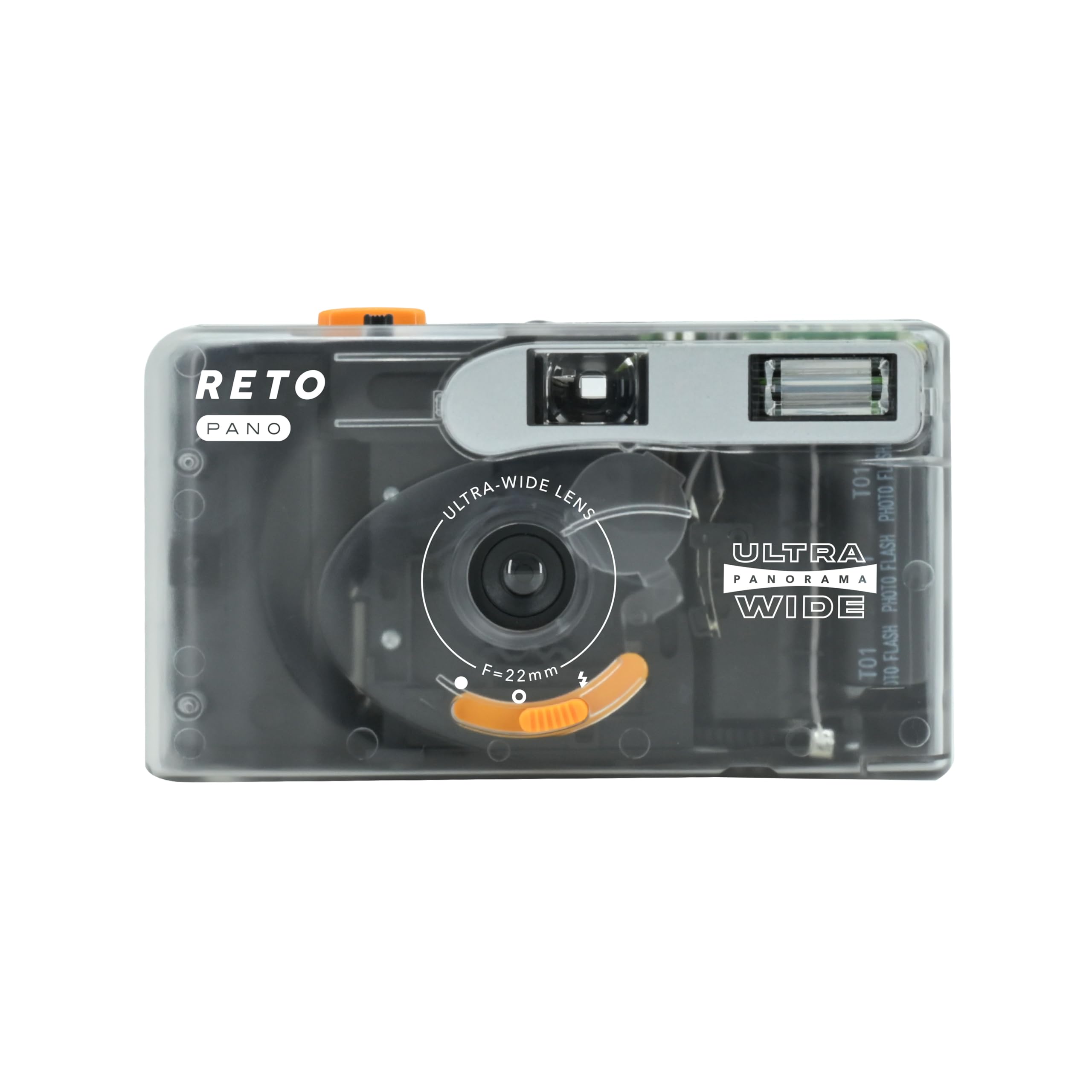
If you are shooting a group of friends in a tight alley or trying to fit an entire cathedral facade into one frame, the RETO PANO is the only camera here with a 22mm ultra-wide lens. That is wider than both the TBC’s 28mm lens and the 50mm lens on the 1 Shot, which means you get much more of the scene in every frame. Its ISO range of 100-6400 is a massive 4.0x gap over the Kodak H35 and F9 (both fixed at 400), letting you use everything from slow sunny-day film to high-speed indoor rolls.
Customers note the camera is fun and easy, and they love the wide angle and flash combination, especially with Fuji 400 film. The built-in flash fires quickly, and switching between panoramic and standard mode is as simple as flipping a switch. At just 0.13 kg, it is nearly as light as the Kodak F9, though the plastic build feels less sturdy — a few reviewers noted it felt “plasticky” and not very durable.
The standout spec here is that 22mm ultra-wide lens — no other model in this price range gives you that field of view.
What stands out
- Unique 22mm ultra-wide lens — captures more of the scene than any other budget pick
- Broad ISO range (100-6400) works with almost any 35mm film
- Easy switch between panoramic and standard photo modes
The trade-offs
- Plastic build feels less durable than the Kodak Ultra F9
- Some units have film-feeding problems — check your first roll carefully
- Flash is decent but not very powerful for large indoor spaces
4. to Be Continued (TBC) Reusable 35mm Film Camera – Transparent Design
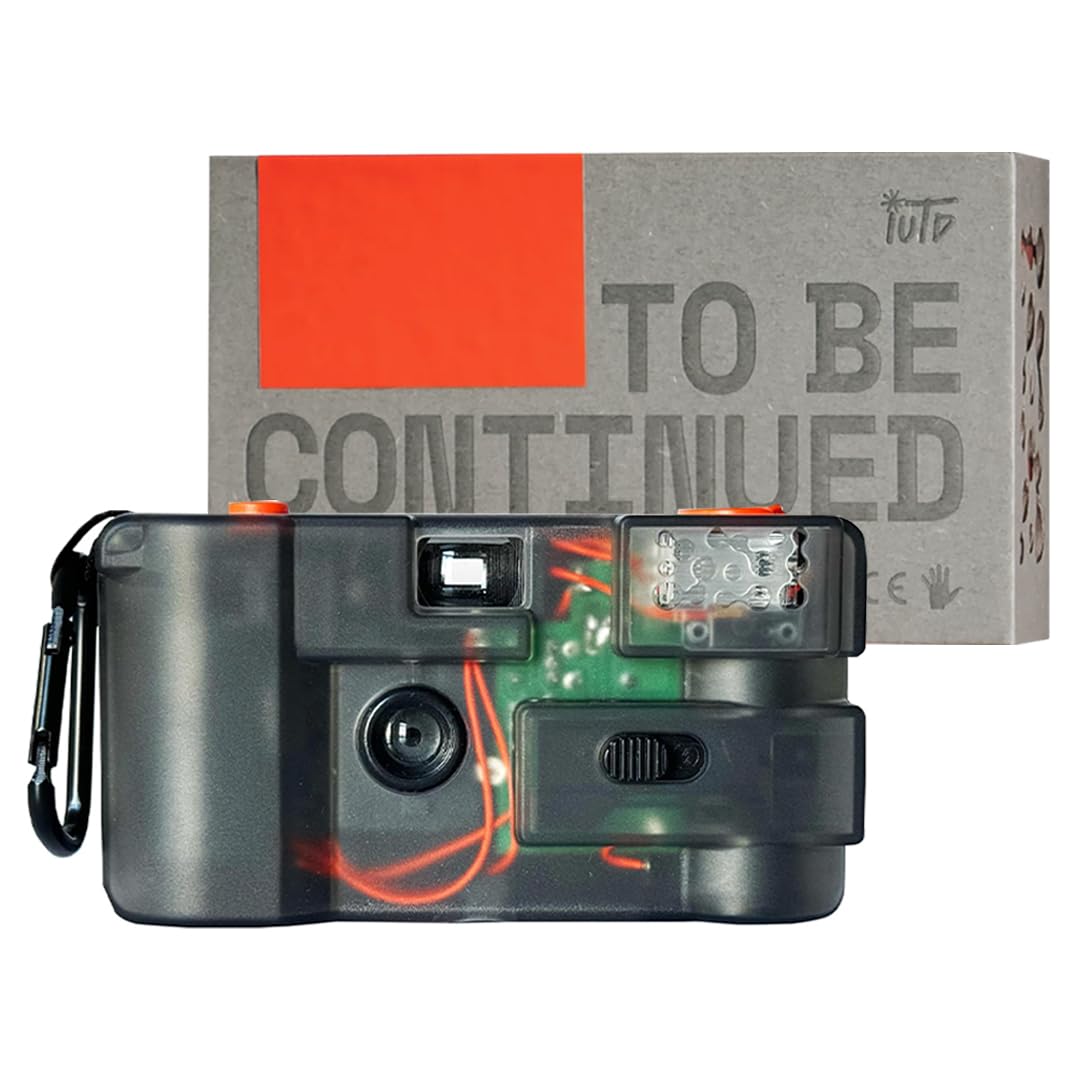
The single number that matters most in this category is weight: the TBC camera is 285 grams — a full 42% more than the Kodak EKTAR H35 (200 grams) — but that heft comes from a transparent plastic body that actually looks cool. If you care about how your camera looks as an accessory, this is the only one with a fully transparent shell that shows the internal mechanics. It also includes a carabiner clip, so you can attach it to a belt loop or bag for quick access.
Buyers consistently praise the build quality and transparent design, and one buyer mentioned the “carabiner for easy carry” makes it very portable. The 28mm wide lens is wider than a standard 50mm but not as wide as the RETO’s 22mm — a middle ground that works well for street scenes and everyday snapshots. It supports an ISO range of 100-6400, same as the RETO, so you are not locked into one film speed.
The downside is that the rewind release button is plastic and feels fragile — one reviewer called the camera “reusable but still feels disposable.” The automatic flash is powerful enough for daylight fill, but the manual exposure control requires a bit of learning. At this price, you are paying more for the design and the carabiner than for pure image quality.
The upsides
- Unique transparent design that shows the camera mechanics inside
- Includes a carabiner for clipping to a bag or belt loop
- Broad ISO range (100-6400) works with most film types
Keep in mind
- Heavier than the H35 — 285 grams vs 200 grams
- Rewind release button is plastic and feels like it could break
- More about style than superior image quality
5. 1 Shot Point and Shoot 35mm Film Camera, Reusable Retro Half Frame Camera, Brown Color

At the lowest price point, the 1 Shot gives you a half-frame camera that comes with one roll of ASA/ISO (film sensitivity) 400 black-and-white film (18 exposures, yielding 36 shots) so you can start shooting immediately. Its 50mm F5.6 lens and 1/120s shutter speed are basic but workable for daytime outdoor scenes. The half-frame design means a 36-exposure color roll gives you 72 shots — matching the EKTAR H35’s per-roll economy.
The honest trade-off is build quality. Several reviewers point out the “build caused film jam ruining pictures” and that “all photos came out super dark, even with flash.” The camera is very cheaply made, and the flash takes 10-15 seconds to recycle, meaning you cannot shoot quickly in low light. It is best treated as a disposable-style camera that you can reload rather than a long-term investment.
This is perfect for a beginner who wants to dip their toes into film without any real commitment, or for a parent buying a camera for a child. The included black-and-white roll will give you grainy, nostalgic results, and if you love the process, you can upgrade later. If you have even a slightly larger budget, the Kodak EKTAR H35 is far more reliable and delivers better images for not much more.
Why we’d pick it
- Lowest entry price and includes one roll of black-and-white film
- Half-frame design gives you roughly twice as many photos per roll
- Simple operation — great for absolute beginners and kids
A few caveats
- Build quality is very cheap — film jams and dark photos are common complaints
- Flash takes 10-15 seconds to recharge between shots
- 50mm lens works best in bright daylight; indoor shots are often too dark
Understanding the Specs
Half-Frame vs Full-Frame
Half-frame cameras expose a smaller area on the film (18×24 mm instead of 24×36 mm). This lets you fit about twice as many shots per roll — a standard 36-exposure roll becomes 72 shots. The trade-off is that each negative is smaller, so scans and prints have less detail. Full-frame cameras give you larger negatives that are better for enlargements and scanning, but you get fewer photos per roll.
ISO Range (Film Sensitivity)
ISO tells you how sensitive the film is to light. A low ISO (like 100) needs bright sun for good results. A high ISO (like 800 or 1600) works better indoors or at night. A camera with a wide ISO range — like 100-6400 — lets you use any film you want. Cameras with a fixed ISO (like Kodak’s F9 at ISO 400) limit you to mid-speed film, which is fine for general use but less flexible in extreme lighting.
FAQ
Do I need to buy batteries for these cheap 35mm film cameras?
What kind of film should I buy for a film camera?
Final Thoughts: The Verdict
If you want one dependable pick, the best cheap 35mm film camera winner is the Kodak EKTAR H35 because it doubles your shots per roll, is easy to carry, and has reliable flash performance. If you want a full-frame camera that can survive drops and heavy use, grab the Kodak Ultra F9. And for capturing wide landscapes with a 22mm lens, the standout is the RETO PANO 35mm.

Mo Maruf
I created WellFizz to bridge the gap between vague wellness advice and actionable solutions. My mission is simple: to decode the research and give you practical tools you can actually use.
Beyond the data, I am a passionate traveler. I believe that stepping away from the screen to explore new environments is essential for mental clarity and physical vitality.