Our readers keep the lights on and my smoothie glass nicely filled. As an Amazon Associate, I earn from qualifying purchases.
The hunt for the perfect travel charger is the hunt for a compromise-free formula: enough juice to keep a phone alive during a 14-hour layover, small enough to slip into a passport wallet, and versatile enough to handle a laptop, a tablet, and a pair of earbuds without forcing you to juggle five bricks and a tangle of cables. Most options on the shelf either deliver raw capacity in a brick that weighs down a carry-on or shave off weight by capping wattage, leaving a MacBook stuck on a trickle charge overnight. That gap between what fits and what actually powers a full device ecosystem is where this guide lives.
I’m Mohammad Maruf — the founder and writer behind WellFizz. I spent hours analyzing wattage curves, port configurations, thermal management claims, and battery density metrics across power banks and GaN charging stations to build a guide that helps you pick the right block for your trip, not your drawer.
Whether you’re fighting for a seat-side outlet on a cramped flight or setting up a mobile office in a hotel room with exactly one usable socket, finding the right chargers for travel means weighing pocket-friendly size against the charging speed your devices actually need.
How To Choose The Best Chargers For Travel
The right travel charger hinges on three axes: power output (measured in watts), total capacity (measured in milliamp-hours for battery packs), and port count. A 10,000mAh power bank will refill a modern smartphone twice but won’t sustain a 14-inch laptop. A GaN charging station with 65W USB-C ports can run a MacBook Pro, but if the total shared power across all ports drops to 30W when you plug in three devices, the laptop slows down. Understanding these numbers before you buy prevents the disappointment of a charger that looks versatile on paper but negotiates speed at every step.
Power Output and Device Compatibility
Look for the wattage rating on each individual USB-C port, not the total advertised wattage of the charger. A power bank that claims 30W total but has two ports may split that to 15W each when both are active, which is too slow for a modern iPad or laptop. For charging a standard smartphone at full speed, aim for 20W per port. For tablets and ultrabooks, individual ports should deliver at least 30W — 67W or higher if you plan to charge a MacBook Pro while simultaneously powering a phone and earbuds.
Capacity vs. Portability
Battery capacity is measured in milliampere-hours (mAh). A 10,000mAh power bank fits in most jacket pockets and delivers two full phone charges. A 20,000mAh unit roughly doubles your range but also doubles weight and thickness, pushing it into bag-only territory. For short trips and EDC (everyday carry), 10,000mAh is the sweet spot. For multi-day camping or flights with no in-seat power, step up to 20,000mAh. GaN wall chargers eliminate the capacity question entirely by relying on a wall outlet — they trade battery weight for high-speed pass-through power, making them ideal for hotel desks and airport lounges with available sockets.
Built-in Cables and Port Diversity
Integrated cables dramatically reduce the frustration of digging through a bag for a loose Lightning or USB-C cord, but they introduce a failure point. Look for cables rated for 10,000+ bends. A diverse port set — at least one USB-C and one USB-A, plus a dedicated Micro-USB where needed — ensures you can charge an older Kindle, a friend’s Android, or a Bluetooth speaker without carrying a separate adapter. Charging stations should have independent output circuits (not shared power) if you plan to charge multiple high-wattage devices simultaneously.
Quick Comparison
On smaller screens, swipe sideways to see the full table.
| Model | Category | Best For | Key Spec | Amazon |
|---|---|---|---|---|
| Anker Zolo Power Bank | Power Bank | Fast laptop & phone charging | 30W output, 10,000mAh | Amazon |
| GKUTW 200W GaN Station | Wall Charger | Whole-family multi-device charging | 65W per C port, 8 ports | Amazon |
| Orfeika Power Bank | Power Bank | All-in-one cable convenience | 22.5W, 4 built-in cables | Amazon |
| VRURC Power Bank | Power Bank | Ultra-pocketable daily carry | 22.5W, 0.7 inch thick | Amazon |
| Anker Nano 67W Power Strip | Wall Charger | Hotel room & cruise travel | 67W total, 2 AC outlets | Amazon |
In‑Depth Reviews
1. Anker Zolo Power Bank 10,000mAh 30W

Anker’s Zolo line targets the traveler who carries both a phone and a laptop and refuses to slow down at airport gates. The 30W USB-C output pushes an iPhone 16 Pro Max to 50% in 27 minutes — about twice the speed of most 18W rivals — and the bi-directional charging (30W out, 20W in) means the bank itself refills in roughly two hours through the built-in cable. The 10,000mAh capacity delivers two full charges for an iPhone 15 or about 1.94 charges for a Galaxy S24, which covers a full travel day plus a hotel overnight.
The integrated 5.4-inch USB-C cable is tested to 10,000 bends, a meaningful durability spec for travelers who will stow and retrieve this bank multiple times per day. The unit measures 4.32 x 2.58 x 0.98 inches, so it’s thicker than a credit-card slim design but still slides into a jean coin pocket. The LED percentage display shows remaining charge at a glance without guesswork. Anker backs this unit with an 18-month warranty and a connected equipment promise, which signals confidence in the internal circuitry.
For travelers who need a single power bank that handles both a flagship phone and a tablet or small laptop without compromising speed on either device, the Zolo’s 30W ceiling is a material advantage over the 22.5W competition. The trade-off is weight — 223 grams makes it heavier than the VRURC by about 45 grams — and the fact that the built-in cable is fixed, so if you need Lightning or Micro-USB you must bring adapters. For the iPhone 15 and newer USB-C ecosystem, however, this is the most speed-efficient pocket-sized option in the comparison.
Why it’s great
- 30W PD output charges phones and tablets at full speed
- Bi-directional fast recharge (20W input) cuts downtime
- Durable built-in USB-C cable rated for 10,000 bends
Good to know
- Heavier than ultra-slim alternatives at 223g
- No Lightning or Micro-USB input on the integrated cable
2. GKUTW 200W GaN III 8-Port Charging Station

This is not a power bank — it is a 200-watt desktop charging station built around third-generation gallium nitride (GaN III) chips that shrink the internal transformer while maintaining high output. The GKUTW station delivers four USB-C ports (two at 65W, two at 30W) and four USB-A ports, each running on independent output circuits. Unlike multi-port chargers that share total power and force speed reductions when multiple devices plug in, this unit keeps every port at its rated wattage simultaneously. That means you can charge a MacBook Pro at 65W, an iPad at 30W, and two iPhones at full speed without any one device slowing down.
For a family of four traveling with two laptops, two phones, and a set of earbuds, this single charger replaces the typical tangle of wall bricks and extension cords. The 1.5-meter (5-foot) power cord reaches hotel nightstands and conference room tables comfortably. The GaN III chip runs cooler than older silicon-based chargers, so the unit stays safe even when running near its 200W ceiling for hours. The compact footprint — roughly the size of a stack of four credit cards — saves significant bag space compared to carrying four separate chargers.
The primary reason to reach for the GKUTW over a power bank is that you have consistent access to wall power. It is not portable in the pocket sense; it stays in a backpack or laptop bag and sets up on a desk. The white plastic shell may scuff with heavy travel use, and the 5-foot cord is fixed (not detachable), which limits placement flexibility. For multi-device charging in airport lounges, hotel rooms, and shared offices, however, its independent-port architecture is the most future-proof design among these picks.
Why it’s great
- All 8 ports run full speed independently
- 65W per USB-C handles MacBook Pro and ultrabooks
- GaN III chip runs cool and saves bag space
Good to know
- Requires wall outlet — no battery backup
- Fixed power cord limits positioning options
3. Orfeika Portable Phone Charger 10,000mAh 22.5W
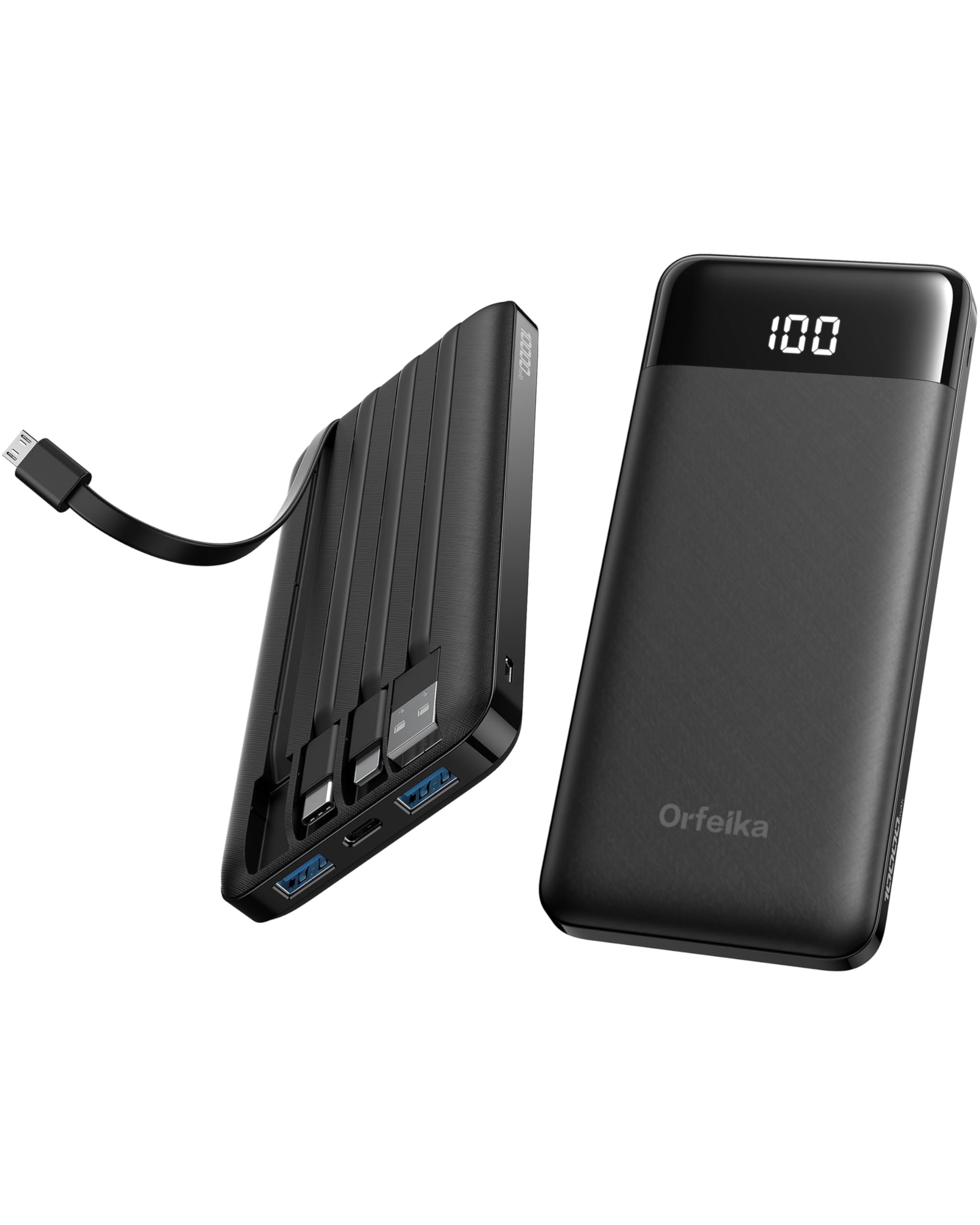
The Orfeika power bank solves the universal travel problem of misplaced or missing cables by integrating four cords — USB-C for modern phones and tablets, USB-A for older accessories, Micro-USB for legacy devices like Kindles and Bluetooth speakers, and a dedicated iPhone Lightning cable. That coverage means you can leave your entire cable pouch at home and still charge every device a typical family carries. The 22.5W PD/QC fast charging pushes an iPhone 17 to 50% in 30 minutes, which is competitive with most mid-range power banks and enough for a quick top-up between flights.
TSA approval with dimensions of 5.81 x 2.72 x 0.78 inches and a weight of 0.53 lb keeps it compliant for carry-on luggage, though it is noticeably larger than the credit-card slim VRURC. The 10,000mAh cell delivers roughly two full phone charges, and the built-in LED digital display shows exact remaining capacity at 1% increments — no vague four-dot guessing. The unit supports six outputs simultaneously (three built-in cables plus three external ports) and pass-through charging, so you can recharge the bank while it powers another device.
The trade-off for the cable convenience is bulk. The Orfeika is not the most pocket-friendly shape; it sits square in the palm rather than sliding into a watch pocket. The silicone cables are durable (rated for 10,000 bends) but create a slightly bulkier form factor than a clean slab design. For travelers who hate carrying separate cords and frequently need to charge devices from different ecosystems — iPhone, Android, USB-C tablet, Micro-USB earbuds — the Orfeika’s built-in coverage is unmatched in this price tier.
Why it’s great
- Four integrated cables cover iPhone, USB-C, USB-A, and Micro-USB
- Pass-through charging allows simultaneous refill and device power
- LED display shows battery percentage to the exact 1%
Good to know
- Slightly bulky shape doesn’t fit small pockets well
- Silicone cables add weight and thickness to the unit
4. VRURC Portable Charger 10,000mAh 22.5W
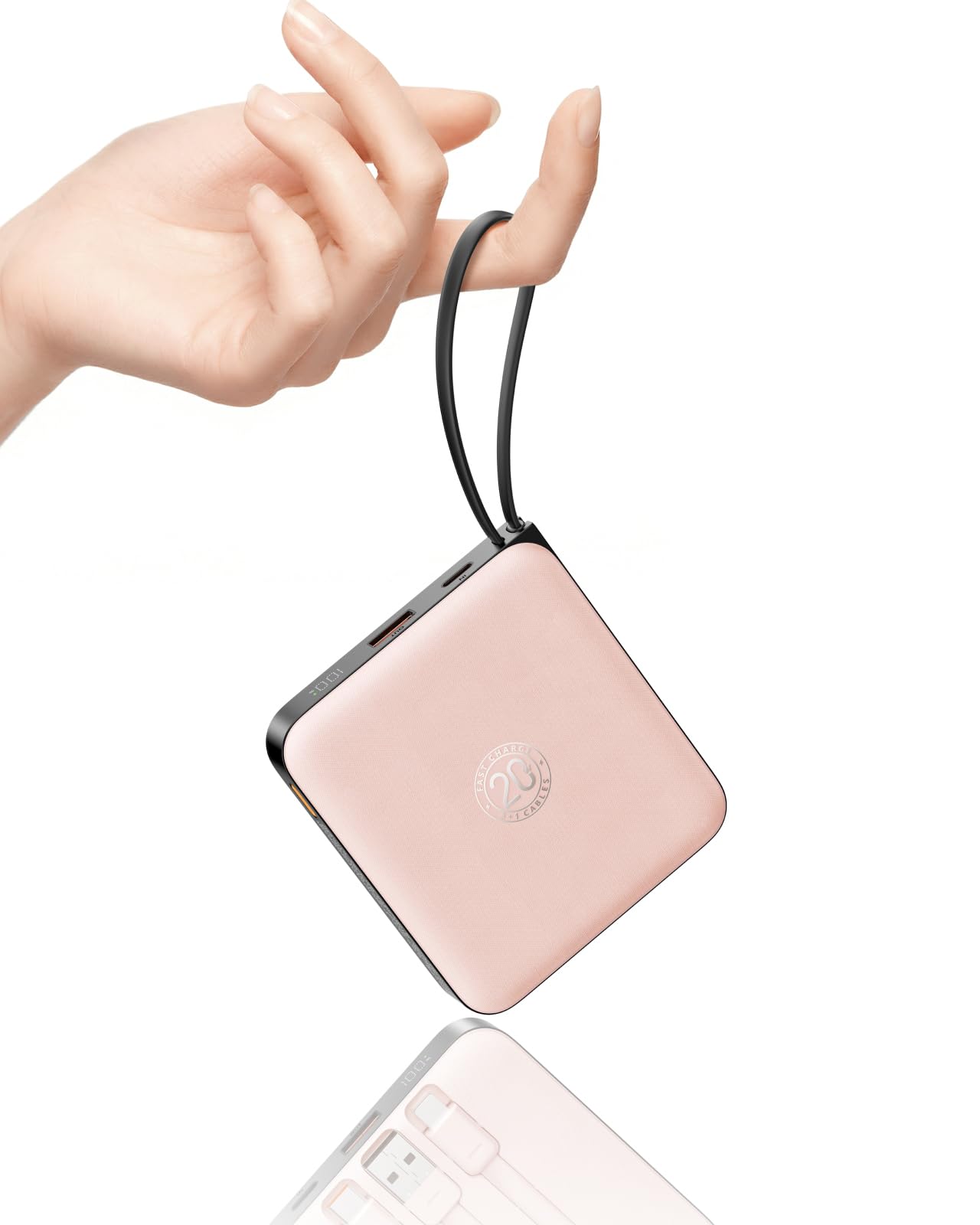
The VRURC is the thinnest power bank in this comparison at just 0.71 inches thick — roughly the depth of a smartphone case. At 6.87 ounces (195 grams), it is light enough to clip inside a clutch, a slim crossbody bag, or even a large coat pocket without noticeable sag. Despite the slim profile, it delivers the same 22.5W fast charging (PD/QC 3.0) as the Orfeika, pushing a modern iPhone to 60% in 30 minutes. The 10,000mAh lithium polymer cell holds enough capacity for one full phone recharge plus a partial second, which suits a day trip or a short overnight.
The built-in cable set covers USB-C input and output, a second USB-C cable for devices, and a Micro-USB cable for legacy gadgets. The separate USB-A and USB-C ports on the body add two additional output options, so the bank can charge up to four devices simultaneously. The bank itself refills in 2.5 hours via the integrated USB-C cable using QC/PD 3.0 input, or in 6 hours through the slower USB-A cable. The LED digital display provides exact battery level down to 1%, and the aviation safety certificates (including overcharge, overvoltage, and short-circuit protection) pass TSA checkpoints without issue.
The compromise for the ultra-slim silhouette is that the 22.5W ceiling cannot drive a laptop — tablets like an iPad Pro will charge but at reduced speed compared to the Anker Zolo’s 30W output. The pink color option is aesthetically narrow, though the unit is also available in other finishes. For users who prioritize absolute pocket-ability and elegant design over raw wattage and multi-device laptop charging, the VRURC is the most carry-friendly power bank in the group.
Why it’s great
- 0.7-inch profile is one of the slimmest 10,000mAh banks available
- Lightweight 195g design disappears into small bags
- Recharges via built-in cable in only 2.5 hours
Good to know
- 22.5W output won’t fast-charge larger laptops
- Limited color options may not suit everyone
5. Anker Nano 67W 6-in-1 Travel Power Strip

The Anker Nano is not a battery — it is a compact power strip designed to solve the most frustrating problem of modern travel: too many devices and too few outlets. It combines two AC outlets (for laptop bricks, camera chargers, or CPAP machines) with two USB-C ports (one at 67W, one at 20W) and two USB-A ports (both at 12W). The 67W USB-C port can fully charge a MacBook Pro 13-inch in under two hours, while the secondary 20W port fast-charges an iPhone at the same time without any speed sharing. Programmable Power Supply (PPS) and Power Delivery (PD) technology allow the charger to negotiate the optimal voltage for each device.
The form factor is where this excels for travelers. At just 0.75 inches thick with a flat plug profile, the power strip slides behind nightstands and desk clutter without tipping over. The 5-foot extension cord gives enough reach to connect from a distant wall socket to a hotel desk. Anker built the housing from 75% post-consumer recycled plastic, and the unit weighs 13.9 ounces — heavier than a single power bank but far lighter than carrying three separate wall chargers. The 24-month warranty and lifetime connected equipment warranty provide peace of mind for expensive electronics.
Unlike pure USB-C hubs, the two AC outlets allow legacy devices — a camera charger, a Nintendo Switch dock, or a partner’s laptop brick — to plug in without adapters. This makes it especially useful for cruise cabins, shared hotel rooms, and convention center tables where outlet access is a premium. The downside is that the power strip is wall-dependent and cannot serve as an emergency backup during power outages. For travelers who need to power multiple AC and USB devices from a single plug, this is the most thoughtful multi-format solution available.
Why it’s great
- 67W USB-C charges laptops and tablets at full speed
- Flat plug and slim body fit tight hotel outlets and tight spaces
- Two AC outlets support legacy gear without dongles
Good to know
- No surge protection despite the power strip design
- Heavier than a standard GaN block at 13.9 oz
FAQ
Can I bring a 20,000mAh power bank on a plane?
Is GaN really better than standard silicon chargers?
What does PD (Power Delivery) mean for my devices?
Final Thoughts: The Verdict
For most users, the chargers for travel winner is the Anker Zolo Power Bank because its 30W output is the fastest pocketable speed for both phones and tablets, and the 10,000mAh capacity neatly covers a full travel day. If you need to charge an entire family’s worth of devices from a single outlet, grab the GKUTW 200W GaN Station. And for hotel rooms with scarce AC plugs and legacy AC-powered gear, nothing beats the Anker Nano 67W Power Strip.

Mo Maruf
I created WellFizz to bridge the gap between vague wellness advice and actionable solutions. My mission is simple: to decode the research and give you practical tools you can actually use.
Beyond the data, I am a passionate traveler. I believe that stepping away from the screen to explore new environments is essential for mental clarity and physical vitality.