Our readers keep the lights on and my smoothie glass nicely filled. As an Amazon Associate, I earn from qualifying purchases.
A dead battery at the field isn’t just an inconvenience—it’s a session-ender. The real challenge isn’t finding a charger; it’s finding one that actually balances your cells properly, doesn’t cook your packs, and delivers the advertised wattage without fan noise that drowns out your pit talk. The market is flooded with generic units that claim high current but sag under load, and some cheap options even skip storage discharge, which is a fast track to puffy LiPo bags.
I’m Mohammad Maruf — the founder and writer behind WellFizz. I’ve spent dozens of hours cross-referencing technical datasheets, cell count compatibility charts, and real-world user reports to isolate the chargers that genuinely protect your investment in expensive LiPo, LiHV, and NiMH packs.
This guide breaks down the four most compelling models on the market, from entry-level USB-C field chargers to dual-channel 240W workhorses. Whether you fly quads or bash monster trucks, you’ll find the right charger for rc batteries on this list.
How To Choose The Best Charger For RC Batteries
Selecting a charger isn’t about brand loyalty—it’s about matching the charger’s electrical limits to the capacity and cell count of the packs you actually own. A 50W charger can handle a 3S 2200mAh pack fine, but it will take all day to balance a 6S 5000mAh brick. Here are the three critical specs to evaluate before you click “buy.”
Wattage vs. Current — Understand the Limiting Factor
Charge current (amps) is only half the equation. Wattage (volts x amps) determines how fast the charger can actually push power into a high-voltage pack. A charger rated for 10A but limited to 80W will max out at roughly 5.5A on a 4S pack (14.8V nominal). Always cross-reference the stated wattage against your highest cell count battery to calculate real charge time.
Balance Current and Active Balancing
Standard balance chargers use a passive bleed method—they dump excess voltage from high cells as heat. Active balancers, like the one inside the SKYRC B6Neo, shuttle energy between cells instead of wasting it. This results in faster balance cycles and less heat buildup inside the charger during long storage-discharge sessions.
Input Power Flexibility — AC vs. DC vs. USB-PD
If you charge exclusively at home, an AC-powered unit like the SKYRC iMAX B6AC V2 is the simplest option—just plug into the wall. Field chargers with DC input (XT60) and USB-C Power Delivery (PD) let you charge from a deep-cycle battery or a power bank, which is essential for drone pilots and crawler enthusiasts who run multiple packs per outing.
Quick Comparison
On smaller screens, swipe sideways to see the full table.
| Model | Category | Best For | Key Spec | Amazon |
|---|---|---|---|---|
| SKYRC iMAX B6AC V2 | AC/DC Premium | Home hobbyists who want a silent, proven workhorse | 50W charge / 6A max current | Amazon |
| Hiyiton C6X2 Dual | Dual-Channel | Pilots charging two different packs simultaneously | 240W DC / 10A per channel | Amazon |
| SKYRC B6Neo | Portable USB-C | Field charging from power banks or small DC supplies | 200W DC / 80W PD / active balancer | Amazon |
| Hiyiton V6 | Budget All-in-One | Newcomers needing a full accessory kit and wide connector support | 6A max / supports 1-6S LiPo | Amazon |
In‑Depth Reviews
1. SKYRC iMAX B6AC V2

The SKYRC iMAX B6AC V2 is the reference standard that other chargers are measured against. This updated version integrates an AC power supply directly into the chassis, so you simply plug the included cord into a wall outlet and start charging—no extra DC brick needed. The dual-power input (AC 100–240V or DC 11–18V) provides flexibility, though the 50W charge power and 6A current limit mean it’s best suited for packs up to 4S 4000mAh where speed is a secondary concern to reliability.
Owners consistently praise the near-silent operation. The cooling fan is barely audible during discharge cycles, a welcome change from the jet-engine whine of competitors. The unit’s serial number can be verified on the iMAX website to confirm authenticity, a step worth taking given the number of counterfeit clones. The included XH2.54 balance board supports 1S-6S LiPo, LiFe, LiIon, NiMH, NiCd, and Pb chemistries, making it a universal tool for any hobbyist’s bench.
One notable quirk is the lack of a soft-start circuit or power switch—plugging the DC input cable causes a visible arc from the input filter capacitor. It’s not a functional flaw but it can be startling the first time. The menu system is deep but rewards patience: you can set charge current in 0.1A increments, configure storage voltage targets, and review per-cell internal resistance data.
Why it’s great
- Integrated AC power supply eliminates desk clutter
- Fan is remarkably quiet even during discharge
- Authenticity verification via iMAX serial lookup
Good to know
- 50W power limit means slow charges on large 6S packs
- No power switch—DC input connector arcs on plug-in
- Menu requires manual to navigate initially
2. Hiyiton C6X2 Dual LiPo Charger
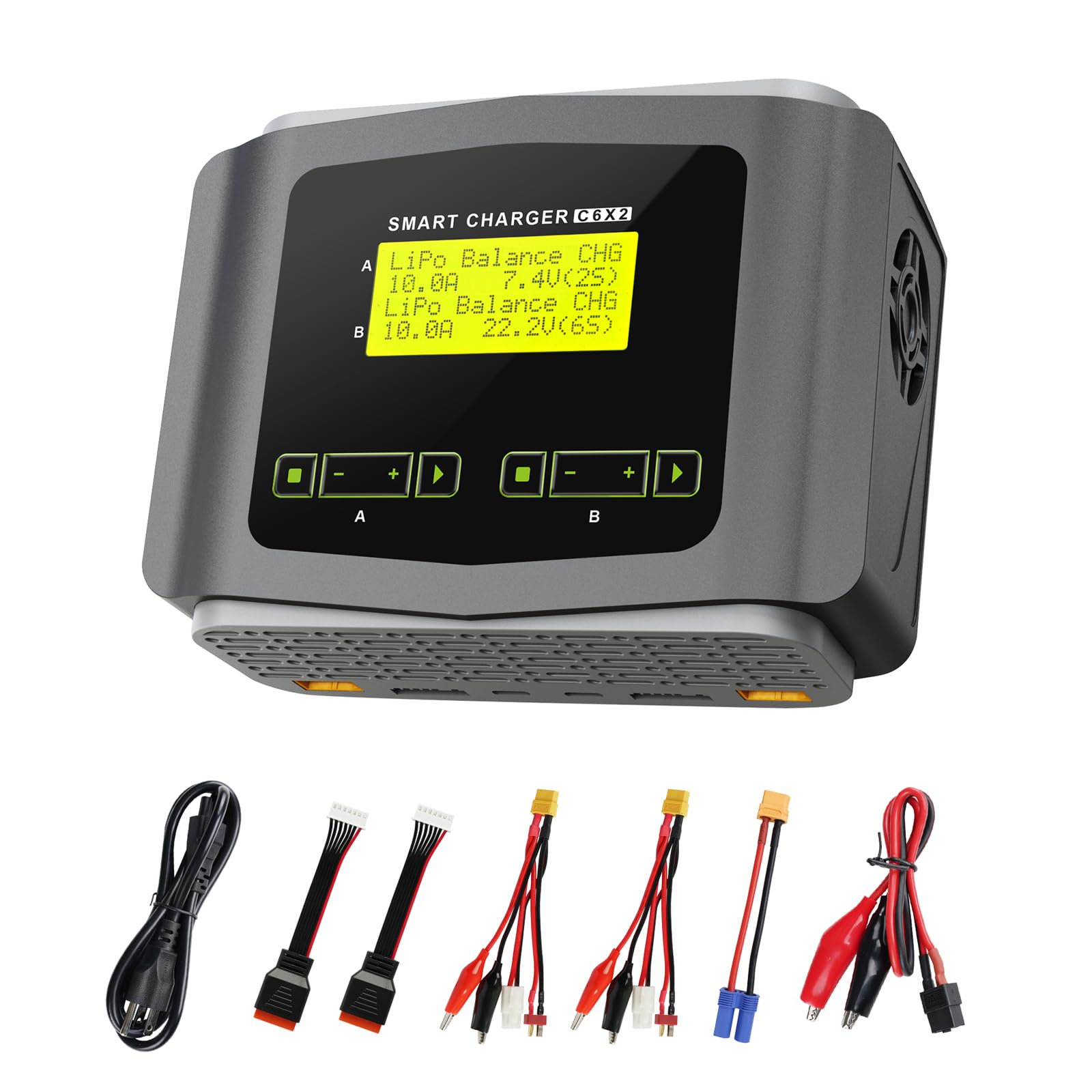
The Hiyiton C6X2 addresses the most common bottleneck in any pit area: you can only charge one battery at a time. Its two fully independent channels each deliver up to 10A of charge current, with a combined DC input ceiling of 240W. That means you can balance-charge a 6S 5000mAh LiPo on channel one while simultaneously storage-discharging a 4S 2200mAh pack on channel two without cross-channel interference. The AC input is capped at 150W total (split dynamically between channels), so for maximum throughput you’ll want to feed it with a 12–18V DC power supply.
The 5-year warranty is a confidence signal rarely seen at this price point. The LCD screen is backlit and scrolls real-time data including per-cell voltage, charge current, elapsed time, and capacity in mAh. Each channel stores up to 20 memory presets, so you can save specific charge profiles for your most-used packs and recall them without diving into menus every session. Included accessories are generous: two balance extension cords, two 3-in-1 converter cables (XT60, EC5, and bare wire), AC cord, and DC cord.
A few users noted that the built-in safety features—over-voltage, over-temperature, over-current, and short-circuit protection—caught a misconfigured charge before it caused damage. The auto cell-count detection works reliably on all common chemistries, but the manual warns against charging two different battery types simultaneously on one channel, which is standard practice. The discharge power is a modest 10W per channel, so deep-discharging large packs still takes time.
Why it’s great
- Two independent 10A channels for simultaneous charging
- 240W DC input handles large 6S packs without sag
- 5-year warranty provides long-term peace of mind
Good to know
- AC input limited to 150W total—requires DC supply for full power
- Discharge current is only 2A per channel
- Menu navigation can be confusing without the manual
3. SKYRC B6Neo

The SKYRC B6Neo redefines what a compact charger can do. Despite weighing only 82 grams and fitting in a jacket pocket, it delivers 200W over DC input (10–28V, 10A) and 80W over USB-C Power Delivery at 20V. The USB-C PD mode is the standout feature—plug it into a 100W power bank and you can charge a 4S 2200mAh LiPo pack in the field without hauling a lead-acid battery. The built-in active balancer shuttles energy between cells instead of bleeding it as heat, which reduces wear on the charger and shaves minutes off the balance phase.
The 48 dB fan noise rating is noticeable but not intrusive; users describe it as a gentle hum that doesn’t compete with pit conversation. The firmware is upgradable via the USB-C port, so future battery chemistries or feature improvements can be added without buying a new unit. The interface is a step up from traditional LCD menus—the smart navigation uses context-sensitive icons that reduce the learning curve significantly.
Several long-term reviewers reported using the B6Neo daily for months without issues, though a single verified report of a unit dying after three weeks highlights the importance of buying from an authorized seller with a return policy. The discharge function reaches up to 24W through the balance port, which is enough for storage-discharging mid-size packs. It includes an XT60 output connector and a Type-C input cable, but you’ll need adapters for Deans, Tamiya, or Futaba plugs.
Why it’s great
- USB-C PD input enables charging from power banks
- Active balancer reduces heat and speeds balance time
- Ultra-compact design for true field portability
Good to know
- Single battery at a time—no dual-channel
- Requires XT60 adapter for non-XT60 connectors
- Isolated reports of early failure suggest quality variance
4. Hiyiton V6 LiPo Charger
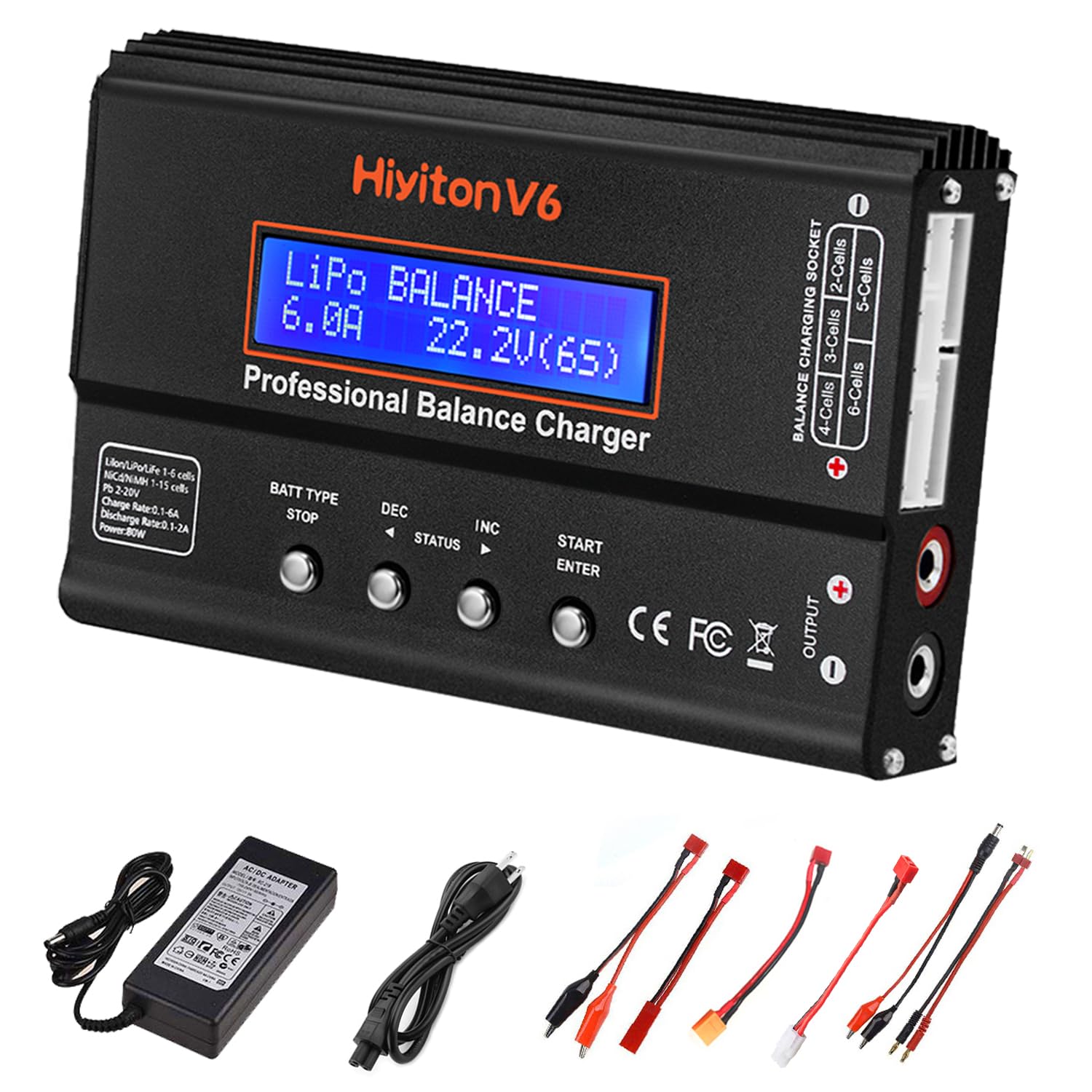
The Hiyiton V6 is the entry-level gateway for new RC enthusiasts who want a complete charging solution without buying extra cables. The package includes a Tamiya-to-crocodile clip cable, an XT60 plug, a 4mm-to-Deans charge cable, and a Tamiya cable—covering virtually every connector used in toy-grade and hobby-grade RC cars, boats, drones, and airsoft batteries. It charges 1S-6S LiPo (3.7V-22.2V), 1S-6S Li-ion, 1S-6S LiFePO4, 1S-15S NiMH/NiCd, and 2V-24V SLA packs, making it one of the widest chemistry-compatible units under the mid-range threshold.
The backlit LCD display is easy to read in bright sunlight, and the menu supports memory storage and load, cyclic charging/discharging, and warning/error messages. The internal smart chip handles over-current, over-discharge, over-voltage, and short-circuit protection, and the unit is CE and FCC certified. Users who have owned the V6 for over two years report consistent performance, with one noting that a battery explosion in their home was caused by improper winter storage, not the charger itself—reinforcing that user error, not hardware failure, is often the culprit in negative reviews.
That said, the 6A max current and the included AC adapter’s modest wattage mean you won’t be fast-charging large 6S packs. The charge time on a 6S 5000mAh pack can stretch past two hours. The menu system relies on a printed manual; users who skip reading it find the programming confusing. The fan runs when needed and is reasonably quiet, though not as silent as the iMAX B6AC V2.
Why it’s great
- Comes with seven adapters—no extra purchases required
- Extremely wide chemistry and cell count support
- CE and FCC certified with multiple built-in safety protections
Good to know
- 6A max current is slow for 6S 5000mAh packs
- Menu is not intuitive without the printed manual
- No USB output or Bluetooth connectivity
FAQ
Can I leave my LiPo battery on the charger after it’s full?
What does the balance port do and do I need it?
Final Thoughts: The Verdict
For most users, the charger for rc batteries winner is the SKYRC B6Neo because it packs active balancing, USB-C field charging, and 200W DC power into a truly pocketable package. If you want dual independent channels to charge two packs at once, grab the Hiyiton C6X2. And for a silent bench charger with a proven track record and AC power built in, nothing beats the SKYRC iMAX B6AC V2.

Mo Maruf
I created WellFizz to bridge the gap between vague wellness advice and actionable solutions. My mission is simple: to decode the research and give you practical tools you can actually use.
Beyond the data, I am a passionate traveler. I believe that stepping away from the screen to explore new environments is essential for mental clarity and physical vitality.