Our readers keep the lights on and my smoothie glass nicely filled. As an Amazon Associate, I earn from qualifying purchases.
A backpacking trip is only as good as your ability to navigate, capture the view, and call for help if things go sideways. When your phone dies two days in, a bulky power brick that weighs down your pack is the last thing you need. The right charger for the backcountry has to balance capacity, weight, and ruggedness so you stay connected without breaking your back.
I’m Mohammad Maruf — the founder and writer behind WellFizz. I’ve spent countless hours analyzing portable power specs, comparing solar efficiency ratings, and reading through trail-tested feedback to find the setups that actually work when you’re miles from an outlet.
Whether you’re on a week-long thru-hike or a weekend campout, finding the best charger for backpacking comes down to matching your device load, trip length, and weight tolerance to the right power solution.
How To Choose The Best Charger For Backpacking
Picking the right power source for the trail isn’t about grabbing the biggest number. Every ounce in your pack counts, and a charger that doesn’t match your actual trip profile will either run out of juice on day two or weigh you down unnecessarily. Focus on these three factors to narrow your options.
Capacity That Matches Your Trip Length
Your phone’s battery is the baseline. If your smartphone holds around 3,000mAh and you need to recharge it twice over a three-day trip, a 10,000mAh power bank gives you a comfortable buffer. For longer treks or if you’re charging a camera, headlamp, and GPS device, look toward the 27,000mAh range. More capacity means more weight, so match the numbers to your actual device list rather than buying the biggest bank you can find.
Charging Speed and Port Configuration
Time at camp is limited, and slow charging eats into rest or hiking hours. A 20W Power Delivery (PD) port will recharge most phones to 50% in about 30 minutes, which is the sweet spot for efficiency. If you’re carrying a tablet or a laptop that supports USB-C charging, consider a 45W option to keep those devices topped off without waiting all evening. At least two output ports (USB-A and USB-C) let you charge your phone and a secondary device like a smartwatch simultaneously.
Weight, Size, and Solar Options
Ultralight backpackers should prioritize chargers under 200 grams (roughly 7 ounces) that slide into a hip belt pocket or stuff sack. If your route has reliable sun exposure and you’re out for more than four days, a foldable solar panel (21W or higher) paired with a small power bank can extend your autonomy indefinitely. Just remember that solar panels need direct sunlight and proper angling to produce meaningful output — they work best when left at camp or attached to the top of your pack in open terrain.
Quick Comparison
On smaller screens, swipe sideways to see the full table.
| Model | Category | Best For | Key Spec | Amazon |
|---|---|---|---|---|
| Portable Power Bank Station 99.9Wh | Premium | Multi-day trips with multiple devices | 27000mAh / 22.5W PD | Amazon |
| INIU 45W Portable Charger | Mid-Range | Fast charging for phones and small tablets | 10000mAh / 45W PD | Amazon |
| WeeFancy Mini with Built-in Cables | Mid-Range | Ultralight travel with minimal cable clutter | 10000mAh / 22.5W PD | Amazon |
| BigBlue SolarPowa 20 | Specialty | Extended sun-exposed trips off the grid | 21W Solar / IP68 | Amazon |
| WeeFancy Small Portable 10000mAh | Budget | Day hikes and short overnights | 10000mAh / 20W PD | Amazon |
In‑Depth Reviews
1. Portable Power Bank Station 99.9Wh

This 99.9Wh power station is the backbone of a multi-day backcountry setup. Its 27,000mAh capacity is enough to recharge a smartphone seven to eight times or a laptop three to four times, making it ideal for trips where you’re powering a phone, camera, and GPS unit simultaneously. The PD 22.5W USB-C port pushes your phone to 60% in half an hour, so you’re not waiting around at camp.
The build quality feels substantial without being excessive for a backpack — it weighs 1.46 pounds, so it’s best suited for hikers who already carry a base weight that can absorb an extra pound. Seven output ports, including built-in Type-C and Lightning cables, mean you can charge every device you brought without digging for cords. The intelligent LCD display shows exact remaining battery, removing the guesswork of whether you’ll make it through another day.
A built-in flashlight with four modes (activated by double-clicking the button) adds genuine utility for night navigation or emergencies. Customer feedback confirms it keeps an iPhone running for four to five days of moderate use, and the seller resolves any issues quickly. If your backpacking trips involve multiple electronics and you don’t mind the weight, this is the most versatile all-in-one solution.
Why it’s great
- Massive 27000mAh capacity supports phones, laptops, and tablets for a week
- Built-in cables eliminate the need to pack separate charging cords
- Bright flashlight with multiple modes is a real survival tool
Good to know
- Weighs 1.46 pounds — heavy for ultralight hikers
- Some units may need a firmware reset to reach full charge
2. INIU 45W Portable Charger
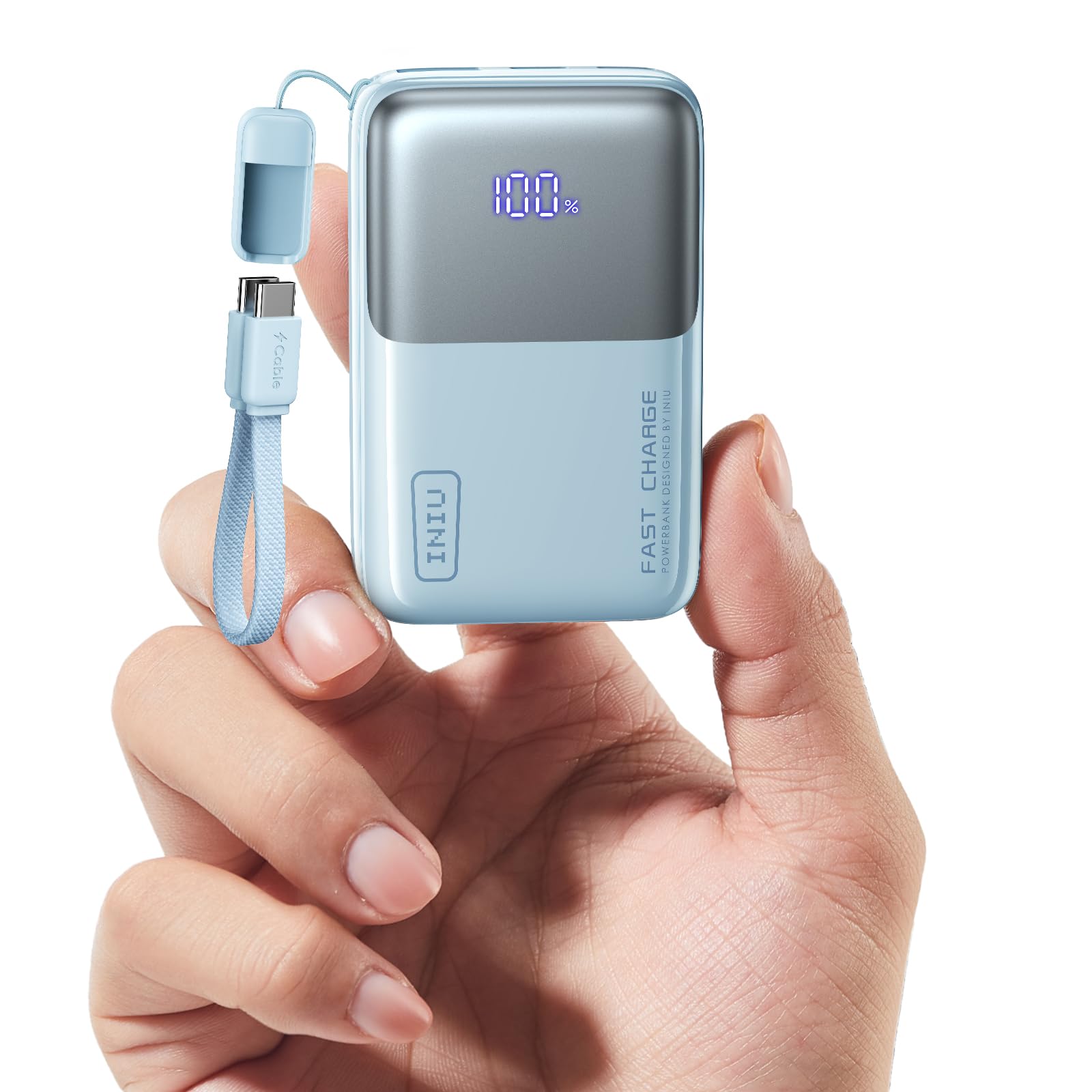
The INIU 45W portable charger packs desktop-grade charging speed into a case roughly the size of an AirPods Pro. At 10,000mAh and 160 grams (5.6 ounces), it delivers two full phone charges or roughly 1.5 charges for a Samsung Galaxy S26, all while taking up minimal pack space. The true standout here is the 45W Power Delivery — it blasts a Samsung S26 Ultra from 20% to 92% in 30 minutes, which is a game-changer when you have a limited break at a trailhead or camp.
The detachable nylon-braided USB-C lanyard cable is a smart design choice for backpackers. It doubles as a carry strap and a charging cable, and because it’s replaceable, a frayed cord won’t send the whole unit to the trash. The built-in cable supports the same 45W output, so you don’t lose speed when using it. Three ports (two USB-C and one USB-A) let you charge your phone, a friend’s device, and your earbuds case simultaneously.
INIU backs this unit with a 3-year warranty and has shipped to over 38 million users globally, which provides real confidence for a piece of gear that sees rough trail conditions. The compact footprint slides into a hip belt pocket or a small stuff sack without creating a bulge. If speed and portability are your top priorities, this is the most capable lightweight charger in its class.
Why it’s great
- 45W PD charges phones at desktop speed — 92% in 30 minutes
- Detachable lanyard cable is replaceable and doubles as a carry strap
- Ultra-compact size fits in a pocket or hip belt
Good to know
- 10000mAh capacity is suited for short to medium trips, not week-long treks
- Takes about 3 hours to recharge the power bank itself
3. WeeFancy Mini with Built-in Cables
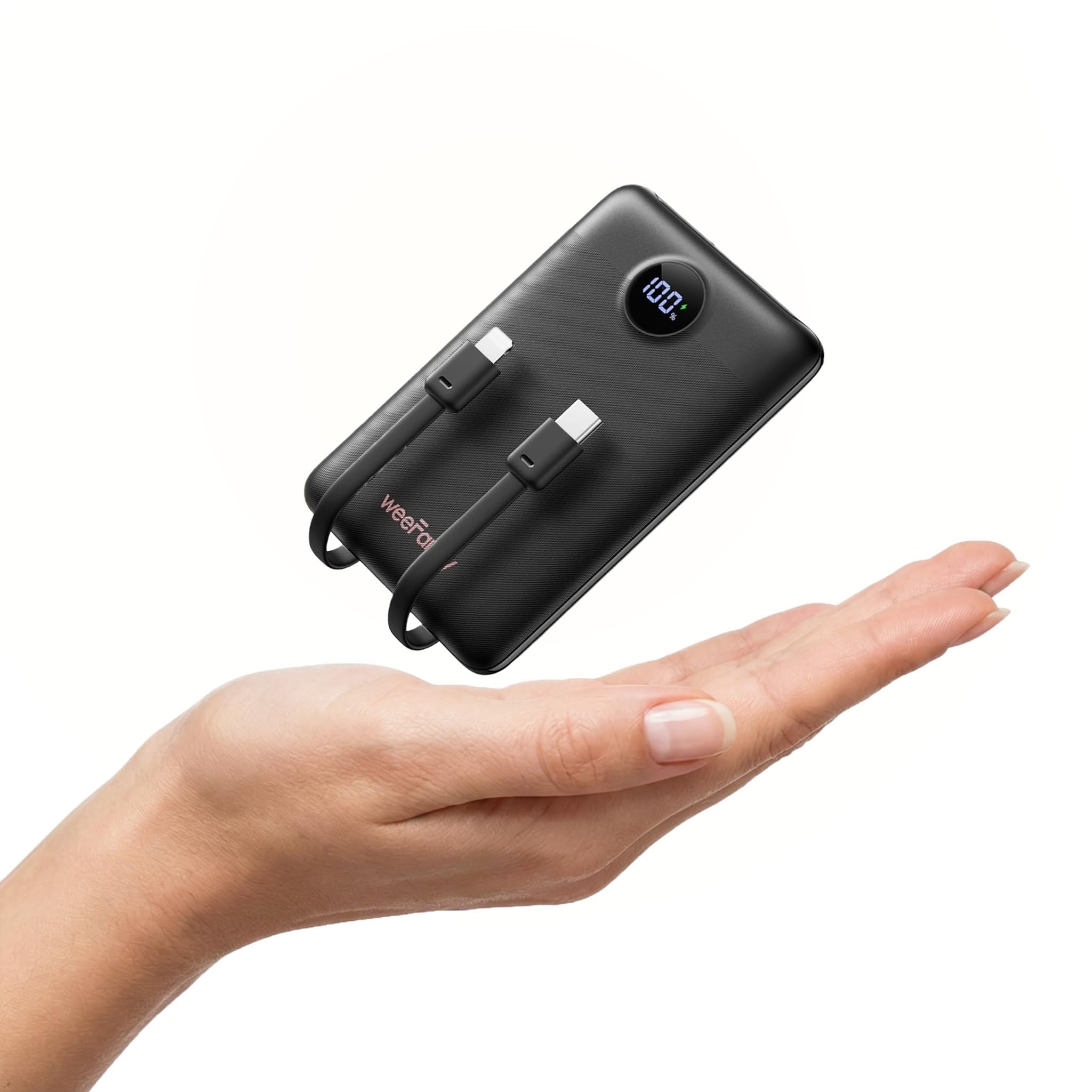
The WeeFancy Mini is engineered for the ultralight backpacker who refuses to sacrifice charging capability. At 5.76 ounces and 0.6 inches thick — about three-quarters the size of an iPhone — it slips into a pocket or a small pouch without adding noticeable weight. The built-in iPhone and USB-C cables are the headline feature: no more digging through your pack for a loose cord or realizing you packed the wrong one.
With 22.5W Power Delivery, it charges an iPhone to 50% in 30 minutes and provides roughly two full charges for an iPhone or 1.5 for a Samsung Galaxy. The 10,000mAh capacity is the sweet spot for weekend trips — enough to keep your phone, headphones, and a small camera running without carrying a brick. The bank itself recharges in 3 to 4 hours via USB-C, so you can top it off during a rest day if you have access to power.
TSA-approved and built with intelligent over-current and short-circuit protection, it’s trail-safe and flight-friendly. The fire-resistant shell adds a layer of security if you’re storing it near fuel or in a hot tent. Customer reviews consistently highlight its reliability for travel, cruises, and daily commutes. If your main backpacking goal is to shave ounces while still carrying a functional charger, this is the most practical option available.
Why it’s great
- Built-in cables eliminate the need to pack separate cords
- Extremely lightweight and slim — easy to lose in a pocket
- 22.5W PD delivers fast top-offs during short breaks
Good to know
- Built-in cables are fixed length and cannot be swapped
- Recharging the bank itself takes 3-4 hours
4. BigBlue SolarPowa 20

The BigBlue SolarPowa 20 is not a power bank — it’s a 21W foldable solar panel designed to keep your gear topped off indefinitely when the sun is out. Folding down to the size of a book and weighing 1.32 pounds, it attaches to your backpack or tent with the included carabiners and supplies power directly to your devices or a small power bank. The high-efficiency monocrystalline panels achieve up to 24.7% conversion, which is among the best for portable solar in this price bracket.
Dual USB ports (each 5V/3A, combined 5V/4.2A) are enough to charge two phones or a phone and a power bank simultaneously. In direct sunlight, real-world testing shows it pushes about 2.3 to 2.4 amps to each port — enough to recharge two 10,000mAh power banks in under three hours. The IP68 waterproof rating means it can handle rain and splashes, though the USB junction box itself is not waterproof, so keep that connection dry when charging.
The key limitation is that solar panels require direct, unobstructed sunlight and proper angling to produce meaningful output. Shade on even one panel can drop charging near zero, and the black device pocket can overheat electronics in direct sun. Use this panel to charge a power bank during the day, then use the bank to charge your phone at night. For extended off-grid trips where the sun is reliable, this is the most sustainable option.
Why it’s great
- Renewable power source for trips longer than power bank capacity can handle
- High monocrystalline efficiency (up to 24.7%) outperforms many budget panels
- Folds small and attaches easily to a pack or tent
Good to know
- Does not store electricity — requires a power bank or direct device connection
- Shade on any panel section drops output significantly
5. WeeFancy Small Portable 10000mAh
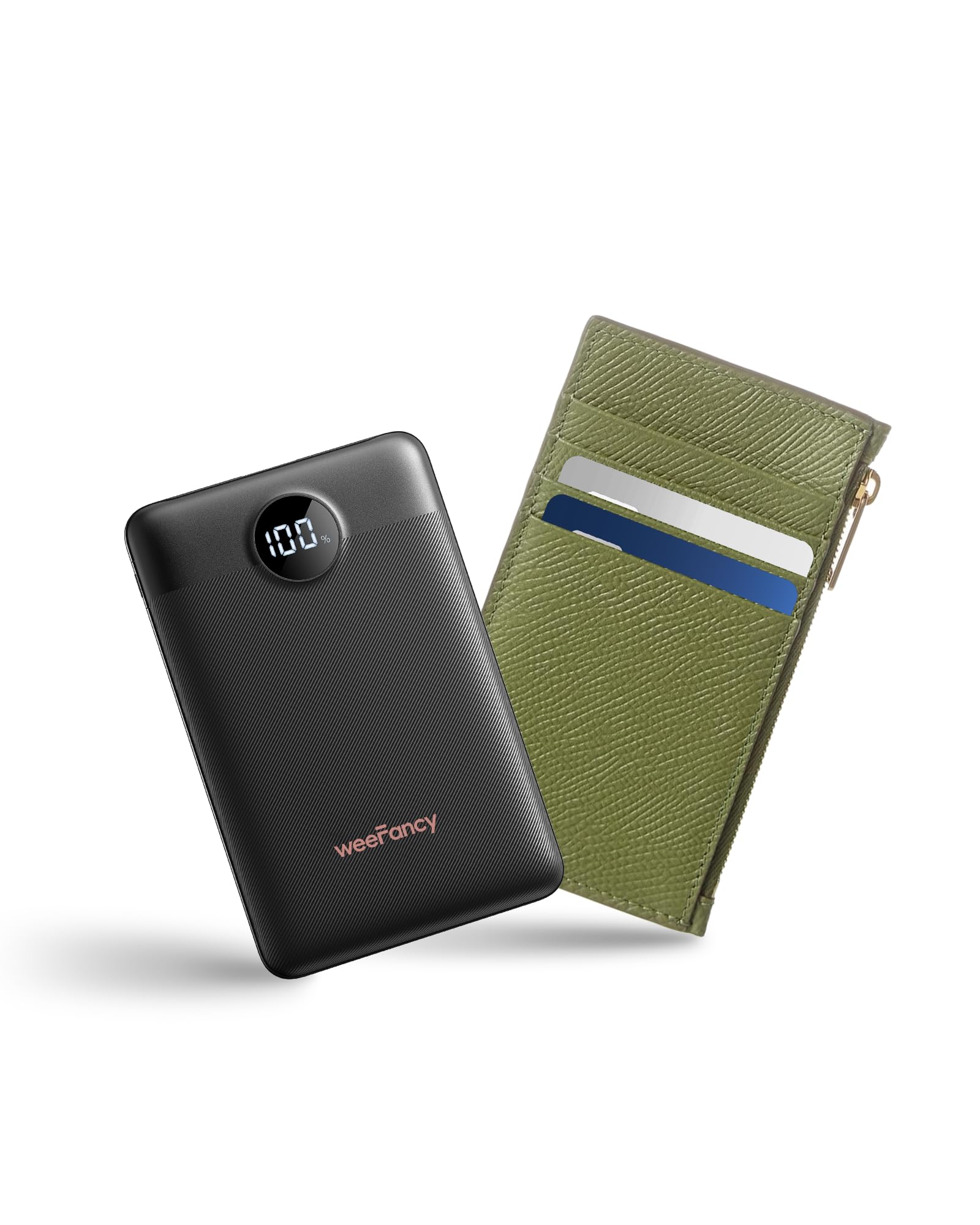
The WeeFancy Small Portable 10,000mAh charger is the entry-level workhorse for budget-conscious backpackers. Weighing just 165 grams (5.82 ounces) and measuring 0.63 inches thick, it’s one of the slimmest 10,000mAh options on the market — easily fitting into a wallet pocket or the smallest pouch in your pack. The 20W Power Delivery output charges an iPhone 17 to full in about 35 minutes, which is competitive with chargers twice its price.
Three output ports (USB-A and two USB-C) give you flexibility for charging multiple devices at camp, and the LED digital display shows the exact remaining percentage so you’re never guessing. The striped, scratch-resistant exterior holds up well against the abrasion of a pack pocket or a stuff sack. A 9-layer safety system with overcurrent, overvoltage, and temperature protection means it won’t overheat or short out during a hot afternoon hike.
Customer feedback confirms it delivers roughly two full charges for an iPhone with a little leftover for a headset or earbuds. The main trade-off is the slower 20W speed compared to the 45W INIU or the higher-capacity premium option — but for day hikes and single-night trips, this charger delivers everything you need at the lowest entry price. It recharges in about 3 hours via USB-C, so you can top it off during a rest stop.
Why it’s great
- Extremely slim and light — fits in a wallet pocket
- LED display shows exact remaining power
- 20W PD charges an iPhone in about 35 minutes
Good to know
- 20W is slower than the 45W options for device top-offs
- 10,000mAh capacity limits use to short trips or one device
FAQ
Can I use a solar panel without a power bank on a backpacking trip?
How many times will a 10000mAh power bank charge my phone on the trail?
Is it safe to charge a power bank inside a tent or backpack?
Final Thoughts: The Verdict
For most backpackers, the best charger for backpacking winner is the INIU 45W Portable Charger because it delivers laptop-grade charging speed in a truly pocketable 5.6-ounce body with a detachable lanyard cable that won’t leave you stranded. If you need maximum capacity for a week-long trip with multiple devices, grab the Portable Power Bank Station 99.9Wh. And for ultralight hikers who want to eliminate cable clutter entirely, nothing beats the WeeFancy Mini with Built-in Cables.

Mo Maruf
I created WellFizz to bridge the gap between vague wellness advice and actionable solutions. My mission is simple: to decode the research and give you practical tools you can actually use.
Beyond the data, I am a passionate traveler. I believe that stepping away from the screen to explore new environments is essential for mental clarity and physical vitality.