Our readers keep the lights on and my smoothie glass nicely filled. As an Amazon Associate, I earn from qualifying purchases.
Watching an elderly loved one move through their day brings comfort, but the moment they stand from a chair or bed without assistance is a moment of high risk. A fall can change everything—fractures, hospital stays, and a loss of independence that upends a family’s routine. The right alert system acts as a silent guardian, notifying a caregiver the instant pressure is lifted, buying precious seconds that can prevent a tragedy.
I’m Mohammad Maruf — the founder and writer behind WellFizz. I’ve spent hundreds of hours analyzing the specifications and real-world performance of fall prevention equipment, scrutinizing sensor types, range limits, false alarm rates, and volume controls to find the most reliable protection for your family.
Whether you are caring for a parent with dementia or a spouse recovering from surgery, this guide breaks down the sensor technologies, pager ranges, and setup requirements you need to know to choose the best chair alarm for elderly that keeps your loved one safe without compromising their dignity.
How To Choose The Best Chair Alarm For Elderly
Selecting the right chair alarm is about more than just picking the loudest siren. You need to match the sensor type to the user’s mobility, the pager range to your home, and the alert method to the caregiver’s lifestyle. Overlooking any of these can lead to ignored alerts, false alarms, or a system that the user fights against.
Sensor Type: Pressure Pad vs Motion Detector
A pressure-sensor pad sits on the chair seat or under the mattress and triggers the alarm when weight is removed. These are ideal for users who sit consistently and need to be monitored specifically when they stand. Motion detectors use a passive infrared beam to sense when legs enter a zone—often placed on the floor. Motion detectors can be used for both chair and doorway monitoring, but they can also trigger false alarms when pets or objects cross the beam.
Pager Volume and Range
The pager must be loud enough to reach the caregiver wherever they are in the house. Look for a range of at least 300 feet in open space for a typical single-story home. Volume adjustability is critical—some pagers produce 120 decibels, which can be startling if the caregiver is in the same room. A vibration-only mode is essential for nighttime use when the caregiver is sleeping in the same room but still needs to be alerted.
In-Room Alarm vs Silent Pager Alert
Federal CMS guidance has phased out in-room bed alarms because the loud noise at the bedside can startle elderly patients, causing agitation and increasing fall risk. A system that sends the alert only to a caregiver’s pager is preferred. This keeps the environment calm for the user while ensuring the caregiver is notified instantly.
Quick Comparison
On smaller screens, swipe sideways to see the full table.
| Model | Category | Best For | Key Spec | Amazon |
|---|---|---|---|---|
| Lunderg Under Mattress Bed Alarm | Premium | Advanced fall prevention with early alert | 300 ft range, 15-month pad lifespan | Amazon |
| Lunderg Wireless Bed Alarm System | Mid-Range | Incontinence-resistant pressure pad | 10×30 inch pad, 120 dB pager | Amazon |
| Upgrade Professional Bed Sensor Alarm | Mid-Range | Dual sensor setup for bed and door | 918 ft range, 113 dB alarm | Amazon |
| Upgraded Version Bed Sensor Alarm | Budget | Entry-level fall prevention with backup power | 600 ft range, LED alert + USB backup | Amazon |
In‑Depth Reviews
1. Lunderg Under Mattress Bed Alarm for Elderly
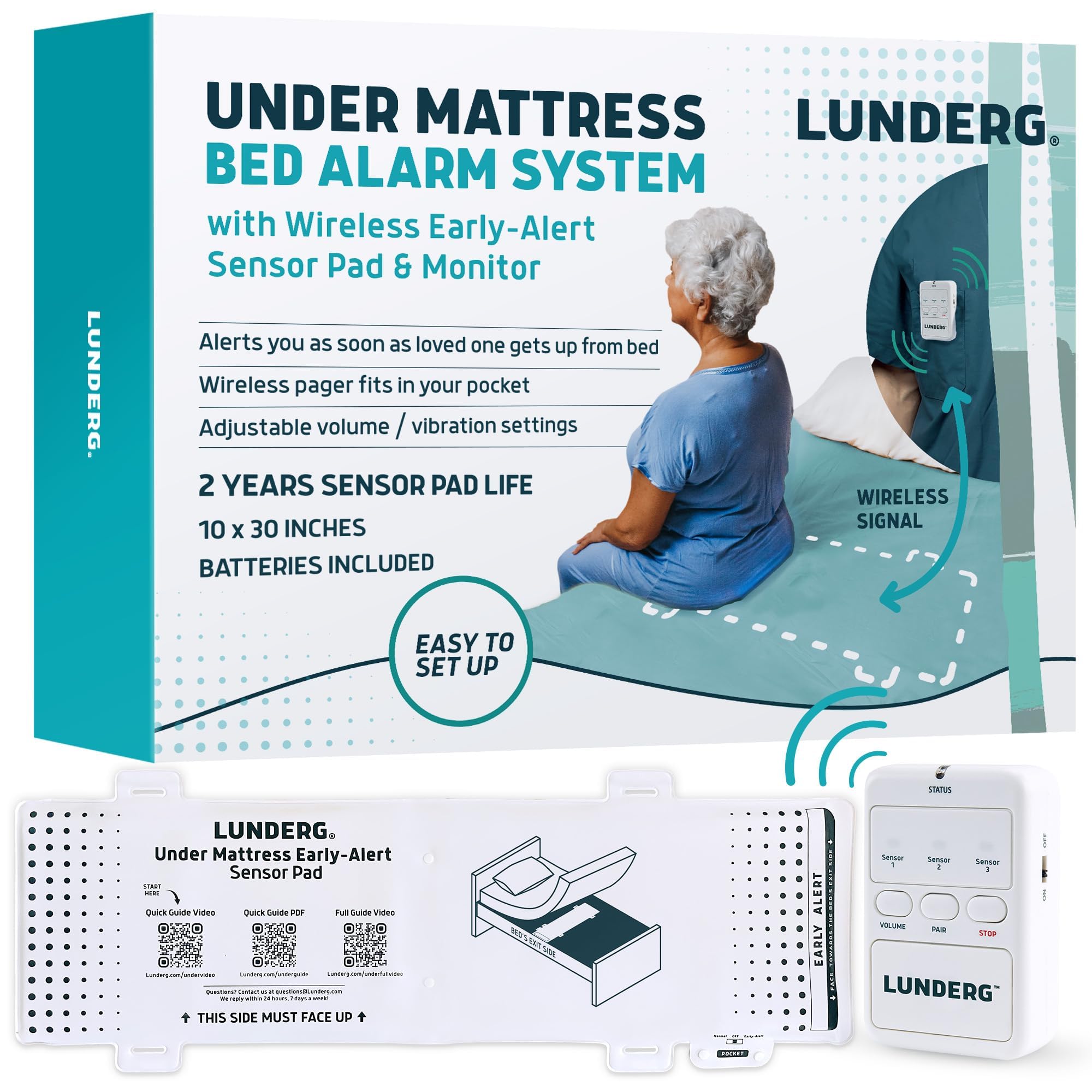
The most advanced system in the lineup, this Lunderg model places the sensor pad completely under the mattress, making it invisible and undetectable to the user. This is a critical advantage for dementia patients who may refuse to sit on a pad or push it away. The patented PreRise Early-Alert technology detects the shift in pressure before the user stands, giving the caregiver time to arrive before the feet hit the floor, not after.
The sensor pad is rated for up to 15 months of daily use—far exceeding the 45-day or 12-month lifespan of competitor pads. The included pager offers adjustable volume and a vibration-only mode, which is ideal for nighttime monitoring when the caregiver is sleeping nearby but does not want a loud alarm waking the household. Setup is straightforward with no Wi-Fi or app required, and batteries are included for both the pad and pager.
A single user reported a false alarm when their mother slept on the far edge of the bed, and another noted that the pad’s battery is not replaceable—but given the 15-month lifespan, this is a minor inconvenience. Overall, this is the gold standard for fall prevention when the user is resistant to monitoring and the caregiver needs a silent, early alert.
Why it’s great
- Patented PreRise technology alerts before the user stands, preventing falls rather than reacting to them
- Completely invisible installation under the mattress with no wires, pads, or obtrusive equipment
- Exceptional 15-month sensor pad lifespan compared to the industry average of 45 days
- Pager offers vibration-only mode for silent night monitoring
Good to know
- Sensor pad battery is not user-replaceable; the entire pad must be replaced after 15 months
- Works best with mattresses 13 inches or thinner for reliable detection
- Can trigger false alarms if the user consistently sleeps at the very edge of the bed
2. Lunderg Wireless Bed Alarm System for Elderly

This mid-range Lunderg system uses a traditional pressure-sensor pad that sits on the chair or mattress, measuring 10 by 30 inches—large enough to detect movement without the user feeling cramped. The pad features an incontinence-resistant surface that wipes clean easily, and anti-slip stickers keep it in place, addressing the number one cause of false alarms in pressure-pad systems.
The pager offers a 400-foot range in open space and produces 120 decibels at maximum volume, with the ability to adjust down to low or switch to vibration only. The system sends alerts wirelessly to the pager only—no in-room alarm that can startle the user. This is a critical feature for dementia patients, as the vendor notes that in-room alarms were classified as a potential restraint by federal CMS guidance in 2017 and phased out in care facilities.
Some users reported occasional loss of pairing between the sensor and pager, which can be mistaken for dead batteries. The instructions are clear, and the vendor offers 24/7 real-person support to troubleshoot. For a traditional pressure-pad system that prioritizes dignity and reliability, this is a strong, well-thought-out choice.
Why it’s great
- No in-room alarm to startle or agitate the user; alert goes only to the caregiver’s pager
- Incontinence-resistant surface and anti-slip stickers reduce false alarms from pad shifting
- Portable pager with clip, wall mount, and adjustable volume including vibration-only mode
- Eligible for FSA/HSA pre-tax spending accounts
Good to know
- Occasional loss of pairing between sensor and pager requires re-pairing, not just battery replacement
- Sensor pad sits on top of the mattress, which some users may try to push away or refuse
- Range of 400 feet may be reduced by walls and obstructions in larger homes
3. Upgrade Professional Bed Sensor Alarm and Fall Prevention

This Nesthao system includes two motion sensors that can be placed on the floor under the bed, in a doorway, or near a chair. Unlike pressure pads that require the user to sit on them, this motion sensor triggers when the user’s legs cross the infrared beam—making it effective for monitoring both bed exits and room departures with the same hardware.
The pager offers an exceptional 918-foot open-area range, making it suitable for large homes or care facilities with multiple rooms. Four alert modes allow switching between sound plus light, light only, LED light, or a 113-decibel alarm. The volume is adjustable, and the system includes a battery backup with Micro USB charging, ensuring it works even during power outages. The sensors and pager are factory-paired and ready to use out of the box.
User feedback highlights that the motion beam is wide enough to catch leg movement reliably, but one reviewer found it too wide and added cardboard blinders to narrow the field of view. The alarm can be loud even on the lowest setting, and the bright LEDs flash intensely, which may be startling in a dark room. For caregivers who need to monitor multiple zones with a single system, this is a flexible and powerful tool.
Why it’s great
- Two motion sensors included for simultaneous monitoring of bed and doorway from one pager
- Light beam detection method eliminates false alarms from incontinence, pad shifting, or pad refusal
- Exceptional 918-foot open-area range reaches across large homes and facilities
- Dual power supply with battery backup and Micro USB capability for uninterrupted operation
Good to know
- The motion beam has a wide detection angle; some users need to narrow it with physical barriers to prevent false triggers
- Alarm can be quite loud even at minimum volume, and the flashing LEDs are bright
- Requires careful testing of sensor placement to avoid blind spots or missed detections
4. Upgraded Version Bed Sensor Alarm and Fall Prevention

This entry-level Nesthao system provides the same core motion-detection technology as the more expensive model but with a single sensor and a slightly reduced range of 600 feet. The sensor can be placed on the floor under the bed to detect when a foot is about to touch the ground, or in a doorway to monitor room exits. The pager offers a dual reminder with LED light and sound, plus five adjustable volume levels.
A standout feature at this tier is the dual power supply: the pager and sensor can run on alkaline batteries (included) or via Micro USB charging. This provides a reliable safety net during power outages or when batteries run low, without needing to scramble for replacements. The system is factory-paired and includes double-sided tape, screw kit, and manual for easy installation.
Customer reviews consistently highlight the reliable detection and affordable price point. One user noted a button breaking on a single unit, but the replacement functioned perfectly. The alarm is loud even on the lowest setting, and the bright LEDs could be distracting in a dim room—but for budget-conscious caregivers needing a straightforward fall prevention solution, this is an excellent entry point that covers the essentials without compromise.
Why it’s great
- Very affordable entry point for fall prevention monitoring without sacrificing detection reliability
- Dual power supply with both battery and Micro USB backup ensures continuous operation
- Simple installation—sensor detects leg movement on the floor or at the doorway within seconds
- Five volume levels allow some customization of alert loudness
Good to know
- Single sensor included; monitoring multiple zones requires purchasing additional units
- Alarm can still be quite loud even at the lowest volume setting
- One reported issue with a button breaking on a single unit, though replacements functioned correctly
FAQ
Will a chair alarm startle my elderly parent with dementia?
Can I use a motion detector sensor for both the bed and the chair?
How long do sensor pads last before they need replacing?
Final Thoughts: The Verdict
For most families needing reliable, dignified, and proactive fall prevention, the winner among the chair alarm for elderly options is the Lunderg Under Mattress Bed Alarm because its invisible installation and PreRise early-alert technology prevent falls before they happen. If you need a traditional pressure-pad system with excellent incontinence resistance and no in-room alarm, grab the Lunderg Wireless Bed Alarm System. And for a budget-friendly motion-detector system that covers both the bed and doorway, nothing beats the Upgraded Version Bed Sensor Alarm.

Mo Maruf
I created WellFizz to bridge the gap between vague wellness advice and actionable solutions. My mission is simple: to decode the research and give you practical tools you can actually use.
Beyond the data, I am a passionate traveler. I believe that stepping away from the screen to explore new environments is essential for mental clarity and physical vitality.