Our readers keep the lights on and my smoothie glass nicely filled. As an Amazon Associate, I earn from qualifying purchases.
When you are fifty feet up a trunk, strapped into your saddle, every ounce of weight on your harness translates directly into fatigue. A standard rear-handle chainsaw designed for ground work becomes an awkward, unbalanced hazard in the canopy — it fights your center of gravity, limits your reach, and wears your shoulders out before you finish the first limb. The difference between a productive climb and a miserable one often comes down to the saw clipped to your lanyard.
I’m Mohammad Maruf — the founder and writer behind WellFizz. I have spent hundreds of hours analyzing arborist tool specifications, comparing engine displacement, bar lengths, vibration dampening systems, and handle geometries to understand what actually separates a functional climbing saw from a burden aloft.
This guide cuts through the brand noise to help you find the right chainsaw for climbing based on weight, power, and real-world cut performance rather than marketing claims.
How To Choose The Best Chainsaw For Climbing
Selecting a climbing saw involves more than just picking the lightest option. You need a balance of power for clean cuts, a compact form factor for tight spaces, and safety features that work reliably when you are working one-handed. Here are the critical factors to evaluate.
Top-Handle vs. Rear-Handle Design
For climbing, a top-handle saw is the standard. The handle sits directly above the center of gravity, allowing you to hold the saw with one hand while using the other to maintain your position. Rear-handle saws shift the weight backward, making one-handed cuts unstable and dangerous. Most top-handle saws also include a lanyard attachment loop, which is essential for hoisting the saw up to your work position.
Engine Displacement and Power-to-Weight Ratio
Engine size directly influences cutting speed and torque, but more displacement adds weight. For limbing and pruning in a tree, a 35cc to 40cc engine strikes the best compromise — enough torque to cut through a 10-inch limb without bogging, yet light enough that you can operate it with one hand for short bursts. Higher-displacement saws (50cc and above) are better reserved for ground-based firewood processing.
Bar Length and Chain Pitch
A 12-inch to 14-inch bar is ideal for climbing. It provides enough reach to cut through the largest limbs you will typically encounter aloft, while remaining short enough to maneuver between branches and avoid accidental contact with your climbing line. A 3/8-inch low-profile chain pitch offers a good balance between cut speed and kickback reduction.
Vibration Dampening and Anti-Vibe Systems
Prolonged exposure to handle vibration causes hand-arm vibration syndrome, a serious risk for professional climbers. Look for saws with rubber dampeners between the engine and chassis — often branded as LowVib or anti-vibe systems. These reduce the vibration transmitted to your hands, allowing you to work longer without numbness or fatigue.
Quick Comparison
On smaller screens, swipe sideways to see the full table.
| Model | Category | Best For | Key Spec | Amazon |
|---|---|---|---|---|
| Husqvarna T435 | Top Handle | Professional climbing and limbing | 35.2cc, 12-inch bar | Amazon |
| ECHO CS-271T | Top Handle | All-day climbing work | 26.9cc, 12-inch bar | Amazon |
| STIHL MS 194 T | Top Handle | Precision pruning and one-hand cuts | 30cm bar, lightweight build | Amazon |
| Milwaukee M18 Hatchet | Battery Pruner | Low-noise pruning and quick limbing | 8-inch bar, 18V brushless | Amazon |
| Makita DUC306Z | Battery Top Handle | Cordless climbing with high power | 30cm bar, 36V (2x18V) | Amazon |
| Husqvarna 120 Mark III (16″) | Rear Handle | Ground limbing and light cutting | 38cc, 16-inch bar | Amazon |
| Husqvarna 130 | Rear Handle | Homeowner tree pruning | 38cc, 2-HP, 16-inch bar | Amazon |
| Husqvarna 450S Rancher | Rear Handle | Heavy firewood and bucking | 50.2cc, 20-inch bar | Amazon |
| Husqvarna 120 Mark III (14″) | Rear Handle | Budget-friendly light limbing | 38cc, 14-inch bar | Amazon |
In‑Depth Reviews
1. Husqvarna T435 12 in. 35.2cc Top Handle Gas Chainsaw

The Husqvarna T435 is purpose-built for climbers who spend full days in the canopy. Its 35.2cc X-Torq engine delivers enough torque to zip through a 12-inch limb without hesitation, yet the entire saw weighs only 7.5 pounds — light enough to run one-handed without compromising your balance on the rope. The top-handle design places the center of gravity directly under your palm, so the saw tracks naturally with your arm motion rather than pulling your wrist off axis.
The anti-vibe system uses rubber dampeners between the engine and chassis, which measurably reduces the vibration transmitted to your hands during extended cuts. This is critical when you are making dozens of cuts per climb — less vibration means less forearm fatigue and better control on the final cuts. The side-mounted chain tensioner lets you adjust the chain without removing the bar nut, a convenience that becomes essential when you need to retension mid-climb.
A factory-installed lanyard loop allows you to hoist the saw up to your tie-in point or keep it clipped to your harness when you need both hands free. The included X-Cut chain and X-Force bar provide long-lasting sharpness, and the rope attachment makes it easy to hoist the saw up into a tree. This is the reference standard for serious climbing saws.
Why it’s great
- Lightweight 7.5-pound chassis reduces climbing fatigue
- Top-handle design with lanyard loop for safe one-hand operation aloft
- Side-access chain tensioning for quick adjustment in the tree
- X-Torq engine provides professional-grade torque in a compact package
Good to know
- Bar oiler adjustment screw may loosen during extended use
- Not intended for ground-level bucking or large-diameter felling
2. ECHO CS-271T 12 In. Top Handle Gas Chainsaw
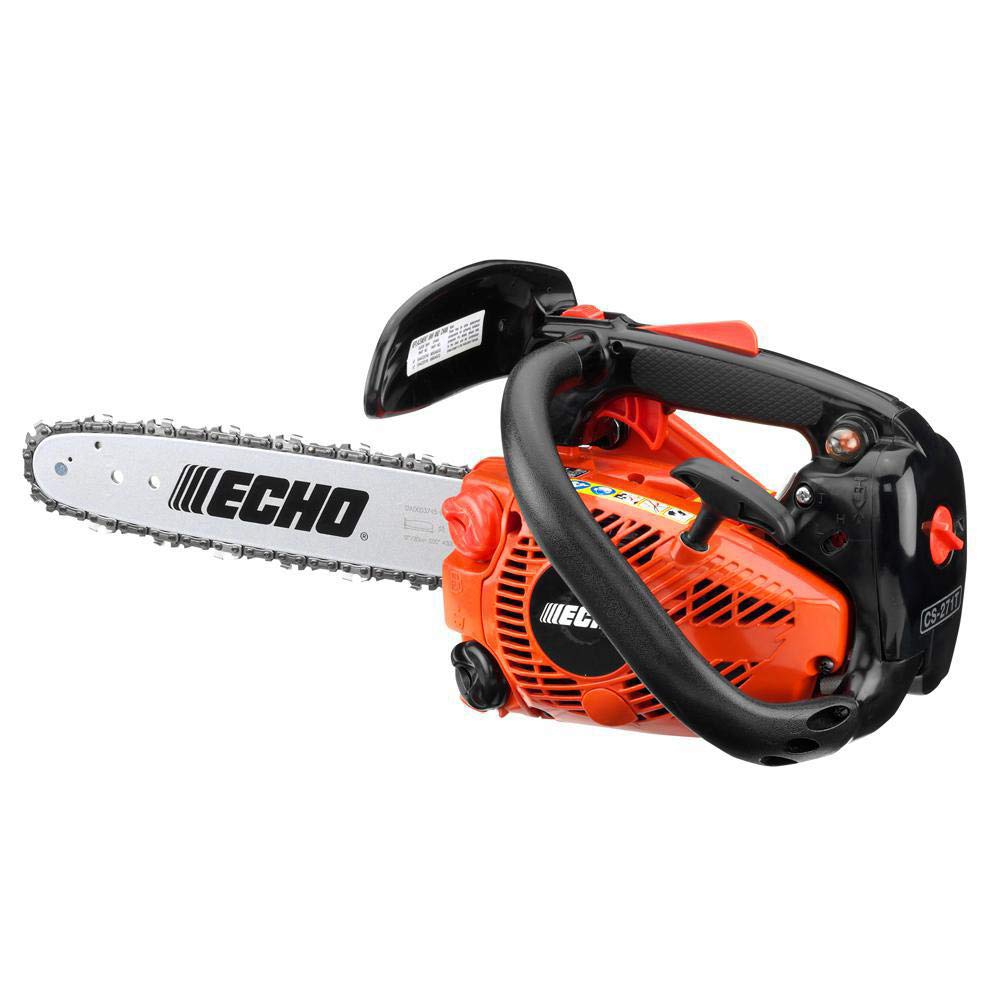
The ECHO CS-271T is engineered for climbers who prioritize extreme lightness without sacrificing reliability. Its 26.9cc professional-grade engine is smaller than the Husqvarna T435, but the saw’s compact 12-inch bar and low overall weight make it one of the most maneuverable climbing saws on the market. The digital ignition system and purge bulb ensure quick starts with minimal pulling effort — a real advantage when you are already fatigued halfway through a long climb.
The inertia-activated chain brake is responsive and positive, engaging when the saw experiences a sudden rotational force. This is a key safety feature for one-handed use aloft, where a kickback event has less room to dissipate before it contacts your body or climbing line. The side-access chain tensioner allows you to adjust the chain without reaching for tools, which is a meaningful time-saver during repetitive cutting cycles.
Professional climbers consistently report that this saw handles ambidextrously, meaning you can switch it between your dominant and non-dominant hand without fighting the weight balance. The top handle also provides a natural grip point for hoisting, though you will need to add your own lanyard attachment if it is not included with your specific unit. For all-day climbing where every ounce matters, the CS-271T is a proven workhorse.
Why it’s great
- Extremely lightweight top-handle design minimizes fatigue on long climbs
- Digital ignition and purge bulb reduce starting effort
- Inertia chain brake enhances safety during one-handed operation
- Ambidextrous handling for versatile positioning in the canopy
Good to know
- Fuel consumption is higher per cut compared to larger displacement saws
- Smaller engine may bog on limbs over 10 inches in diameter
3. STIHL MS 194 T Chainsaw (30 cm)

The STIHL MS 194 T is the lightest top-handle saw in the Stihl professional lineup, weighing just 3.3 kilograms with a 30-centimeter bar. This saw is specifically designed for one-handed operation in the tree, with a compact chassis that allows you to reach into tight branch crotches without snagging your climbing gear. The 1.4-horsepower engine is tuned for rapid throttle response, letting you feather the cut rather than relying on brute force alone.
The single-lever master control combines the choke, stop switch, and throttle lock in one convenient control, letting you start the saw with one hand while the other secures your position. The micro-chain (1/4″ pitch) cuts with notably less vibration than standard 3/8″ chains, which directly reduces fatigue during extended pruning sessions. Professional climbers note that the ergonomic handle design provides excellent control for precise tip cuts near the trunk.
Stihl’s anti-vibration system uses four rubber buffers to isolate the handle from the engine, which makes a perceptible difference on longer cuts. If you are used to heavier saws, the MS 194 T feels almost like a toy in your hand — until you see how cleanly it slices through a 6-inch limb. For climbers who demand balance and control above all else, this saw delivers a level of finesse that larger saws simply cannot match.
Why it’s great
- Ultra-lightweight 3.3 kg design reduces fatigue during long climbs
- Micro-chain cuts with minimal vibration and excellent precision
- Single-lever master control for one-handed starting
- Stihl anti-vibration system keeps hands fresh during extended use
Good to know
- Higher price point, often seen as a premium investment
- 30cm bar limits capacity on larger limbs
4. Milwaukee M18 FUEL 8 in. HATCHET Pruning Saw Kit

The Milwaukee M18 FUEL Hatchet redefines the climbing saw category by delivering gas-comparable cut speed in a silent, no-fume battery platform. Its 8-inch bar is shorter than most climbing saws, but the POWERSTATE brushless motor generates 2.3 horsepower equivalent — enough torque to zip through a 6-inch limb without bogging. The compact form factor and 18V lithium-ion battery mean zero pull-start effort, instant throttle response, and no exhaust smell in your face while you work.
The full-house chain minimizes vibration, and the automatic oiler ensures consistent bar lubrication even when you are working in awkward positions. The translucent oil reservoir gives you clear visibility to the oil level, so you don’t accidentally run dry mid-climb. The included climbing scabbard covers the bucking spikes and locks onto the saw, providing tie-off points for aerial applications.
Battery runtime with the included 6.0 High Output battery is sufficient for most residential pruning jobs, and the saw is part of the M18 system, so it shares batteries with hundreds of other tools. If you already own Milwaukee power tools, this is the most cost-effective climbing saw option available. The only trade-off is the short 8-inch bar, which limits you to limbs smaller than the typical 12-inch climbing saw standard.
Why it’s great
- Instant starts with zero pull-start effort, ideal for battery users
- No exhaust fumes or loud noise, better for residential use
- Integrated lanyard loop and climbing scabbard for safe arborist use
- Automatic oiler with visible reservoir prevents dry chain operation
Good to know
- 8-inch bar limits capacity compared to 12-inch gas climbing saws
- Battery may require recharging for extended all-day climbs
5. Makita DUC306Z 36V (2x18V) Pruning Chainsaw

The Makita DUC306Z brings a top-handle configuration to the cordless platform, offering a 30-centimeter bar and a 36-volt motor that runs on two 18-volt LXT batteries. This saw is significantly quieter than any gas alternative, which makes it practical for residential work where noise ordinances are a consideration. The 36-volt system provides ample torque for cutting limbs up to 10 inches in diameter, and the brushless motor delivers consistent power throughout the battery discharge cycle.
The tool-only design (DUC306Z) means you supply your own 18V LXT batteries, which is a major cost saving if you are already invested in the Makita ecosystem. The saw is compact and well-balanced, with the weight of the batteries acting as a counterweight that improves handling when you are cutting at odd angles. The chain tensioning system is tool-less, allowing you to adjust the chain quickly without fumbling for a scrench.
Users report that the saw handles fallen debris and small tree trunks with ease, and the lack of a pull cord eliminates the most frustrating part of gas saw operation. The main limitation for climbing work is that the top-handle design is technically intended for pruning rather than professional climbing applications. If you need a cordless option for occasional tree work and already run Makita tools, this is a compelling choice.
Why it’s great
- Quiet 36V brushless motor with no exhaust emissions
- Tool-less chain tensioning for quick adjustments
- Compact top-handle form factor with good balance
- Leverages existing Makita 18V LXT battery system
Good to know
- Batteries and charger sold separately
- Not certified as a professional climbing saw by all arborist standards
6. Husqvarna 120 Mark III 16-Inch Gas Chainsaw

The Husqvarna 120 Mark III is a rear-handle saw, so it is not designed for one-handed climbing work. However, it is an excellent tool for the ground-based aspects of tree work — limbing fallen branches, pruning from a ladder, or cutting firewood from the woodpile. The 38cc X-Torq engine produces 1.88 horsepower, which is more than sufficient for a 16-inch bar and handles hardwood without bogging. The saw starts reliably, and the LowVib technology reduces vibration compared to older models.
The inertia-activated chain brake provides a critical safety layer when you are working on uneven terrain or from a ladder. The Air Injection system spins dust and debris away from the air filter, which extends the time between filter cleanings when you are working in dirty conditions like cutting storm-damaged trees. The combined choke/stop control simplifies the starting procedure, reducing the risk of flooding the engine.
Several users note that the saw can stall when positioned parallel to the ground with low fuel, which is something to be aware of if you are cutting stumps or flush-cutting to the ground. Overall, this is a solid homeowner-to-light-professional saw that works well as a complement to a dedicated top-handle climbing saw. If you do not climb professionally but need a saw for occasional tree pruning from the ground, this is a sensible choice.
Why it’s great
- 38cc X-Torq engine with good torque for a 16-inch bar
- LowVib dampeners reduce fatigue during ground work
- Air Injection system extends air filter life
- Inertia chain brake adds safety during ladder or ground use
Good to know
- Rear-handle design is not suitable for one-handed climbing work
- Some units may stall when fuel is low in horizontal orientation
7. Husqvarna 130 16-Inch Gas Chainsaw

The Husqvarna 130 sits one step above the 120 Mark III in the lineup, offering a slightly more powerful 2-horsepower version of the same 38cc engine. This extra horsepower translates to faster cutting on medium-diameter limbs, making it a good choice for homeowners who need a reliable saw for semi-regular pruning and small tree removal. The saw is comfortable to use for extended ground sessions, and the fuel pump and combined choke/stop control make starting straightforward.
The LowVib technology is present here as well, and it makes a noticeable difference when you are cutting for an hour or more. The Air Injection centrifugal cleaning system expels debris before it reaches the filter, which helps maintain consistent engine performance in dusty conditions. The 2-year manufacturer warranty provides some peace of mind compared to budget-priced alternatives.
Some users have reported issues with the bar adjustment screw being bent or difficult to adjust out of the box, so it is worth checking the tensioner mechanism before your first use. The saw is generally well-regarded for its build quality and starting consistency. Like the 120 Mark III, this is a rear-handle saw intended for ground use, not climbing. It pairs well with a top-handle saw if you do both ground and aerial work.
Why it’s great
- 2-HP X-Torq engine for faster cuts on medium limbs
- LowVib dampeners reduce vibration during extended use
- Fuel pump and combined choke/stop for easy starting
- 2-year manufacturer warranty included
Good to know
- Rear-handle design not suitable for climbing or one-hand use
- Some units have reported bent bar adjustment screws on delivery
8. Husqvarna 450S Rancher 20-Inch Gas Chainsaw
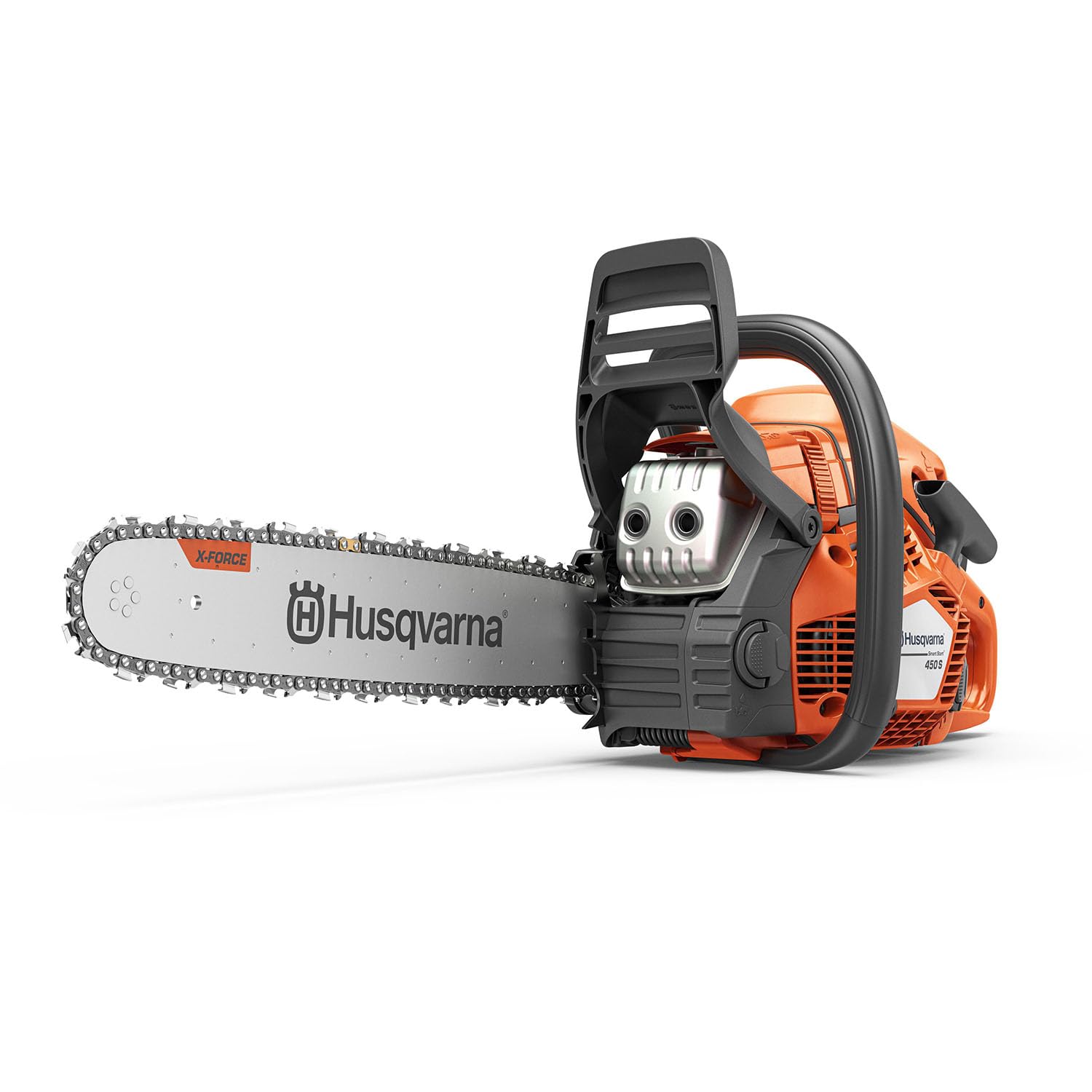
The Husqvarna 450S Rancher is a powerful ground saw designed for firewood cutting, bucking large trunks, and property maintenance. The 50.2cc X-Torq engine delivers 3.2 horsepower, which is more than double the power of the 38cc saws in this list. This is the saw you reach for when you need to process a full load of firewood, drop medium trees from the ground, or cut through 20-inch logs without breaking a sweat.
The Smart Start system reduces the rope pull force needed to start the engine, which is a welcome feature on a larger displacement saw. The side-mounted chain tensioner and captured bar nuts simplify maintenance, and the LowVib technology is effective enough that you can run the saw for extended sessions without excessive hand fatigue. The reinforced crankcase improves cooling during heavy use.
This saw is too heavy and large for climbing, and its rear-handle design would be dangerous for one-handed operation aloft. If you do both climbing and ground work, the 450S Rancher is a logical complement to a lightweight top-handle saw. There have been some reports of the chain derailing if the plastic shipping spacer is not removed before first use — follow the assembly instructions carefully. For serious property maintenance, this is a proven workhorse.
Why it’s great
- 3.2-HP X-Torq engine handles large logs and firewood bucking
- Smart Start reduces pull-start effort on the larger engine
- LowVib and slim-body design for comfortable ground operation
- Captured bar nuts simplify chain and bar swaps
Good to know
- 20-inch bar and 14.9-pound weight make it unsuitable for climbing
- Requires removal of plastic shipping spacer before first operation
9. Husqvarna 120 Mark III 14-Inch Gas Chainsaw
The 14-inch version of the Husqvarna 120 Mark III offers the same 38cc X-Torq engine as the 16-inch model, but with a shorter bar that improves maneuverability in tight spaces. This saw is well-suited for homeowners who primarily cut limbs and small trees around the yard rather than processing large firewood. The shorter bar reduces the overall length of the saw, making it easier to handle and store.
The LowVib system and inertia-activated chain brake are both present, providing the same safety and comfort features as the larger models. The saw is easy to start and runs smoothly, and several users note that it handles a 14-inch bar with plenty of power to spare. The lightweight 10.7-pound design makes it practical for occasional use without causing excessive fatigue.
This is not a climbing saw — the rear-handle design prevents one-handed operation. However, it is a capable limbing saw for ground-based tree work. Some users have reported stalling when the saw is held parallel to the ground with low fuel, so maintaining adequate fuel levels is important. For the buyer on a budget who needs a reliable gas saw for yard maintenance, the 14-inch 120 Mark III is a solid entry point.
Why it’s great
- 14-inch bar provides good maneuverability for limb trimming
- 38cc X-Torq engine delivers plenty of power for the bar length
- LowVib dampeners reduce vibration during use
- Affordable entry point into gas chainsaw ownership
Good to know
- Rear-handle design is not compatible with climbing or one-hand use
- May stall when low on fuel and oriented horizontally
FAQ
Can I use a rear-handle chainsaw for climbing?
Is a battery climbing saw as powerful as a gas model?
What is a lanyard loop and why is it important for climbing?
Final Thoughts: The Verdict
For most climbers, the chainsaw for climbing winner is the Husqvarna T435 because it delivers the best power-to-weight ratio in a dedicated top-handle form factor with professional-grade vibration dampening and easy hoisting features. If you want battery convenience and already own Milwaukee tools, grab the Milwaukee M18 Hatchet. And for climbers who prioritize absolute light weight and precision above all else, nothing beats the STIHL MS 194 T.

Mo Maruf
I created WellFizz to bridge the gap between vague wellness advice and actionable solutions. My mission is simple: to decode the research and give you practical tools you can actually use.
Beyond the data, I am a passionate traveler. I believe that stepping away from the screen to explore new environments is essential for mental clarity and physical vitality.