Our readers keep the lights on and my smoothie glass nicely filled. As an Amazon Associate, I earn from qualifying purchases.
If you’re exploring medicinal mushrooms, you quickly discover that brewing chaga isn’t like steeping a standard bag of Earl Grey. The true obstacle is finding a form that fits your morning routine without compromising the dense polyphenol content that makes this birch fungus famous. Whether you prefer a single-serve bag or a loose chunk that simmers for an hour, your choice of extraction method directly controls the potency and flavor depth of every cup.
I’m Mohammad Maruf — the founder and writer behind WellFizz. I’ve spent countless hours analyzing hundreds of user reviews and third-party lab reports to separate brands that prioritize wild-harvested quality from those that rely on generic cultivated stock.
This guide evaluates five distinct options across powdered, chunk, and tea-bag formats so you can confidently pick the best chaga tea for your daily wellness ritual.
How To Choose The Best Chaga Tea
Chaga is not a standardized commodity. The same mushroom can produce vastly different cups depending on its origin, harvest method, and processing technique. Understanding three core factors will help you buy a product that delivers genuine antioxidant density rather than overpriced dust.
Wild-Harvested vs. Cultivated
Wild chaga grows exclusively on live birch trees in cold northern forests, absorbing the tree’s betulin and betulinic acid — compounds responsible for many of its reported immune benefits. Cultivated chaga, grown on sawdust logs indoors, rarely contains meaningful levels of these birch-derived compounds. Always check for explicit “wild-harvested” language on the label. Siberian, Canadian, and Northern Scandinavian sources are the gold standard.
Form Factor: Powder, Chunk, or Tea Bag
Powders offer the fastest preparation and can be stirred into coffee or smoothies, but many brands do not use hot-water extraction, leaving the chitin-heavy cell walls intact and reducing absorption. Raw chunks require a 30- to 60-minute simmer but can be re-steeped two to three times, dramatically lowering the cost per serving. Tea bags split the difference: they are convenient but often contain finely ground material that may lack the black crust (sclerotium) where the highest concentration of active compounds resides.
Third-Party Testing and Beta-Glucan Content
Reputable brands commission independent lab analysis for heavy metals, microbial contaminants, and beta-glucan percentage — the polysaccharide linked to immune modulation. A product that lists “standardized to beta-glucans” on its label provides a measurable quality assurance. Avoid brands that only cite “proprietary blend” or fail to disclose any analytical data.
Quick Comparison
On smaller screens, swipe sideways to see the full table.
| Model | Category | Best For | Key Spec | Amazon |
|---|---|---|---|---|
| Sayan Siberian Pure Raw Chaga Chunks | Raw Chunks | Traditional slow-brewing | Black crust included; 14% moisture retention | Amazon |
| Baikal Tea Siberian Wild Chaga Bags | Tea Bags | Quick cup with 5-year growth guarantee | 30 bags; wild Siberian with bergenia | Amazon |
| Nutricost Organic Chaga Powder | Powder | Mixing into coffee or smoothies | 227 servings; 1 g per scoop | Amazon |
| Vimergy Chaga Powder | Powder | Bioavailable hot-water extracted formula | Standardized beta-glucans; 33 servings | Amazon |
| My Berry Wild Canadian Chaga Bags | Tea Bags | Woman-owned small batch sourcing | 25 bleach-free bags; Atlantic Canada wild | Amazon |
In‑Depth Reviews
1. Sayan Siberian Pure Raw Chaga Chunks
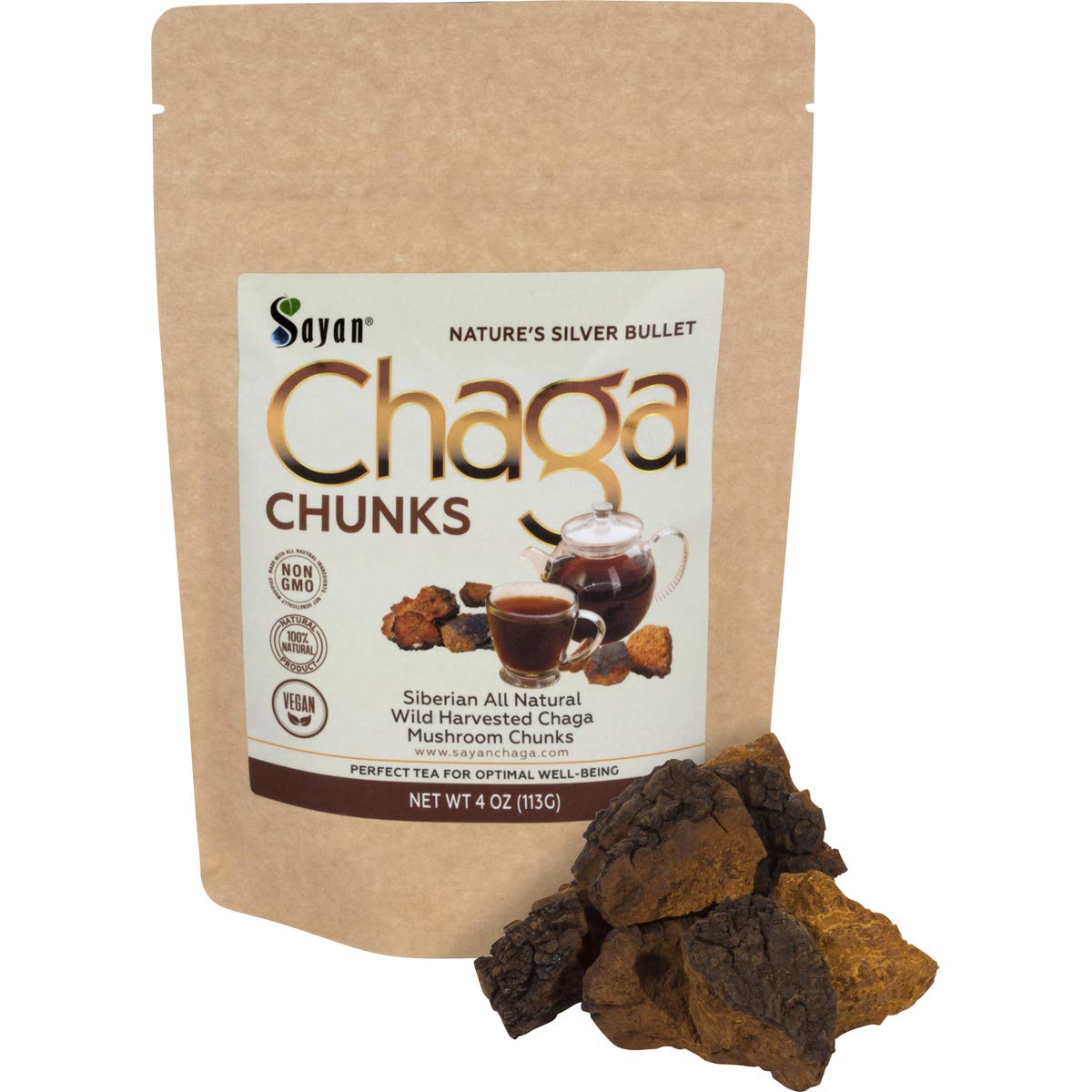
What separates Sayan’s offering from most competitors is that the supplier deliberately retains the black top crust — the sclerotium layer that contains the highest concentration of triterpenoids and melanin. Each chunk is dried to a precise 14 percent humidity, which preserves the woody aroma without encouraging mold growth during storage. Multiple user reports confirm that one 4-ounce bag yields four to six deep-amber brews when you crush the chunk with a mortar and pestle or blitz it in a coffee grinder before simmering.
The preparation commitment is real: expect a 30- to 60-minute simmer to extract the full color and earthy flavor profile. Customers describe the taste as “forest-like” and “nutty,” with no bitter edge. Because the chunks are dense and the black crust is water-insoluble, you can reuse the same material two to three times before the tea loses potency — an economic advantage over powders and single-use bags.
Long-term users note that the tea produces a calm, centered sensation rather than a jittery energy spike, and some report clearer mental focus the following morning. The packaging is straightforward without flashy marketing, which aligns with the no-frills nature of a traditional medicinal mushroom product.
Why it’s great
- Black crust preserved for maximum bioactive compound density
- Each chunk can be re-steeped 2-3 times
- Pharmaceutical-grade drying prevents spoilage
Good to know
- Requires grinding and simmering — not instant
- Smaller 4-oz bag compared to powder alternatives
2. Baikal Tea Siberian Wild Chaga Bags
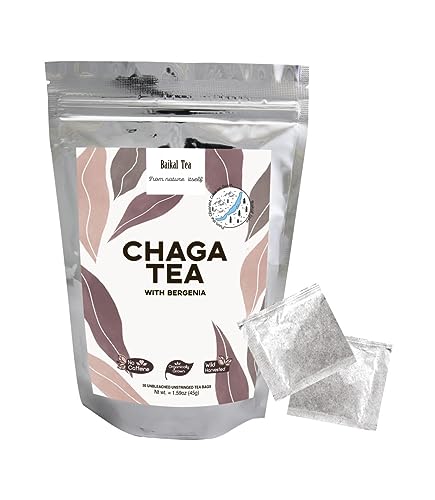
Baikal Tea sources its chaga from the forests surrounding Lake Baikal, the world’s deepest and oldest freshwater lake, where each mushroom grows for a minimum of five years before hand-picking. The inclusion of bergenia leaf — a traditional Siberian herb — adds a subtle astringent note that rounds out chaga’s typical earthiness. Every tea bag is unbleached, and the total count of 30 bags in the box gives you a full month of daily cups if you drink one per day.
The flavor profile receives consistent praise for being “rich and deep” yet not overpowering. Users who typically dislike mushroom teas note that the woody notes sit well alongside black tea or coffee without clashing. The convenience factor is high: drop a bag in a mug, pour boiling water, and steep for five to seven minutes. There is no powdery sediment at the bottom because the grind is coarse enough to be contained within the bag.
The subtle taste also makes this an excellent entry point for first-time chaga drinkers who want to test the waters before committing to a bulk powder or a lengthy simmering ritual.
Why it’s great
- Minimum 5-year growth guarantee ensures mature sclerotium density
- Bergenia leaf adds depth without bitterness
- Unbleached bags and eco-friendly packaging
Good to know
- Subtle flavor may be too light for seasoned chaga drinkers
- Bags cannot be re-steeped as effectively as raw chunks
3. Nutricost Organic Chaga Powder
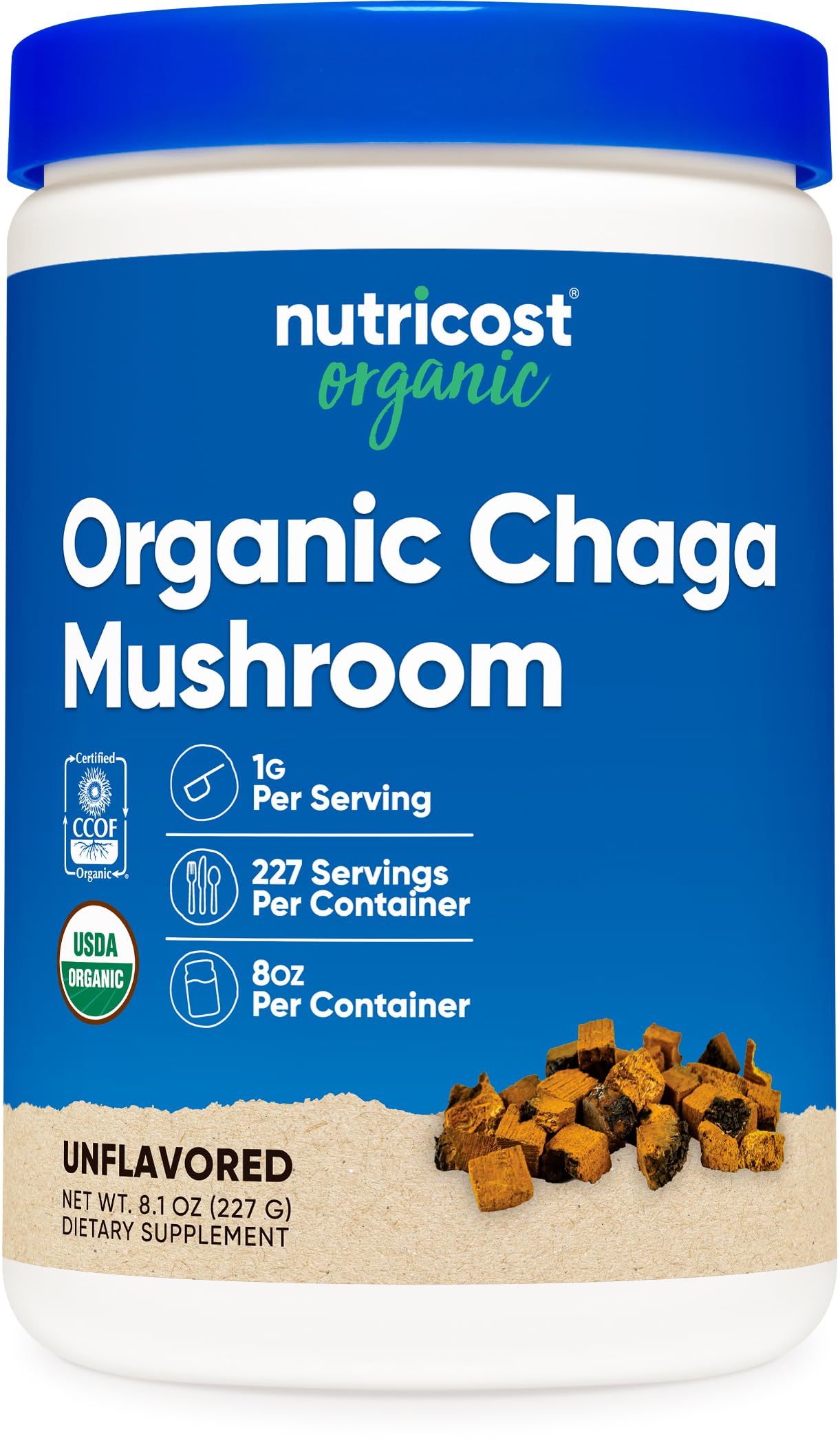
Nutricost’s 8-ounce bottle delivers 227 one-gram servings, making it the highest volume option in this roundup. The powder is certified USDA Organic, gluten-free, and non-GMO, and the facility is GMP-compliant and FDA-registered — a level of manufacturing transparency that matters for a product consumed daily. Multiple long-term users report stirring it into their morning coffee, oatmeal, or smoothies for over three years without noticing any degradation in quality.
The taste is described as mild and non-bitter, which is unusual for unextracted mushroom powder. Some users claim it dissolves fully in hot liquid with no gritty residue, though a few note that clumping can occur if you add it to cold beverages without a blender bottle. Because the powder is not hot-water extracted, the cell walls remain intact, meaning your body may not absorb the full spectrum of beta-glucans as efficiently as from an extracted product.
For the raw serving count, this product is the most economical per dose. The trade-off is that you are getting a straight dried powder rather than a concentrated extract. If your priority is a pantry-stable, mixable powder that disappears into food, Nutricost delivers exceptional value. Users looking for maximum bioavailability should consider a hot-water extracted alternative.
Why it’s great
- Unmatched serving count for daily use
- Mild taste works well in coffee and smoothies
- Third-party tested in a regulated facility
Good to know
- Powder not hot-water extracted — lower absorption potential
- Can clump in cold liquids without vigorous mixing
4. Vimergy Chaga Powder
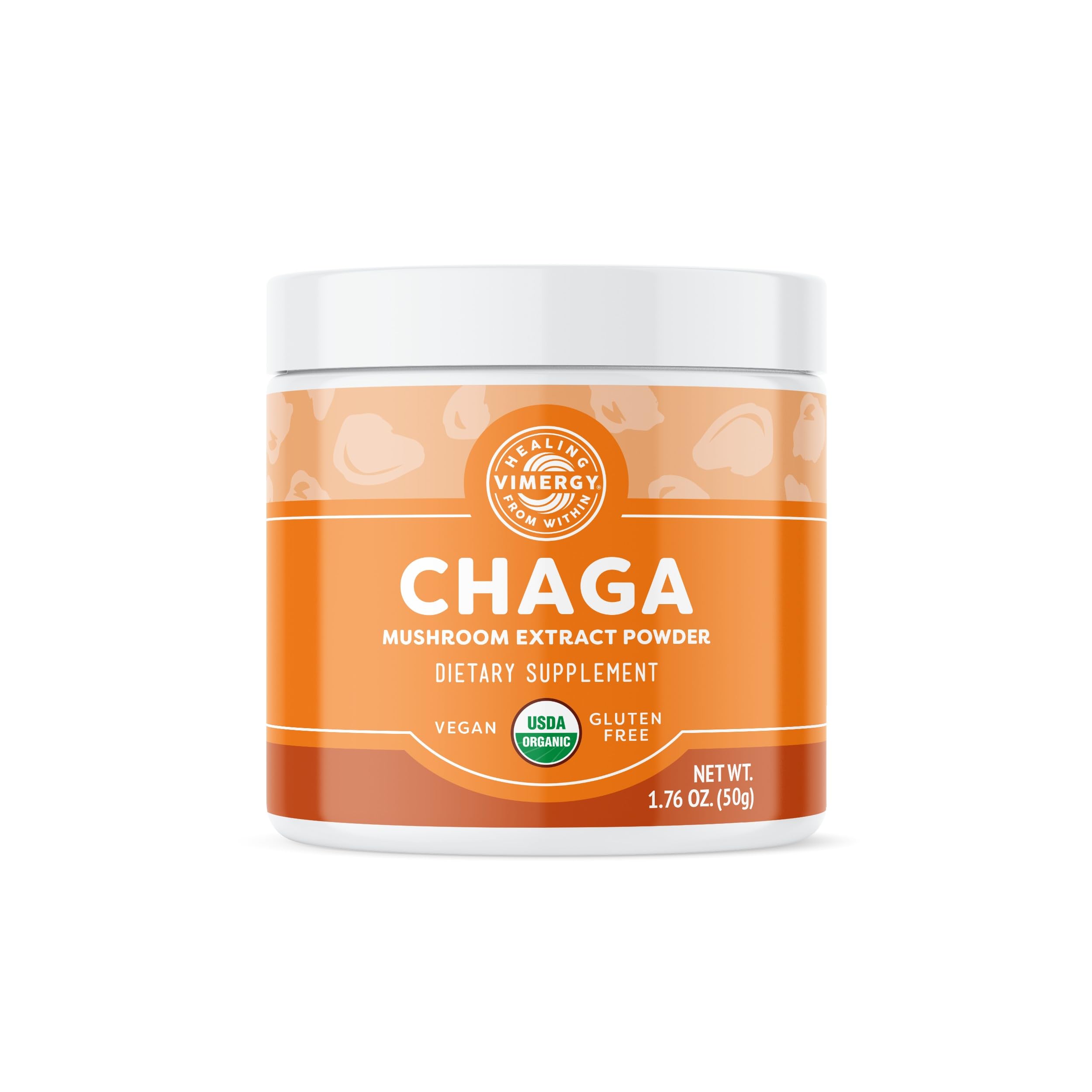
Vimergy’s chaga powder stands apart because it undergoes hot-water extraction without alcohol, a process that breaks down the chitin-rich cell walls and makes the bioactive polysaccharides and beta-glucans directly available to your digestive system. The product is triple third-party verified, USDA Certified Organic, vegan, kosher, and free from citric acid, maltodextrin, soy, corn, and preservatives. The scoops are tiny — the container holds 33 servings — because extraction concentrates the active compounds significantly.
Reviewers frequently compare the flavor to black coffee, describing it as “rich” and “fuller” than other chaga powders they have tried. Many add it to their morning coffee as a mushroom coffee blend, noting that no sweetener is required when paired with almond milk. The fine powder dissolves quickly in hot liquid with minimal stirring, and the absence of filler ingredients means every milligram counts toward your beta-glucan intake.
The primary drawback is the serving size relative to the price: you get 33 servings per container, which is significantly fewer than Nutricost’s 227 servings. Some users noted that the container arrives only partially full due to settling, though the weight matches the label. The included scoop is also very small, making it easy to under-dose if you are not careful.
Why it’s great
- Hot-water extracted for superior beta-glucan bioavailability
- Triple third-party verified and allergen-free
- Rich coffee-like flavor blends seamlessly
Good to know
- Low serving count — 33 servings per container
- Tiny scoop makes exact dosing fiddly
5. My Berry Wild Canadian Chaga Bags
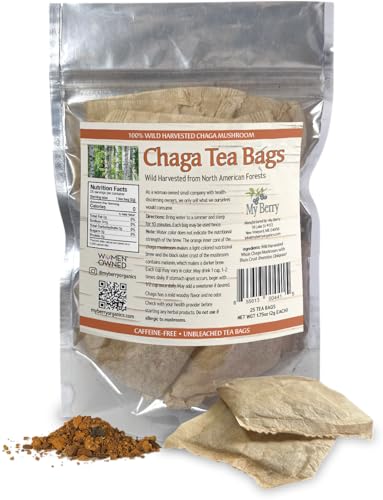
My Berry sources exclusively from the birch forests of Atlantic Canada, which avoids the regulatory ambiguity that sometimes accompanies Siberian-sourced products. The business is woman-owned and small-scale — the founder states that she only sells products she personally consumes. Each of the 25 tea bags is bleach-free, and the chaga inside is 100 percent wild-harvested with the black crust intact, a detail that many mass-market bagged teas omit.
Taste reviews are remarkably consistent: customers describe the tea as “earthy,” “comforting,” and “the best chaga tea I’ve tasted” compared to other brands. Several users have been drinking this specific product for years, and one reviewer specifically credits it as part of a post-cancer recovery regimen. The bags can be steeped a second time with slightly weaker results, effectively doubling the serving count to 50 cups per box.
The packaging is minimalist, and the bags are individually wrapped in a resealable pouch to preserve freshness. Because the grind is fine enough to fit inside a teabag but coarser than standard powder, you get a faster steep time (three to five minutes) compared to raw chunks while still retaining the black crust particles that deliver the highest antioxidant density.
Why it’s great
- 100% wild-harvested with black crust in every bag
- Bleach-free bags and small-batch integrity
- Can be steeped twice for extended value
Good to know
- Only 25 bags per box — fewer than Baikal Tea’s 30
- Fine grind may leave slight sediment if bag tears
FAQ
Can you reuse chaga chunks and tea bags for a second brew?
Does chaga tea contain caffeine?
How long should I brew raw chaga chunks to extract the full benefits?
What does quality chaga taste like?
Final Thoughts: The Verdict
For most users, the best chaga tea winner is the Sayan Siberian Pure Raw Chaga Chunks because they deliver the highest concentration of the black crust in a format that can be re-steeped multiple times, offering the best potency-to-cost ratio. If you want convenience and a smooth entry point, grab the Baikal Tea Siberian Wild Chaga Bags for mess-free brewing with a guarantee of mature five-year growth. And for maximum bioavailability in a powder that blends into your morning coffee, nothing beats the Vimergy Chaga Powder with its hot-water extraction and standardized beta-glucan content.

Mo Maruf
I created WellFizz to bridge the gap between vague wellness advice and actionable solutions. My mission is simple: to decode the research and give you practical tools you can actually use.
Beyond the data, I am a passionate traveler. I believe that stepping away from the screen to explore new environments is essential for mental clarity and physical vitality.