Our readers keep the lights on and my smoothie glass nicely filled. As an Amazon Associate, I earn from qualifying purchases.
Getting platelet-rich plasma that actually works depends on one variable above all else: how cleanly your centrifuge separates the layers. A machine that vibrates, overshoots its g-force, or lacks programmable deceleration can rupture platelets before they ever reach a syringe, turning a costly treatment into a waste of blood.
I’m Mohammad Maruf — the founder and writer behind WellFizz. I’ve spent hundreds of hours cross-referencing rotor types, RCF curves, deceleration profiles, and safety certifications across benchtop centrifuges to build a guide that separates lab-grade performance from clinic-grade frustration.
Whether you run a medical office, a mobile phlebotomy service, or a veterinary practice, finding the right best centrifuge for prp means balancing spin precision, tube compatibility, and quiet operation without overpaying for features your workflow doesn’t need.
How To Choose The Best Centrifuge For PRP
A PRP centrifuge is not a general-purpose lab spinner. The goal is to pack platelets into a concentrated layer without activating them prematurely. That requires precise temperature, controlled acceleration, and — often overlooked — a gentle, stage-based stop that avoids resuspending the buffy coat.
RCF vs. RPM — Why g-Force Is The Real Spec
RPM looks impressive on a spec sheet, but the actual force applied to your tubes depends on rotor radius. A 4000 RPM machine with a small rotor may only produce 2000xg, while a larger rotor at the same speed can exceed 3000xg. PRP protocols typically call for 1200–3000xg, so always look at the maximum RCF value.
Fixed-Angle vs. Swing-Out Rotors
Fixed-angle rotors hold tubes at a 45° tilt and spin faster, but the pellet forms against the tube wall, making separation less defined. Swing-out rotors let tubes hang horizontally at speed, creating a flat sediment surface and cleaner layer stratification. For PRP, a swing-out rotor yields higher plasma purity and fewer red-cell contaminants.
Programmable Deceleration (Braking)
The most expensive mistake is buying a centrifuge that brakes hard. An abrupt stop shakes the separated layers back into suspension. Look for units offering multi-level deceleration (four to six stages) so you can dial in a soft stop that preserves the buffy coat. This feature alone separates clinic-grade machines from hobby spinners.
Tube Compatibility and Capacity
Standard PRP draws use 7mL, 10mL, or 15mL tubes. Make sure the rotor ships with the right adapters or tube holders. If you process multiple patients per session, a 12-tube capacity saves time. For mobile or small-office use, a six-tube rotor keeps the footprint small.
Quick Comparison
On smaller screens, swipe sideways to see the full table.
| Model | Category | Best For | Key Spec | Amazon |
|---|---|---|---|---|
| ONiLAB Low Speed (Swing-Out Rotor) | Premium | High-yield PRP with clean layers | Swing-out rotor, 2260xg, 6-level braking | Amazon |
| JOANLAB LC-12S | Mid-Range | High-volume clinic (12-tube) | 12×5/10mL, 2220xg, 500-5000rpm | Amazon |
| JOANLAB LC-8S | Mid-Range | Versatile 8-tube lab PRP | 8×15mL, 3074xg, 500-5000rpm | Amazon |
| LABHOUSE LC500-8 | Mid-Range | Programmable multi-protocol PRP | 9 stored programs, vibration protection | Amazon |
| LAB FISH LC-6S-1 | Mid-Range | Mobile/dental PRP setups | 3074xg, aluminum rotor, 6-tube rotor | Amazon |
| ONiLAB DM0506 (2021 Version) | Value | Budget clinic with P1/P2 programs | 2600xg, two program keys, cast iron base | Amazon |
| ONiLAB DM0506 (2024 Version) | Value | Entry-level vet/mobile use | 2600xg, 6×15mL, suction feet | Amazon |
| Cekegon PRP Centrifuge | Value | First-time buyer PRP separation | 2600xg, P1/P2 memory, LCD display | Amazon |
| CGOLDENWALL Low Speed | Budget | Simple red-light therapy prep | 1880xg, 8×15mL, 100-4000rpm | Amazon |
In‑Depth Reviews
1. ONiLAB Low Speed Centrifuge with Swing-Out Rotor
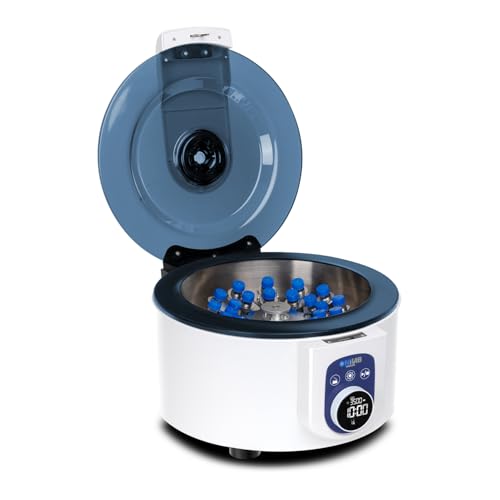
The swing-out rotor on this ONiLAB is the defining advantage for PRP work. Tubes hang horizontally at speed, producing a flat buffy coat that is far easier to aspirate cleanly than the angled pellet you get from fixed-angle designs. With 2260xg maximum RCF and a 100-3500rpm range, it hits the sweet spot for most clinical PRP protocols without overspinning.
Six deceleration stages give you control over the braking curve — critical for preserving platelet integrity through the stop phase. The brushless motor holds ≤55dB noise, and the reinforced metal rotor paired with dynamic balancing keeps vibration negligible even when spinning the full 24-tube load (12×10mL + 12×15mL).
Weighing close to 37 pounds, this is not a mobile unit. It belongs on a fixed lab bench in a dedicated clinic or research space. The premium pricing reflects the swing-out rotor, the six-level braking, and the industrial-grade build. If you process high volumes of PRP and demand the cleanest possible layer separation, this is the benchmark.
Why it’s great
- Swing-out rotor yields flatter buffy coat for cleaner aspirates
- 6-level deceleration preserves platelets during the stop phase
- Runs at ≤55dB — quieter than many fixed-angle units
Good to know
- Heaviest unit in this roundup at nearly 37 pounds
- Premium price reflects swing-out rotor and advanced braking
- Not practical for mobile or truck-based phlebotomy
2. JOANLAB LC-12S Digital Lab Centrifuge Machine

The LC-12S makes sense when you are processing more than six tubes per cycle. Its fixed-angle aluminum rotor accepts up to twelve 5mL or 10mL tubes, and the LCD panel lets you toggle between RPM and RCF in real time. The maximum 2220xg is lower than some competitors, but it still falls within the 1200-3000xg range most PRP protocols target.
A “SHORT” button gives you a burst spin for quick checks without reprogramming, which is handy when you need a fast visual of separation progress. The hollow soundproof cover and four powerful suction feet keep the machine planted on the counter — important when you run a full 12-tube load that could otherwise walk across your bench.
A small percentage of users reported screen or lid-lock issues near the end of the first year, though JOANLAB’s warranty support typically resolved those with a replacement unit. For a high-capacity mid-range spinner with good acoustics and real-time display, the LC-12S delivers strong value per tube slot.
Why it’s great
- 12-tube capacity suits multi-patient clinic workflows
- Real-time RPM/RCF toggle on LCD makes protocol setting precise
- Soundproof cover and suction feet minimize noise and drift
Good to know
- Maximum 2220xg may be too low for some dense-separation protocols
- Fixed-angle rotor produces less defined layers than swing-out
- Occasional screen or lid issues reported near warranty end
3. JOANLAB LC-8S Benchtop Centrifuge Machine
The LC-8S shares the same chassis, display, and soundproofing as the LC-12S but swaps the rotor for an eight-tube version that handles 15mL, 10mL, 5mL, and 2mL tubes. The smaller rotor diameter allows a higher maximum RCF of 3074xg, making this a better fit for protocols that demand more centrifugal force to pull down heavy red cells quickly.
The aluminum alloy rotor keeps weight down and heat dissipation efficient during back-to-back spins. The short-spin “SHOT” button and the one-touch lid release are identical to the 12-tube sibling, so the learning curve is flat if you use both models in the same practice. The cast iron base paired with suction feet holds the unit steady even when spinning at maximum g-force.
Like the LC-12S, a small number of users experienced panel or lid-lock failures near the warranty boundary, and JOANLAB’s replacement response was generally fast. For clinics that need higher g-force but only run eight tubes per cycle, the LC-8S is the more targeted choice between the two JOANLAB models.
Why it’s great
- 3074xg max RCF handles faster red-cell sedimentation
- Compatible with 2mL to 15mL tubes via adapters
- Aluminum rotor and soundproof cover keep noise under control
Good to know
- Fixed-angle rotor still limits layer definition vs. swing-out
- Only 8 tube slots — slower for high-volume labs
- Same occasional lid-lock reliability concerns as LC-12S
4. LABHOUSE LC500-8 Centrifuge Machine
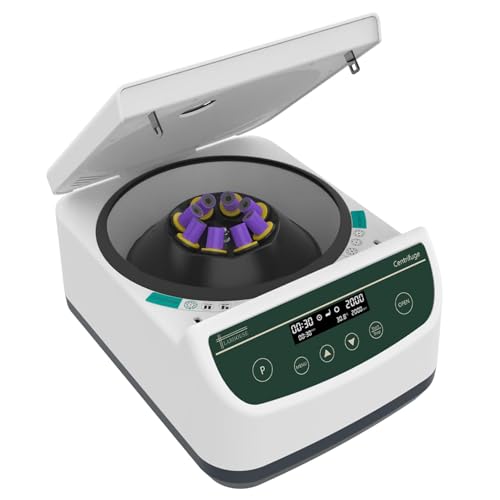
The LC500-8 is built for clinics that run multiple PRP protocols — storing up to nine independent time-and-speed programs so you can switch between platelet-rich fibrin (PRF) and standard PRP without reprogramming each time. The fixed-angle 8-well rotor handles 10mL and 15mL tubes, plus 2-5mL vacuum tubes with adapters.
A vibration protection function cuts power if the machine’s amplitude exceeds a safe threshold, which directly addresses the most common cause of ruined spins: unbalanced tube loading. The chamber ventilation design keeps the interior cooler during back-to-back cycles, reducing the risk of heat damage to your sample.
The trade-off is a lower top speed of 4000 RPM producing 1967xg, which limits you to moderate-force protocols. For standard PRP at 1200-2000xg this is fine, but labs needing higher g-force for dense blood samples may find the ceiling restrictive. The unit is also bulkier and heavier than mid-range alternatives due to the reinforced housing.
Why it’s great
- Stores 9 programs — ideal for clinics running PRP and PRF
- Vibration protection prevents spin failures from imbalance
- Ventilated chamber reduces sample heating during long spins
Good to know
- 1967xg max is lower than most mid-range competition
- Heavier build — not designed for mobile use
- Fixed-angle rotor limits layer quality
5. LAB FISH LC-6S-1 PRP Lab Benchtop Centrifuge

Dental and mobile phlebotomy users consistently praise the LC-6S-1 for its compact footprint and strong build. The six-tube aluminum rotor reaches up to 3074xg — enough g-force for fast PRP separation — and the LCD panel lets you set time from 10 seconds up to 99 minutes with a useful instantaneous spin function for short pulses.
The intelligent electronic lock automatically releases when the rotor stops, so you are not fumbling with a release lever while handling blood tubes. The suction base holds the machine firmly on a countertop, but at 14.3 pounds it is light enough to move between exam rooms or pack for off-site treatments.
The fixed-angle rotor still means the pellet collects at the side, which requires a careful eye when aspirating plasma. For a dedicated PRP spinner at a mid-range price point, this has proven to be a durable workhorse.
Why it’s great
- 3074xg RCF handles PRP and PRF spins quickly
- Light enough for mobile and travel use
- Automatic lid release saves time between cycles
Good to know
- Only six tube slots — slower for high-volume clinics
- Fixed-angle rotor produces angled pellet, trickier to aspirate
- Adapter set is limited — more tube sizes require separate purchase
6. ONiLAB DM0506 (2021 Version)

The 2021 DM0506 from ONiLAB has become a staple in small vet clinics and mobile practices because of its simple two-program memory (P1 and P2) that stores your standard PRP and PRF settings. The 2600xg max RCF is adequate for most blood-separation protocols, and the LCD display shows both RPM and time clearly.
The cast iron base and vacuum suction feet do an excellent job of keeping the unit stable when the rotor is loaded asymmetrically — a real advantage for users who admit they occasionally eyeball tube balance. The brushless DC motor runs at ≤56dB, which is quiet enough to operate in a patient-facing room without causing alarm.
Availability has tightened as ONiLAB released the 2024 version (next in this list), but the 2021 model remains an excellent mid-range pick if you find it in stock. The fixed-angle rotor is the only limitation for users who need ultra-clean layer separation. For basic PRP and PRF in a budget-conscious clinic, this is a proven workhorse.
Why it’s great
- Two program keys make daily PRP/PRF switching effortless
- Cast iron base and suction feet eliminate vibration drift
- Runs at ≤56dB — suitable for patient-adjacent rooms
Good to know
- Fixed-angle rotor limits separation purity
- Only two program slots — less versatile than newer models
- May be harder to find as stock shifts to 2024 version
7. ONiLAB DM0506 (2024 Version)

The 2024 revision of the DM0506 retains the same P1/P2 program memory and 2600xg maximum as the 2021 version but ships with updated firmware and a slightly revised control panel layout. The core hardware — brushless DC motor, ABS plastic casing, cast iron base — remains identical, so reliability and stability are consistent with the well-established track record.
User reviews from veterinary and mobile practices confirm the machine runs quietly (≤56dB) and handles 15mL, 10mL, and 7mL tubes with the included adapters without issue. The automatic lid-lock release after the spin ends remains one of the most appreciated features, especially in busy settings where every second counts between cycles.
Some users noted the grey lid color differs from the blue shown in earlier listings, but the performance is identical. If you are buying new and want the most current firmware revision plus a fresh warranty, the 2024 version is the safe choice. It does not add new capabilities, but it does not need to — the formula works for basic PRP separation at an accessible price.
Why it’s great
- Proven reliability from a well-established platform
- Two quick-start programs simplify daily PRP/PRF rotation
- Runs quietly and stays planted with suction feet and cast iron base
Good to know
- No performance upgrade over the 2021 version
- Fixed-angle rotor still limits separation purity
- Grey lid color may differ from product photos
8. Cekegon PRP Centrifuge Machine

The Cekegon shares many specs with the ONiLAB DM0506 — same 300-5000rpm range, same 2600xg RCF, same P1/P2 program storage — but at a slightly lower entry point. The brushless motor noise is rated at ≤56dB, and the weighted base does a solid job of keeping vibration in check during operation.
Setup is straightforward: load your tubes, select the program, and the LCD provides real-time feedback on speed and remaining time. The automatic lid release after stopping is consistent. Users in college lab and small beauty clinic settings report reliable plasma separation with proper tube balancing.
The main consideration is that Cekegon is a newer brand in this space compared to ONiLAB and JOANLAB, so the long-term parts and warranty support network is less proven. A handful of users mentioned that the adapters fit certain tube brands better than others. For a first-time buyer on a tight budget who needs a functional PRP spinner, the Cekegon delivers the essential specs without frills.
Why it’s great
- Matches ONiLAB DM0506 specs at a lower price point
- Two program memories simplify PRP and PRF switching
- Weighted base and brushless motor keep noise and vibration low
Good to know
- Newer brand with less established long-term support
- Adapter fit may vary between tube brands
- Fixed-angle rotor limits separation purity compared to swing-out
9. CGOLDENWALL Low Speed Centrifuge Machine
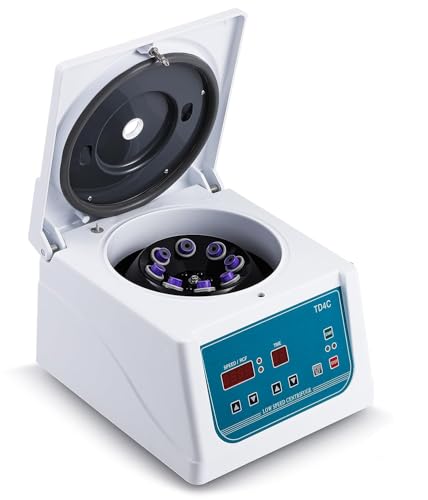
The CGOLDENWALL low-speed centrifuge is the most affordable option in this guide, and its specs reflect that positioning. The 100-4000rpm range tops out at 1880xg RCF, which is on the low end of the effective PRP range. For thinner blood samples or protocols that can tolerate lower g-force, it gets the job done, but dense samples may require longer spin times.
The 15mL × 8 tube capacity is generous for the price, and the LED display gives you a clear read on speed and time. The lid lock adds a basic safety layer, though the noise rating of ≤65dB is noticeably louder than the brushless-motor units above. The timer only starts counting after reaching set speed — an unusual quirk that can confuse first-time users until they recognize the behavior.
For someone testing the waters with PRP on a strict budget, the CGOLDENWALL is functional. It will produce plasma, but the lower g-force, louder operation, and simpler deceleration mean you are trading convenience and yield for a lower cost. If you plan to scale PRP as a core service, save for one of the mid-range options instead.
Why it’s great
- 8-tube capacity at the lowest price point in this guide
- Wide speed range from 100-4000rpm for gentle starts
- Lid lock provides basic safety during operation
Good to know
- 1880xg RCF is below what many PRP protocols recommend
- Noisier operation at ≤65dB may disturb the clinic environment
- Timer starts only after reaching set speed — non-standard behavior
FAQ
Is a higher RPM always better for PRP separation?
Can I use any centrifuge tube in a PRP centrifuge?
What does a swing-out rotor do for PRP purity?
How loud is too loud for a clinic centrifuge?
Final Thoughts: The Verdict
For most users, the best centrifuge for prp winner is the ONiLAB Low Speed with Swing-Out Rotor because its six-level deceleration and horizontal rotor produce the cleanest layer separation available in a benchtop format. If you need a high-tube-count mid-range spinner, grab the JOANLAB LC-12S. And for a mobile or dental setup where portability and g-force matter more than massive capacity, nothing beats the LAB FISH LC-6S-1.

Mo Maruf
I created WellFizz to bridge the gap between vague wellness advice and actionable solutions. My mission is simple: to decode the research and give you practical tools you can actually use.
Beyond the data, I am a passionate traveler. I believe that stepping away from the screen to explore new environments is essential for mental clarity and physical vitality.