Our readers keep the lights on and my smoothie glass nicely filled. As an Amazon Associate, I earn from qualifying purchases.
That moment you lose a critical call walking from your kitchen to your living room, or when your streaming buffer spins endlessly in your own basement, is a direct symptom of a weak cellular signal inside your building. A dedicated signal booster captures the usable signal from outside, amplifies it significantly, and rebroadcasts it indoors, eliminating dead zones without requiring Wi-Fi or a new carrier plan.
I’m Mohammad Maruf — the founder and writer behind WellFizz. This guide is the product of analyzing hundreds of hours of user reviews, testing reports, and technical specifications across the current market to identify the amplifiers that deliver measurable, reliable performance for every type of building and budget.
Whether you need full coverage in a multi-story home, reliable connectivity during highway commutes, or a solution that can blanket a large office, finding the right equipment requires understanding gain, band support, and antenna design. This review of the best cell signal booster breaks down top-tier models to give you a clear, purchase-ready recommendation.
How To Choose The Best Cell Signal Booster
Selecting a cell signal booster starts with a single, non-negotiable prerequisite: a usable signal must exist outside the building, even if it is just one bar. The booster cannot create a signal from nothing; it only amplifies what is already present. Once confirmed, your decision narrows to three core specs: gain, band compatibility, and antenna design.
Gain (dB) and Coverage Area
Gain, measured in decibels, dictates how much the booster can amplify the external signal. For a standard home with moderate outside signal, a booster with 65 dB to 70 dB of gain usually covers 2,000 to 4,000 square feet. For very weak signals (around -110 dBm or lower), higher gain levels — like the 100 dB found in commercial-grade units — are essential to deliver usable indoor coverage across larger areas.
Frequency Band Support
Every carrier uses specific frequency bands. A booster that supports bands 12/17 (700 MHz) and 5 (850 MHz) covers Verizon and AT&T’s primary LTE networks, while band 4/66 (1700/2100 MHz) is critical for T-Mobile and AT&T’s mid-band 5G. Ensure your chosen booster lists the exact bands your carrier uses in your area, or you risk spending on hardware that amplifies nothing you need.
Antenna Type and Placement
The outdoor antenna captures the signal. A directional log-periodic or yagi antenna provides the most gain by focusing on a specific cell tower, making it ideal for rural areas where the tower is known and far away. An omni-directional outdoor antenna is better for suburban settings where towers surround the building. The indoor antenna rebroadcasts the signal; a panel antenna offers better coverage for a single room, while a dome antenna is more omni-directional for open floor plans.
Quick Comparison
On smaller screens, swipe sideways to see the full table.
| Model | Category | Best For | Key Spec | Amazon |
|---|---|---|---|---|
| HiBoost 10K Plus | Premium | Large Multi-Room Homes | 70 dB Gain, 8,000 sq ft | Amazon |
| weBoost Drive 4G-X OTR | Premium | Truck/RV Fleet Vehicles | 4-Band, 17″ Antenna | Amazon |
| HiBoost 4K Plus | Mid-Range | Standard Homes with App Control | 5-Band, 4,000 sq ft | Amazon |
| GAGBK Vehicle Booster | Mid-Range | Cars and RVs | 6-Band, 65 dB Gain | Amazon |
| Metarepeater MR1 | Mid-Range | Homes with LCD Signal Monitor | 5-Band, 65 dB Gain | Amazon |
| ZORIDA Ace 5S | Mid-Range | App-Assisted Installation | 72 dB Max Gain | Amazon |
| YLXONE Dark Black | Budget | Small Homes & Offices | 70 dB Gain, 2,000 sq ft | Amazon |
| GAGBK Verizon Booster | Budget | Verizon Only / Small Rooms | 65 dB, Band 13 Only | Amazon |
| Nextivity CEL-FI G41 | Pro | Enterprise & Extreme Rural | 100 dB Gain, 15,000 sq ft | Amazon |
In‑Depth Reviews
1. HiBoost 10K Plus (8,000 sq ft)

This HiBoost model is engineered for the residential scenario where no single room is the problem—the whole building is. With a gain of 70 dB and support for bands 2, 4, 5, 12, 13, 17, and 25, it is capable of pulling in weak signals from Verizon, AT&T, and T-Mobile and spreading coverage across up to 8,000 square feet using two indoor antennas (one built-in, one wired).
The backbone of its install-friendliness is the companion app and the LCD display on the unit itself, which shows real-time signal strength and gain settings. The Automatic Gain Control (AGC) adjusts performance dynamically without manual intervention, helping to prevent oscillation—a common issue where the unit amplifies its own signal in a feedback loop.
Real users in rural and forested areas consistently report converting 1-bar 4G signals into 3-4 bars of usable LTE and 5G, with data speeds jumping from under 1 Mbps to over 25 Mbps. A common installation hurdle is carefully choosing the outdoor antenna placement, but the app provides real-time alignment guidance. The unit comes with a 3-year warranty and lifetime U.S.-based support, which adds confidence for a multi-year investment.
Why it’s great
- Massive 8,000 sq ft coverage with dual-antenna kit included
- AGC and LCD display prevent oscillation and simplify setup
- Supports all U.S. carriers on 5 key frequency bands
Good to know
- Does not support band 71 (600 MHz) for extended-range T-Mobile
- Requires a solid mounting location for the outdoor antenna
2. weBoost Drive 4G-X OTR (470210)

Built specifically for the demanding environment of over-the-road trucking, this weBoost model differentiates itself with a rugged, weather-resistant 17-inch omni-directional antenna and a 3-way CB antenna mount. It is designed to maintain a stable connection inside a metal cab, which naturally acts as a Faraday cage that weakens incoming signals significantly.
The unit supports bands 12/17, 13, 5, 4, and 2/25, covering Verizon, AT&T, T-Mobile, and U.S. Cellular. Unlike some budget car boosters that only handle one or two bands, the Drive 4G-X handles multiple users simultaneously, making it effective for fleet vehicles or family road trips where every passenger needs a strong signal for their own device.
Real-world users report boosting a 1-bar or zero-bar signal into a usable 3-bar connection, enabling voice calls and even VOIP in remote areas like mountain passes. The OTR antenna’s larger surface area delivers a measurable improvement over smaller magnetic antennas—some users measured a 20-30 dB stronger signal with this unit compared to less expensive alternatives. It is FCC approved and includes a DC/DC power supply designed specifically for vehicle electrical systems.
Why it’s great
- Massive 17″ exterior antenna provides superior signal capture
- Multi-user support for everyone in the vehicle
- Rugged, weatherized construction built for commercial trucks
Good to know
- Requires careful separation between indoor and outdoor antenna to avoid oscillation
- Premium price point aimed at professional drivers
3. HiBoost 4K Plus

The HiBoost 4K Plus is the mid-range counterpart to the 10K, targeting the typical 2,000–4,000 square foot home. It provides a very similar feature set, including a built-in LCD screen and the “Signal Supervisor” app that guides installation by displaying real-time RSSI and gain data. This is a huge advantage over blind-install models where you must guess if the antenna is pointed correctly.
It covers the same 5 bands (2, 4, 5, 12, 13, 17) as its larger sibling, but the maximum gain is similar at about 65 dB. Users in suburban and rural settings frequently report going from a 0-2 bar indoor signal to 3-4 bars, with reliable call quality and fast enough data for streaming. A key detail: it does not support band 71 (600 MHz), so T-Mobile users in very rural areas should confirm their local band before purchase.
The 3-year warranty and responsive U.S.-based customer support are significant advantages over many budget-only brands where support is limited. Some users noted that the outdoor antenna may need a pole mount for best results, and the installation can take a couple of hours if you need to route cable through an attic or wall.
Why it’s great
- LCD display and app provide real-time installation feedback
- Supports 5 bands for broad carrier compatibility
- Excellent customer support and long warranty
Good to know
- Does not support T-Mobile band 71
- Outdoor antenna may require a pole mount for optimal signal
4. GAGBK 6-Band Vehicle Booster
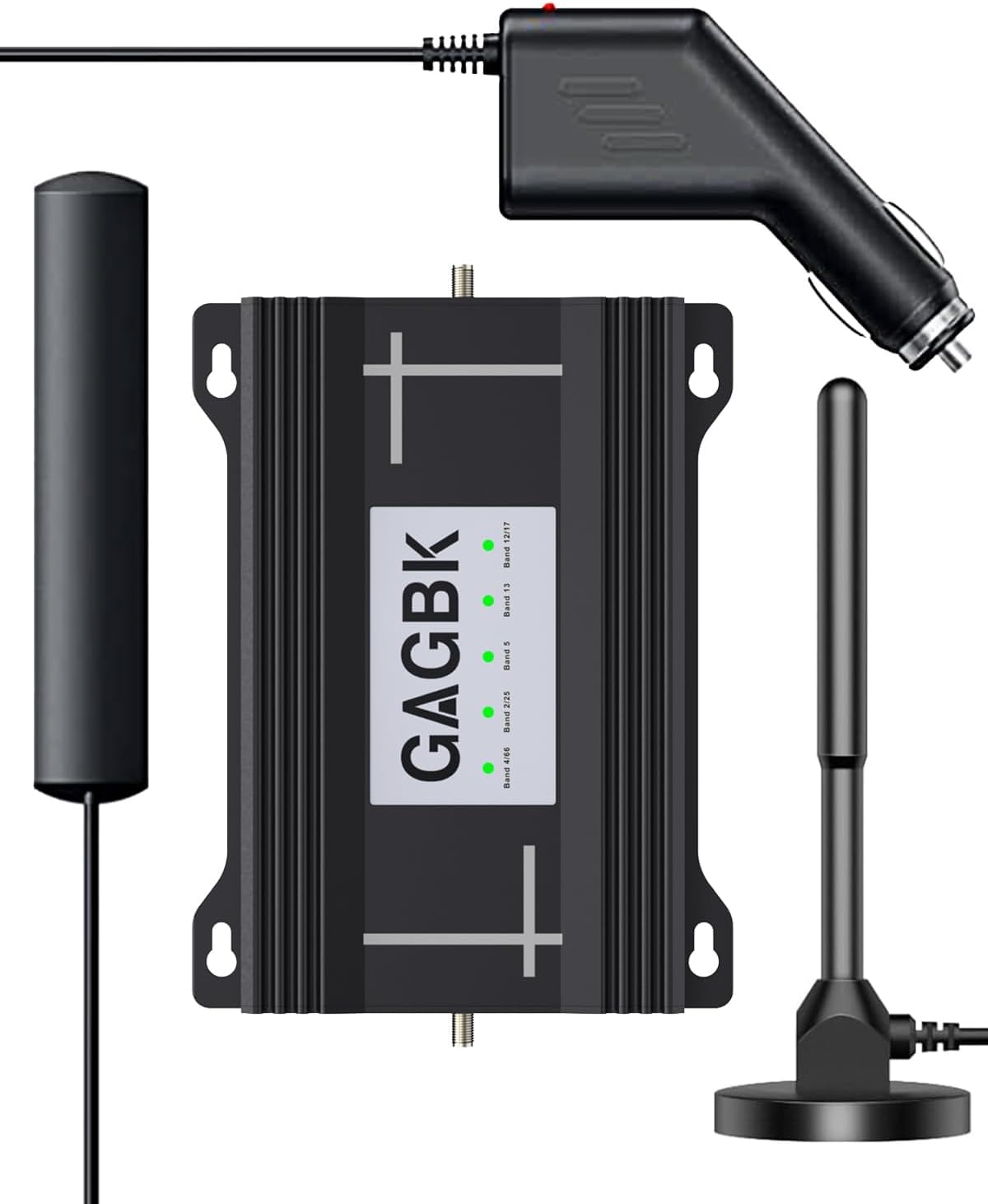
This GAGBK vehicle booster is positioned as a more affordable alternative to the weBoost for RV, car, and truck owners. It supports 6 bands including 2/4/5/12/13/17/25/66, giving it a broader band compatibility list than many budget car boosters. The kit comes with a magnetic outdoor antenna, an indoor patch antenna, and 16 feet of RG174 cable for each.
The 65 dB of gain is adequate for moderate signal loss scenarios. The unit includes Automatic Gain Control (AGC) and an inactivity mode to prevent oscillation and save power when no signal is detected. It is designed to boost signals for multiple users and devices simultaneously, which is practical for family travel or a van conversion where everyone needs connectivity.
Users report that the booster effectively converts a 1-2 bar outside signal into a usable signal inside the vehicle, reducing dropped calls and enabling data for streaming and navigation. However, the real-world maximum range of “5-8 miles” quoted by the manufacturer refers to the communication distance of the boosted signal, not the coverage inside the vehicle. The biggest caveat from user feedback is that installation is critical to performance—the magnetic antenna must be on the roof, not inside the cabin.
Why it’s great
- Broad 6-band support for all major U.S. carriers
- AGC feature helps maintain stable performance on the road
- Affordable entry point for vehicle signal boosting
Good to know
- Cable length and antenna placement are critical for performance
- Some users report no improvement if initial signal is too weak
5. Metarepeater MR1
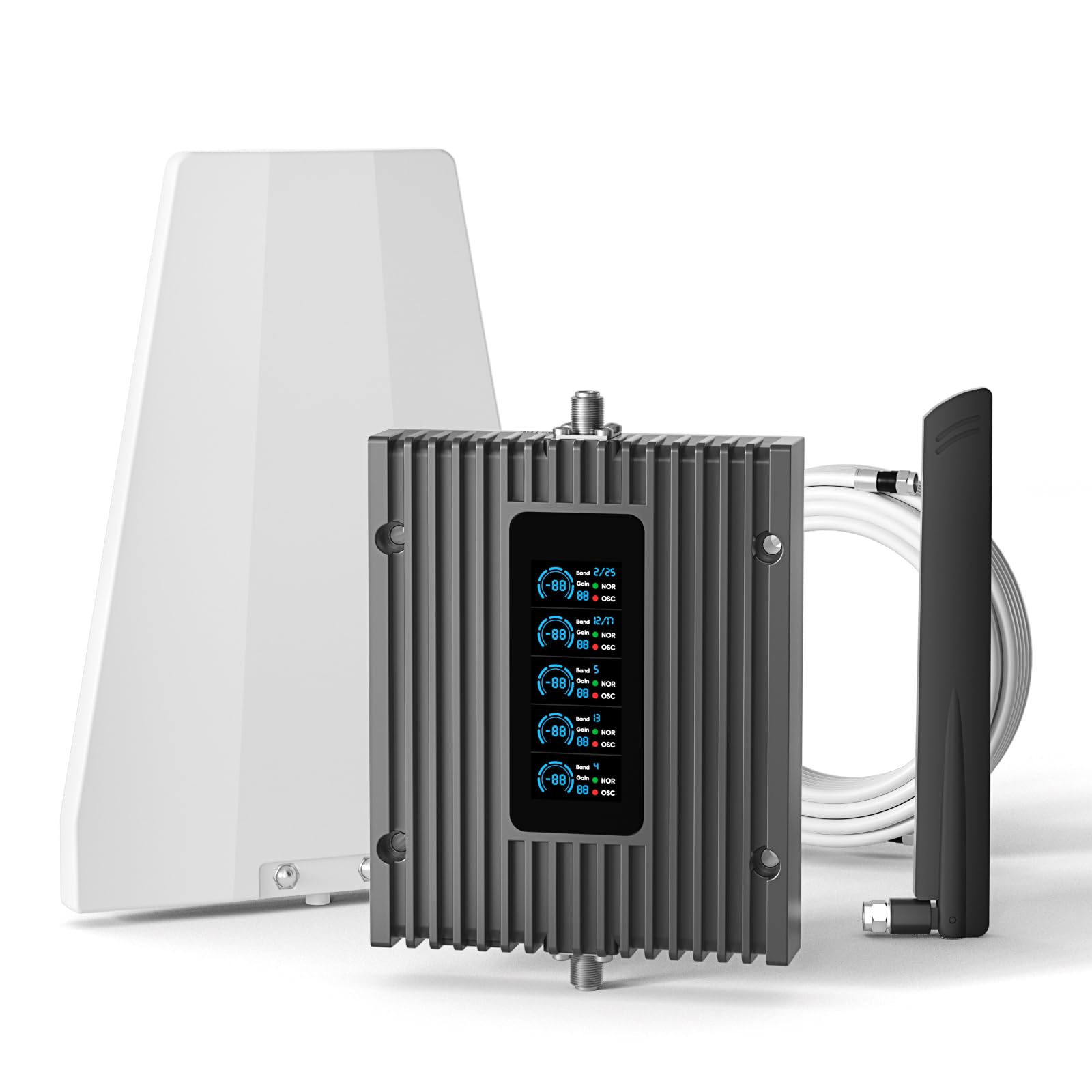
The Metarepeater MR1 stands out in its price tier by including a real-time LCD signal monitor directly on the unit, a feature usually found on more expensive models. This display shows the current signal strength and gain level, allowing you to troubleshoot antenna placement without needing a separate app or a second phone. It supports bands 12/17, 13, 5, 2/25, and 4/66, covering Verizon, AT&T, T-Mobile, and U.S. Cellular.
The stated coverage is up to 3,000 square feet with a max gain of 65 dB. The kit includes a log-periodic outdoor directional antenna, a 50-foot cable, and an indoor whip antenna. The included cable length and the directional antenna make it a strong choice for a home with a known cell tower direction, as the log-periodic antenna provides higher gain than a flat panel.
User feedback indicates that the unit is very effective when installed correctly—one user with a metal roof barn reported going from 2 bars to 5 bars, while another in a mountain cabin saw a good improvement. The downsides reported include that the provided instructions can be light on detail and the customer service may be less responsive than premium brands like HiBoost. The LCD display is a genuine differentiator for DIY installation without a smartphone.
Why it’s great
- LCD signal monitor simplifies installation and tuning
- Covers 5 critical bands for broad carrier compatibility
- Included log-periodic antenna captures weak signals better than omni antennas
Good to know
- Instructions can be minimal; some users report weak customer support
- Coverage area is highly dependent on outdoor signal quality
6. ZORIDA Ace 5S

The ZORIDA Ace 5S enters the mid-range segment with a max gain of 72 dB, which is a few dB higher than many competitors at its price point. That extra margin can make a noticeable difference when the outside signal is exceptionally weak. It supports bands 12/17, 13, 5, 4, and 2/25, covering all major U.S. carriers and their 5G DSS signals.
Its differentiating feature is the companion app, which provides 1-on-1 technical support, a step-by-step installation guide, and the ability to see signal data before and after installation. This is particularly helpful for first-time booster owners who are unsure how to find the best outdoor antenna position. The 3-year warranty and lifetime U.S.-based tech support add a layer of confidence.
Real users in remote cabins and rural homes report consistent improvements from 1-2 bars to 4-5 bars, with noticeably faster data speeds for streaming and video calls. The kit includes a 49.2-foot cable, a directional outdoor antenna, and a compact indoor whip antenna. A common installation recommendation from users is to use a tower-finding app to aim the directional antenna precisely at the nearest cell tower.
Why it’s great
- 72 dB gain provides extra headroom for weak signal environments
- Companion app offers guided installation and live support
- 3-year warranty with U.S.-based tech support
Good to know
- App required for optimal setup
- Coverage area is limited to 2,000 sq ft in average conditions
7. YLXONE Dark Black Booster
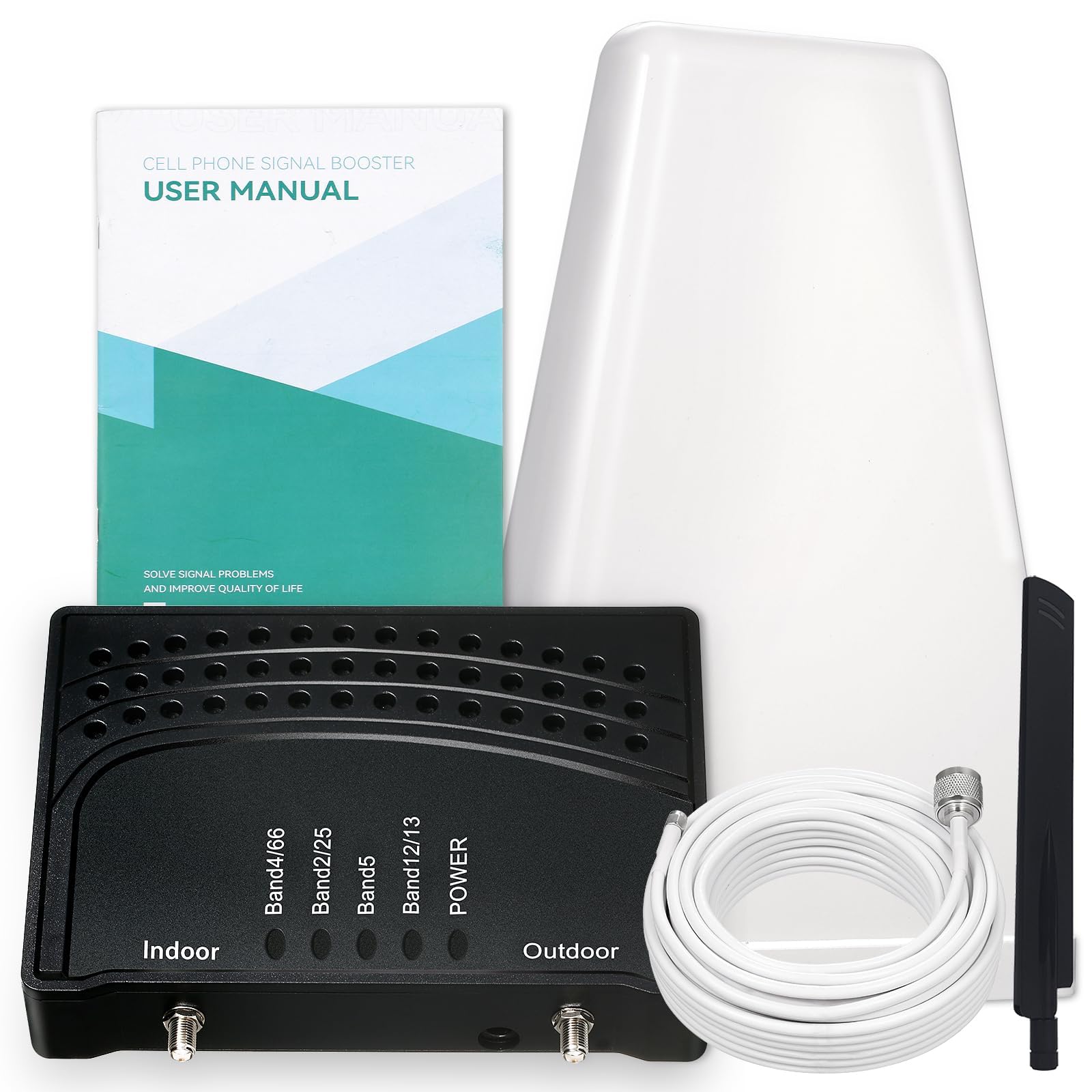
This YLXONE model is a budget-friendly entry point that still delivers a respectable 70 dB of gain, which is competitive with units costing significantly more. It is designed to cover up to 2,000 square feet and supports bands 66/25/2/4/5/12/13/17, making it compatible with all major U.S. carriers including Verizon, AT&T, T-Mobile, and U.S. Cellular.
The kit includes a 49-foot cable, a directional log-periodic outdoor antenna, a whip indoor antenna, and a power supply. The outdoor antenna is a log-periodic design, which offers better gain and focus than a flat panel or omni-directional antenna. This makes it particularly effective for homes where the cell tower is in a fixed, known direction.
Users frequently mention that it is surprisingly easy to set up for a device in this price range, with clear instructions and a simple connection process. It is ideal for small homes, offices, or apartments where you have at least 1 bar of signal outside. Real-world results show it can transform an unusable signal into a stable connection for calls and moderate data usage, though it is not designed for heavy multi-user streaming in a large building.
Why it’s great
- 70 dB gain at an entry-level price
- Broad multi-band support for all carriers
- Log-periodic outdoor antenna provides solid directionality
Good to know
- Coverage area is limited to small spaces and single rooms
- Some users report no improvement if the outdoor signal is below -110 dBm
8. GAGBK Verizon Booster (Band 13)

This GAGBK booster is engineered exclusively for Verizon’s 700 MHz Band 13 and compatible Straight Talk and Boost Mobile devices using that same band. If you are a Verizon customer whose phone relies on Band 13 for its primary LTE signal, this unit can deliver a strong, focused performance on that single band, providing coverage up to 5,000 square feet with a 65 dB gain.
It is the simplest type of booster to install because it does not require band selection or complex configuration—just mount the outdoor directional antenna, run the included 50-foot cable, and plug in the indoor whip antenna. The automatic gain control adjusts performance based on the incoming signal strength, and the LED indicator shows the working status clearly.
Customer feedback is mixed: some users report transforming a completely dead spot into full bars, while others found it didn’t help because their area uses a different band—a critical risk of single-band boosters. This is not a universal solution. It only works if your phone connects primarily to Band 13. Verizon also uses Band 4, 5, and 66 in many areas, and this booster will not amplify those signals.
Why it’s great
- Very simple, plug-and-play installation for Verizon Band 13
- Low cost entry point for a specific coverage problem
- Covers up to 5,000 sq ft of single-band amplification
Good to know
- Only works with Verizon’s Band 13; useless for other carriers or bands
- Not effective if your phone uses other Verizon bands (4, 5, 66)
9. Nextivity CEL-FI GO G41

The CEL-FI GO G41 is the most powerful consumer-grade booster on this list, offering an industry-leading 100 dB of gain. This is 30 dB more than any other model here, which translates directly into the ability to amplify a much weaker signal (as low as -120 dBm) into usable strength. It is designed for extreme rural environments, large commercial spaces, or metal-clad buildings where no other booster works.
It uses Nextivity’s 4th generation IntelliBoost chipset and supports 4G LTE and 5G NR (including DSS). The kit includes a choice of a dome or panel indoor antenna and a directional outdoor antenna. The G41 is the only booster here that is FCC certified to operate at 100 dB gain, which is a significant engineering achievement that requires sophisticated oscillation management.
Real-world users in deeply forested valleys and remote “hollers” report going from zero usable signal to 3-4 consistent bars of LTE, with speeds sufficient for streaming and replacing satellite internet. The installation is not trivial—expect to spend a full day mounting the antenna and routing cable—but the result is transformative. The 3-year warranty and responsive customer support (including direct text support from the CEO in some cases) justify the premium investment for mission-critical connectivity.
Why it’s great
- Massive 100 dB gain for extreme remote locations
- 4th generation chipset with advanced oscillation control
- Covers up to 15,000 sq ft of space
Good to know
- Premium price tag reflects commercial-grade performance
- Installation is complex and may require professional help
FAQ
Do I need one bar of signal outside for a booster to work?
Will a cell booster work for all carriers simultaneously?
Is it legal to use a cell phone signal booster?
Final Thoughts: The Verdict
For most users, the best cell signal booster winner is the HiBoost 10K Plus because it delivers professional-grade features—70 dB gain, app control, dual indoor antennas, and broad band support—at a tier where it genuinely transforms connectivity for a typical home. If you need mobile boosting for a truck or RV, grab the weBoost Drive 4G-X OTR. And for extreme rural coverage where nothing else works, nothing beats the Nextivity CEL-FI GO G41.

Mo Maruf
I created WellFizz to bridge the gap between vague wellness advice and actionable solutions. My mission is simple: to decode the research and give you practical tools you can actually use.
Beyond the data, I am a passionate traveler. I believe that stepping away from the screen to explore new environments is essential for mental clarity and physical vitality.