Our readers keep the lights on and my smoothie glass nicely filled. As an Amazon Associate, I earn from qualifying purchases.
If your phone shows one bar or “SOS” and every call drops before you finish a sentence, the problem isn’t your carrier or your device — it’s the physical distance and obstacles between you and the nearest tower. A cellular signal booster captures that weak outdoor signal, amplifies it, and rebroadcasts it inside your home, converting dead zones into usable coverage for voice, text, and data.
I’m Mohammad Maruf — the founder and writer behind WellFizz. This guide is built from reviewing dozens of technical datasheets, FCC filings, and real-world user reports to identify which signal boosters actually deliver measurable gain in challenging environments like metal-roofed homes, rural cabins, and basements.
After analyzing gain ratings, coverage claims, carrier compatibility, and installation complexity across nine models, I can confidently recommend the best cell phone booster for every common scenario — from budget-friendly single-room fixes to whole-home powerhouses.
How To Choose The Best Cell Phone Booster
Not all boosters are built the same, and a cheap unit with inflated coverage numbers will leave you frustrated. Focus on these four factors to match the right amplifier to your specific dead zone.
Gain Rating vs. Real-World Coverage
Gain, measured in decibels (dB), tells you how much the booster amplifies the incoming signal. A 65 dB booster can often turn one bar into three or four in a small home, while 70 dB or higher units handle larger spaces and weaker outdoor signals. Be skeptical of coverage claims — a 7,000 sq ft rating assumes a strong outdoor signal. If you have zero bars outside, no booster will create signal from nothing.
Carrier Frequency Bands
Every carrier uses specific frequency bands. Verizon relies heavily on Band 13 (700 MHz). AT&T and T-Mobile use Bands 12/17 (700 MHz) and Band 4 (1700/2100 MHz). A booster that only covers one band will leave you with no improvement on other carriers. The best units cover Bands 2, 4, 5, 12, 13, 17, and 25 to ensure compatibility with all major U.S. networks.
Antenna Separation and Installation
Indoor and outdoor antennas must be physically separated — typically 20 to 50 feet — to prevent oscillation, a feedback loop that ruins performance. Vertical separation (mounting the outdoor antenna high and the indoor antenna low or in a different room) works best. Boosters with Automatic Gain Control (AGC) can reduce oscillation automatically, but they cannot overcome poor antenna placement.
FCC Certification
By law, all signal boosters sold in the U.S. must be FCC-certified to prevent network interference. Uncertified boosters can disrupt cell towers, cause dropped calls for everyone nearby, and result in fines. Always confirm FCC approval before purchasing — every model on this list meets that requirement.
Quick Comparison
On smaller screens, swipe sideways to see the full table.
| Model | Category | Best For | Key Spec | Amazon |
|---|---|---|---|---|
| SureCall Fusion4Home Max | Premium | Largest whole-home coverage | 70 dB gain, 6500 sq ft | Amazon |
| HiBoost 10K SL | Premium | App-monitored performance | 70 dB gain, 5500 sq ft | Amazon |
| HiBoost 8000 Sq Ft | Premium | Multi-room with dual antennas | 70 dB gain, 8000 sq ft | Amazon |
| weBoost Home Studio | Mid-Range | Reliable brand, smaller spaces | 65 dB gain, 3000 sq ft | Amazon |
| ZORIDA Ace 5S | Mid-Range | App-assisted setup, all carriers | 72 dB gain, 2000 sq ft | Amazon |
| Nstcell 7000 Sq Ft | Mid-Range | Rural areas, metal buildings | 70 dB gain, 7000 sq ft | Amazon |
| JACOOL AT&T Booster | Budget | AT&T/T-Mobile specific dead zones | 65 dB gain, 4000 sq ft | Amazon |
| FreeQueen Verizon Booster | Budget | Verizon-only single band fix | 65 dB gain, 5000 sq ft | Amazon |
| GAGBK Verizon Booster | Budget | Verizon Band 13 entry-level | 65 dB gain, 5000 sq ft | Amazon |
In‑Depth Reviews
1. SureCall Fusion4Home Max
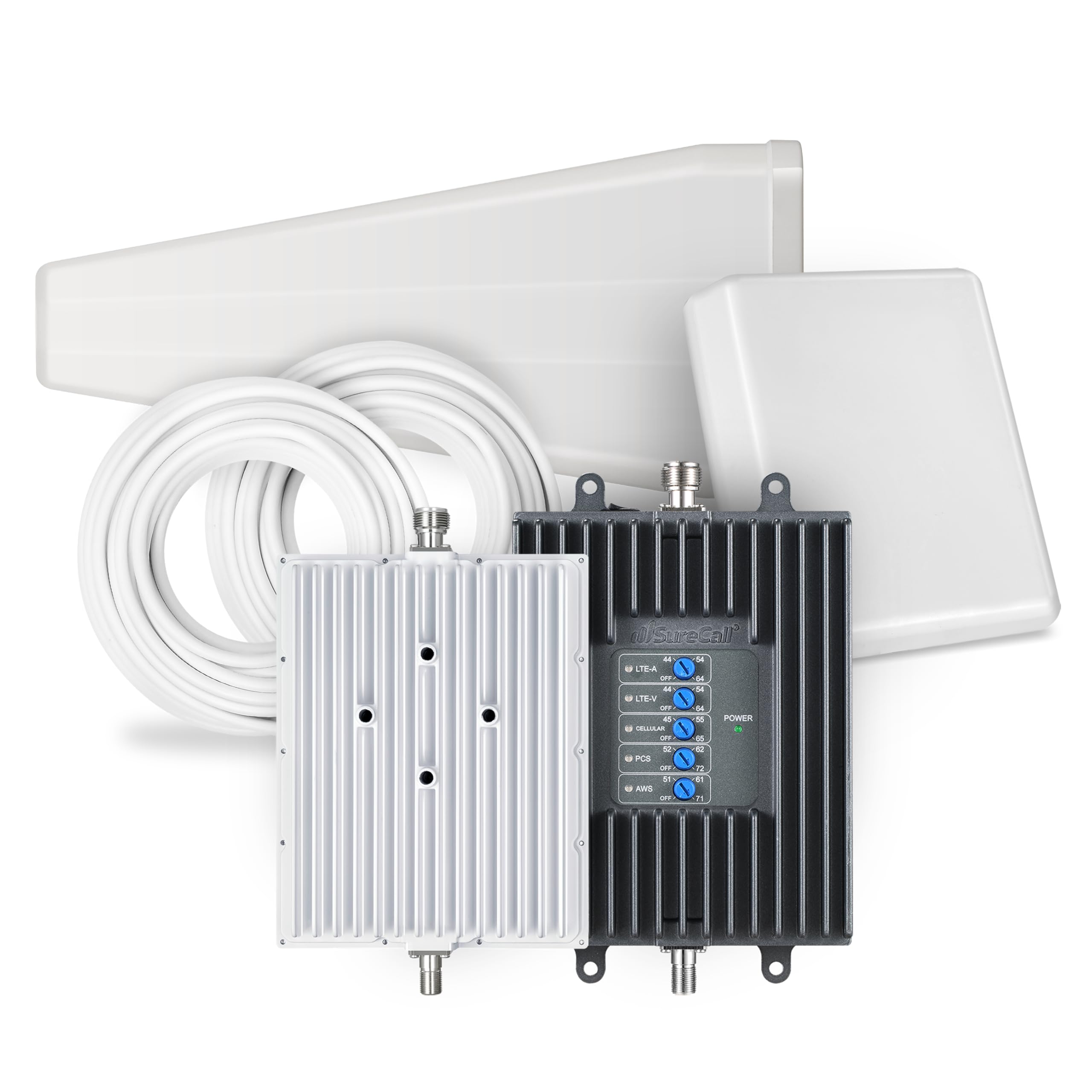
The SureCall Fusion4Home Max uses patented Extended Range Technology (ERT) that amplifies the signal at its strongest point outside the building before distributing it indoors, delivering up to 6,500 square feet of coverage. That approach makes it uniquely effective for homes with thick walls, metal roofs, or distant towers where standard boosters struggle to maintain separation. It supports all major U.S. carriers across Bands 2, 4, 5, 12, 13, 17, and 25, and it handles multiple devices simultaneously without signal degradation.
Installation requires careful antenna placement — the outdoor unit must face the cell tower and be separated from the indoor antenna by at least 30 vertical feet — but users report that the system provides a noticeable 15 dB signal boost even in attics with borderline reception. The unit is FCC certified, assembled in the USA, and backed by a 3-year warranty with lifetime U.S.-based support. Metal building owners report that it delivers indoor signal strength that matches or exceeds outdoor levels.
The biggest consideration is the price point, which places it firmly in the premium tier. It also demands a clear sightline to the nearest cell tower — if your outdoor signal is zero, ERT cannot create coverage. For homes that already catch a faint outdoor signal, this is the most reliable solution for whole-building coverage.
Why it’s great
- ERT amplifies signal at strongest outdoor point before distribution
- Covers all U.S. carriers across key frequency bands
- Built and assembled in the U.S. with FCC certification
- 3-year warranty with lifetime phone and email support
Good to know
- Premium price reflects top-tier performance
- Requires a minimum usable outdoor signal to function
- Antenna separation of 30+ feet necessary to prevent oscillation
2. HiBoost 10K SL

The HiBoost 10K SL distinguishes itself with a built-in LCD screen and a dedicated SignalSupervisor app that displays real-time gain, signal strength, and installation diagnostics. That feedback loop takes the guesswork out of antenna alignment — you can see the dB improvement as you rotate the outdoor directional antenna. It covers up to 5,500 square feet with 70 dB of gain and supports all major U.S. carriers on Bands 2, 4, 5, 12, 13, 17, and 25.
Users in forested valleys and hurricane-prone areas have reported jumping from unusable data to 25+ Mbps downstream after fine-tuning the antenna angle using the app. The system includes an outdoor directional antenna, an indoor panel antenna, and low-loss cables that allow separation without drilling through walls. The metal case shields the amplifier from RF interference, and AGC prevents oscillation during signal fluctuations.
The 10K SL does not support Band 71 (600 MHz), which T-Mobile uses for long-range 5G in some rural areas. If you depend on T-Mobile’s extended-range 5G, verify your local tower uses Band 71 before buying. The app- and screen-guided installation makes this the best option for DIY users who want precision without hiring a professional.
Why it’s great
- LCD screen and app provide real-time installation feedback
- 70 dB gain delivers measurable signal improvement
- Supports all major U.S. carriers across six frequency bands
- Includes window pass-through cable, no drilling required
Good to know
- No Band 71 (600 MHz) support
- Outdoor antenna mounting bracket must be purchased separately
- Requires at least one bar of outdoor signal to function
3. HiBoost 8000 Sq Ft Booster

HiBoost’s 8,000 sq ft model is essentially the larger sibling of the 10K SL, designed for homes and offices that span multiple floors or have challenging layouts. It ships with two indoor antennas — one built into the main unit and one separate panel — to distribute signal across up to six rooms. The 70 dB gain amplifier covers Bands 2, 4, 5, 12, 13, 17, and 25, ensuring compatibility with Verizon, AT&T, T-Mobile, and regional carriers.
Users in three-story homes and rural cabins report that the dual-antenna setup eliminates dropped calls even in basement rooms that previously had no signal. The built-in LCD and HiBoost app provide the same real-time alignment tools as the 10K SL, allowing you to optimize the outdoor antenna angle from inside. AGC automatically adjusts gain to prevent oscillation when signal conditions change.
The coverage claim of 8,000 sq ft assumes a moderate outdoor signal. If your outdoor signal is weak (one bar), expect effective coverage closer to 3,000–4,000 sq ft. The included cables are 50 feet for the outdoor antenna, which is generous but may still require careful routing in larger homes. For multi-floor coverage with two indoor antennas, this is the most complete turnkey option.
Why it’s great
- Two indoor antennas cover up to six rooms
- App and LCD for real-time installation guidance
- AGC prevents oscillation in fluctuating signal conditions
- Supports all major U.S. carriers on key frequency bands
Good to know
- Actual coverage depends on outdoor signal strength
- No Band 71 support for T-Mobile extended-range 5G
- Larger footprint requires more space for indoor antenna placement
4. weBoost Home Studio

The weBoost Home Studio is the entry point into Wilson Electronics’ lineup, a brand that has dominated the booster market for decades. It delivers 65 dB of gain and covers up to 3,000 square feet, supporting all major U.S. and Canadian carriers across Bands 2, 4, 5, 12, 13, and 17. The kit includes an outdoor directional antenna, an indoor whip antenna, two 30-foot low-loss cables, and a mounting bracket.
Real-world users report dramatic improvements in small homes and studio apartments — moving from a single weak bar and dropped calls to four or five bars with usable data speeds. The whip antenna sits on a desk or shelf and does not require ceiling mounting, making this the easiest system to deploy in a single room or open-concept layout. FCC approval and the weBoost reputation for durability add confidence.
The coverage area is smaller than the premium models, and the whip antenna cannot match the even distribution of a panel antenna in multi-room spaces. Users in off-grid cabins report that mounting the outdoor antenna on a flagpole or PVC pipe at 20 feet yields the best results. For a reliable, no-fuss solution in a smaller space, the Home Studio delivers consistent performance.
Why it’s great
- Trusted brand with decades of RF engineering experience
- Indoor whip antenna sits on a desk or shelf — no drilling
- Includes two 30-foot cables for flexible outdoor antenna placement
- FCC approved and compatible with all U.S./Canadian carriers
Good to know
- 3,000 sq ft coverage is best for single rooms or small homes
- Whip antenna provides less uniform coverage than panel antennas
- Booster runs warm during extended use
5. ZORIDA Ace 5S

The ZORIDA Ace 5S packs 72 dB of gain — higher than many premium models — into a compact unit rated for 2,000 square feet. It supports all U.S. carriers across Bands 2, 4, 5, 12, 13, 17, and 25, and its companion app provides step-by-step video guides, real-time signal readings, and direct chat with technical support. The kit includes a 49.2-foot outdoor antenna cable, an indoor whip antenna, and a power supply.
Users consistently praise ZORIDA’s customer support, with multiple reviews highlighting how the support team helped troubleshoot antenna positioning to achieve a jump from one bar to five solid bars. The high gain is especially useful when the outdoor signal is weak — the Ace 5S can extract usable coverage where lower-gain units fail. The app’s signal data display helps you compare before-and-after readings to confirm the boost.
The 2,000 sq ft coverage limit means this is best for a single level or a small home. The indoor whip antenna may not distribute signal evenly through multiple rooms compared to a panel antenna. For small homes, cabins, or apartments where every dB counts, the Ace 5S offers exceptional value and support.
Why it’s great
- 72 dB gain is higher than many more expensive models
- App provides installation guidance and real-time signal data
- Rated for all U.S. carriers across six frequency bands
- Lifetime U.S.-based tech support with chat and phone
Good to know
- 2,000 sq ft coverage requires strong outdoor signal for full range
- Indoor whip antenna less effective in multi-room layouts
- Some users report app compatibility issues with specific Android phones
6. Nstcell 7000 Sq Ft Booster

The Nstcell 7000 Sq Ft booster is designed specifically for rural homes and metal buildings, bundling two indoor panel antennas, an outdoor log-periodic Yagi antenna, and a 49-foot cable. With 70 dB of gain and support for 700 MHz, 1700/2100 MHz, and 1900 MHz bands, it covers Verizon, AT&T, T-Mobile, and regional carriers. The dual panel antennas distribute signal more evenly across multiple rooms than a single whip or panel.
Users with metal roofs and metal siding — typical in rural pole barns and ranch homes — report moving from zero usable signal to three or four bars throughout the house. One reviewer noted that the installation took a morning to complete, and after two months, the system maintained stable coverage without adjustment. The FCC certification ensures legal operation without interfering with nearby towers.
The instructions are translated and can be confusing; some users report that the antenna mounting bracket does not include a pole. The coverage rating of 7,000 sq ft assumes a strong outdoor signal — reviewers in remote mountainous areas saw more modest improvements. For homes with metal construction and dual-antenna needs, this is a solid mid-range choice.
Why it’s great
- Two indoor panel antennas for even room-to-room distribution
- 70 dB gain handles weak outdoor signals
- Includes 49-foot outdoor cable for flexible antenna placement
- FCC approved for legal operation on all networks
Good to know
- Installation instructions are poorly translated
- Does not include a mounting pole for the outdoor antenna
- Coverage varies significantly with outdoor signal strength
7. JACOOL AT&T/T-Mobile Booster
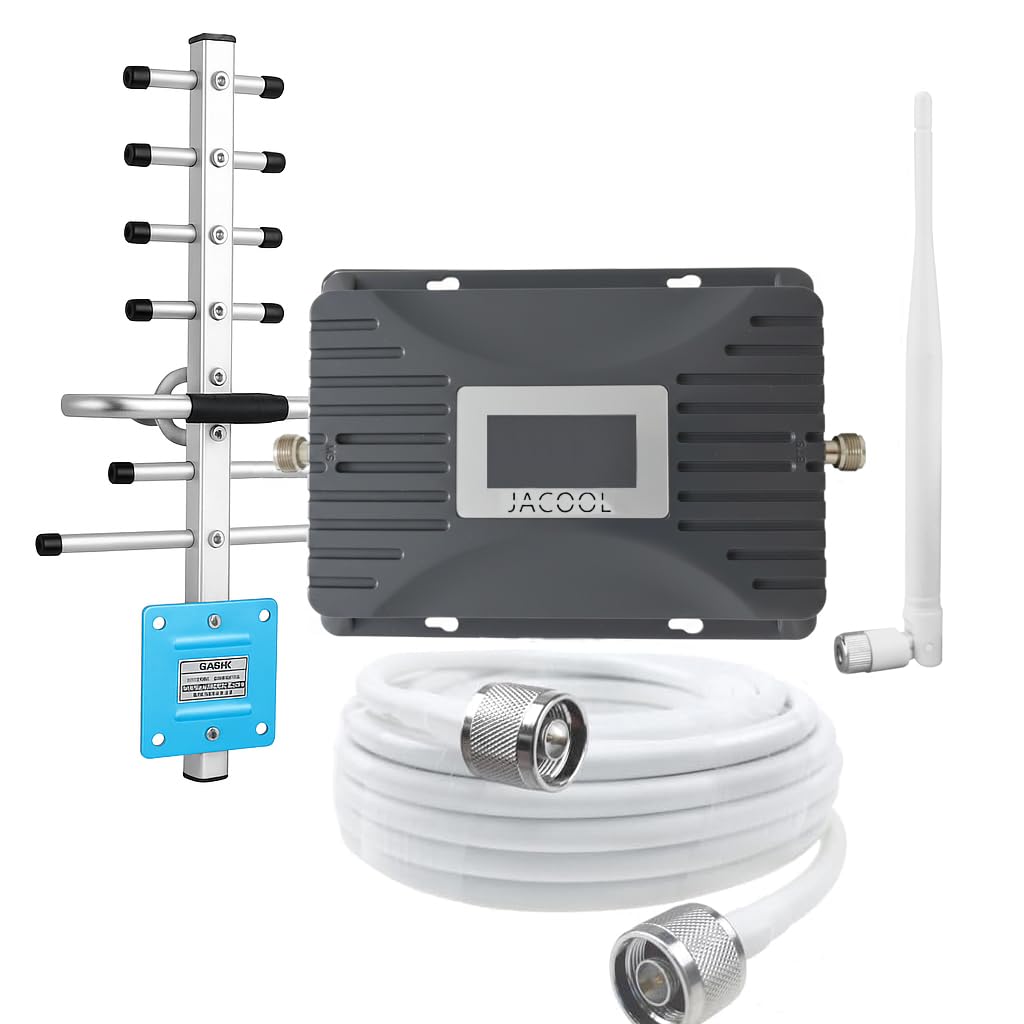
The JACOOL booster is tuned for AT&T’s Band 12/17 at 700 MHz and also supports T-Mobile, Straight Talk, Cricket, and U.S. Cellular on the same frequencies. It delivers 65 dB of gain and claims coverage up to 4,000 square feet. The kit includes an outdoor directional antenna, an indoor whip antenna, and a 50-foot coaxial cable that can be extended to 100 feet for additional separation.
Users report clear VoLTE calls and faster data speeds after installing the outdoor antenna at least 20 feet above ground level. The AGC function automatically adjusts gain to prevent oscillation, which is useful when signal strength fluctuates throughout the day. The booster is FCC certified and backed by a 3-year warranty with lifetime technical support.
This unit is single-band and does not support Verizon’s Band 13 or the 1700/2100 MHz bands used by some carriers. If you or your guests use Verizon phones, this booster will not improve their signal. It also lacks the dual-antenna design of larger units, so coverage in multi-room homes may be uneven. For AT&T or T-Mobile users on a budget, this is a focused solution.
Why it’s great
- Purpose-built for AT&T Band 12/17 and T-Mobile compatibility
- AGC and anti-oscillation protection maintain stable performance
- 50-foot cable included, extendable to 100 feet
- FCC certified with 3-year warranty and lifetime support
Good to know
- Does not support Verizon Band 13 or 1700/2100 MHz bands
- Single indoor whip antenna limits even multi-room coverage
- Installation requires careful outdoor antenna placement
8. FreeQueen Verizon Booster
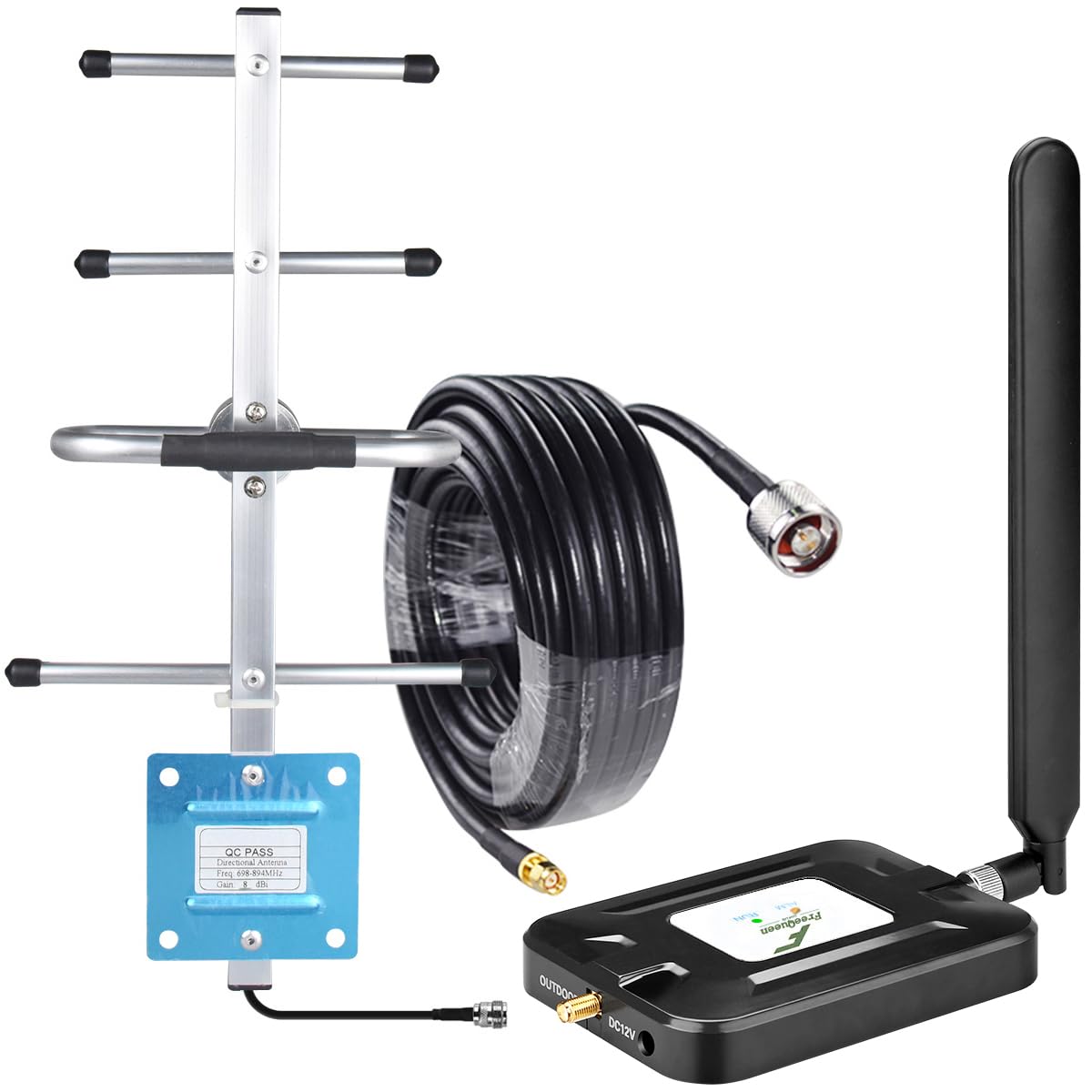
The FreeQueen booster is a single-band solution tuned exclusively for Verizon’s Band 13 (700 MHz), covering 4G LTE and 5G on that frequency. It offers 65 dB of gain and claims coverage up to 5,000 square feet. The kit includes a high-gain outdoor Yagi antenna, an indoor whip antenna, a 50-foot N-SMA cable, and a 12V power supply.
Verizon users in rural areas, basements, and metal buildings report that the booster reliably converts one or two bars into four or five bars, enabling clear calls and usable data. The AGC system adjusts gain automatically to prevent feedback loops. The compact booster unit has a sleep mode for energy efficiency and LED indicators to show operating status.
This unit only works with Verizon and its MVNOs like Straight Talk (on Verizon’s network). AT&T and T-Mobile customers will see no improvement. The coverage claim of 5,000 sq ft is achievable only with a strong outdoor signal; weaker signals produce proportionally smaller indoor coverage. For Verizon households on a tight budget, it is a functional entry point.
Why it’s great
- Affordable single-band solution for Verizon Band 13
- 65 dB gain improves 1–2 bars to 4–5 bars in most cases
- AGC and sleep mode for stable, efficient operation
- Includes 50-foot cable and all mounting hardware
Good to know
- No support for AT&T, T-Mobile, or other carrier bands
- Coverage range depends heavily on outdoor signal strength
- Customer reviews suggest mixed reliability over time
9. GAGBK Verizon Booster

The GAGBK Verizon booster operates on the same principle as the FreeQueen — single-band amplification for Verizon’s Band 13 at 65 dB gain, with a claimed coverage area of 5,000 square feet. The kit includes an outdoor directional Yagi antenna, an indoor whip antenna, a 50-foot cable, and a 12V power supply. It supports 4G LTE and 5G on compatible Verizon devices.
Users in weak-signal areas report that calls become clear and data speeds improve enough for basic streaming and web browsing after installation. The AGC function helps maintain stable gain when the outdoor signal fluctuates. The unit is FCC certified and comes with a 2-year manufacturer warranty and 30-day money-back guarantee.
Like the FreeQueen, this booster is limited to Verizon Band 13 and will not help AT&T, T-Mobile, or other carrier users. The coverage of 5,000 sq ft depends on catching at least one bar of usable outdoor signal — zero outdoor signal means zero indoor improvement. For a second budget option targeting the same niche, this competes directly with the FreeQueen on specifications and price.
Why it’s great
- Budget-friendly option for Verizon Band 13 users
- 65 dB gain with AGC for automatic performance adjustment
- Includes Yagi antenna and 50-foot cable for outdoor mounting
- FCC certified for safe, legal operation
Good to know
- Single-band design limits use to Verizon and its MVNOs
- Coverage highly dependent on outdoor signal availability
- 2-year warranty is shorter than some competitors
FAQ
How much outdoor signal do I need before a booster will work?
Can I use one booster for both Verizon and AT&T at the same time?
Why does my booster need antenna separation?
Will a cell phone booster work in a metal building or basement?
Final Thoughts: The Verdict
For most users, the best cell booster winner is the SureCall Fusion4Home Max because it combines the highest coverage area with patented ERT technology that amplifies signal at its strongest outdoor point, making it ideal for homes with weak fringe signals and metal construction. If you want app-guided real-time installation feedback and slightly lower cost, grab the HiBoost 10K SL. And for an entry-level or carrier-specific fix on a budget, nothing beats the focused simplicity of the JACOOL AT&T Booster or the FreeQueen Verizon Booster.

Mo Maruf
I created WellFizz to bridge the gap between vague wellness advice and actionable solutions. My mission is simple: to decode the research and give you practical tools you can actually use.
Beyond the data, I am a passionate traveler. I believe that stepping away from the screen to explore new environments is essential for mental clarity and physical vitality.