Our readers keep the lights on and my smoothie glass nicely filled. As an Amazon Associate, I earn from qualifying purchases.
Weak cellular signal inside your own home turns every room into a frustrating guessing game—will this call drop when you walk into the kitchen, or will that video buffer endlessly in the basement. A dedicated signal booster solves this by pulling in the faintest outdoor signal and rebroadcasting it indoors, converting dead zones into reliable coverage for calls, texts, and data across multiple rooms and multiple devices at once.
I’m Mohammad Maruf — the founder and writer behind WellFizz. I’ve spent hundreds of hours analyzing amplifier gain ratings, antenna patterns, frequency band compatibility, and real-world installation results to separate the boosters that actually deliver from those that just flash green lights.
This guide breaks down the top nine models by coverage, gain, and carrier support so you can confidently choose the right cell phone booster for home without wasting money on a unit that can’t handle your specific signal situation.
How To Choose The Best Cell Phone Booster For Home
The perfect booster depends on three variables: the strength of the signal outside your house, the carriers you use, and the square footage you need to cover. Miss one of these and you risk buying a unit that either underperforms or overcomplicates installation with features you don’t need.
Gain (dB) is the real power number
Manufacturers often advertise coverage in square feet, but that number is optimistic. The actual coverage you get depends on gain measured in decibels. A 65 dB booster can handle a single room or a small apartment. A 72 dB unit pushes into 3–4 rooms. At 100 dB, you’re looking at whole-home coverage across multiple floors. Always look at the gain first, not the marketing claim.
Frequency band compatibility determines if it works at all
Every carrier broadcasts on specific frequency bands. Verizon uses Band 13 (700 MHz) heavily. AT&T and T-Mobile rely on Band 12/17 (700 MHz) and Band 4/66 (1700/2100 MHz). A booster that only covers one band will only help that carrier. If you need to boost both Verizon and AT&T simultaneously, you need a multi-band or dual-band unit that supports the specific frequencies used by both carriers in your area.
Outdoor antenna type changes everything
A directional Yagi antenna focuses on one cell tower and pulls in a stronger signal from farther away, making it ideal for rural areas. An omni antenna receives from all directions equally but captures less distant signal, which works better in suburbs where towers surround your home. The wrong antenna type can leave you with no improvement at all, even with a high-gain amplifier.
Quick Comparison
On smaller screens, swipe sideways to see the full table.
| Model | Category | Best For | Key Spec | Amazon |
|---|---|---|---|---|
| SureCall Fusion4Home Yagi Panel | Premium | Rural homes with distant towers | 72 dB gain, 5,000 sq ft | Amazon |
| ZORIDA 5S Ultra | Mid-Range | Multi-room home coverage | 72 dB gain, 4,500 sq ft | Amazon |
| ZORIDA Ver 5S Pro | Mid-Range | All-carrier flexibility | 72 dB gain, 4,000 sq ft | Amazon |
| HiBoost 8,000 Sq Ft | Premium | Large homes & metal buildings | 70 dB gain, 8,000 sq ft | Amazon |
| CEL-FI GO G41 | Premium | Massive coverage & extreme rural | 100 dB gain, 15,000 sq ft | Amazon |
| weBoost Home Studio Omni | Mid-Range | Simple suburban installation | 65 dB gain, 2,000 sq ft | Amazon |
| JACOOL Multi-Carrier | Budget | AT&T/T-Mobile single-carrier | 65 dB gain, 4,000 sq ft | Amazon |
| JACOOL Verizon Band 13 | Budget | Verizon-only dead zones | 65 dB gain, 3,000–5,000 sq ft | Amazon |
| weBoost Destination RV | Premium | Stationary RV & remote cabins | 65 dB gain, directional antenna | Amazon |
In‑Depth Reviews
1. SureCall Fusion4Home Yagi Panel

The SureCall Fusion4Home Yagi Panel uses a patented extended-range architecture that amplifies the signal at its strongest point outside your building before rebroadcasting indoors. This approach delivers a measured improvement from -111 dBm to -68 dBm in real installations, translating to five solid bars and data speeds jumping from under 1 Mbps to 12–20 Mbps. It supports all major U.S. carriers and covers up to 5,000 square feet with its 72 dB gain amplifier.
Assembly requires mounting the Yagi antenna on a roof or eave and routing the coaxial cable through a window or drilled entry point. Users who take the time to aim the antenna—often 30 degrees off the direct tower bearing—report near-perfect results even from towers 20 miles away. The kit includes a panel antenna for indoor distribution and all necessary cabling.
The only tradeoff is that coverage can feel uneven in homes exceeding 4,000 square feet, especially with internal walls blocking line-of-sight to the indoor antenna. Occasional signal loss during hot afternoons has been noted in extreme rural scenarios, but for most homes this unit transforms unusable areas into fully functional spaces.
Why it’s great
- Best-in-class 72 dB gain with patented outdoor-first amplification
- Simultaneous support for Verizon, AT&T, T-Mobile, and US Cellular
- Includes both Yagi directional and panel indoor antennas
Good to know
- Coverage drops off noticeably in homes over 4,000 square feet
- Yagi antenna requires precise aiming and good line-of-sight
2. ZORIDA 5S Ultra
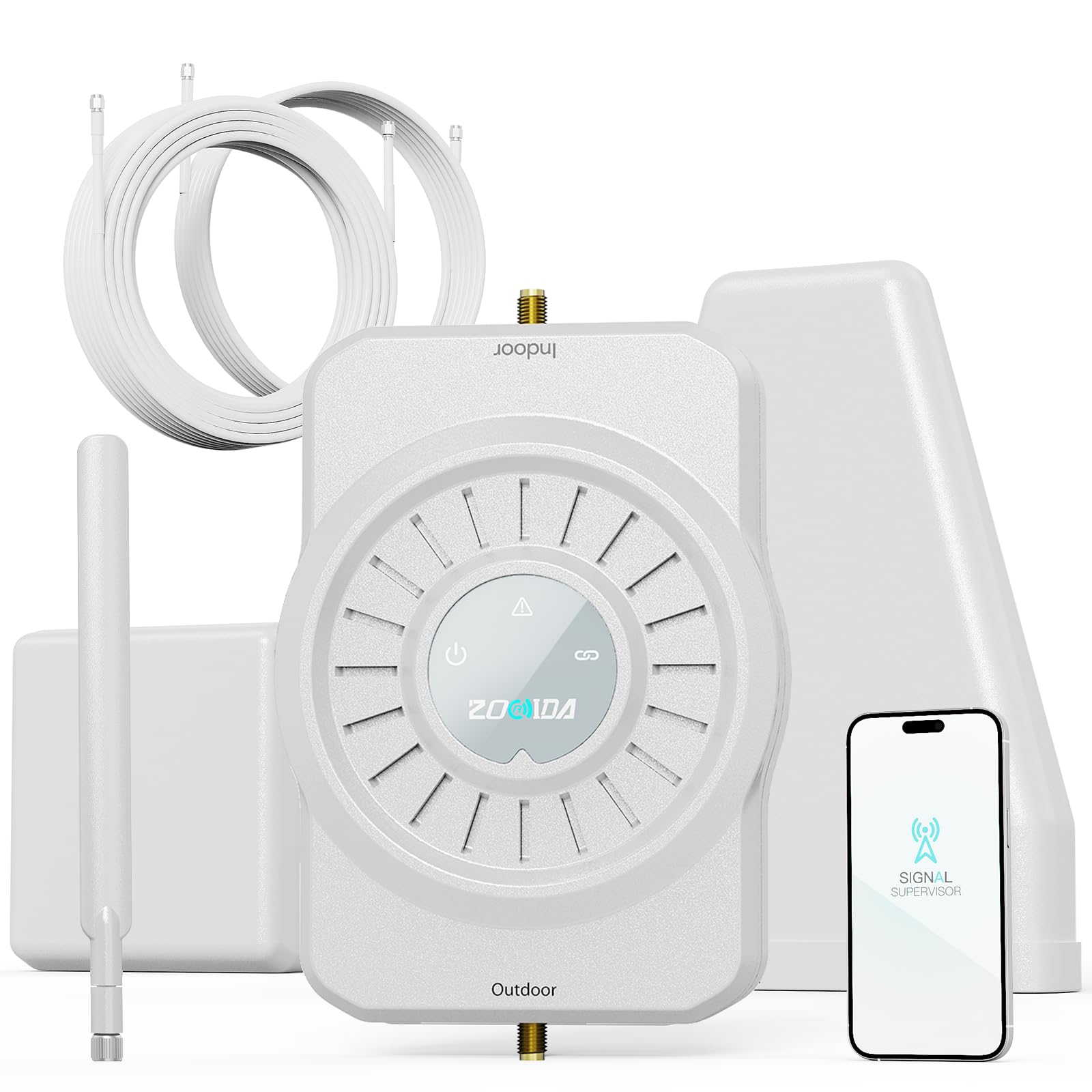
The ZORIDA 5S Ultra pushes coverage to 4,500 square feet with a 72 dB amplifier, making it one of the strongest mid-range options for whole-home signal domination. It supports every U.S. carrier and all current network generations from 3G through 5G, working across bands 12, 13, 17, 5, 25, 2, and 4. Users report jumping from 1–2 unreliable bars to 5 solid bars, with streaming and Zoom calls working flawlessly in basement offices and metal garages.
Setup is guided by the ZORIDA app, which walks you through real-time signal measurements and antenna placement. The kit includes both outdoor Yagi and indoor panel antennas with sufficient cabling to separate them by the required distance—vertical and horizontal separation prevents oscillation. Customer support from the US-based team is frequently praised for persistence and deep knowledge.
The main catch is that a small number of users received mismatched hardware revisions during shipping, which required exchanges. Additionally, the app can occasionally struggle with connectivity during initial setup, though the step-by-step guidance generally compensates for this.
Why it’s great
- 72 dB gain blankets 3–5 rooms with strong signal
- All-carrier support with wide band compatibility
- App-guided installation with real-time signal measurement
Good to know
- Shipping quality control can result in wrong hardware revisions
- App interface sometimes has connection issues during setup
3. ZORIDA Ver 5S Pro
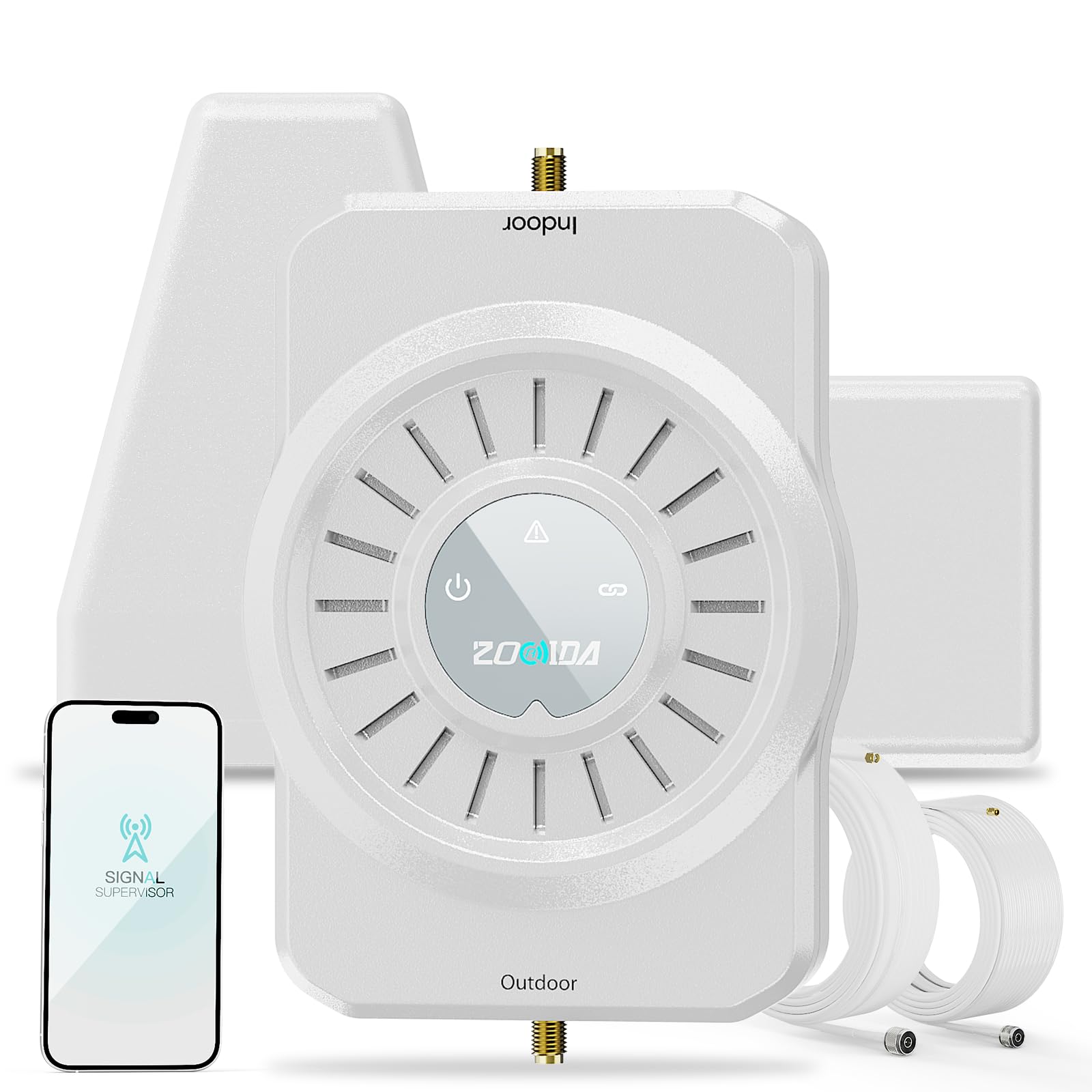
The ZORIDA Ver 5S Pro delivers the same 72 dB amplifier and all-carrier compatibility as the 5S Ultra but in a slightly smaller coverage envelope of 4,000 square feet. Real-world users saw signal improve from 2-bar 4G to full 5G indoors at cabins and homes in Northern Michigan, with clear calls and fast data speeds. The booster automatically handles all major carriers—Verizon, AT&T, T-Mobile, and others—across 2G, 3G, 4G, and 5G networks.
Installation follows the same app-guided process as the Ultra model, with step-by-step instructions and real-time signal matching. The kit ships with a high-gain outdoor antenna, indoor antenna, and all required cables. Users highlight the FCC certification as reassurance against interference with cell towers, and the 3-year warranty adds long-term confidence.
The tradeoff is that the 4,000 square foot rating is optimistic for homes with multiple floors or dense walls. Users in very large or multi-level spaces sometimes find signal weak on the far side of the house. Also, the app, while helpful, occasionally shows connection drops during the initial pairing phase.
Why it’s great
- Universal carrier compatibility with strong 72 dB gain
- App-guided setup simplifies antenna placement
- FCC certified with 3-year warranty and lifetime support
Good to know
- Coverage drops in homes with multiple floors or thick walls
- App connectivity can be intermittent during initial configuration
4. HiBoost 8,000 Sq Ft

The HiBoost 8,000 Sq Ft booster is built specifically for large homes, metal buildings, and cabins that need signal distributed across 5–6 rooms. Its 70 dB amplifier and two indoor antennas—one built into the main unit and one external panel—create a wider broadcast pattern than most single-antenna boosters. In real-world use, a test in a 2,700 square foot home went from no data to 50+ Mbps on Verizon 5G and 15+ Mbps on T-Mobile 5G, with the app enabling real-time antenna alignment.
The unit features an LCD display and automatic gain control that adjusts performance to prevent oscillation. Setup is manageable for a motivated homeowner, though routing the two outdoor cables and positioning the second indoor antenna requires planning. The HiBoost app provides live signal monitoring and gain adjustments. Customer support has been called excellent, with US-based technicians helping users work through installation issues.
The main limitation is that the 8,000 square foot claims assume optimal conditions. In a 4,500 square foot three-floor home without tower line-of-sight, users found the booster insufficient for covering all levels and wished for the larger 15K model. It also lacks support for Band 71 (600 MHz), which T-Mobile uses extensively in rural areas.
Why it’s great
- Two indoor antennas provide wider signal distribution
- App and LCD display for real-time monitoring and alignment
- Automatic gain control prevents oscillation
Good to know
- May struggle to cover all floors of a multi-level 4,500+ sq ft home
- Does not support T-Mobile Band 71 (600 MHz)
5. CEL-FI GO G41
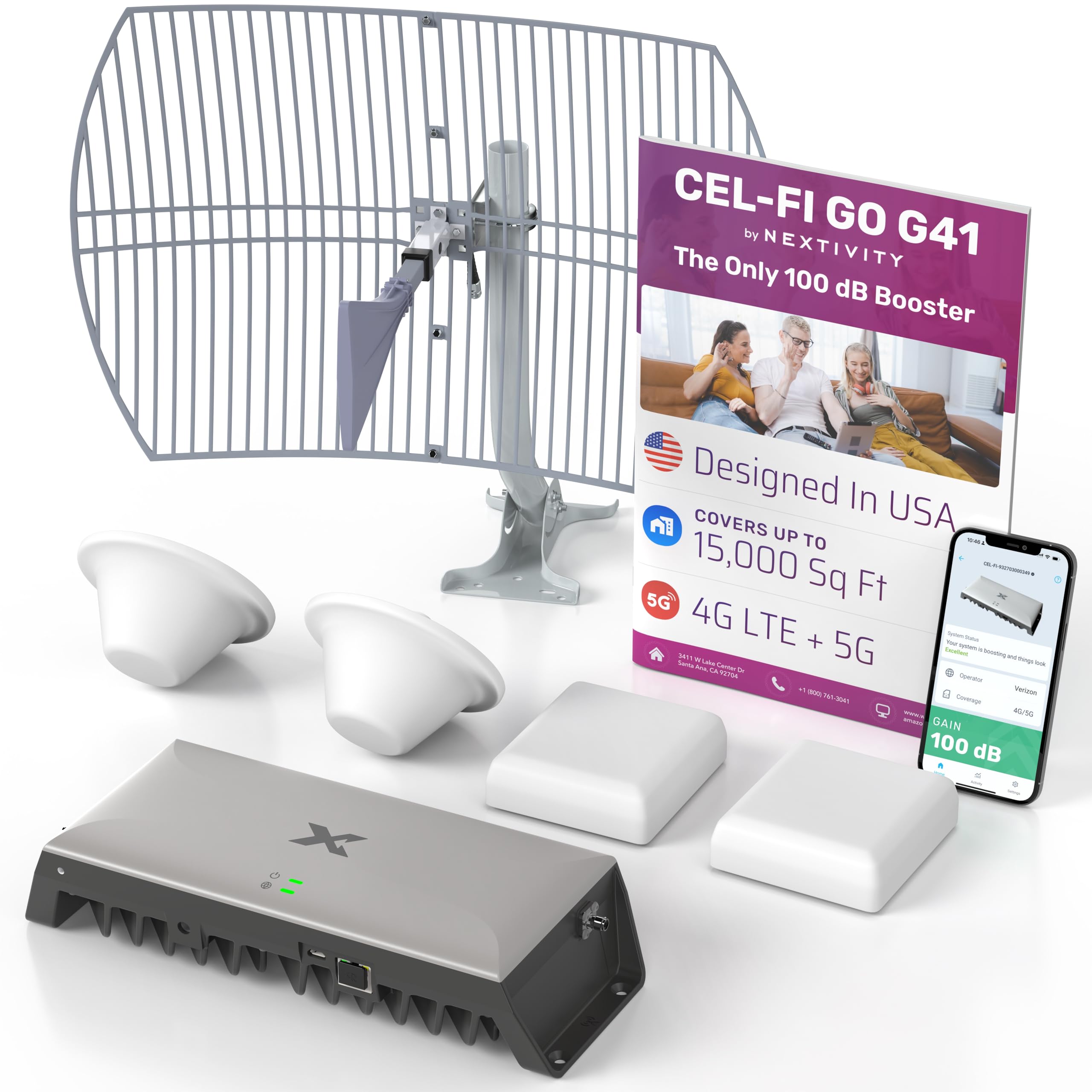
The CEL-FI GO G41 is in a league of its own with 100 dB gain—30 dB more than typical boosters—allowing it to cover up to 15,000 square feet. Built around the 4th-generation IntelliBoost chipset, it supports 4G LTE, 5G-DSS, and 5G NR technology. In practice, it pulls signal from -108 dBm to -75 dBm inside homes with metal roofs and zero outdoor signal, delivering full bars across all floors. The kit includes two indoor panel antennas and two indoor dome antennas, giving you flexibility to choose the best distribution setup.
Installation is a full-day project involving mounting the outdoor antenna, routing cables, and placing the indoor antennas for proper separation. The unit’s software automatically finds the strongest tower and optimizes gain across supported bands. Customer support is exceptional, with the CEO personally responding to installation questions in some cases. For rural homes that have never had usable cell service, the G41 effectively replaces the need for expensive satellite internet for basic connectivity.
The downside is that the G41 only amplifies two bands at a time. In areas where towers broadcast on bands 30 and 66, your phone may prefer those stronger non-amplified bands, causing inconsistent results. It’s also a significant investment, though users universally describe it as worth the cost when cheaper boosters have failed.
Why it’s great
- Industry-leading 100 dB gain handles the toughest rural dead zones
- 4th-gen chipset supports 5G-DSS and 5G NR
- Includes two panel and two dome antennas for flexible indoor placement
Good to know
- Only amplifies two bands at a time, which can cause phone preference issues
- Full-day installation required with careful cable routing
6. weBoost Home Studio Omni
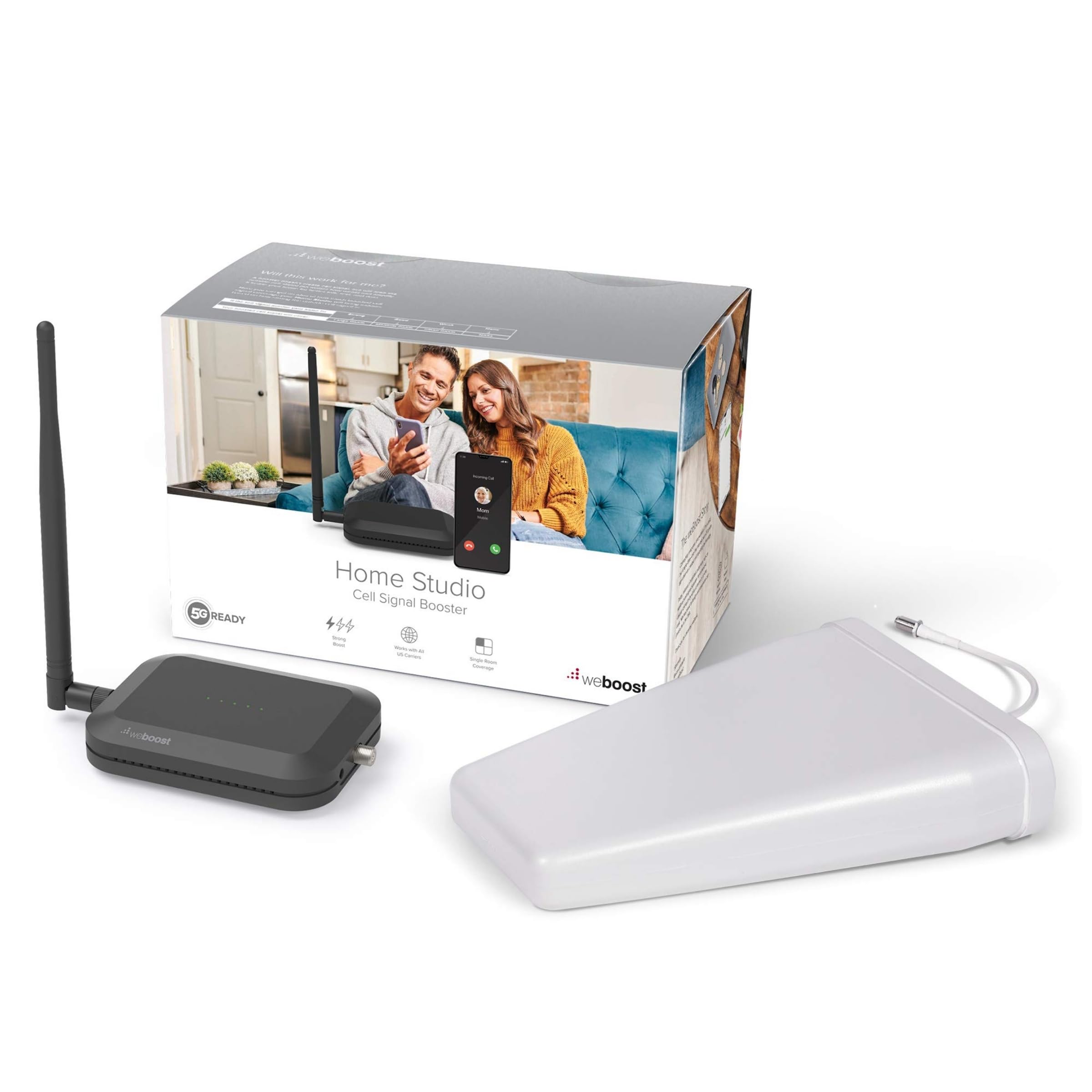
The weBoost Home Studio Omni is designed for homeowners who want a straightforward installation without climbing onto the roof to aim a directional antenna. It uses an omni-directional outdoor antenna that picks up signals from all directions, making it ideal for suburban areas where towers surround the property. The booster provides 65 dB of gain and covers up to 2,000 square feet—enough for a main living area or a home office. Real users report Verizon home internet speeds jumping from 1.8 Mbps to 122.6 Mbps after installation.
Setup is the simplest among all options here. The omni antenna mounts on a vent pipe or eave, and the included 30-foot cables connect to the amplifier, which plugs into a standard wall outlet. The indoor antenna is a compact unit that sits on a desk or shelf. All components are made in the USA and FCC approved, giving confidence in both safety and legality.
The limitation is coverage. The 2,000 square foot rating is realistic for a single open area but won’t reach bedrooms on the other side of the house or a basement. Some users in weak signal areas saw no improvement even with all green lights, particularly in regions with challenging topography like Los Angeles canyons. For small homes or single-room coverage, it’s an excellent entry-level choice.
Why it’s great
- Simple omni-antenna installation with no tower aiming required
- Made in the USA with FCC certification
- Easy setup for small homes and apartments
Good to know
- Coverage is limited to about 2,000 square feet, one room effectively
- May not improve signal at all in very weak or obstructed areas
7. JACOOL Multi-Carrier
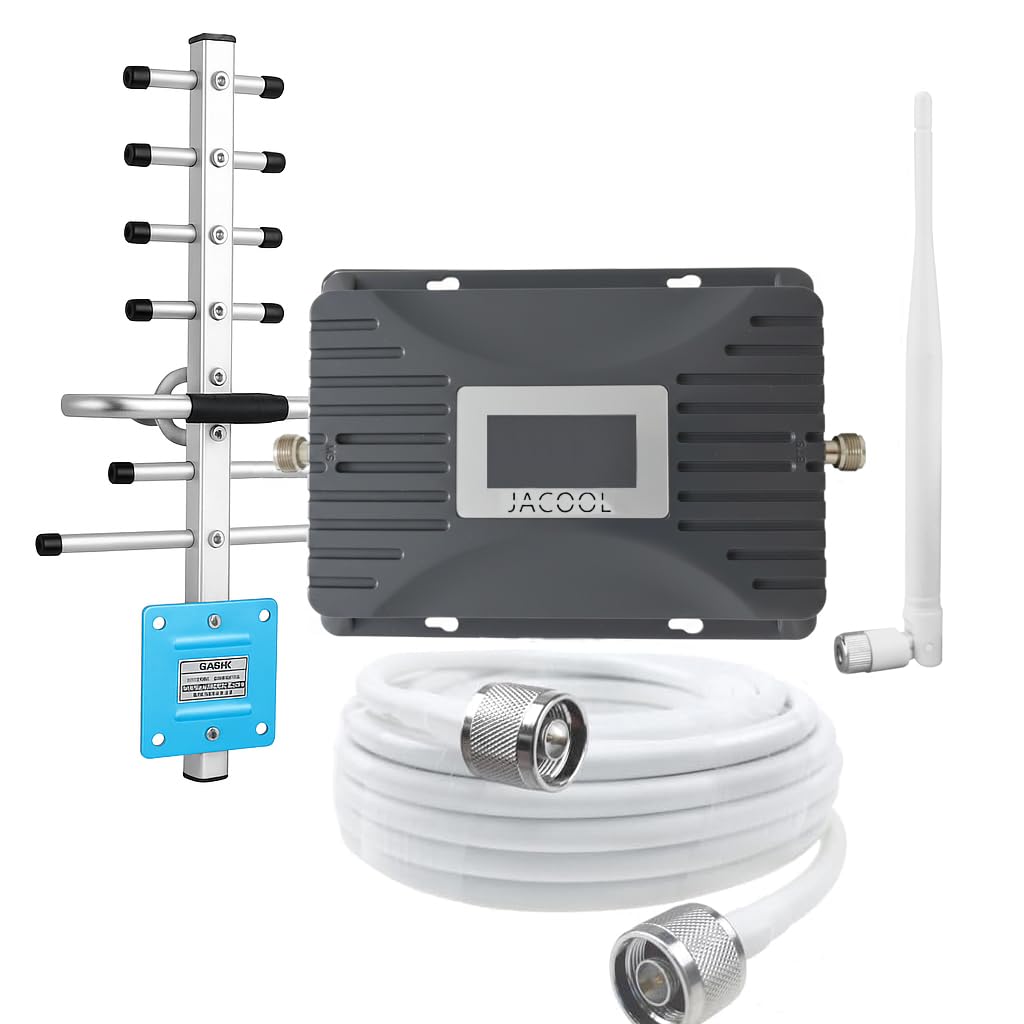
The JACOOL Multi-Carrier booster is engineered specifically for AT&T’s Band 12/17 700 MHz network but also supports T-Mobile, Straight Talk, Cricket, and US Cellular. It provides 65 dB gain and claims coverage up to 4,000 square feet, making it one of the most affordable options for AT&T and T-Mobile users who need a single-carrier solution. The unit is 5G-ready and enhances both voice and data, delivering clearer VoLTE call quality and faster uploads and downloads.
Installation is straightforward with the included 50-foot coaxial cable and Yagi antenna, requiring about 30 minutes for basic setup. The automatic gain control feature adjusts performance to prevent oscillation and maintain stability. Users report reliable signal improvement in homes, offices, and metal buildings, with most seeing a jump from 1–2 bars to 3–5 bars in the coverage area.
The primary limitation is that it only covers Bands 12 and 17. If you need Verizon Band 13 support, or if your carrier uses different bands, this unit won’t help. Some reviews from bike lock contexts contaminated the data, but verified phone booster users confirm the unit functions as advertised for AT&T and T-Mobile single-band needs.
Why it’s great
- Affordable entry point for AT&T and T-Mobile users
- FCC certified with AGC for stable performance
- Includes 50-foot cable for flexible outdoor antenna placement
Good to know
- Only supports Bands 12 and 17, not compatible with Verizon
- Coverage rating of 4,000 sq ft is optimistic for multi-level homes
8. JACOOL Verizon Band 13
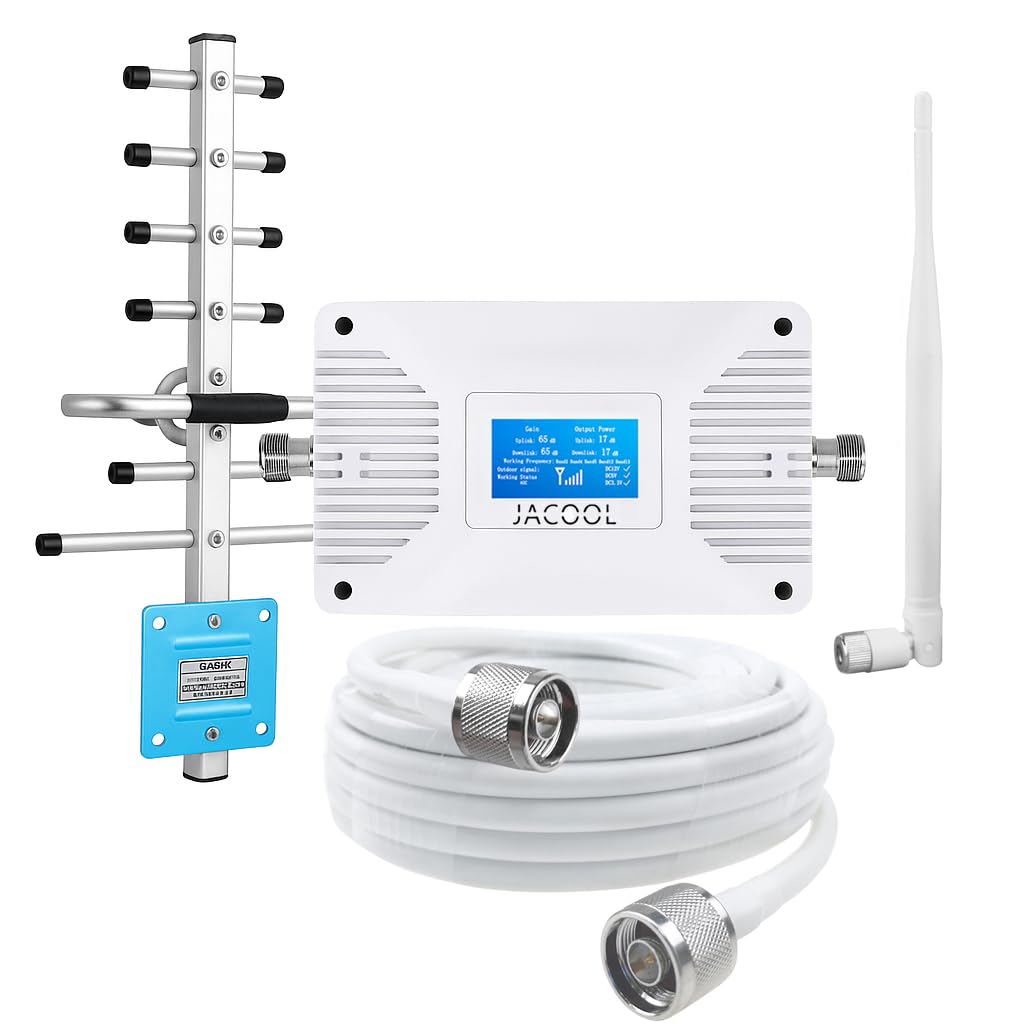
The JACOOL Verizon Band 13 booster is purpose-built for Verizon and Straight Talk customers using Band 13 (700 MHz) and Band 4/66 (1700/2100 MHz). With a 65 dB amplifier, it covers between 3,000 and 5,000 square feet, making it a strong budget option for Verizon users in rural areas, basements, garages, and metal-roof homes. The unit features automatic gain control that adjusts signal strength to reduce oscillation and power consumption.
Included in the kit is a high-gain outdoor Yagi antenna, indoor antenna, and all necessary cables for installation that most users complete in under 30 minutes. The booster supports multiple simultaneous users and devices, improving call clarity and data speeds for iPhones, Android phones, and tablets. FCC approval ensures legal operation on US networks.
The downside is that this booster is single-band and only amplifies Verizon’s Band 13. If you need AT&T or T-Mobile support, look elsewhere. The 3,000–5,000 square foot range is also dependent on the strength of the outside signal available; users with very weak outside signals may find coverage toward the lower end of that range.
Why it’s great
- Specifically optimized for Verizon Band 13 performance
- AGC prevents oscillation and extends equipment lifespan
- Budget-friendly with coverage up to 5,000 sq ft
Good to know
- Only works with Verizon and Straight Talk on Band 13
- Real coverage depends heavily on available outside signal strength
9. weBoost Destination RV

The weBoost Destination RV is designed for stationary use in RVs, campers, trailers, and remote cabins. It includes a collapsible 25-foot telescoping pole with a directional antenna that you aim at the nearest cell tower, delivering a strong boost to a single RV or cabin interior. The system amplifies 4G LTE and 5G signals for all U.S. and Canadian carriers, including Verizon, AT&T, T-Mobile, Dish, and US Cellular. Real-world tests show Verizon speeds going from 0.5 Mbps to 4–9 Mbps, and signal bars increasing from 0–1 to 3–4 inside the camper.
Setup takes about 10 minutes with the included mast and mounting brackets, and the weBoost app provides step-by-step guidance. The kit includes both AC/DC and DC/DC power supplies, making it suitable for both shore power and battery operation. Directional antenna aiming is critical—users consistently report that aligning the antenna with the tower using a compass and tower-finding app makes the difference between a marginal signal and a usable one.
The primary limitation is that the booster only covers the interior of the RV or cabin; signal drops off noticeably once you step outside. Additionally, the included tower-finding app is considered poor by many users, often directing you to home internet towers rather than cellular ones. Owners of RVs with non-metal roofs (vinyl, plywood, fiberglass) may experience oscillation due to insufficient RF shielding between the outside and inside antennas.
Why it’s great
- 25-foot collapsible pole for optimal antenna height
- All-carrier support with 5G compatibility
- Includes both AC and DC power supplies for versatility
Good to know
- Coverage limited to interior of RV or cabin only
- Included tower-finding app is unreliable
FAQ
Do I need a booster if I already have Wi-Fi calling?
Can a booster make my signal worse instead of better?
How do I find out which frequency bands my carrier uses in my area?
Will a signal booster work if I have zero bars outside my home?
Final Thoughts: The Verdict
For most users, the cell phone booster for home that delivers the best balance of gain, coverage, and carrier support is the SureCall Fusion4Home Yagi Panel because its 72 dB gain and patented outdoor-first amplification turn even distant weak signals into usable indoor coverage across up to 5,000 square feet. If you want a simpler setup for a small apartment or single room where coverage is already spotty, grab the weBoost Home Studio Omni. And for the most extreme rural dead zones where no other booster has worked, nothing beats the CEL-FI GO G41 with its 100 dB gain and 15,000 square foot coverage capacity.

Mo Maruf
I created WellFizz to bridge the gap between vague wellness advice and actionable solutions. My mission is simple: to decode the research and give you practical tools you can actually use.
Beyond the data, I am a passionate traveler. I believe that stepping away from the screen to explore new environments is essential for mental clarity and physical vitality.