Our readers keep the lights on and my smoothie glass nicely filled. As an Amazon Associate, I earn from qualifying purchases.
Few things are more frustrating than watching your call fail or your video buffer endlessly when you are standing in the same spot you always do. A quality cell phone antenna is the dedicated hardware that captures weak radio signals from distant towers and delivers usable bars to your device, solving that exact problem at its source rather than masking it with software tricks.
I’m Mohammad Maruf — the founder and writer behind WellFizz. I’ve spent hundreds of hours analyzing signal booster specifications, understanding gain ratings, and matching frequency bands to carrier networks to bring you the most reliable data on what actually works.
After comparing gain levels, coverage areas, carrier compatibility, and installation requirements across seven leading models, this guide breaks down every option so you can confidently choose the right best cell phone antenna for your home, vehicle, or remote workspace.
How To Choose The Best Cell Phone Antenna
Selecting the right antenna starts with three non-negotiable factors: your carrier’s primary frequency bands, the physical space where you need coverage, and whether you need a fixed home system or a mobile vehicle solution. Ignoring any one of these can leave you with a unit that amplifies nothing useful.
Understand Your Carrier’s Frequency Bands
Every carrier uses a specific combination of licensed spectrum blocks such as Band 12, Band 13, or Band 2. A cell phone antenna that does not support your carrier’s bands will simply pass noise through, no matter how high the gain rating. For example, Verizon relies heavily on Band 13, while T-Mobile uses Band 12 and Band 71. Always verify the band compatibility table before buying.
Match the Coverage Area to Your Space
Indoor coverage is measured in square feet, and manufacturers rate their units based on optimal outdoor signal conditions. In reality, tree cover, building materials, and distance from the tower can cut that figure in half. For a single room or small office, a 2,000 sq ft unit may suffice. For a multi-story house or metal building, look for a model rated at 5,000 sq ft or higher.
Consider Installation Complexity
A cell phone antenna is only as good as its outdoor antenna placement. Units that come with longer coaxial cables and better mounting hardware give you the flexibility to place the outdoor antenna high enough to catch a clear line-of-sight signal. Automatic Gain Control (AGC) can compensate for changing conditions, but proper physical separation between the indoor and outdoor antennas is the single most important installation step to avoid oscillation and signal feedback.
Quick Comparison
On smaller screens, swipe sideways to see the full table.
| Model | Category | Best For | Key Spec | Amazon |
|---|---|---|---|---|
| ZORIDA Ace 5S | Mid-Range | Multi-carrier home coverage | 72 dB max gain | Amazon |
| AT&T Signal Booster | Mid-Range | AT&T / T-Mobile Band 12/17 homes | 65 dB gain, 4,500 sq ft | Amazon |
| JACOOL Verizon Booster | Mid-Range | Verizon Band 13 homes | 65 dB gain, 5,000 sq ft | Amazon |
| GAGBK 6-Band Vehicle Booster | Mid-Range | RV, truck, and car travel | 65 dB gain, 5-8 mile range | Amazon |
| weBoost Drive 4G-X OTR | Premium | Long-haul truckers | 50 dB gain, 17″ omni antenna | Amazon |
| Waveform QuadPro 4×4 MIMO | Premium | Fixed wireless home internet | 9.1 dBi, 4×4 MIMO panel | Amazon |
| HiBoost 8K Home Booster | Premium | Large homes up to 8,000 sq ft | 70 dB gain, dual indoor antennas | Amazon |
In‑Depth Reviews
1. ZORIDA Ace 5S Cell Phone Signal Booster

The ZORIDA Ace 5S delivers the highest gain in its price tier at 72 dB, putting it ahead of most competitors in raw signal amplification. It supports all major US carriers across bands 12/17, 13, 5, 4, and 2/25, so you do not have to check which carrier your network uses before installing — it simply works with Verizon, AT&T, T-Mobile, and US Cellular simultaneously.
Real-world user reports show consistent jumps from 1-2 bars outdoors to 5 bars indoors after proper antenna aiming, with streaming and clear calls becoming reliable even in rural and hilly terrain. The companion app provides step-by-step installation guidance and lets you verify signal improvement in real time, which is a genuine help when you are trying to find the optimal spot for the outdoor antenna on your roof or wall.
Coverage is rated at 2,000 square feet, which fits small homes, apartments, or a single room in a larger building. The compact indoor whip antenna mounts directly on the booster unit, keeping the indoor setup clean. It includes 49.2 feet of cable, enough for most installations where the outdoor antenna is mounted on a wall or eave within that distance.
Why it’s great
- Highest gain in the mid-range tier at 72 dB
- Companion app with real-time signal monitoring
- Works with all US carriers without registration
Good to know
- Coverage limited to 2,000 square feet
- Requires at least 1 bar of outdoor signal to function
2. AT&T Signal Booster (F FREEQUEEN)
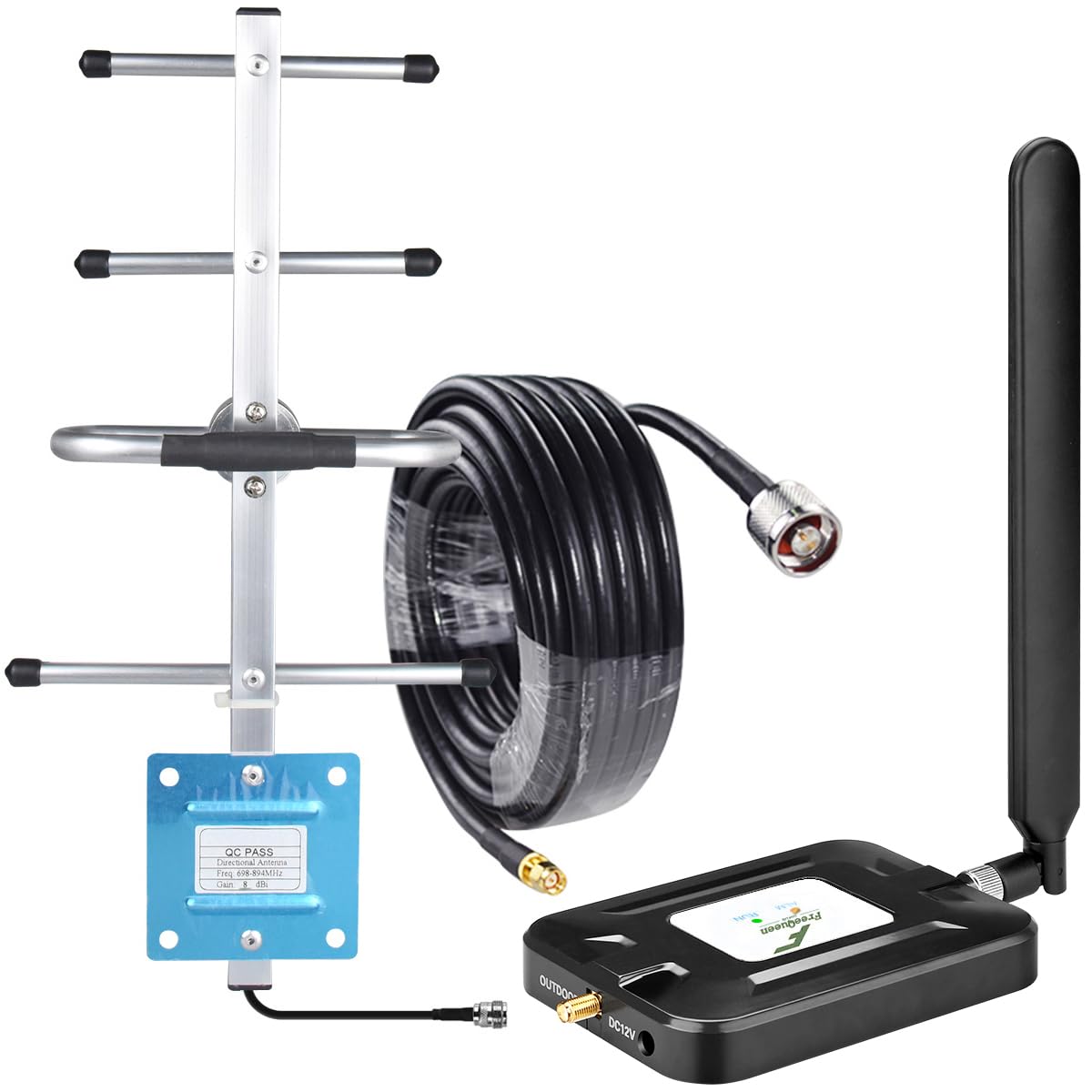
This unit is purpose-built for AT&T, T-Mobile, and Cricket subscribers using Band 12/17 at 700 MHz. It offers 65 dB of gain and covers up to 4,500 square feet, making it a strong fit for larger homes where the primary need is improving voice call quality and reducing dropped calls on those specific networks.
Automatic Gain Control (AGC) intelligently adjusts output based on incoming signal strength, which is useful when conditions fluctuate due to weather or tower congestion. The included 50-foot coaxial cable can be extended to 100 feet, giving you flexibility to mount the outdoor directional Yagi antenna well above obstructions.
Users report signal improvement from 1-2 bars to 4-5 bars in basements and garages, with noticeably clearer voice calls. The unit enters sleep or inactivity mode when no devices are connected, conserving power. It is FCC-approved and backed by a 3-year manufacturer guarantee.
Why it’s great
- Covers up to 4,500 square feet
- AGC adjusts to changing signal conditions
- Extendable cable up to 100 feet
Good to know
- Only works on Band 12/17 — not for Verizon Band 13
- Indoor antenna is a simple whip design, not a panel
3. HiBoost 8K Home Booster

The HiBoost 8K is the highest-coverage unit in this lineup, rated for up to 8,000 square feet with dual indoor antennas — one built into the main unit and one separate panel antenna for placement in a distant room. This design is ideal for multi-story homes, metal buildings, and commercial spaces where a single indoor antenna would leave dead zones.
It delivers 70 dB of gain and supports all major US carriers across bands 2, 4, 5, 12, 13, 17, and 25. The built-in LCD display and HiBoost app give you real-time signal strength readings and AGC status, so you can watch your installation progress as you fine-tune the outdoor antenna position. Users in forested valleys report going from 1 bar to 3-4 bars and from 1 Mbps to 25 Mbps download speeds.
The package includes a through-window cable entry, waterproof tape, and mounting accessories so you do not need to drill through walls if you prefer a temporary install. It comes with a 3-year warranty and lifetime US-based technical support.
Why it’s great
- Massive 8,000 square foot coverage area
- Dual indoor antenna setup for dead-zone elimination
- LCD display with real-time signal data
Good to know
- Premium price point reflects the higher coverage
- Does not support Band 71 (600 MHz) used by T-Mobile
4. JACOOL Verizon Cell Phone Booster
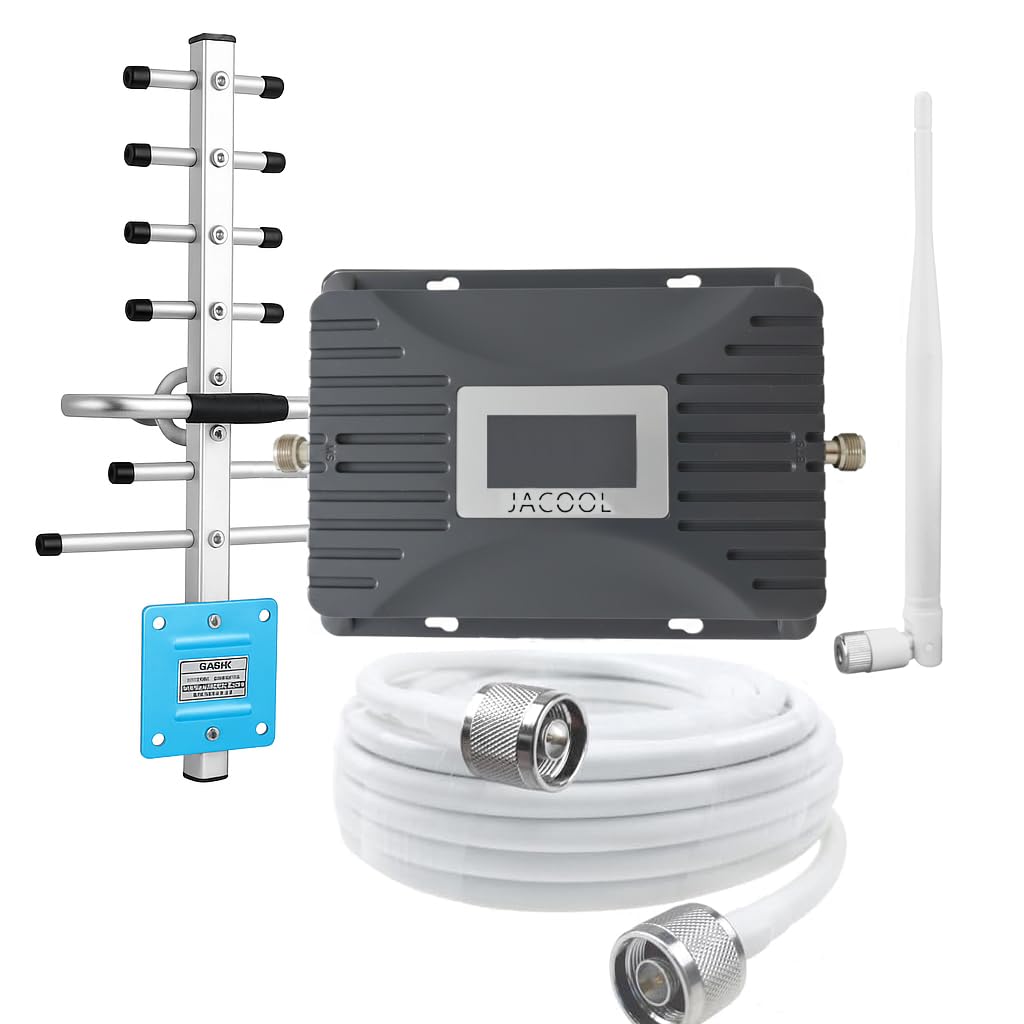
If you are a Verizon subscriber in need of a dedicated home booster, the JACOOL unit focuses entirely on Band 13, the 700 MHz spectrum where Verizon delivers its strongest rural and building penetration. At 65 dB gain and 5,000 square feet of coverage, it is engineered for homes, cabins, and offices that rely exclusively on Verizon’s network.
The AGC function manages gain adjustments automatically, and the LED indicator gives you immediate visual confirmation that the booster is working. Users report signal jumps from 1-2 bars to 4-5 bars, with a noticeable reduction in dropped calls and buffering during streaming. It supports multiple devices simultaneously, so everyone in the household benefits.
The package includes a high-gain directional outdoor antenna, a 50-foot cable, and all necessary mounting hardware. It is FCC-approved with a 30-day money-back guarantee and a 3-year warranty.
Why it’s great
- Optimized for Verizon’s primary Band 13
- 5,000 sq ft covers most single-family homes
- LED indicator for instant status verification
Good to know
- Single-band design — not compatible with AT&T or T-Mobile
- Installation still requires careful antenna separation
5. weBoost Drive 4G-X OTR Truck Booster

The weBoost Drive 4G-X OTR is the most powerful vehicle booster we have tested, purpose-built for long-haul truckers and RV owners who spend hours in remote corridors where cell service vanishes. It uses a 17-inch omnidirectional antenna designed to mount on a truck mirror or CB antenna bracket, giving you a massive capture area that pulls in weak signals from all directions.
It supports all US carriers and offers 50 dB of gain, which in real-world use translates to a jump from no measurable signal to usable 4G data for email, web browsing, and even streaming in places like Teton Canyon or Mesa Verde. Multiple users can connect simultaneously, making it a strong choice for team drivers or families on extended road trips.
The kit includes the booster unit, 4G Trucker mirror mount antenna, a 3-way mount, mast extension, and a side exit adapter. Users consistently note that the large OTR antenna dramatically outperforms the smaller magnetic antennas found in cheaper vehicle boosters.
Why it’s great
- Industry-leading vehicle signal booster for long-haul use
- 17-inch omni antenna captures distant tower signals
- Supports multiple users and all US carriers
Good to know
- Requires professional-grade installation on a truck mirror
- 50 dB gain is lower than high-end home boosters
6. Waveform QuadPro 4×4 MIMO Panel Antenna Kit

The Waveform QuadPro is not a traditional signal booster — it is a 4×4 MIMO panel antenna designed specifically to connect to 4G/5G fixed wireless routers and gateways from T-Mobile Home Internet, Verizon 5G Home, and AT&T Internet Air. If you rely on cellular home internet, this antenna directly improves your modem’s connection rather than just amplifying a signal to your phone.
It provides up to 9.1 dBi gain across the full 600-6000 MHz range, supporting every 4G and 5G band used in North America. In side-by-side tests, users have reported download speeds jumping from 50 Mbps to over 250 Mbps after installation, with upload speeds tripling. The kit includes a window entry cable so you can install without drilling holes, plus high-quality UltraFlex-Quad cable and weatherproofing boots.
Installation requires aiming the panel toward the nearest tower and connecting to your gateway’s antenna ports, which involves opening the gateway on some models. The included detailed guides and customer support make this manageable for a DIY user, but it is more technical than a standard booster.
Why it’s great
- Designed specifically for cellular home internet routers
- Full 4×4 MIMO support for maximum data throughput
- Window entry cable eliminates need to drill
Good to know
- Does not amplify phone signals directly
- Installation involves opening the gateway on many modems
7. GAGBK Vehicle 6-Band Cell Signal Booster
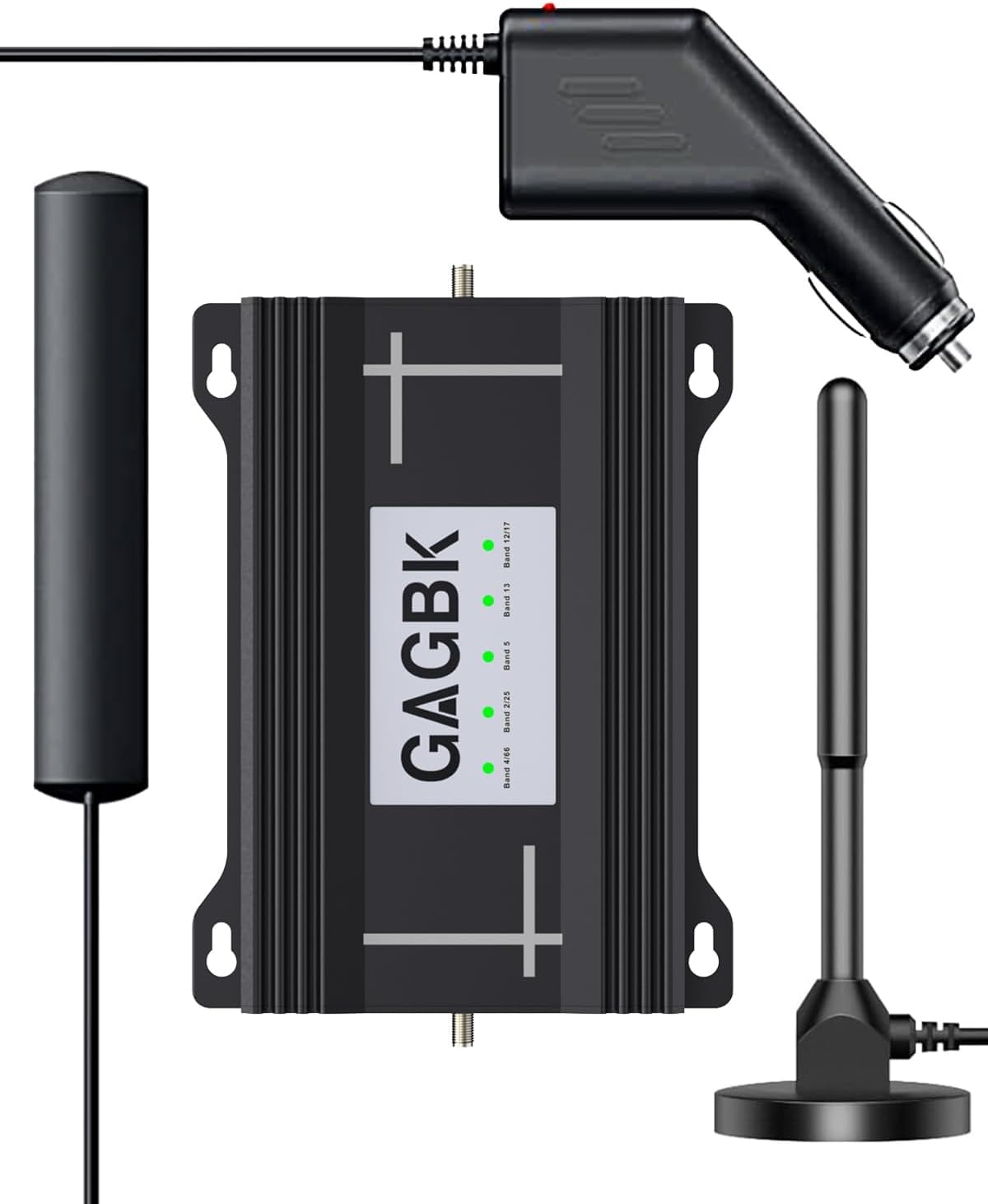
The GAGBK vehicle booster delivers the same 65 dB gain found in many home units but in a compact form factor designed for cars, trucks, RVs, and SUVs. It supports bands 2, 4, 5, 12, 13, 17, 25, and 66, making it one of the most carrier-agnostic vehicle options available, covering Verizon, AT&T, T-Mobile, and their MVNOs seamlessly.
Its range is rated at 5-8 miles from the tower in ideal conditions, though real-world performance depends heavily on terrain and line-of-sight. The kit includes a 16-foot RG174 cable for the outdoor magnet antenna and a 10-foot cable for the indoor patch antenna, which is short enough for a vehicle but may require creative routing in larger RVs. AGC and oscillation elimination features keep the system stable as you drive through varying signal zones.
Users report that once installed correctly — with the outdoor antenna pointed away from the indoor antenna — the booster eliminates dropped calls and makes hotspot data usable even in remote camping spots. It supports multiple devices simultaneously, so everyone in the vehicle can benefit.
Why it’s great
- Broad 6-band support for all major US carriers
- 65 dB gain matches many home boosters
- Compact design fits easily in any vehicle
Good to know
- Cables are shorter than ideal for larger RVs
- Magnet antenna needs a flat metal surface for proper attachment
FAQ
Will a cell phone antenna work if I have zero signal outside?
Can I use a booster designed for one carrier on another carrier’s network?
How far should the indoor and outdoor antennas be from each other?
Do I need to register my cell phone booster with my carrier?
Final Thoughts: The Verdict
For most users, the best cell phone antenna winner is the ZORIDA Ace 5S because it offers the highest gain at 72 dB, universal carrier support, and an app-guided installation process that makes setup straightforward for any homeowner. If you need to cover a large multi-story house, grab the HiBoost 8K with its dual indoor antennas and massive 8,000 square foot range. And for long-haul truckers or RV travelers who lose signal on the highway, nothing beats the weBoost Drive 4G-X OTR with its powerful 17-inch omni antenna designed for life on the road.

Mo Maruf
I created WellFizz to bridge the gap between vague wellness advice and actionable solutions. My mission is simple: to decode the research and give you practical tools you can actually use.
Beyond the data, I am a passionate traveler. I believe that stepping away from the screen to explore new environments is essential for mental clarity and physical vitality.