Our readers keep the lights on and my smoothie glass nicely filled. As an Amazon Associate, I earn from qualifying purchases.
Specs are compiled from manufacturer listings and verified buyer reviews and can change over time — please confirm the key details on the product page before buying.
A ceiling cassette mini split hides in the ceiling while cooling or heating a room — that is the whole idea. You get strong ductless climate control without a wall-mounted box or a window unit blocking the light. The hard part is picking between single-zone and multi-zone systems, choosing the right BTU (British Thermal Units — the measure of cooling power) for your room size, and finding a unit quiet enough for a bedroom or office.
I’m Mohammad Maruf — the founder and writer behind WellFizz. This guide is built by comparing the manufacturers’ published specifications and the patterns across verified customer reviews, so you get each pick’s real strengths and trade-offs instead of marketing spin.
Based on the specs and real owner feedback across different capacity sizes, these three models are the strongest picks in the best ceiling cassette mini split category for spaces from a single large room to an entire floor.
Our Picks at a Glance
How To Choose The Best Ceiling Cassette Mini Split
A ceiling cassette is a permanent fixture in your home. Getting it right saves you from costly rework later. Here are the three decisions that matter most.
Match the BTU to the room size
BTU (British Thermal Units) tells you how much heat the unit can remove in an hour. A cassette too small for the room will run constantly without ever getting comfortable. Too large and it short-cycles — turning on and off so often that it wastes energy and never dehumidifies properly. As a rough guide, you need about 20 BTUs per square foot of living space. An 18,000 BTU unit covers roughly 900-1,000 square feet. A 24,000 BTU unit stretches to about 1,200-1,400 square feet. Multi-zone systems like the 28,000 BTU dual-zone model let you treat two separate rooms with one outdoor condenser.
Single zone vs. multi-zone — know your layout
A single-zone system has one indoor cassette connected to one outdoor condenser. It is the simplest, most efficient setup for a single large room, an open-plan living area, or a dedicated home office. A multi-zone system connects two or more indoor cassettes to one larger outdoor unit. This is the right call when you want to cool (or heat) separate rooms — say a master bedroom plus a living room — without installing a full ducted system. The trade-off is complexity: multi-zone installs require more refrigerant lines and careful planning.
Efficiency rating and operating costs
The SEER rating (Seasonal Energy Efficiency Ratio) measures how efficiently the unit converts electricity into cooling. A higher SEER means lower monthly power bills. The 20.5 SEER on the single-zone Cooper & Hunter is strong — you will notice the difference compared to older 13-14 SEER units. The Senville at SEER 20.0 is very close. A modern inverter compressor (a variable-speed compressor that ramps up or down instead of cycling on and off) is what makes high SEER possible. Every unit on this list uses one, so you are getting that efficiency gain from the start.
Quick Comparison
In‑Depth Reviews
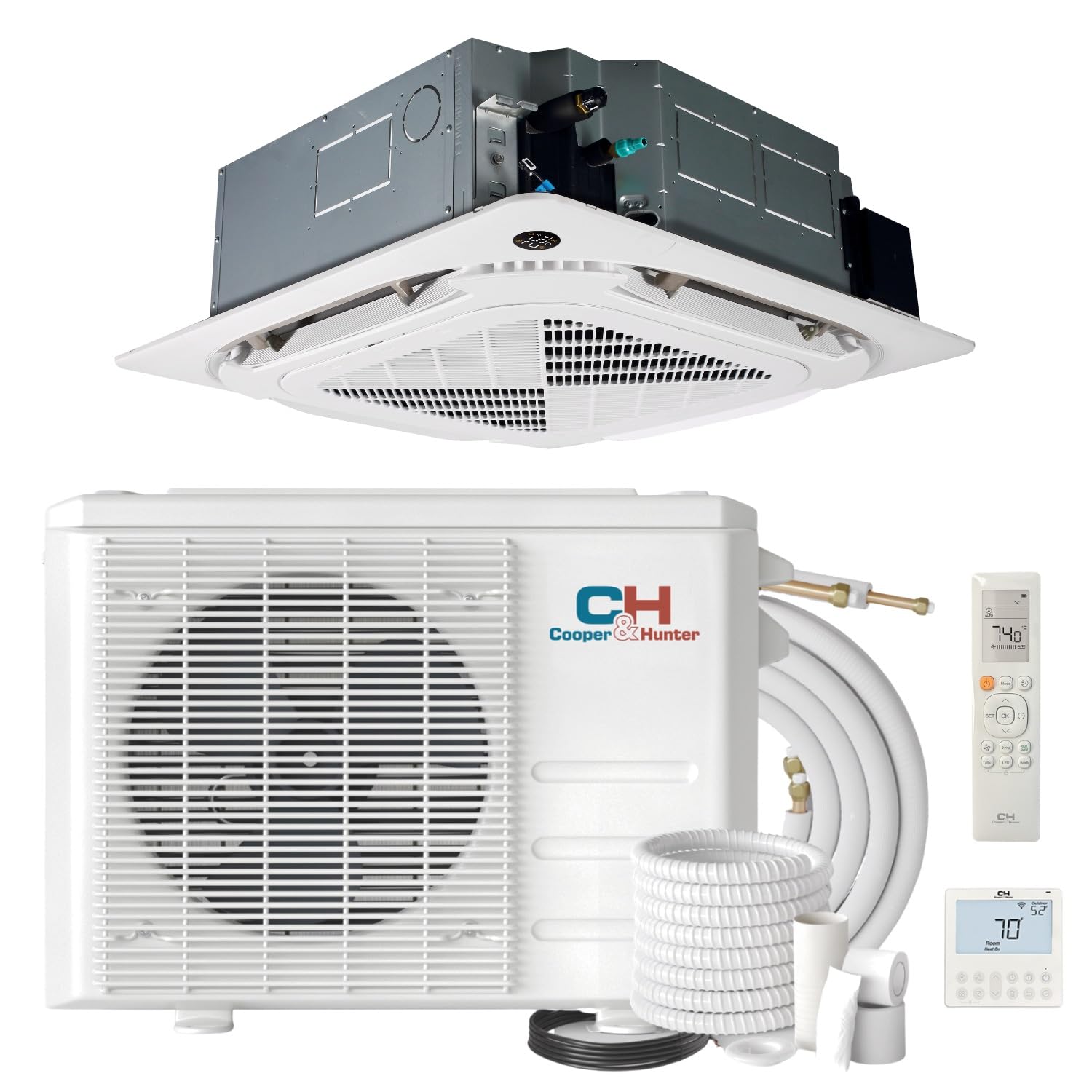
1. Cooper & Hunter 18,000 BTU Ceiling Cassette
Our pick — over 4★ from 20+ verified ratings; the strongest balance of quality and price.
The single-zone cassette that balances quiet efficiency with a straightforward spec sheet for a room up to 1,000 square feet.
This 18,000 BTU unit runs on an inverter compressor (a variable-speed compressor that never fully shuts off, just slows down — meaning steady temperatures and lower power draw). The 20.5 SEER efficiency rating is genuinely strong for this class — you will see that in lower monthly bills compared to older mini splits or central AC. Owners consistently describe it as quiet, even in bedrooms and living rooms, which is the whole point of running a cassette instead of a rattly window unit.
The 1.5-ton capacity delivers even cooling, and the included 16-foot installation kit with pre-flared copper lines simplifies the pro install slightly. But owners flag a real legwork item: the drain hose supplied is a 1-inch ID (inside diameter — a measure of the tube’s width), so your installer may need a different fitting than standard 3/4-inch setups. And Wi-Fi is not built in despite the “ready” sticker — you buy the thermostat separately if you want app control. The crowd favorite, though, is the price-to-performance math. As owners put it: “quiet, efficient, even cooling” describes the day-to-day reality, and the included thermostat gives you basic control without fuss.
What wins people over
- 20.5 SEER efficiency keeps power bills in check even with long daily runtimes.
- Whisper-quiet operation is the real deal — owners install it in bedrooms and commercial spaces.
- All needed parts for installation are in the box, from the line set to the wall thermostat.
What to plan around
- Wi-Fi is a separate purchase — the “ready” label is not the same as included.
- Drain hose is a less common 1-inch ID, so your installer may need to adapt.
- The outdoor unit’s wiring cover is not separate, which can make the hookup fussier.
Reach for this if: you want a single-zone ceiling cassette for a bedroom, living room, or small commercial space with quiet operation as the top priority.
Think twice if: you need to cover two separate rooms — this is a single-zone system, and you would need a dual-zone model for that layout.
2. Senville 24000 BTU Ceiling Cassette Mini Split
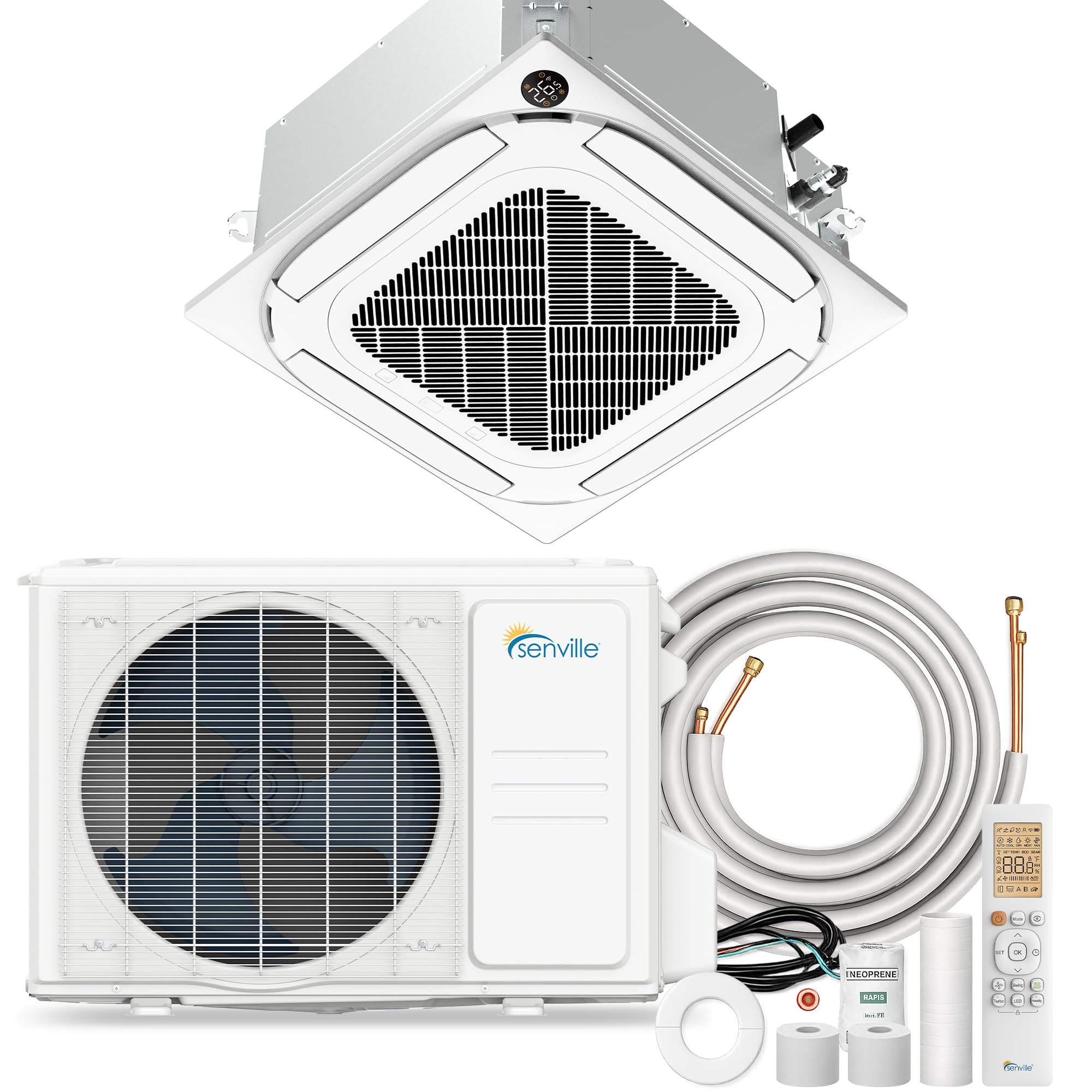
A 2-ton cassette that fits a whole cottage or a large open-plan area with a reputation for solid customer support.
At 24,000 BTUs with a SEER 20.0 efficiency rating, this Senville handles spaces up to roughly 1,400 square feet. Owners confirm it can cool an entire 650-square-foot guest cottage with just the door cracked, and the ceiling-mount design keeps the room looking clean without a wall unit. The 10-year compressor warranty (the part that does the heavy lifting in any mini split) is a meaningful safety net — well beyond the typical 5-7 years.
The inverter technology here means the unit ramps its power up and down rather than cycling on and off, so you avoid the temperature swings that older units create. The included 16-foot copper line set and wiring harness cover the basics for a pro install. But there is an important change to note: the system now uses R-454B refrigerant, not the older R-410A that some descriptions still reference. One owner bought it as a replacement for a 36,000 BTU Fujitsu that reached end of life and reported the installation was straightforward — a direct swap is possible in many cases. Owners also praise the variable fan speed and the digital temperature display on the remote, calling the operation genuinely quiet.
Why it stands out
- Energy Star certification and SEER 20.0 mean this unit earns efficiency rebates in many regions.
- The 10-year compressor warranty is unusually long and provides real confidence.
- Buyers report excellent customer service — tech support sent a replacement board to fix an error code.
What to verify before buying
- The refrigerant is R-454B, not R-410A — confirm compatibility with your installer before ordering.
- A few units arrive with an F7 error code on startup, usually resolved by the control board replacement.
- Returning a freight-shipped unit of this size is logistically painful if there is an issue.
Ideal for: the owner of a large guest house, open-plan shop, or main-floor living area who wants Energy Star efficiency and a long warranty.
Not ideal for: anyone whose installer only works with R-410A refrigerant — confirm the new R-454B compatibility first, or plan for a fresh install.
3. Cooper&Hunter 28,000 BTU Dual Zone Ceiling Cassette

The dual-zone system that puts two ceiling cassettes in different rooms while sharing one outdoor condenser — a space-saving move.
At 28,000 BTU total (a 9,000 BTU cassette plus an 18,000 BTU cassette, 2.3 tons combined), this is for homes where you want climate control in two distinct areas without installing two separate outdoor units. The 25-foot installation kit includes pre-flared copper lines, communication wires, and a 16-foot drainage extension — a noticeably longer line set than the single-zone models, which helps if the indoor units are far from the outdoor condenser. The inverter compressor and Whisper Technology are the same quiet operation you get on the 18,000 BTU single-zone unit.
This system comes with wall thermostats for both zones, so each room gets its own temperature control without conflict. Owners mention that once properly installed, the unit works well and covers both zones effectively. But customer service gets mixed reviews — one owner said: “Had to call out my installer several times to fix it” — and a few note you may need extra cables beyond what the kit includes. The outdoor unit has had occasional first-year failures, so a careful install by someone familiar with this brand matters.
What makes it a good multi-zone choice
- Two-zone control from one outdoor unit saves yard space and simplifies electrical work.
- The 28,000 BTU total (28,000 BTU total versus the single 18,000 BTU unit) handles a combined area up to 1,400 square feet.
- Each zone gets its own wall thermostat and remote control for independent temperature management.
What to budget for
- First-year service calls are not uncommon — set aside some budget for potential technician visits.
- Customer service is described as helpful but slow, so anticipate delays if something goes wrong.
- The installation kit may not include all the cabling your specific layout needs — check with your installer beforehand.
Best suited for: a home with two separate rooms or zones that need dedicated climate control but share one outdoor condenser location.
One honest limitation: the reliability reports from the first year are more mixed than on the single-zone models, so plan on using a skilled installer who is willing to stand behind their work.
Understanding the Specs
BTU — British Thermal Units
This is the standard measure of cooling capacity. One BTU is roughly the heat given off by a single wooden match. In a mini split, a higher BTU number means the unit can remove more heat from the room per hour. An 18,000 BTU unit is typical for a 900-1,000 square foot room, while 24,000 BTUs covers around 1,200-1,400 square feet. Going too high on BTU for a small room causes short-cycling — the unit turns on and off too quickly and never properly dehumidifies. Going too low means it runs constantly trying to catch up.
SEER — Seasonal Energy Efficiency Ratio
SEER measures how much cooling you get per unit of electricity. Think of it like miles per gallon for your air conditioner. A SEER of 20.0 or 20.5 is considered very efficient — you will see noticeably lower power bills compared to a 13-14 SEER unit. Modern mini splits use inverter compressors to achieve these numbers; the compressor ramps its speed up and down rather than cycling on and off, which saves energy and keeps temperatures steady.
Tonnage — The shorthand for BTU
HVAC pros often talk in “tons” — one ton equals 12,000 BTU per hour. So a 1.5-ton unit is 18,000 BTU, a 2-ton is 24,000 BTU, and a 2.3-ton is 27,600 BTU rounded to 28,000. Tonnage is just a shortcut, but it is useful when searching for compatible parts or comparing across brands.
Inverter Compressor
An inverter compressor is a variable-speed compressor. Instead of running at full blast until the room hits the set temperature and then shutting off completely, it slows down and speeds up to match the load exactly. The result: fewer temperature swings, quieter operation, and significantly lower electricity use. All three units listed here have one.
FAQ
Can I install a ceiling cassette mini split myself?
How much ceiling clearance do I need for a cassette?
What is the difference between a ceiling cassette and a wall-mounted mini split?
Will a ceiling cassette work for a bedroom?
How long does a ceiling cassette mini split last?
Do ceiling cassettes require a condensate pump?
Can I use a ceiling cassette for both heating and cooling?
What size room does a 2-ton ceiling cassette cover?
Do I need a separate thermostat for each zone in a multi-zone system?
What refrigerant do these units use and why does it matter?
Final Thoughts: The Verdict
For most people, the best ceiling cassette mini split is the Cooper & Hunter 18,000 BTU model because it delivers 20.5 SEER efficiency and genuinely quiet operation in one well-priced single-zone package. If you need to handle a larger space — a full guest cottage or a shop — grab the Senville 24,000 BTU unit with its long 10-year compressor warranty. And for separate rooms that share one outdoor condenser, the Cooper&Hunter 28,000 BTU dual-zone is the right call, as long as you budget for a skilled installer who knows the brand.
How We Picked
We do not accept paid placement. Every pick is matched to a real buyer and a real use-case; we do not hands-on test units.
Sources & Methodology
Specifications: manufacturer listings and product documentation. Review insights: verified customer reviews, as of July 2026. Pricing: not shown on this page (it changes often); check the current price via the retailer link.
As an Amazon Associate, WellFizz earns from qualifying purchases. This does not affect which products we feature.
Related Guides

Mo Maruf
I created WellFizz to bridge the gap between vague wellness advice and actionable solutions. My mission is simple: to decode the research and give you practical tools you can actually use.
Beyond the data, I am a passionate traveler. I believe that stepping away from the screen to explore new environments is essential for mental clarity and physical vitality.